Introduction: The DO Licensing Landscape, Why This Matters Now
A third-year emergency medicine resident, let us call her Dr. K, accepted an attending position at a Level II trauma center in a neighboring state. She had her COMLEX-USA Level 3 scores, AOA board eligibility, and a clean disciplinary record. Three months before her start date, the hospital's credentialing committee flagged her application. The state board required documentation she did not have. Her COMLEX scores were accepted, but the board wanted a supplemental letter from her program director attesting to specific ACGME rotation equivalencies. Nobody told her this during the interview. Nobody told her during residency. She lost six weeks of income waiting for the paperwork to clear.
This happens more than the AOA likes to admit. The dual licensure system in the United States, where DOs and MDs each maintain separate examining bodies, separate board certification pathways, and in some cases separate state regulatory frameworks, creates divergent pathways that can blindside even well-prepared physicians. MDs face their own bureaucratic headaches, certainly. But the structural reality is that DOs encounter a thicker layer of complexity because they sit at the intersection of two systems that do not always align cleanly.
Let me break this down specifically. Here are ten areas where state medical boards treat DOs differently from MDs, and where the differences matter enough to affect your career trajectory, your practice scope, and your ability to take a job across state lines.
Understanding the historical context of osteopathic licensing variations helps you anticipate future changes. (See also: State Licensing Nuances for DO vs. MD: Edge Cases and Odd Regulations for detailed state-by-state specifics.)
Disclaimer: This article is provided for educational purposes only and does not constitute financial advice, legal advice, or tax advice. Specific requirements and figures vary by jurisdiction and over time; consult a qualified professional for guidance on your individual situation.
1. COMLEX-USA vs USMLE Requirements, The Fundamental Divide
Most states accept COMLEX-USA for full and unrestricted osteopathic licensure. That is the good news. The bad news is that "accepted for licensure" and "accepted for every purpose" are not the same thing.
Several states, including Pennsylvania historically, and certain hospital systems in states like Michigan and Ohio, have maintained implicit or explicit preferences for USMLE scores, particularly for hospital-employed positions or when applying through the Interstate Medical Licensure Compact. The language is often buried in hospital bylaws rather than state statute. A state medical board may accept COMLEX for licensure, but a hospital credentialing committee can still ask for USMLE Step 2 CK as a condition of privileges. This is legal. It is also infuriating.
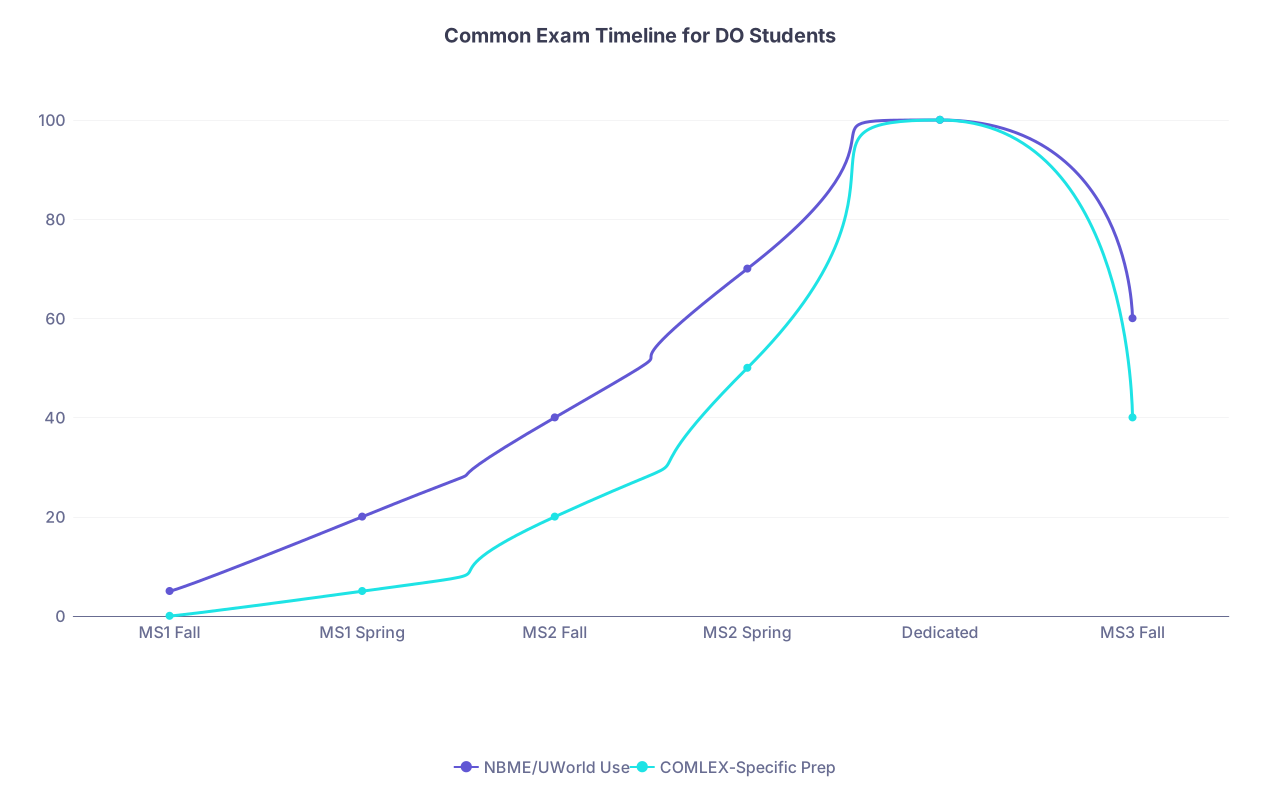
I have seen DOs adopt what I call the "two-exam strategy" specifically to avoid this trap. They take COMLEX-USA Levels 1, 2, and 3 (as required by their osteopathic medical school and residency) but also sit for USMLE Step 2 CK during their third or fourth year. It costs money. It costs study time. It is arguably unnecessary. But if your target state or target hospital has a stated or unstated USMLE preference, that single additional exam removes the friction entirely.
The practical navigation here is straightforward but requires effort: pull the actual current requirements from your target state's medical board website, and then call the credentialing office at the specific hospital or system where you intend to practice. Do not rely on what your medical school tells you. Do not rely on what the AOA website says. Board requirements change, and hospital bylaws are more conservative than state statutes.
2. Osteopathic Manipulative Medicine (OMM/OMT) Continuing Education Mandates
Standard CME requirements apply to everyone. DOs face an additional layer: many states require documented OMT-related continuing education as a condition of osteopathic license renewal, above and beyond standard CME hours. This is not universal, but it is more common than most residents realize.
The AOA requires 120 hours of CME per three-year cycle, with a specified portion in osteopathic principles and practice. State boards layer their own requirements on top. Some states, Michigan is a notable example, have historically required specific OMT CME hours for DO licensure renewal, even if the physician never performs OMT in their clinical practice.

Here is where it gets practically messy. A DO practicing hospitalist medicine in a state with OMT CME mandates must still complete those hours to renew their license. That means attending courses or workshops in a skill set they do not use clinically. It is not oppressive in volume, usually 10 to 20 hours per cycle, but it is a requirement that MDs do not face.
If you are a DO who does not plan to practice OMT regularly, verify your target state's CME requirements before you apply for licensure. Some states allow substitution of equivalent CME categories, but you have to request it in writing. Do not assume.
3. Licensure by Endorsement and Reciprocity Differences
Licensure by endorsement, obtaining a license in a new state based on an existing license elsewhere, works differently for DOs than for MDs in several jurisdictions. Historically, MDs benefited from broader reciprocity agreements among state boards. DOs faced a patchwork: some states had established DO-to-DO reciprocity through AOA channels, others required fresh review of COMLEX scores and training documentation.
The NBOME certification verification process adds a step that MDs do not encounter. When you apply by endorsement, the new state board must verify your COMLEX-USA examination history directly with NBOME. This sounds trivial. It is not. Verification requests can take four to eight weeks, and NBOME processes them on their timeline, not yours.
Certain states apply additional scrutiny to DO endorsement applications, particularly if your original licensure was in a state with different training requirements. I have seen endorsement applications delayed by requests for original rotation logs from medical school, documents that are fifteen years old and stored in a filing cabinet in a dean's office that may or may not still exist.
The practical move: start the endorsement process six months before you need the license. Submit NBOME verification requests immediately. Keep a personal file of your medical school rotations, residency completion certificates, and every board exam score report. You will need them.
4. State-Specific Practice Act Variations
State medical practice acts define what a "physician" is and what they can do. Most states define physician to include both MDs and DOs with equal scope. Most. Not all.
A handful of states maintain statutory language that creates subtle scope differences. These are rarely overt, nobody writes "DOs cannot practice medicine" into statute in 2024. But language specifying "allopathic medicine" versus "osteopathic medicine" in certain scope-of-practice provisions can create ambiguity that hospital attorneys exploit during credentialing decisions. If the practice act defines surgery as within the scope of "allopathic medicine" without explicitly including osteopathic medicine, a hospital legal department might flag a DO surgeon's application for additional review.
Post-ACGME single accreditation, this landscape has improved substantially. Residencies are now unified under ACGME, and the distinction between "AOA-approved" and "ACGME-approved" training has largely dissolved. But state practice acts are updated slowly. Statutory language lags behind regulatory reality.
5. Board Certification Recognition and Hospital Privileges
AOA board certification and ABMS board certification are both legitimate credentials. The problem is that not every hospital treats them as equivalent.
Some states have explicit statutory language requiring hospitals to accept AOA board certification on equal footing with ABMS. Others leave it to hospital bylaws. And hospital bylaws, especially in systems with heavy specialty board influence, sometimes specify "ABMS certification or equivalent", where "equivalent" is interpreted subjectively by a credentialing committee that may not include a single DO.
The single GME accreditation system has narrowed this gap significantly. DOs now train in ACGME-accredited programs and increasingly pursue ABMS board certification rather than AOA certification, particularly in specialties where AOA boards are merging or dissolving. But for DOs who completed training before 2020 and hold AOA board certification, the recognition question remains live when applying for privileges in certain systems.
Strategy: if you hold AOA board certification and are applying for hospital privileges in a state without explicit equal recognition statutes, proactively include a letter explaining the AOA board certification equivalency. Some credentialing committees simply lack familiarity. Education is often faster than litigation.
6. Prescriptive Authority Nuances
Full prescriptive authority for DOs is the norm. The exceptions are narrow but real.
A small number of states have statutory language that creates subtle differences in controlled substance prescribing or collaborative practice requirements for DOs. These are usually artifacts of older practice acts that were never updated when osteopathic licensure was modernized. They are not typically enforced in a way that materially restricts DOs, but they exist on paper and can surface during credentialing or audit processes.
Federal DEA registration is identical for DOs and MDs. The federal system does not distinguish between them. State-level variations are where the friction appears, particularly in collaborative agreement requirements that some states impose on certain practice settings.
If you are entering a state with collaborative agreement requirements, verify whether the language applies to DOs differently. In most cases it does not, but I have seen DOs in rural practice settings encounter unexpected language about "physician supervision" that was written with mid-level providers in mind but applied ambiguously to osteopathic physicians in certain collaborative models.
7. Graduate Medical Training (G residency) Requirements
Residency pathway documentation is an area where the single accreditation system has simplified things enormously, but legacy issues persist.
Before 2020, some states required specific documentation of AOA-approved residency training for DO licensure. Others accepted ACGME training but with additional documentation. The single accreditation system has largely eliminated this distinction, but states that have not updated their statutes may still have language requiring "AOA-approved" or "ACGME-accredited" training, creating confusion for DOs who completed training during the transition period.
IMG considerations are a separate and complicated topic. DOs who completed osteopathic medical school outside the U.S. (a very small population, but it exists) face a particularly tangled licensure landscape. Most state boards have minimal experience with this pathway, and processing times can extend significantly.
8. Disciplinary Action Reporting and Interstate Compact
The Interstate Medical Licensure Compact has been a net positive for DO portability. It streamlines licensure across participating states and reduces the documentation burden. But it does not eliminate all state-specific challenges, and disciplinary reporting under the Compact has nuances that DOs should understand.
When a DO faces disciplinary action in one state, the National Board of Medical Examiners data bank report carries that information to other states. The Compact's expedited licensure process is blocked if there is a disciplinary history. This is the same for MDs, but DOs face an additional reporting layer through the AOA, which maintains its own disciplinary database.
Historically, there were discrepancies in how violations were reported between the AOA and state board databases. A disciplinary action might appear in one system but not the other, creating inconsistency that could either help or hurt depending on which database a state board checked. This has improved with better data sharing, but the practical advice remains the same: protect your record proactively. Disciplinary actions are career-altering. Respond to board inquiries immediately. Never let a complaint go unanswered.
9. Professional Liability and Malpractice Insurance Variations
Malpractice insurance requirements are set at the state level, and a few states have specific provisions that affect DOs. Some require mandatory malpractice coverage for license maintenance, and the documentation requirements can differ slightly for DOs versus MDs based on how the state statute was originally drafted.
The premium differences between DOs and MDs in the same specialty are generally minimal, actuarial risk is based on specialty and claims history, not degree type. But some states have separate risk pools or historically maintained separate DO-specific malpractice funds (Pennsylvania's MCare fund, for example, has had nuances in how DOs participate).
For locum tenens work, verify coverage requirements in each state. Some states require proof of coverage before issuing a license; others require it only at the time of practice. The distinction matters for timing.
10. Telemedicine and Interstate Practice Provisions
Telemedicine has transformed multi-state practice, and the Compact's telemedicine provisions have made it easier for DOs to practice across state lines without obtaining full licensure in every state. But the pandemic-era emergency waivers that allowed broad cross-state telemedicine have largely expired, and the regulatory landscape has settled into a more restrictive baseline.
States regulate telemedicine for DOs and MDs under the same statutory framework in most cases. The differences arise when a state's telemedicine provisions reference specific board certification types or training documentation requirements that DOs must navigate separately.

Practical guidance: if you intend to practice telemedicine across multiple states, the Compact is your best tool, but verify that each target state participates. Several populous states, notably California and New York, do not currently participate in the Compact. For those states, you need full licensure, and all the documentation requirements discussed earlier apply in full.
Summary: Strategic Navigation for DOs
The ten differences outlined here, exam requirements, OMT CME mandates, endorsement reciprocity, practice act language, board certification recognition, prescriptive authority, GME documentation, disciplinary reporting, malpractice insurance, and telemedicine provisions, are narrowing over time. The single accreditation system, the Compact, and ongoing statutory modernization are all pushing toward uniformity. But "narrowing" does not mean "eliminated." If you are a DO or a DO student, these differences affect you today.
Checklist before applying for licensure in a new state:
- Pull the current state board requirements directly from the board website, not from a summary page, not from a colleague's memory.
- Verify whether the state accepts COMLEX alone or requires USMLE for any purposes.
- Confirm CME requirements, including any OMT-specific mandates.
- Submit NBOME verification requests immediately if applying by endorsement.
- Check whether the state practice act defines "physician" to explicitly include DOs.
- Contact the hospital credentialing office directly to ask about board certification acceptance.
- Verify telemedicine provisions if cross-state practice is part of your plan.
- Start the process six months earlier than you think you need to.
Key resources:
- AOA: osteopathic.org, licensure requirement summaries and advocacy updates
- NBOME: nbome.org, score verification and examination information
- FSMB: fsmb.org, Interstate Compact information and state board directory
- Individual state medical board websites, always the final authority
The big picture: these differences are real, they are specific, and they will cost you time and money if you ignore them. But they are navigable with planning. The DOs who encounter problems are the ones who assume the system is uniform. It is not. Treat licensure as a strategic decision you make early in your career, not a formality you handle at the last minute.

Plan your licensure strategy before you need it. The system rewards the prepared.