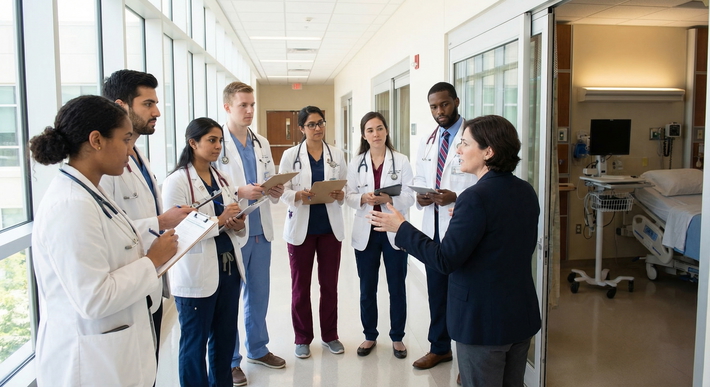
Picture this: you're a third-year osteopathic medical student sitting in your dean's office. You've crushed your first two years, your COMLEX Level 1 score came back solid, and now you're thinking bigger, maybe a competitive ACGME residency, maybe a fellowship later. So you ask about taking USMLE Step 1 alongside your COMLEX Level 2. The counselor nods, says it's "very doable." Your classmates echo it. Nobody mentions the bill.
That's the gap.
Dual board certification for DOs, pursuing both AOA and ABMS credentials, has exploded since the 2020 ACGME/AOA residency merger. More doors, more flexibility, more "why not?" logic. But nobody talks about the hidden costs and logistical hurdles that quietly drain your wallet, your time, and occasionally your sanity. I'm going to lay them out for you, no fluff, no brochure language.
The following discussion of costs, fees, and financial planning is for educational purposes only and not financial advice. Figures vary based on exam cycles, vendor pricing, and individual circumstances. Before making major financial or career decisions, consult a qualified professional.
Before you commit to such a rigorous schedule, consider learning more about the realities of taking USMLE as a DO student.
To better understand the career implications of this decision, check out our guide on navigating your medical career path for success.

It is also crucial to be aware of the long-term career implications, such as the potential risks of choosing DO only for easier admission.
The 5 Hidden Costs Nobody Warns You About
Most pre-med advisors and medical school administrators will tell you the obvious costs: exam fees, prep materials, maybe a few extra months of studying. What they skip over is everything else. Here's what actually hits your wallet and your calendar when you go dual.
1. Double the exam fees, plus the hidden subscription trap
Let's start with the price tag, because it's the easiest number to grasp.
- COMLEX Level 1: $730 (now pass/fail as of 2022, but you still pay)
- COMLEX Level 2 CE: $730
- USMLE Step 1: $1,000+ (also pass/fail)
- USMLE Step 2 CK: $1,000+
- Score reporting fees to additional institutions: $90 per score report, per cycle
You're looking at roughly $3,500-$4,500 in pure exam fees alone if you sit for both systems through Step 2. That doesn't count re-takes if you underperform on either.
Then come the prep subscriptions, and this is where vendors quietly feast:
- UWorld: Separate subscription required for COMLEX (
$500-$700) and USMLE ($500-$700). You can't transfer progress between the two question banks. - TrueLearn, COMBANK, or COMQUEST: Another $200-$400 if you want COMLEX-specific practice.
- First Aid, Pathoma, Sketchy, Boards & Beyond: $400-$800 combined.
- Anki decks, Cram Fighter, study schedules: Another $50-$200.
If you are specifically eyeing these programs, you should explore when a DO degree quietly helps you and when it hurts before finalizing your application strategy.
Realistically, you're staring down $5,000-$8,000 in cumulative direct costs before you even apply to residency. That's not a typo. And that's before you consider the lost income from a delayed graduation, which can happen if a failed attempt forces a remediation cycle.
2. The 400-hour study time sink, and the burnout that follows
Here's where the math gets ugly.
Studying for both COMLEX and USMLE isn't just "double the work." They test overlapping but materially different content. COMLEX emphasizes osteopathic manipulative treatment (OMT), biostatistics in a specific NBOME format, and a distinct question style. USMLE leans more heavily on molecular pathophysiology, ethics vignettes, and a tighter clinical reasoning style.
You're effectively running two parallel prep tracks during dedicated study time. Most DO students who dual-prepared report studying 50-100 hours more than their COMLEX-only peers during the dedicated period. That's a half-month of full-time study hours you don't get back.
Worse: the burnout compounds. You might be juggling third-year clinical rotations, board prep, audition electives, and ERAS applications simultaneously. The DO community has been increasingly vocal about mental health strain during this window. I've seen classmates tank a perfectly good COMLEX score because they were mentally cooked by the time they sat for it.
The opportunity cost is real. Every hour cramming USMLE Step 2 biostats is an hour not spent on a key audition rotation, a research manuscript, or networking at a conference that could've netted you a mentor letter.

3. Residency application logistics, the ERAS score-reporting maze
Once you survive both exams, you hit ERAS. And ERAS does not love you.
Here's what most applicants don't realize:
- COMLEX scores are submitted through one channel; USMLE scores through another.
- You pay separately for each score release to programs.
- Program signals, geographic preferences, and supplemental applications all behave differently depending on whether a program historically screens on USMLE.
- Some ACGME programs still informally screen out applicants without USMLE, even though that's changing. Others don't care.
The practical nightmare: you might submit your application thinking your USMLE score will strengthen you, only to find out a mediocre score hurts you more than no score at all. I've watched DOs in this exact situation get filtered out of competitive specialties because their Step 2 CK landed below the program's informal threshold.
Then there's the supplemental application layer. More and more programs require secondaries, situational judgment tests (like Casper or Preview), and program-specific essays. Each adds $25-$150 and 2-8 hours of work. If you're applying broadly, smart, given DO match rates, you're looking at 80-150 supplemental applications. That's $2,000-$15,000 in secondary fees alone, on top of the $200+ ERAS fee structure.
4. Board certification fees and MOC, decades of dues
Most pre-med students don't think about this stage because it's years away. You should think about it now.
After residency, dual certification means:
- Initial AOA board certification: Application fees, exam fees (if applicable for your specialty), typically $1,000-$3,000+.
- Initial ABMS board certification: Same range, separate process.
- Maintenance of Certification (MOC): Annual or biennial fees, plus required modules, practice assessments, and continuous learning activities.
- Subspecialty certification: If you pursue a fellowship, expect another round of fees for each board.
You're now paying two boards for the duration of your career. AOA dues: $400-$700/year. ABMS member board dues: similar range, plus MOC program fees of $200-$500/year depending on specialty. Over a 30-year career, that's $30,000-$60,000+ in cumulative board-related costs.
Some employers reimburse board fees. Many don't. Independent practice? You're eating the full bill.
5. The competitive landscape penalty, the signal is murky
This one stings.
When MD students take USMLE, it's expected. When DOs take USMLE, it's sometimes read as a sign that you "needed" the extra credential to compete. This isn't fair, and it's changing, but it's the reality on the ground in 2024-2025.
The signal value of a DO's USMLE score is inconsistent. A 260+ reads strong. A 230 reads as average or below, which can hurt you in competitive specialties like dermatology, orthopedics, plastic surgery, or radiology. Program directors in those fields have informal USMLE thresholds, and a DO applicant sitting just above the threshold might be screened out while an MD applicant at the same score sails through.
The strategic question becomes: are you confident enough in your USMLE performance to take the exam and submit the score? If not, you might be better off focusing purely on a strong COMLEX profile and targeting DO-friendly or DO-friendly-friendly ACGME programs.
Actionable Next Steps, How to Actually Pull This Off
Okay. Now that I've scared you, here's how to be smart about it.
Step 1: Decide before dedicated study time whether you're going dual
Don't waffle. Pick a lane by the start of your dedicated study period. If you're undecided, you'll split your attention, perform worse on both exams, and feel terrible. Talk to your advisor, look at recent NRMP Charting Outcomes data for your target specialty, and decide based on data, not vibes.
Step 2: Build a unified study schedule, not two parallel ones
Most successful dual-prep students use a single integrated schedule. UWorld for both systems, plus First Aid as a backbone, plus COMLEX-specific OMT review (Savarese or COMQUEST). Cram Fighter or similar scheduling tools can help you visualize the integrated plan. Aim for 8-12 weeks of dedicated time if you're going dual. Less than that, and you're guessing.
Step 3: Take USMLE Step 2 CK first, before COMLEX Level 2 CE
This is a contrarian move, but hear me out. USMLE Step 2 CK is now the more important residency filter, especially with Step 1 being pass/fail. Take it when your clinical knowledge is freshest. Then use that momentum for COMLEX Level 2 CE, which has more overlap. Some DO students do the reverse and regret it.
Step 4: Set a hard score floor before submitting
Decide in advance the minimum USMLE score you'll submit to programs. If your practice test scores aren't tracking there by 4 weeks out, consider withdrawing and focusing purely on a strong COMLEX profile. Withdrawing costs you the exam fee, but it protects you from the screening penalty.
Step 5: Budget realistically and look for reimbursement
Talk to your financial aid office about cost-of-attendance adjustments. Some schools will increase your loan ceiling for documented board prep expenses. After residency, negotiate board fee reimbursement into your contract. It's not a given, but it's reasonable to ask.
Resources worth bookmarking:
- NBOME and USMLE registration portals for fee schedules
- NRMP Charting Outcomes in the Match for specialty-specific score data
- UWorld, TrueLearn, COMBANK for question banks
- Reddit r/medicalschool and r/Osteopathic (with a grain of salt) for peer signal
- AOA and ABMS board websites for certification and MOC details
Key Takeaways
- Dual certification is expensive. Realistically budget $8,000-$15,000 across exam fees, prep materials, application costs, and initial board certification. Annual dues add another $500-$1,500/year for the rest of your career.
- Time and burnout are the hidden tax. Plan for 400+ extra study hours and protect your mental health ruthlessly.
- Decide before you start. Waffling is the worst strategy. Pick a path based on data, commit, and execute.
- The USMLE signal is murky for DOs. A great score helps. A mediocre score can hurt. Set a floor and stick to it.
- Plan for the long arc. Board fees don't stop after residency. Build them into your career financial plan.
If you're standing at this crossroads right now, don't let the "everyone's doing it" energy push you into a decision that doesn't fit your specialty, your finances, or your bandwidth. Dual board certification can absolutely open doors, but only if you walk through them with eyes open and a real budget.
Pull up your school's recent match data, look at the specialties you're actually targeting, run your own numbers, and pick the path that fits your specific situation. That's the move.
And if you're already deep in the dual-prep grind? Protect your sleep. The exam will wait. Your sanity won't.