You did the "smart" thing. Or what felt smart.
You looked at your interviews, decided which programs were your real favorites, cut out the places you couldn't picture yourself at, and built a tight rank list. Clean. Rational. Efficient. Then Match Week gets closer, and a nasty thought shows up: What if this list is too narrow? What if I end up in SOAP because I tried to be selective?
That fear is justified. I've seen applicants with solid stats, decent advising, and perfectly defensible rank logic still end up staring at SOAP as if it's some bizarre punishment for being too confident. It happens. Especially when the list has no padding.
Here's the real question: for a narrow rank list, does a DO applicant carry more SOAP risk than an MD applicant?
Yes, in aggregate, the market often treats those pathways differently. But the bigger truth is this: SOAP risk is not just "will I match or not." It's a layered problem. Your specialty, interview volume, rank list width, acceptability constraints, and how your profile fits the unfilled-slot market all matter. A lot.
This article gives you the practical version. Not mythology. Not forum nonsense. A framework built around the signals applicants actually have: match patterns, interview-to-rank conversion, specialty competition, and how much redundancy your list really has.
What "SOAP Risk" Really Means in Data
Most applicants define risk too simply. They think risk = chance of not matching.
That's incomplete. Badly incomplete.
SOAP risk has at least three separate pieces:
- The probability you don't match in the main Match
- The probability your profile fits what's left in SOAP
- The probability you can actually accept one of those options under real-world constraints
That last one gets ignored all the time. It shouldn't. If the only open positions are in places you absolutely won't go, or in specialties you never prepared for, or in programs with eligibility constraints you don't meet, then "there are SOAP spots" doesn't help you much.
Here's the cleaner way to think about it:
A few confounders shape every step:
- specialty choice
- US MD vs DO status
- Step 2 performance
- clinical grades and letters
- geography
- visa/work authorization issues
- how many interviews you got
- how many of those interviews likely convert into genuine rank positions
That's why broad national match rates can mislead you. They're useful, but blunt. A student with 16 interviews in family medicine and wide geographic flexibility lives in a different world from a student with 7 interviews in a competitive specialty and a spouse who can only work in two metro areas.
The data gives trends. It does not give guarantees. Your actual risk depends on fit plus options plus flexibility. Miss one of those, and the spreadsheet optimism falls apart fast.
DO vs MD SOAP Risk: What Data Trends Typically Show
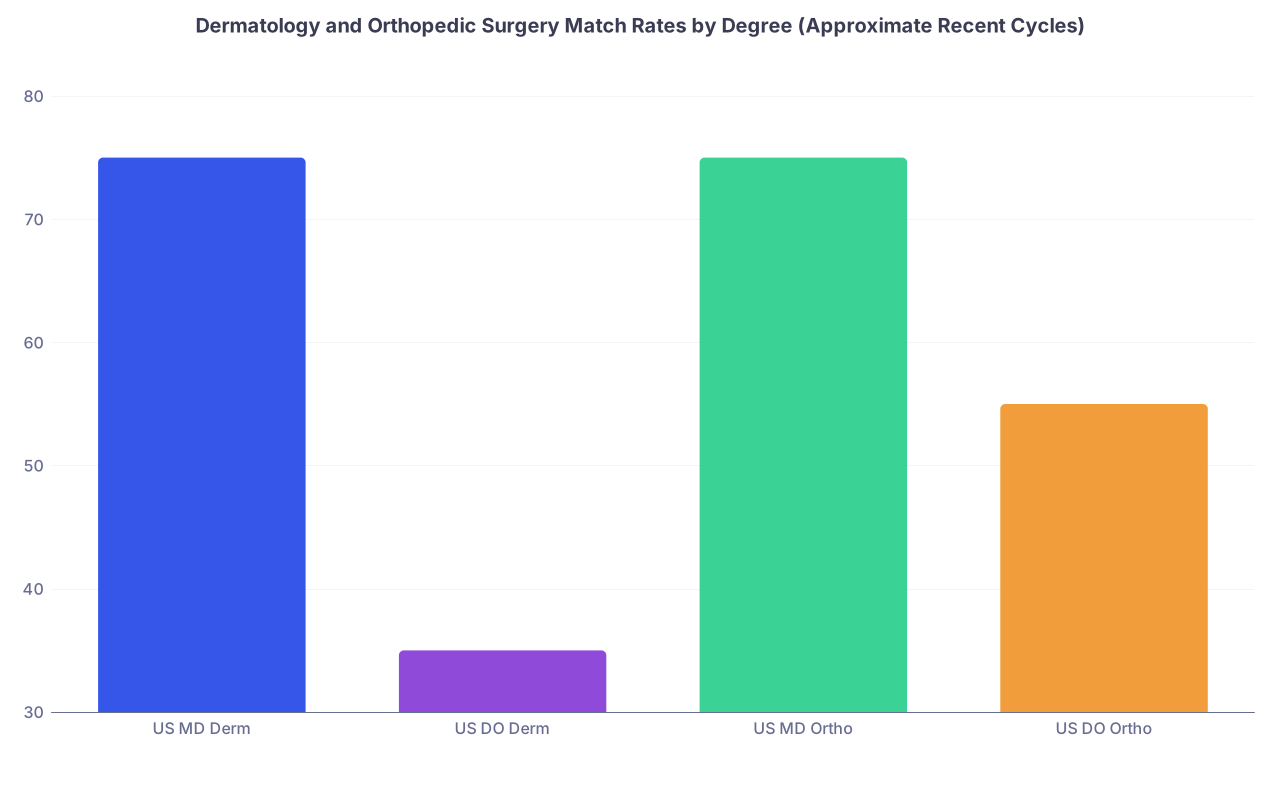
Here's the direct answer: DO applicants, as a group, are often more sensitive to narrow rank lists than MD applicants.
Not because every DO applicant is weaker. That's lazy thinking. The issue is market dynamics.
MD applicants often benefit from broader institutional familiarity, larger historical pipelines into certain residency programs, and in many specialties a smoother interview-to-rank conversion pattern. That doesn't mean every MD applicant is safe. Plenty aren't. It means that in aggregate, the system usually gives them a bit more room for error.
DO applicants often have less of that cushion.
What does that look like in practice?
- A narrow MD list may still contain enough "probable rankable outcomes" to survive a few misses.
- A narrow DO list in the same specialty may have less redundancy because the list is already built from a smaller or more selective interview pool.
- In specialties where program behavior is more status-sensitive, a DO applicant can be more exposed if the list is top-heavy.
That's the key phrase: top-heavy.
I've seen this exact failure mode. Applicant has respectable Step 2, good letters, decent school support, interviews mostly at aspirational or tightly filtered programs, then ranks only the places that "feel right." No true middle. No sturdy backup tier. Match result: no seat. Then SOAP starts, and now they're competing in an entirely different market with entirely different timing and leverage. Ugly.
Aggregate data usually shows this pattern:
- DO outcomes vary more sharply by specialty selection
- DO applicants can be more dependent on ranking enough acceptable programs
- MD applicants usually look lower-risk on paper, but that edge disappears fast in competitive specialties or with artificially narrow lists
That last point matters. Don't turn "MDs do better in aggregate" into "I'm an MD so I can safely rank five places." That's how people create preventable disasters.
Outcomes also swing by specialty and geography. Primary care pathways often offer more elasticity. Competitive specialties often don't. Programs that fill aggressively before SOAP leave very little rescue space afterward. So yes, the DO vs MD difference is real. But no, it's not the whole story. List width and specialty volatility matter just as much, and often more.

Narrow Rank Lists: The Mechanisms That Increase SOAP Exposure
A narrow rank list isn't just "short." It usually means three things:
- too few backups
- too few middle-fit programs
- not enough redundancy to absorb normal match randomness
That randomness is real. People hate hearing that. Too bad. Match outcomes are not perfectly linear.
Here's why narrow lists get people into trouble.
1. Fewer total chances. This one's obvious. If you rank fewer programs, you simply have fewer opportunities to hit a compatible seat. Less redundancy. Less forgiveness.
2. Tiering mismatch. A lot of narrow lists are loaded with reach-ish programs or emotional favorites. That's fine if the rest of your application is overpowering. Most applications aren't. If several top-ranked programs fill with applicants they preferred more, your runway vanishes quickly.
3. Specialty volatility. Some specialties leave meaningful SOAP opportunity. Others slam shut. If your entire rank strategy depends on a field that usually fills tightly, a narrow list is a bad gamble.
4. Real-life constraints. Geography. Family. Partner employment. kids. Visa status. Financial realities. These aren't side issues. They define what's actually acceptable. I've watched applicants claim they had "backup options," then reject half of them mentally because they were three states away from aging parents or in a city their spouse couldn't work in. That's not a backup list. That's fiction.
Decision Framework: How to Use Your Data to Set a Rank List Width
You don't need a magic number. You need a structure.
Step 1: Map your profile to actual fit
Look at Step 2, clerkship performance, letters, research, and specialty alignment. Then sort your interview list into honest categories:
- High-fit
- Medium-fit
- Stretch/uncertain
Be honest. Brutally honest. If a program interviewed you, that's encouraging. It does not mean they plan to rank you high.
Step 2: Convert interviews into confidence tiers
Not all interviews are equal. Some felt warm, specific, connected. Others felt transactional or courtesy-based.
Count how many programs you have in each bucket:
- strong chance of being ranked well
- plausible but uncertain
- possible only if things break right
That gives you a better estimate of true rank security than just counting interviews.
Step 3: Audit constraints now
Ask one ugly question: If SOAP opens, what would I genuinely accept within hours?
Write it down:
- states/regions
- specialty flexibility
- prelim vs categorical openness
- family deal-breakers
- licensing/visa limitations
If your acceptable universe is small, your rank list should usually be wider, not narrower.
Step 4: Build for redundancy across tiers
You want a list that doesn't collapse if your top few choices fail. That means enough medium and backup options to keep the system working for you.
Here's a conceptual model:
This is illustrative, not real national data. The point is simple: both groups gain protection by ranking more acceptable programs. The DO-like curve often starts with less cushion at short list lengths. That's why narrowness can punish harder.
Step 5: If your list is narrow, assume SOAP is a real possibility
Not a certainty. A possibility worth planning for.
That mindset helps. Denial doesn't.
Specialty-Stratified Reality Check: Where SOAP Risk Changes the Most
SOAP isn't one market. It's a bunch of mini-markets.
Some specialties regularly have more movement and unfilled positions. Others are basically closed by the time SOAP begins. That changes everything about narrow-rank-list risk.
Primary care fields often offer more elasticity. Not unlimited elasticity. But more. Internal medicine, family medicine, and sometimes pediatrics may provide a larger rescue zone depending on the cycle and region. If you miss in the main Match, there may still be viable pathways.
Competitive specialties are different. Much harsher. They tend to fill early and fully, and they often leave applicants with abrupt cutoffs. You're either in, or you're suddenly looking at a backup plan you should have built months ago.
This is where people make dumb decisions.
They apply into a niche or competitive field, get a modest number of interviews, then rank like they're holding multiple aces. They aren't. If you have few interviews in a high-demand specialty, your margin for "I'll only rank places I'm excited about" is tiny.
How does DO vs MD status interact here?
Usually through three channels:
- Competitiveness of the specialty
- Program selection patterns
- Total interview volume
A strong DO applicant in a broad specialty with decent interview volume may be safer than a weakly positioned MD applicant in a very competitive one. That's why simplistic status-based advice is junk.
Still, if you're trying to estimate where the DO vs MD difference matters most, look at settings where:
- the specialty fills aggressively
- programs are status-conscious
- your interview count is limited
- your score profile is borderline for that lane
That combination makes narrow ranking dangerous.
Actionable rule: broaden more aggressively if you have fewer interviews, a borderline Step 2 for the specialty, or tight geographic constraints. Those are the applicants who get punished hardest by short rank lists.
Practical Playbook Before Rank Day: Preventing the Worst-Case SOAP Scenario
Here's the pre-rank checklist I'd use.
First, count:
- total interviews
- number of true top-choice programs
- number of acceptable middle-tier options
- number of actual backups you would still take under pressure
Then ask the hard question: if SOAP opens Monday, which places would you really accept by Thursday? If the answer is "not many," you need a wider rank list or a better contingency plan.
Build a SOAP readiness pack now:
- updated CV
- polished ERAS application
- clean personal statement variants if relevant
- contact plan with advisors
- list of geographic boundaries
- list of specialties you'd consider if needed
And avoid the classic mistakes:
- ranking only emotional favorites
- pretending unrealistic geography is flexible
- calling a short list "strategic" when it's really fear or ego
- ranking programs you wouldn't actually attend
Strategic ranking is simple: rank by true preference among places you would truly accept. That's the whole game. Don't game the algorithm. Do build enough redundancy that your list can survive disappointment.