The thank-you panic usually starts the second the interview day ends. You close your laptop, or you get back to your hotel, and suddenly your brain becomes an enemy. Do I email the faculty? Just the PD? The residents too? What if residents secretly matter more than faculty at this program? What if I thank the wrong people? What if not sending one gets read as disinterest?
I've watched applicants torture themselves over this. Honestly, I get it. Residency interviews already feel like one giant exercise in being judged on invisible criteria. Then the day ends, and somehow you're expected to decode the social hierarchy of a program from a Zoom grid, a resident social, and two half-hour interviews.
Here’s the real issue: not everyone you met played the same role. Some people interviewed you directly. Some were hosting. Some will be in the rank meeting. Some may casually mention, “I liked that applicant a lot,” and that comment can matter more than anxious applicants want to believe. The right follow-up depends on who actually spent time with you, who might advocate for you, and what kind of culture the program has.
So let’s make this less mysterious. You do not need a frantic, maximalist thank-you campaign. You need a sane strategy.
Resident-led interviews: who to thank, why it matters, and what residents can influence
Let’s kill one bad assumption right away: residents are not “too junior” to matter. That’s nonsense.
Residents often have a very specific job in the interview process. They’re not always judging your CV line by line. They’re judging whether you seem normal to work with at 2 a.m. Whether you listen well. Whether you’re stiff, arrogant, needy, dismissive, teachable, warm, awkward in a fixable way, or awkward in a “please don’t make me spend three years with this person” way. Harsh, but true.
That means a thank-you to a resident is absolutely appropriate when that resident spent meaningful time with you. Good targets include:
- residents who directly interviewed you
- chief residents
- the resident who coordinated the day or virtual flow
- residents who hosted the social event
- anyone who clearly went out of their way to answer questions, reassure you, or help you feel welcome
I’ve seen applicants ignore residents because they assume only faculty count. Bad move. At many programs, residents absolutely give feedback. Sometimes formally on score sheets. Sometimes informally in post-interview discussions. And informal comments stick. “Seemed humble and easy to talk to” helps you. So does “asked thoughtful questions.” So does “would fit well here.”
If a resident just waved at you in a breakout room for thirty seconds, no, you don’t need to hunt down their email like you’re solving a crime. But if they interviewed you, ran the day, or gave you a real window into the program, thank them.
Resident thank-yous can be slightly more conversational than faculty notes. Still professional. Still polished. But less stiff. If a chief resident spent fifteen minutes candidly explaining call structure or wellness changes, say that. That kind of specificity makes the note feel real instead of copied from a panic template.
Faculty-led interviews: when a thank-you is expected, appreciated, or strategically useful
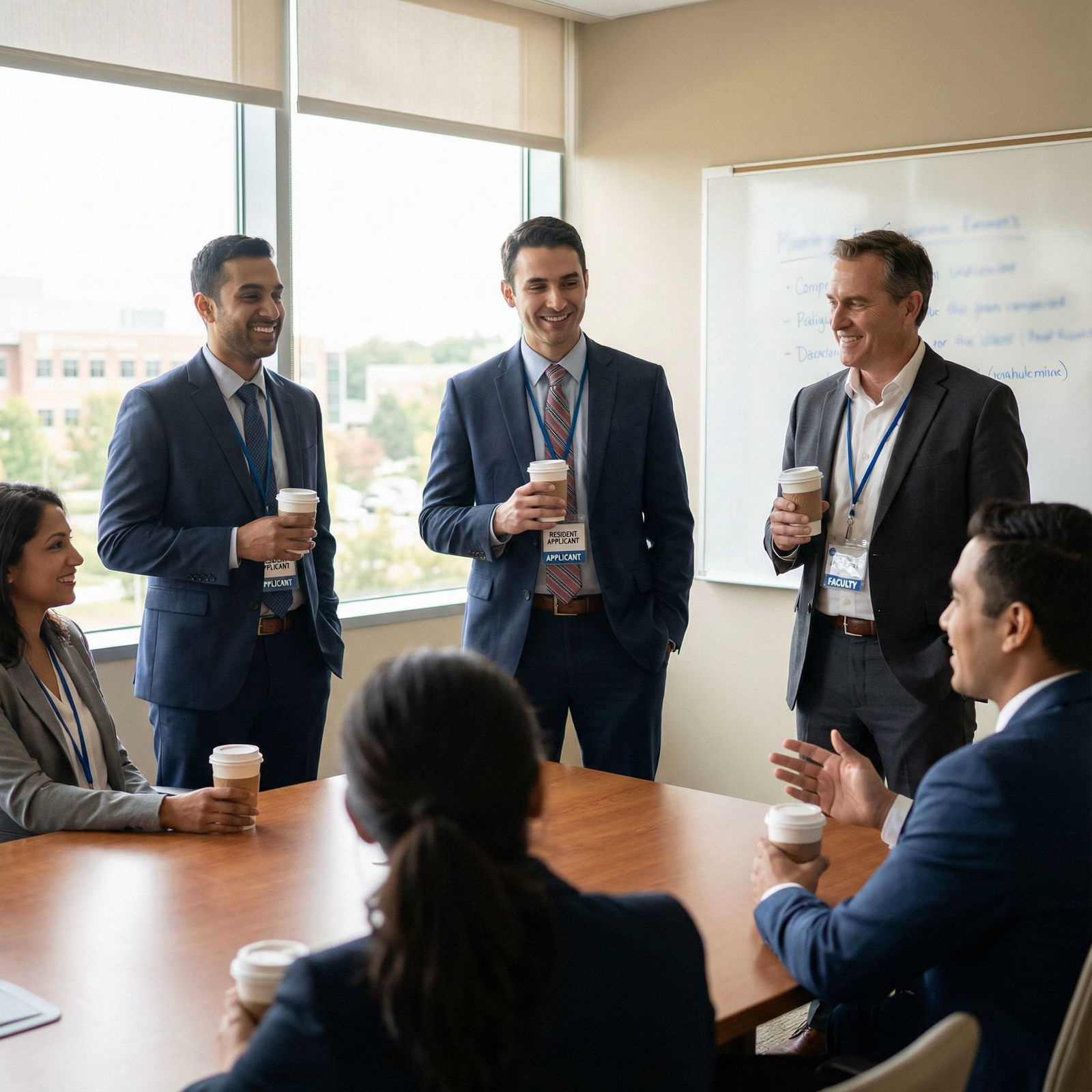
Faculty usually carry more formal power. That part is real. They may sit on the selection committee, lead ranking discussions, direct divisions, or have the program director’s ear. So yes, a thank-you to a faculty interviewer is often strategically important.
Especially if the interaction was substantial.
If a faculty member spent real one-on-one time with you, asked about your goals in depth, gave career advice, discussed your research, or made it clear they were invested in your future, send the note. That’s not performative. That’s basic professionalism.
The applicants who get this wrong tend to swing to extremes:
- They email every physician name they can scrape from the website. Desperate.
- They assume one generic note to the coordinator covers everything. Also wrong.
You do not need to mass-email every faculty member remotely associated with the program. Quality beats volume every time. A sharp, specific note to the faculty who actually engaged with you is much better than six vague messages that all say some version of “thank you for your time and I remain very interested.”
Good faculty thank-you targets:
- your direct faculty interviewer
- the program director, if they interviewed you or spent meaningful time with you
- associate program directors who had substantive conversations with you
- section chiefs or division leaders who discussed your future interests
- research faculty who connected with your scholarly work
- faculty who more or less told you, “I think you’d do well here”
Faculty notes should usually sound a bit more polished than resident notes. Not robotic. Just tighter. Cleaner. Less casual. If Dr. Shah spent twenty minutes discussing your interest in pulmonary critical care and mentorship opportunities, mention that exact topic. If Dr. Nguyen offered thoughtful advice about balancing fellowship goals with generalist training, say so. That level of detail signals sincerity and attention, which is the whole point.
Who gets a thank-you: a practical decision framework for mixed interview days
Most interview days are mixed. A faculty interview. A resident interview. Maybe a chief resident Q&A. Maybe a panel. Maybe a coordinator who saved the day after your Zoom link failed. This is where people start spiraling.
Here’s the cleanest rule I know: thank the people who directly interviewed you, helped organize your day in a meaningful way, or clearly shaped your experience.
That’s it. Not every person in the building. Not every face in the social hour. The people who mattered.
Use this framework:
High priority
- direct faculty interviewer
- direct resident interviewer
- program director or APD who had a real conversation with you
Moderate priority
- chief resident
- resident host
- coordinator who went above and beyond
- faculty mentor or research contact you meaningfully engaged with
Usually unnecessary
- someone you barely met
- faculty you only heard speak in a large intro session
- residents in a big social where you had no real exchange
- panel members you can’t identify and didn’t meaningfully interact with
For panel or group interviews, separate notes are stronger if feasible. They just are. Individualized messages land better. But if the format was a true panel and you only have one contact route, one concise message can be perfectly acceptable. Don’t turn this into a purity test.
And here’s a rule anxious applicants need to hear: if you barely exchanged words with someone, forcing a thank-you often sounds fake. Generic gratitude is not impressive. It just creates email clutter.
Coordinators are a special category. They may not rank you, but they absolutely notice professionalism. If a coordinator worked hard to organize things, solved a technical disaster, or was especially helpful, a brief thank-you is a classy move. Not mandatory every time. But often smart.
How to write the note so it doesn’t sound desperate, awkward, or copy-pasted
The best thank-you notes are short. Specific. Human. Not five paragraphs of panic disguised as gratitude.
Use this structure:
- Thank them for their time
- Mention one specific detail from your conversation
- Close with brief enthusiasm about the program
That’s enough.
A simple template:
- “Thank you for taking the time to speak with me during my interview day.”
- “I especially appreciated our conversation about ___.”
- “It reinforced my interest in your program, particularly ___.”
- “Thank you again for your time and insight.”
Done.
For a resident, you can sound a little more natural:
Thank you for speaking with me during interview day. I really appreciated your candid perspective on the call schedule and how residents support each other early in intern year. Hearing that made me even more excited about the culture of the program. Thanks again for your time.
For a faculty interviewer, tighten it up:
Dear Dr. Patel,
Thank you for taking the time to speak with me during my interview. I especially appreciated our discussion about mentorship in medical education and the ways residents become involved in curriculum development. Our conversation strengthened my interest in the program and its training environment. Thank you again for your time and consideration.
That’s strong. No drama. No flattery overdose.
A few tone rules, because this is where people get weird:
- Don’t apologize for taking their time.
- Don’t write a novel.
- Don’t ask where you stand.
- Don’t “just circle back” three times.
- Don’t send the exact same email to six people and forget to change the name. Yes, that happens. It’s painful.
- Don’t try to repair a bad interview with a thank-you note. If the interview was rough, a thank-you can show professionalism. It cannot perform CPR on a dead conversation.
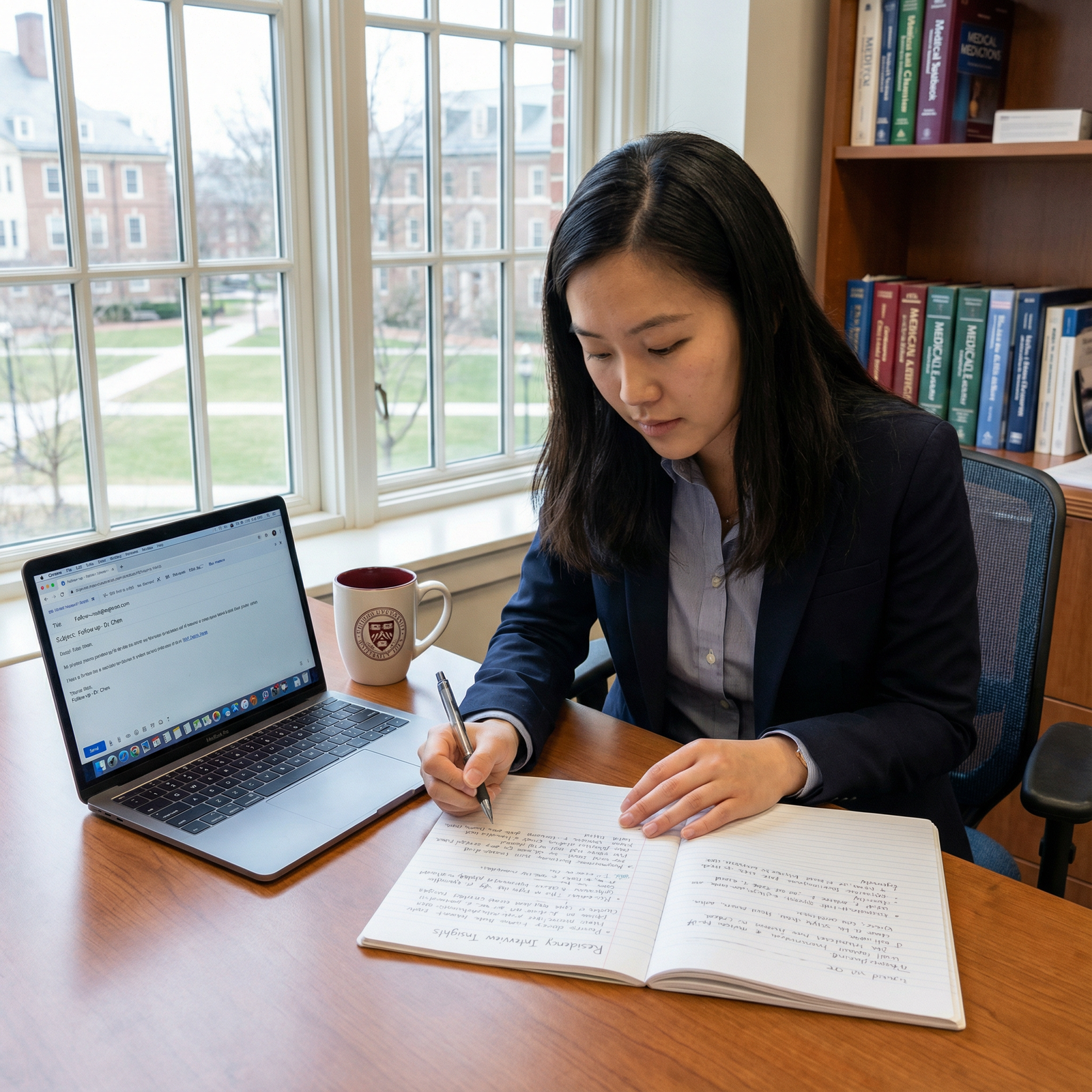
Timing matters, but not in the psychotic way applicants imagine. Ideally send notes within 24 to 72 hours. Earlier is cleaner. But a slightly late thoughtful note is better than a rushed, generic one sent in a frenzy from the airport.
Email etiquette still counts:
- use a clear subject line: “Thank you – [Your Name]”
- address faculty formally unless invited otherwise
- proofread names and titles
- keep it brief enough to read on a phone
And please, resist the temptation to overstate. “Your program is absolutely my dream program and I cannot imagine training anywhere else” sounds melodramatic unless you are intentionally sending a true top-choice communication later in the season and doing so within Match rules. Most thank-you notes should not read like a proposal scene.
Special cases: no-show anxiety, confusing interview formats, and what not to worry about
Virtual interviews make this harder. So do breakout rooms, surprise panel formats, and those weird social hours where you meet seven residents and remember exactly none of their names by the end. I know. It feels like one administrative mistake could tank your rank position. It won’t.
If you had multiple interviewers in one room, thank both if you can identify both and they genuinely engaged you. If a resident seemed rushed or distracted, don’t force a long emotional note to compensate. A brief thank-you is fine, or skip it if the interaction was negligible.
If you only met a faculty member socially and didn’t have a real conversation, don’t invent one. That kind of fake personalization is obvious. Same goes for trying to thank every resident from a pre-interview dinner. No one is keeping score that closely.
If the coordinator saved you from a technical meltdown, rescheduled you smoothly, or was notably kind, a thank-you is a very good idea. Coordinators may not rank applicants, but they often carry impressions back to leadership. And more importantly, being gracious to staff is just the right thing to do.
Most important: one missed thank-you is not going to ruin your application. I need applicants to stop treating this like unexploded ordnance. Programs rank people they want to train. A missing thank-you email rarely overrides a strong application and good interview.
Closing reflection: the real goal is respect, not scorekeeping
Thank-you notes are not a secret exam. They’re a professionalism gesture. A small one.
The goal isn’t to perfectly map the power structure of every resident and faculty member you met, then distribute gratitude with mathematical precision. That way lies madness. The goal is simpler: acknowledge the people who spent time with you, helped you, or clearly influenced your experience.
So if you’re stuck between overdoing it and doing nothing, choose selective sincerity. Thank the resident who interviewed you. Thank the faculty member who had a real conversation with you. Thank the coordinator who made a chaotic day smoother. Skip the performative mass email spree.
That’s enough. More than enough, actually.