
The Opening Panic: You Just Hit Send on the Wrong Hospital Name
You sent it at 9:42 PM. You felt good about it. Polished, grateful, professional. Then you opened your Sent folder to double-check.
"Thank you again for the wonderful day at City General..."
You interviewed at Metro University.
Your stomach drops through the floor. Heart pounding. Cold sweat. That classic intern panic where you just gave the wrong dose and the nurse hasn't noticed yet.
If you're in this situation right now, laptop open, re-reading that line five times hoping it magically changes, breathe. This feels catastrophic because you're exhausted, you're anxious, and the Match feels like everything hinges on perfection. It doesn't.
Let's do a real situational assessment. You are not done. A single copy-paste error does not erase an entire interview day. Program directors are not sitting in a dark room waiting to pounce on one typo and instantly remove you from the rank list. They're tired too.
Was it an isolated slip where you left another program's name in the first sentence? Or did you send the entire wrong letter, wrong faculty names, wrong research interests? Is this the first time or did you also call the PD "Dr. Johnson" when her name is Dr. Jackson? The first one is recoverable. The second starts to look like a pattern.
You made a clerical error under high stress. That's the headline. Not a character flaw.
Inside the Program Director's Head: How This Actually Lands
Here's what you imagine happens: The PD reads your note, gasps, prints it out, pins it to a bulletin board labeled "DO NOT RANK," and laughs with the other faculty.
Here's what actually happens.
Most PDs get 30 to 80 thank-you notes in a week. They know exactly how they're written. You have a template. You swap names. It's 10 PM after a 12-hour day on wards, you have three more to send, and your brain auto-piloted. They know because they've been on your side of this. I've talked to PDs who straight-up admit: "I expect templates."
When they see a competitor's name, two thoughts run through their mind, in order.
First: "Ah, copy-paste fatigue." Annoying, but relatable. Second: "Is this person careless?"
That's the real filter. A one-off wrong hospital name = copy-paste fatigue. Everyone dismisses it. A letter addressed to the wrong PD and the wrong program and mentions the wrong city? Now you're in careless territory. That reads as: you didn't care enough to proofread something that took 45 seconds.
And the context matters a lot. If you interviewed at Mass General and you thanked "Brigham and Women's", two direct crosstown rivals, that's more cringey than thanking a random program 2,000 miles away. It stings because it feels like you literally confused them with their archrival. If you thanked "University of Washington" while interviewing at "Washington University in St. Louis," most PDs will actually chuckle. That confusion happens every year.
Volume buys you grace here. PDs know you applied to 60 programs and interviewed at 15. They are not naive. They aren't ranking you on thank-you note calligraphy. They're ranking you on: Did you seem clinically solid? Would we want you on call at 2 AM? Did you get along with the residents?
The Triage Protocol: Should You Correct It or Let It Go?
Situation A: You left the wrong hospital name in the body of the email, or in the subject line. Glaringly obvious.
You should correct it. Once. Quickly. Within 12-24 hours max.
Silence is worse here because if they do read it, the wrong name is the only thing they will remember. A correction resets the story from "careless applicant" to "human who owns a mistake."
Situation B: You wrote "Johns Hopkin" instead of "Johns Hopkins" or misspelled the coordinator's name.
Let it go. Do not send a correction to correct a typo. You will only highlight it and double the email traffic in their inbox. PDs skim. Coordinators delete.
So you decided to correct. How you write it determines everything. Do not send a five-paragraph apology essay about your anxiety, your interview trail exhaustion, and how much you really meant to write Metro University because your grandmother trained there. No.
Keep it brutally short, professional, and completely devoid of drama.
Here's the template that actually works:
Subject: Correction + Thank You - [Your Name], [Interview Date]
Dr. [Last Name],
Apologies for the error in my previous note - please excuse the mistaken hospital name due to a drafting error. I wanted to reiterate my sincere thanks for the interview at [Correct Program Name] on [Date]. I particularly enjoyed [one specific thing - 10 words max].
Thank you again for your time.
Best, [Your Name], AAMC ID
That's it. Three sentences. No self-flagellation. No excuses about ERAS.
Send it to the same person you originally emailed. Don't CC the chair, the PD, and the coordinator in a panic cascade.
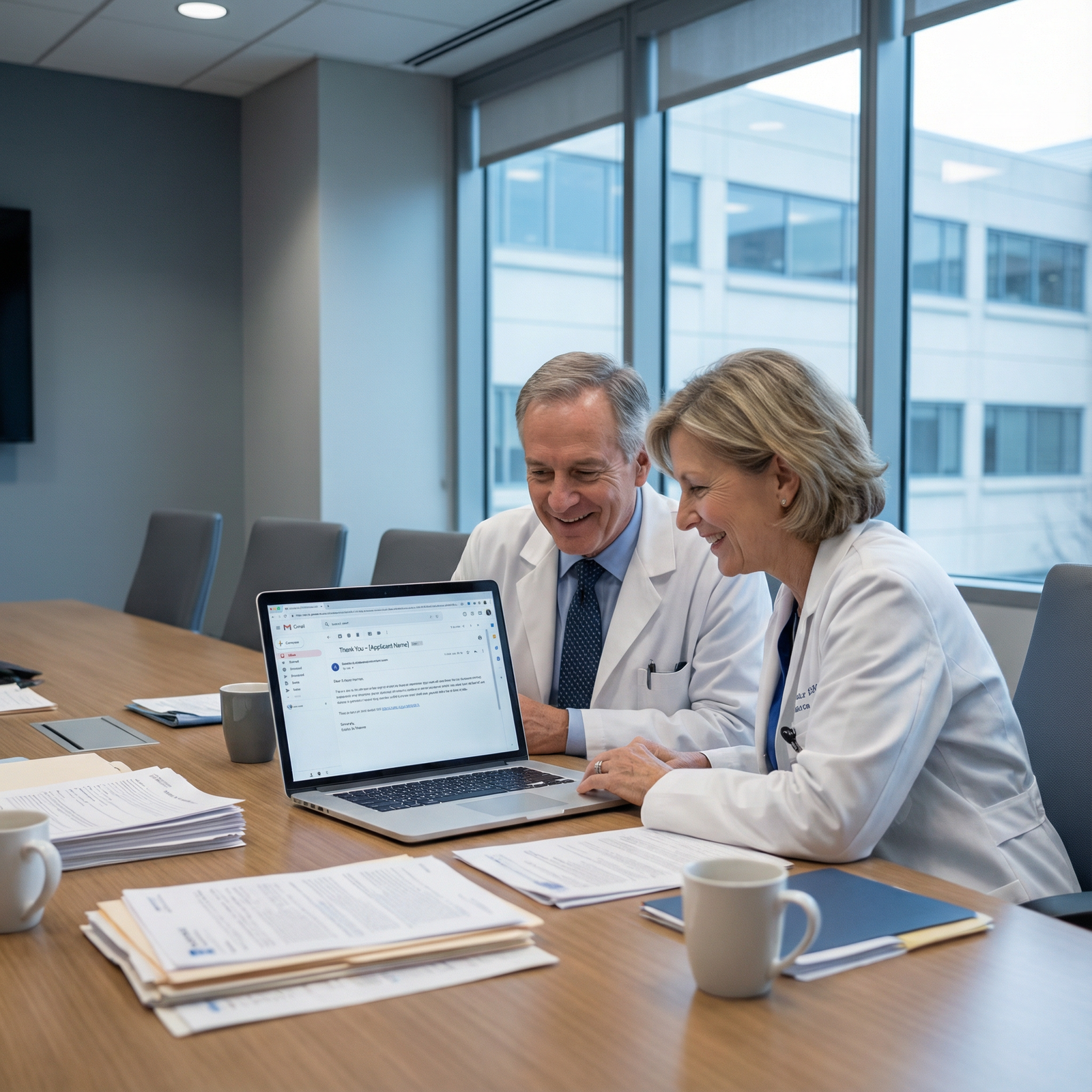
And here's what happens behind the scenes that applicants never see: That email likely goes to the program coordinator first. 80% of thank-you notes never even reach the PD's eyes on a busy day, the coordinator files them. If you send a clean, brief correction, a good coordinator will simply replace the old file with the new one and never mention it to the PD. If you send a frantic, emotional novel, she will show it to the PD because now it's a thing. Keep it boring.
Damage Control and Moving Forward Across the Rest of Your Trail
One mistake does not have to become two.
If you're in this situation, stop sending emails right now. Do a hard audit. Open every single template you have left, thank-you notes, letters of interest, second-look requests, and clear every placeholder bracket. I mean every <
That audit should take ten minutes. Do it before you send anything else.
Next: how to overcompensate without being weird. You don't need to send gifts. You don't need to mention the error on your second-look day. What you can do is be extra specific in your next interaction. If you email the coordinator about logistics, get every name letter-perfect. If you see the PD at a conference, reference something specific from your interview day. Specificity is the antidote to carelessness. One generic email says "mass template." One specific detail, "I really appreciated Dr. Patel's talk on transplant equity", says "I was actually there and paying attention."
And finally, the part you need to hear: accept that this almost never sinks you if your interview was strong.
I've watched PDs rank applicants #5 who spelled the program name wrong in a thank-you because the resident team loved them on the tour. I've watched applicants with flawless letters go unranked because they were dismissive to the front desk staff.
Your interview performance carries about 95% of the weight. Your note carries maybe 2%. The error carries a fraction of that 2%.
So fix what you can, learn the templating lesson, and then get your head back in the game for tomorrow's interview. That program in Cleveland doesn't know or care what you sent to Metro. They just want to see a present, engaged applicant in front of them. Don't let yesterday's typo steal today's energy.
You will match. Not because of your thank-you notes. In spite of them.