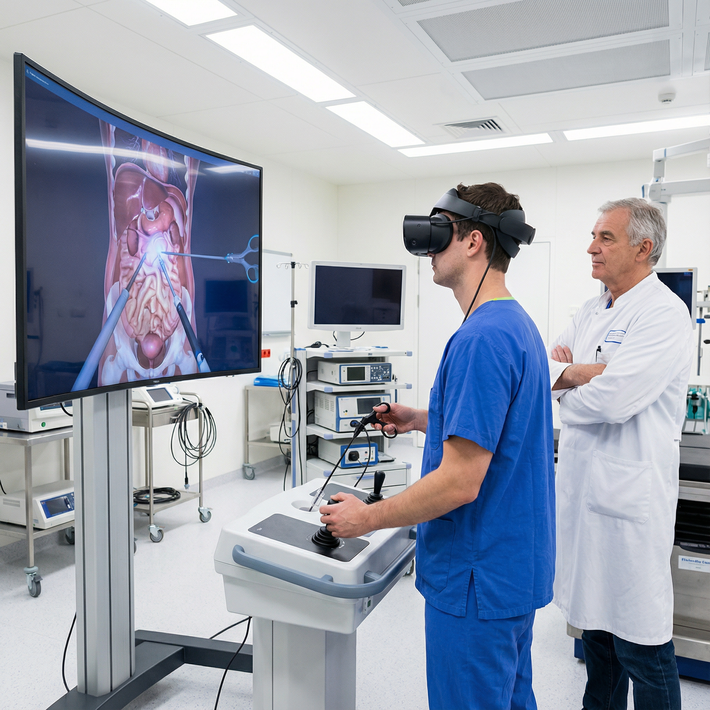
Residents are building AI tools on the wards right now. Not in some distant lab. On overnight shifts, between admissions, after sign-out. They're training models on triage patterns, drafting discharge summarizers, and prototyping sepsis predictors because the existing systems feel stuck in 2005. That surge is real, and it creates a hard collision: your idea versus the hospital's servers, data, and employment contract. This isn't abstract policy talk. It's about who owns the thing you just spent three months of scarce free time creating.
This guide is for educational purposes only. It is not financial advice, not legal advice, and not tax advice. Figures vary. Consult a qualified professional before making any decisions about intellectual property or employment contracts.
Phase 1: Defining Ownership through Employment Contracts
At this point you should open your employment agreement and find the intellectual property section before you write a single line of code. Most academic medical centers bury a work-for-hire clause that claims anything you create "in the course of your duties" or "using institutional resources." I've watched residents assume their side project was safe because they coded at 2 a.m. on a personal laptop. Then the hospital asserted ownership the moment the tool touched patient data or ran on a hospital GPU cluster. That assumption is expensive.
Work-for-hire doctrine is blunt. If the institution pays your salary and you develop the tool while employed, the default is theirs, unless you carve out an exception in writing. Duty hours versus personal time matters less than you think. Courts and tech-transfer offices look at resources first. Used the hospital's de-identified data warehouse to train the model? Institutional ownership is almost automatic. Spun up training jobs on the enterprise cloud account? Same outcome. Even accessing the EHR API under your resident credentials can tip the scale.
Here's the decision path I walk residents through on day one of a new rotation:
Document everything. Timestamp your first commit on a personal GitHub repo. Keep a simple log: "Idea sketched 14 March, 23:40, home office, personal MacBook, no hospital VPN." That paper trail is the only thing that later proves the work sat outside clinical obligations. Skip it and you're arguing from memory against a multi-billion-dollar health system's legal team. I've never seen that end well for the resident.
Understanding how your institution prioritizes these systems is crucial; read more in The Quiet Battle Between IT and Clinicians Over Clinical AI Systems.
Personal time alone doesn't save you if the model later ingests any protected health information or even synthetic data derived from real encounters. The moment hospital data enters the pipeline, the institution's claim strengthens dramatically. At this point you should treat every dataset like radioactive material: handle it only after written clearance.
Phase 2: Navigating Hospital IT and Compliance Protocols
Week one of the rotation is when you move. Not after the MVP works. Not after you demo it at morning report. Before.
As you move forward in your career, balancing innovation with patient safety is paramount; check out Navigating AI Ethics in Healthcare: Essentials for Medical Professionals for deeper insights.
At this point you should schedule a 20-minute call with the technology transfer office and the hospital's IT security lead. Bring a one-page description: problem, intended users, data sources you plan to avoid, and hardware you'll use. Transparency here is not optional. I've seen promising tools killed because a resident built first and disclosed later. The compliance team then treats the whole project as a rogue system and shuts the ports.
Walk the chronological checklist:
- Day 1-3: Email tech transfer and legal with the one-pager. Request a preliminary determination on ownership.
- Day 4-7: Meet IT security. Confirm whether any hospital compute, storage, or API access will be required. Get the answer in writing.
- Week 2: If they green-light limited testing, draft a short Memorandum of Understanding that freezes ownership percentages and licensing rights before any serious coding begins. Sign it.
- Only then start the prototype, on personal hardware, with synthetic or fully public data.
That early MOU is your leverage. Without it, the hospital can claim the finished tool the day you show clinical value. With it, you have a baseline for later equity discussions. Residents who wait until the tool is polished lose the negotiation. The institution already smells revenue or risk reduction and has no incentive to share.
HIPAA and IT policy gates are real. Expect them to demand audit logs, encryption standards, and a data-use agreement even for de-identified sets. Push back only with documentation that proves you never touched the live EHR. Soft-pedaling the data sources is a career-limiting move. I've watched one resident's moonlighting income freeze while the compliance investigation dragged on for nine months. Don't be that person.

Phase 3: The Future Landscape and Strategic Negotiation
Policies differ hard across institutions. Public university hospitals lean heavily toward full institutional ownership, often leaving residents with zero equity and a non-exclusive license at best. Private research hospitals sometimes offer shared ownership or royalty streams, especially if the resident brought substantial prior code. Independent clinics and smaller systems are the most flexible, frequently allowing the developer to retain majority rights if no patient data was used.
Those numbers are directional, not gospel. Figures vary by contract language and state law. Still, the pattern is clear: the bigger and more bureaucratic the system, the smaller your slice.
At this point you should prepare your advocacy package before any negotiation meeting. Include:
- The dated development log proving independent work
- The signed MOU from Phase 2
- A clean valuation of your contribution (hours, unique clinical insight, prior personal IP)
- A proposed split that still gives the hospital a royalty-free clinical license
Ask for equity or a defined royalty rather than a one-time "inventor award" check. Those awards are often laughably small relative to the tool's eventual value. Frame the ask around retention: physician-innovators who keep skin in the game stay longer and keep shipping improvements. Hospitals that strip ownership train their best residents to leave and compete against them.
Long-term, owning even a minority stake changes your career arc. You're no longer just another attending hunting RVUs. You become the clinician who already shipped a product, raised a seed round, or licensed a tool to three other systems. That trajectory compounds. The residents I know who walked away with nothing regret the silence more than the lost dollars. They also learn the hard way that "the hospital will take care of you" is not a strategy.
Closing: Protect Your Work Before You Build
At the ideation stage you must lock three things: the employment contract language, a dated personal development log, and an early written understanding with tech transfer. Do those three and you keep options open. Skip them and the institution owns the upside while you keep the night-float shifts.
Clinical excellence still comes first. An AI tool that distracts you from sick patients is a net loss no matter who owns the code. But excellence and ownership are not opposites. The physicians who will shape the next decade of care are the ones who refuse to hand over every insight the moment it becomes software.
Before your next rotation starts, book the call with a medical IP specialist. Bring your contract. Get the ownership map in writing. Then build.