The fact that your hospital is rolling out a risky AI tool without clear guardrails is not “the future of medicine.” It is a patient safety problem with branding.
You’re not paranoid. You’re underpowered. And you need a strategy.
1. First 24–48 Hours: What You Do Immediately
You find out on Monday that a new AI tool is going live next week. Maybe it’s:
- An AI sepsis alert embedded in the EHR.
- An AI discharge summary writer.
- An algorithm that auto-prioritizes radiology reads.
- A chatbot that messages patients “on your behalf.”
- A predictive model for readmissions or “high-risk” patients.
You read the flyer or sit through the “education” session and your stomach drops. The claims are sweeping. The safety details are thin. Leadership seems more excited about “innovation” than about test characteristics.
Here’s what you do in the first 1–2 days.
Step 1: Capture the official story in writing
Do not rely on memory or rumors.
- Save any broadcast emails.
- Screenshot internal announcements or slide decks.
- Note the go-live date, intended use, and who “owns” the tool (IT? Quality? A specific service line?).
You’re going to need this later when someone says, “We never said you had to use it that way.”
Step 2: Clarify what the tool actually does
Strip away the marketing. Translate it into simple clinical language.
- “Predictive analytics for deterioration” → “It spits out a risk score that may nudge me toward ICU transfer or more tests.”
- “AI-assisted note drafting” → “It will generate documentation that might be wrong, upcoded, or miss key details.”
- “Automated triage messaging” → “It will sometimes talk to my patients as if it’s me.”
Write one sentence for each:
- What does this AI tool change in my clinical workflow?
- What bad outcome is most likely if it fails silently?
- What bad outcome is most likely if it overreacts?
If you cannot answer those, you have your first specific question for leadership.
Step 3: Decide your default stance
As a trainee, you need a default operating principle before the tool goes live:
- “I will treat this like a lab test with unknown sensitivity/specificity.”
- “I will not let this auto-send anything to patients without reviewing it.”
- “I will not act on this tool alone for high-risk decisions (ICU transfer, code status, anticoagulation, etc.).”
Write your stance down. You may need to say it out loud later.
2. How to Assess Real Risk (Without Being a Data Scientist)
You don’t need to be a machine learning engineer. You do need a few sharp questions.
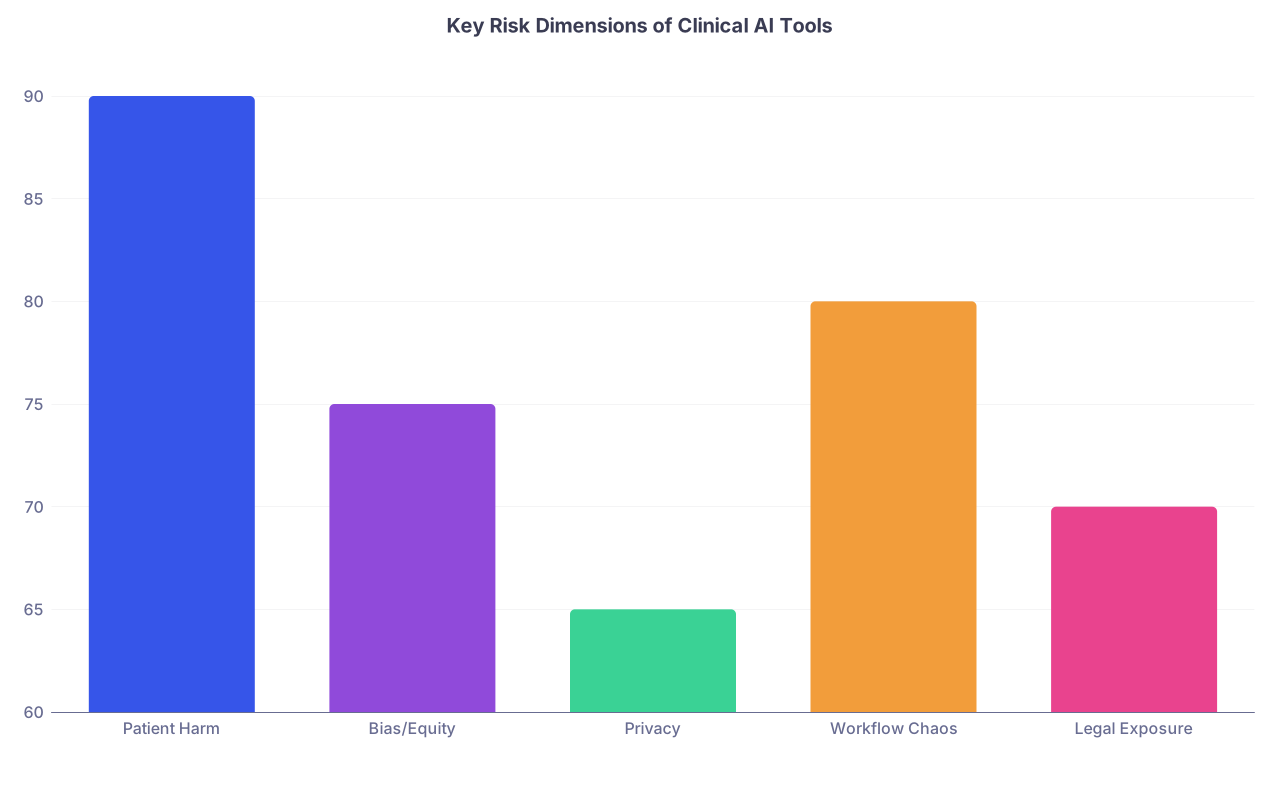
| Category | Value |
|---|---|
| Patient Harm | 90 |
| Bias/Equity | 75 |
| Privacy | 65 |
| Workflow Chaos | 80 |
| Legal Exposure | 70 |
The five questions that matter
Ask or look for answers to these. If no one can answer them, that’s a red flag.
What is the tool’s intended use?
Exact wording. Is it decision support? Documentation aid? Triage assist? “Not for standalone diagnosis” should be explicitly stated somewhere.What data was it trained or validated on?
Same health system? Different country? Only insured patients? Only one specialty? If the population is nothing like yours, assume error.What are the performance metrics in your setting?
You care about:- Sensitivity / specificity.
- Positive predictive value (PPV).
- How often it fires per 100 patients. Not just “it improves outcomes.” Show me the numbers.
What is the human override policy?
Are you allowed to ignore it? Do you have to document why? Is there any hidden “you will be monitored for non-use”?Who is accountable if it causes harm?
Hospital? Vendor? “The treating physician” (which is code for: you, the human, will be blamed)?
You will not always get full answers. But asking these moves the conversation out of the “ooh, shiny” zone and into “we are responsible adults.”
Spotting the highest-risk patterns
From what I’ve seen, the most dangerous AI rollouts in hospitals share at least one of these:
- The AI is hard-wired into order sets (e.g., sepsis bundles pre-checked because of an AI score).
- The AI communicates directly with patients without mandatory human review.
- The tool touches medication selection, doses, or timing, even indirectly.
- Leadership calls it “just a tool” but tracks usage metrics and shames “low adopters.”
- No one can show a local post-implementation safety review.
If you see two or more of these, you treat the entire thing like a new high-alert medication. With suspicion and documentation.
3. What to Do Day-to-Day When You Have to Use It
You’re on wards. The AI is live. Your name, not the algorithm’s, is on the signature line.
Here is how you handle real scenarios.
Scenario A: AI recommendation conflicts with your clinical judgment
You’re on nights. AI deterioration model flags a patient as “low risk.” Your gut says they’re sick. Or vice versa.
What you do:
Document your reasoning, not your feelings.
In your note:
“AI early warning score indicates low risk for deterioration. However, patient with new tachypnea, rising oxygen requirement, and elevated lactate. Escalating level of care despite AI score.”
Or the reverse, if you’re not escalating.Screen for anchoring.
Ask yourself: “If I had never seen this AI score, what would I do?”
If the answer differs, interrogate why. Do not let the machine be the loudest voice in your head.Protect yourself when going against it.
If attending is pushing, “Well, the AI says…” respond with something like:
“I see that, but based on X, Y, Z clinical factors, I recommend ___.” Then chart that sentence.
You’re building a paper trail of independent judgment.
Scenario B: AI auto-generates documentation or messages
Maybe it drafts your discharge summary, HPI, or secure messages.
Your rule: nothing leaves under your name that you would not sign if a malpractice attorney read it out loud in court.
Concrete moves:
For AI notes:
- Always skim med lists, allergies, major problems, code status, and plans for high-risk meds (anticoagulants, insulin, opioids).
- Delete hedging or weird language. AI loves vague phrases that later get interpreted against you.
For patient messages:
- Never let the system auto-send without a hard human review.
- Fix tone and content. Some AI outputs are over-reassuring and under-specific.
If you’re time-pressured, prioritize checking any sentence that includes: “no concerns,” “benign,” “safe to wait,” “cleared,” or anything that sounds like a guarantee.
4. Raising Concerns Without Getting Steamrolled
You’re a trainee. You don’t control the EHR build. But you’re also the one actually using it at 2 a.m. You are often the first person to see a serious problem.
There is a way to raise the alarm without becoming “the difficult resident who hates innovation.”
Step 1: Start with observable facts, not vibes
Instead of:
“This AI tool is unsafe; I don’t trust it.”
Try:
“In the last week, I’ve seen three cases where the AI recommendation contradicted clear clinical signs, and following it would have delayed appropriate care.”
Or:
“I’ve noticed the AI note generator repeatedly misstates anticoagulation plans. Here are two de-identified examples.”
You want patterns + examples. Not rants.
Step 2: Use the right escalation channels
Typical options:
- Service / department meeting.
- EHR or “clinical informatics” workgroup.
- Quality/safety committee.
- GME leadership (PD, APD, chief residents).
- Anonymous incident reporting (sometimes best for early signals).
Pick at least two.
And use language those groups respect:
- “This feels like a patient safety issue rather than a convenience feature.”
- “We may be creating a systematic source of documentation error.”
- “I am worried we’re introducing bias in which patients are flagged.”

| Step | Description |
|---|---|
| Step 1 | Notice AI safety issue |
| Step 2 | Escalate to attending on call |
| Step 3 | Document cases and patterns |
| Step 4 | Notify service chief or department lead |
| Step 5 | Report to clinical informatics or IT |
| Step 6 | File patient safety report |
| Step 7 | Bring to GME or residency leadership |
| Step 8 | Immediate patient harm risk |
Step 3: Use the institution’s own language
Hospitals care about “compliance,” “regulatory risk,” “equity,” and “reputation.”
You can say:
- “Has this gone through the same safety review we use for high-alert medications?”
- “How are we monitoring for disparities by race, language, or insurance status?”
- “Are we confident that this aligns with CMS and HIPAA expectations for AI tools?”
This is not sucking up. It’s speaking in a dialect that gets attention.
Step 4: Protect yourself socially
You do not want to be the only one complaining.
- Have 1–2 co-residents or fellows who agree to co-sign emails or speak up with you.
- When possible, raise concerns as a group observation:
“Several of us on nights have noticed…” - If your PD or chief residents seem receptive, loop them in early. If they’re clearly defensive, route around them: safety office, informatics, or faculty allies.
5. When You See Actual or Near Miss Harm
This is where a bad AI rollout stops being theoretical.
A concrete case: AI triage mislabeled a chest pain patient as low risk, delaying evaluation. Or AI discharge summaries repeatedly omit important follow-up instructions.
Here’s what you do.
Step 1: Take care of the patient first
Do what you’d do if there was no AI:
- Fix the orders.
- Call the rapid response.
- Clarify the discharge.
- Document what actually happened.
AI doesn’t change ABCs.
Step 2: Document the role of the AI in the chart (carefully)
You don’t need to write a manifesto. You do need enough that someone later can see that the AI influenced care.
Examples:
- “Triage categorization in EHR based on AI risk tool labeled patient low acuity; reassessment at bedside suggests high-risk ACS; upgraded level of care.”
- “AI-generated discharge instructions omitted follow-up anticoagulation plan; updated manually and reviewed with patient.”
You’re not assigning blame. You’re describing the environment.
Step 3: File a safety or incident report
If your hospital has any kind of incident reporting system, use it. Include:
- That AI was involved.
- What type (triage, documentation, prediction, messaging).
- What almost happened or did happen.
- Whether there’s any pattern you’ve seen.
Do not assume “someone else already reported it.” They didn’t.
Step 4: Decide if this needs higher-level escalation
If what you saw could:
- Predictably recur across many patients, and
- Cause serious harm, or
- Disproportionately affect certain groups (non-English speakers, uninsured, etc.),
then this is not just a one-off incident. It’s a design flaw.
That’s when you consider:
- Talking directly to the clinical informatics lead or CMIO.
- Involving your residency’s quality/safety curriculum leaders.
- Raising it at M&M — framed as a systems issue, not a single human error.
6. Protecting Your License and Your Future
You’re not just managing risk to patients. You’re managing risk to your name.
| Risk Type | Example Scenario | Your Protection Move |
|---|---|---|
| Overreliance | Followed low-risk score, patient crashed | Document independent assessment & rationale |
| Documentation errors | AI note misstates plan or dose | Edit key plan sections before signing |
| Communication misfires | Bot reassures patient incorrectly | Review/rewrite outbound messages |
| Bias & equity | Tool under-flags certain patient groups | Flag patterns, document concerns, report |
| Blame shifting | “Clinician should have known better” | Record that AI was advisory, not determinative |
Three habits that matter
Always treat AI outputs as “one piece of data,” never the conclusion.
Your note should read like you synthesized AI recommendations with exam, history, labs, imaging — not that you outsourced thinking.Avoid parroting AI language blindly.
If AI says “This is likely benign,” and you copy that into your note, you own that statement. Translate into your own, accurate clinical framing.Keep a quiet log of serious AI issues.
Not patient-identifiable. Just dates, type of tool, rough description:- “July 3 – Deterioration model missed obvious septic shock.”
- “Aug 12 – AI notes repeatedly injected incorrect med doses.”
This is not for social media. It’s so when a real review happens, you have contemporaneous evidence of patterns you saw.
7. How to Push for Safer AI Without Being “Anti-Tech”
You don’t have to be anti-AI. You should be anti-stupid-rollout.
Here’s what good looks like — so you know what to demand.
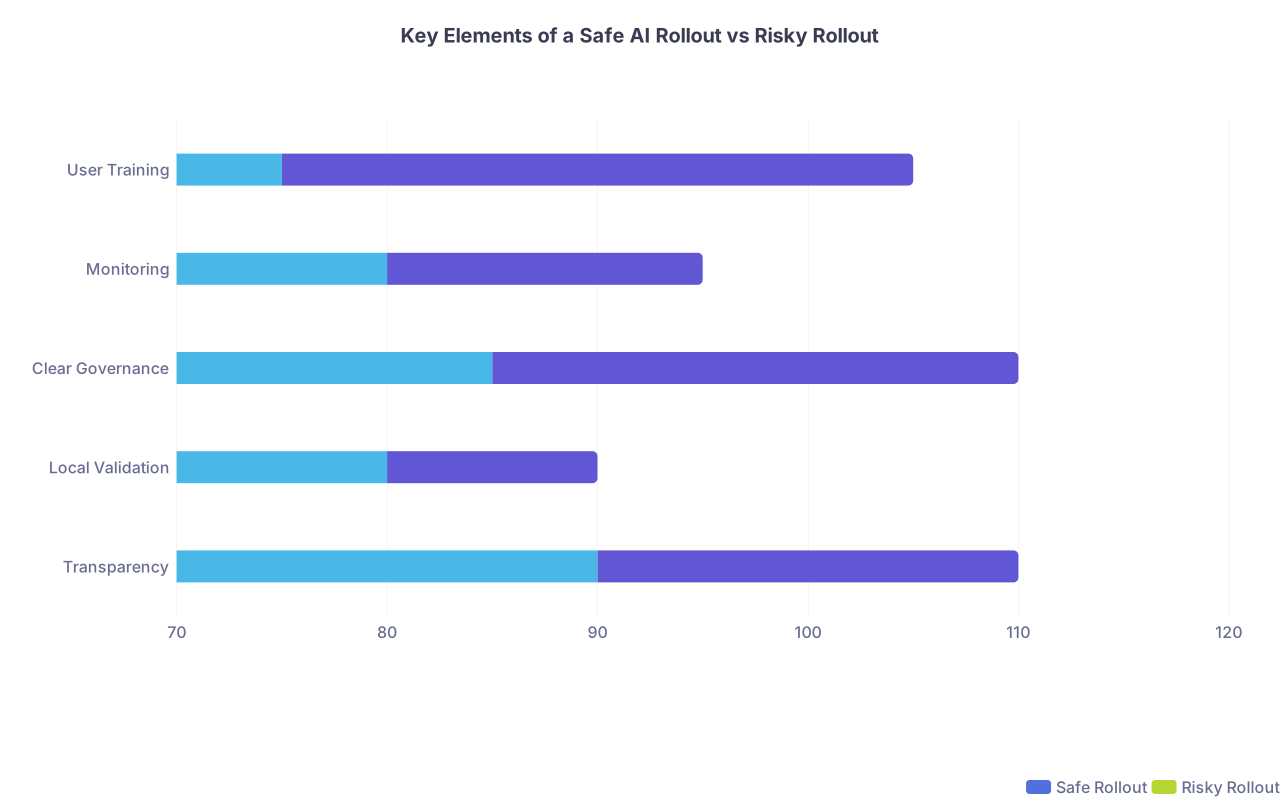
| Category | Safe Rollout | Risky Rollout |
|---|---|---|
| Transparency | 90 | 20 |
| Local Validation | 80 | 10 |
| Clear Governance | 85 | 25 |
| Monitoring | 80 | 15 |
| User Training | 75 | 30 |
Signs of a relatively safe AI deployment
- Clear statement: “Decision support only. Does not replace clinical judgment.”
- Local validation study shared openly (even if imperfect).
- Named owner: “This is under the Clinical Informatics Committee.”
- Simple way to report issues; you see evidence that reports are read and acted on.
- Training that covers limitations and bias, not just how to click the buttons.
If your hospital has none of this, your advocacy can be simple:
- “Can we have a one-page limitations summary for this tool?”
- “Has this been evaluated locally? Can those results be shared with clinicians?”
- “Can we have a dedicated button or link to report AI-related issues directly from the EHR?”
You’re not asking them to shut it all down. You’re asking them to meet basic safety standards.
Using your position as a trainee strategically
You actually have some advantages:
- You see a large volume of frontline cases.
- You cross services (medicine, ED, ICU, etc.).
- You’re not yet financially entangled with the vendor.
Leverage that by:
- Offering to collect de-identified examples of AI errors.
- Volunteering as a resident rep on AI/IT committees.
- Asking specific questions at town halls:
“How will we monitor for drift or performance decay of this model over time?”
8. Advanced: Reading the Institutional Politics
Sometimes the tool isn’t just risky. It’s politically protected.
There’s a senior champion. There’s been media coverage. The vendor is a “strategic partner.” You sense that criticism is… unwelcome.
Here’s what you do then.

Be precise, not ideological
Don’t go in waving a “ban the AI” flag. You will lose.
Do say:
- “The tool might be helpful, but in its current form we’ve observed X, Y, Z safety issues.”
- “I’m not against the technology; I’m against deploying it without monitoring for harm.”
This lets the politics people save face while still forcing incremental fixes.
Separate vendor critique from internal critique
Blaming “the vendor” sometimes helps, sometimes doesn’t.
More effective:
- “Our implementation doesn’t allow easy overrides.”
(Internal issue.) - “We lack a clear feedback loop to the vendor when we see errors.”
(Shared issue.)
You’re positioning yourself as someone trying to make the partnership safer, not blow it up.
Know when to route to GME vs outside channels
If your concerns are repeatedly minimized, and patients are actually at risk, you have a spectrum:
- Internally: PD, DIO, risk management, ethics committee, ombuds office.
- Externally (nuclear options, used rarely and carefully): state board reporting, media, professional societies.
Most situations won’t need the latter. But you should be aware they exist, especially if what you’re seeing looks like systemic, covered-up harm.
9. Using This as a Training Opportunity For Yourself
You are training in the first generation where AI will be normal in hospital medicine. You can do more than just survive it.
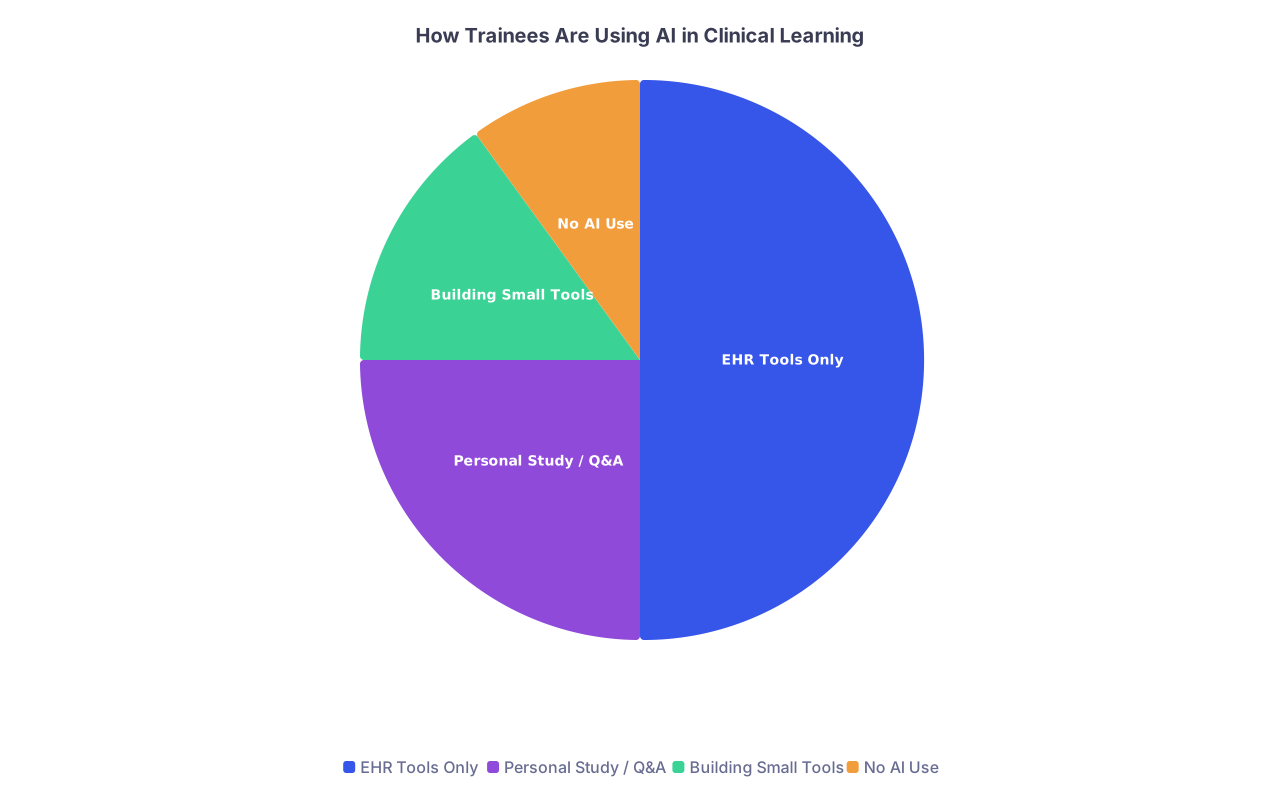
| Category | Value |
|---|---|
| EHR Tools Only | 50 |
| Personal Study / Q&A | 25 |
| Building Small Tools | 15 |
| No AI Use | 10 |
If you’re inclined, you can:
- Learn basics of test characteristics and calibration so you can interpret AI outputs like you interpret D-dimer or procalcitonin.
- Ask to attend or shadow clinical informatics meetings.
- Work on QI projects: “Impact of AI sepsis alerts on antibiotic timing and overuse,” etc.
- Publish case reports or perspectives (de-identified, approved) on AI-related near misses.
I’ve seen residents build entire careers off being “the person who actually understands this stuff and how it plays out at the bedside.”
This doesn’t cancel out the risk. But it can turn a frustrating rollout into a learning and career opportunity.