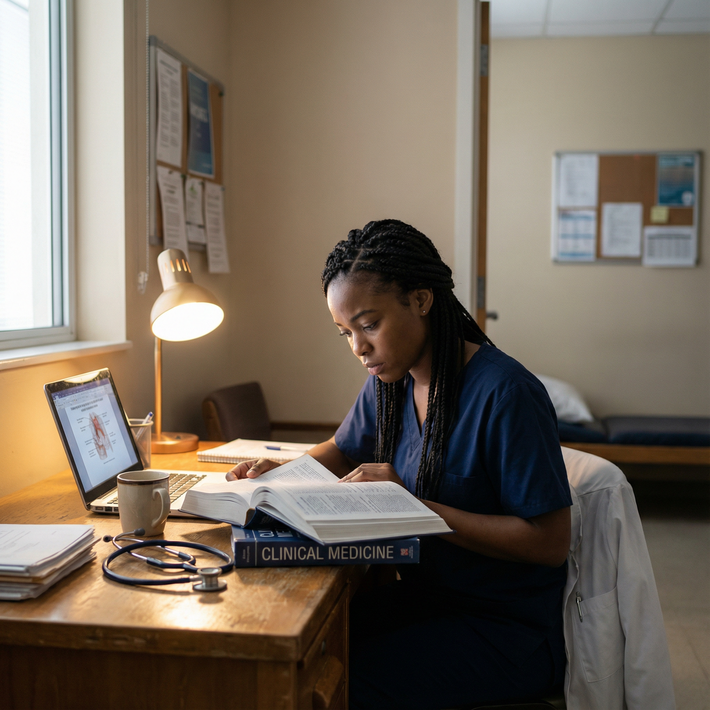
It's 2:00 AM. I'm staring at the ceiling, phone screen burning my retinas as I toggle between two acceptance emails. One from a massive Caribbean medical school, the other from a tiny European program. My chest tightens. All I can picture is opening that USMLE score report in three years and seeing a "Fail." What if I choose wrong and it ruins my entire medical career?
If I go to the Caribbean, I'm terrified of sitting in a lecture hall with 400 other students. Will the professor even know my name? Will I just be a number, quietly drowning in biochemistry while no one notices? But then again, if I go to Europe with a class of 50, what if I'm the dumbest one in the room? Everyone will see me struggle. I'll be singled out. The professor will know exactly how behind I am. It's a nightmare either way. Which environment actually cuts the risk of failing the USMLE? Or am I doomed before I even start?
Cohort Size and the Panic of Anonymity
A lecture hall with 300 people sounds like a nightmare to me. I picture myself sitting in the back row of a massive Caribbean auditorium, completely invisible. If I don't understand a concept in pharmacology, what am I supposed to do? Raise my hand in front of 300 strangers? Fat chance. The professors there are dealing with a cattle drive. They have too many students to notice if one person is slipping through the cracks. You become an ID number. If you fail a midterm, it's just a statistic to them. The worst part? You might need extra help, and no one will ever realize you're struggling until it's too late.
Then I think about the small European cohort. Thirty to eighty students. Sounds safer, right? Maybe. But the panic shifts. In a class that small, you can't hide. If I bomb a quiz, the professor looks right at me. The peer scrutiny is intense. Everyone knows everyone's business. But, and this is what keeps me up at night, there's a lifeline there. The faculty actually know your name. They can pull you aside.
If I look at the faculty-to-student ratios, the European schools win hands down. You actually have a chance at getting mentorship. But do they have the tutoring infrastructure of the massive Caribbean schools? The big Caribbean programs have armies of TAs and structured study groups. But you have to seek them out. If you're the type to withdraw when anxious, a big class is a death sentence. You'll just fade away. In a small class, you're forced to engage, even if it's terrifying. I keep asking myself: where am I more likely to actually ask for help before I fail an exam?
USMLE Prep: Who Has Your Back?
Here's where the panic really sets in. The USMLE. Step 1 is the gatekeeper to my entire future. I need a school that has my back when it comes to prep.
The large Caribbean schools have commercial prep partners. They have dedicated semesters for Step 1 review. They bring in companies to drill you. That sounds comforting, right? But what if I get left behind? Those commercial prep courses move fast. If you aren't self-motivated, you'll drown. The school might offer the resource, but if you can't keep up, you're on your own. I'm terrified of failing Step 1 and having the school just shrug and say, "Well, we gave you the tools."
Small European schools are a completely different beast. A lot of them are focused on their own national exams or the broader European system. They often lack US-specific prep resources. I might have to rely entirely on self-study and buy external prep like UWorld and Sketchy. If I fail Step 1 at a European school, will they even know how to help me retake it? Do they have a system in place for US students who stumble? Or will I just be cast out into the void, trying to navigate the retake process alone?
I dug into the data, and it's confusing. Some small European schools actually have surprisingly high first-time pass rates. Why? Their curricula are brutal. They weed people out early. If you survive their basic science years, you probably know the material cold. But that doesn't stop the dread. What if I need step-specific tutoring and my European school has no idea what that even means?
Clinical Rotations and the Match Anxiety
Getting through the USMLE is only half the battle. Then comes the Match. Clinical rotations are supposed to set you up for residency applications, and this is where I feel like I'm walking through a minefield blindfolded.
Large Caribbean schools often have established clinical affiliate networks in the US. They have contracts with hospitals in New York, Michigan, or Florida. That sounds great, but what they don't tell you is how fierce the competition for those slots is. You're fighting against 400 of your classmates for the best rotation sites. Worst-case scenario: I end up at a hospital with no teaching, just scut work, and no US Letters of Recommendation.
Then there's the European route. Small European schools often send students to local hospitals. That means I'd be doing rotations in a different healthcare system, with less US exposure. How are US residency directors going to view that? I'm terrified that if I go to a European school, I won't be able to get strong US LORs or research opportunities because my school is completely unknown to them.
If I go to Europe, I have to be proactive. Away rotations, networking, cold-emailing for research. It's exhausting just thinking about it. But some small European programs are starting to wake up to this. They're forming partnerships to offer US clinical clerkships. It's not as seamless as the Caribbean pipeline, but it exists. Still, I worry. What if I can't get a away rotation? What if my Step scores are borderline and I have no US clinical experience to back me up? I'll never match.
The Real Failure Risk: Data You Can't Ignore
I've been staring at spreadsheets until my eyes bleed. I look at publicly available USMLE pass rates, but I know schools self-report this data. They might not count the students who failed and dropped out before the exam. It's scary.
Here's what I found: Small European schools often have high attrition. A lot of people drop out or get held back a year. But those who actually make it to graduation? They tend to match well. They survived the gauntlet.
Large Caribbean classes have way more variance. Because they accept so many students, you get a wide range of abilities. Many students pass and match. But a sizable minority struggle. They fail Step 1. They repeat semesters. They burn out. And I keep thinking, "If I'm at the bottom of a 400-person class, am I going to be the one who fails?" It's a numbers game, and I hate gambling with my life.
The data keeps telling me the same thing: personal discipline matters more than cohort size. The school can only do so much. If I don't put in the hours, I'll fail regardless of where I go. But knowing that doesn't stop the "what ifs."
Cost, Retakes, and Financial Ruin Fears
Let's talk about the money, because the financial anxiety is crushing me. Caribbean schools are expensive. Tuition is high, and living on an island isn't cheap. If I fail a class or need an extra semester to prep for a retake, the costs pile up fast. I'm terrified of being $300,000 in debt with no medical degree and a failed Step 1. Can I afford another semester AND USMLE prep materials? What if I max out my loans and just... can't finish?
European schools, like those in Poland or Italy, often have lower tuition. The cost of living can be lower, too. The programs might be six years instead of four, but if I fail a class, the retake costs are less catastrophic. Some European schools allow you to repeat a year without exorbitant fees. It's not cheap, but it doesn't instantly bankrupt you like a Caribbean retake might, where they charge you per credit.
But there's a hidden cost nobody talks about: mental health and time. If I fail in Europe, I might be stuck there for an extra year. Away from my family, dealing with the shame, trying to recover. The financial hit is one thing, but the toll on my mental health? That could break me.
Your Personal Risk Profile: The Decision Framework
I have to make a choice, and I need a framework. No more agonizing. I need to look at myself honestly. Am I self-sufficient? Do I need hand-holding? I wish I could say I'm totally independent, but the truth is, when I get stressed, I isolate myself. I need people to check in on me. That means a large, anonymous Caribbean class might be my downfall.
I need to ask the schools directly. What is your Step 1 pass rate for the past 3 years? Not the cherry-picked number, the real one. What support do you offer for struggling students? If they dodge the question, that's a red flag.
I need to talk to current students. Not the admissions ambassadors, but the random people on Reddit or Facebook groups. What happens when you fail a class? What if I fail and have no friends to study with? That's my nightmare. I need to know if the community is supportive or cutthroat.
I'm going to build a weighted matrix. Cohort size, USMLE resources, cost, US clinical exposure, match history. It sounds nerdy, but it's the only way to stop the panic. No single factor dictates failure. But knowing my own weaknesses? That's the strongest predictor of whether I'll survive.
A Final Reminder: The Exam Will Judge You, Not Your School
Both paths produce successful IMGs. There are doctors practicing in the US right now who came from tiny European cohorts and massive Caribbean classes. The failure risk isn't just about the school. It's about me. My study habits. My resilience.
The worst-case scenario is always in my head, but it's unlikely if I prepare diligently. And if I do fail? I can recover. People fail Step 1 and still match. It's not a death sentence. The real question isn't "which school cuts failure risk?" It's "which school will I thrive in?"
I need to take a deep breath. Most of these night-before anxieties are exaggerated. I've done the research. I know my options. Now I just have to trust my decision and get to work.