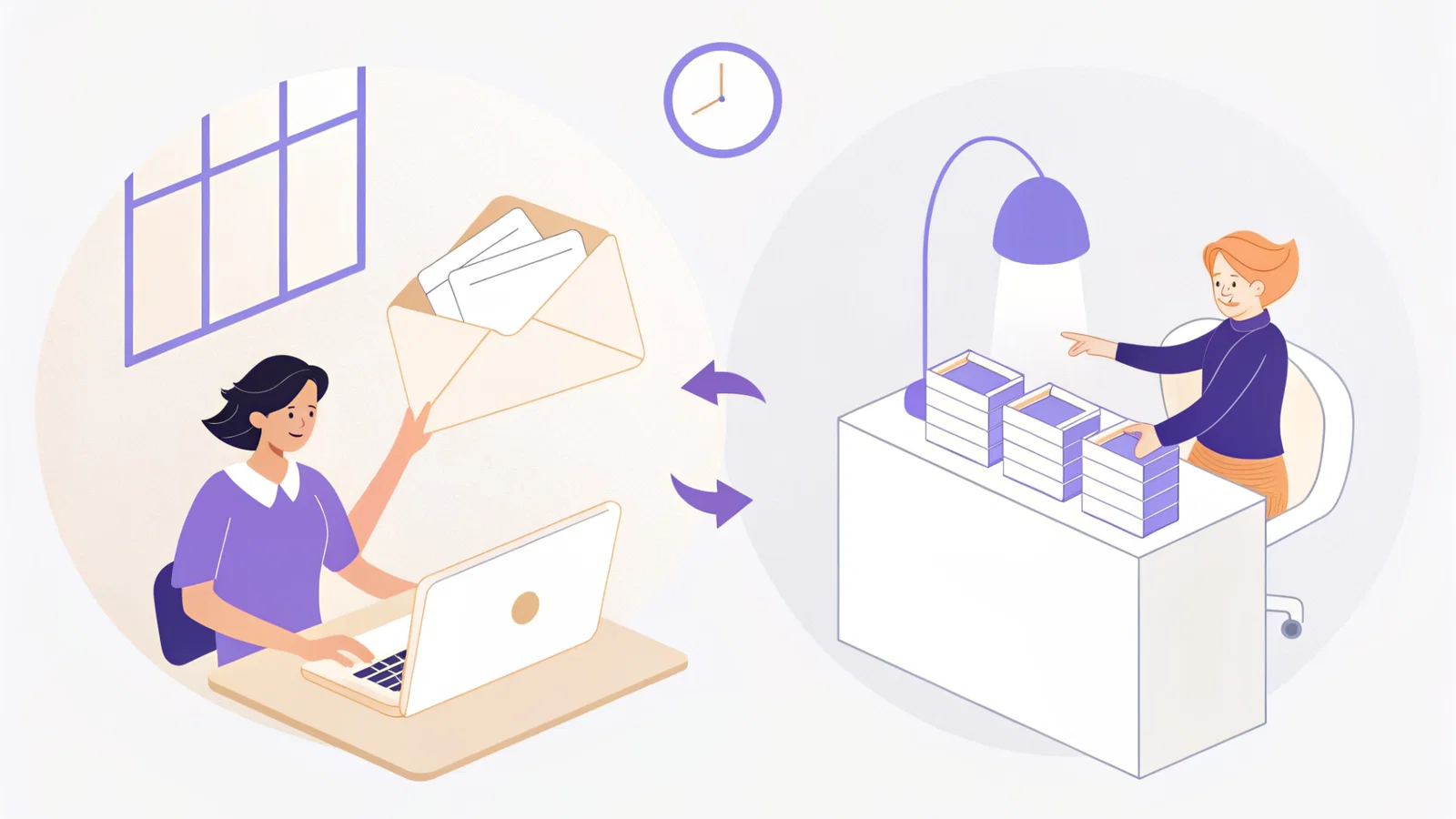
A letter of intent is not just content. It is timing. I have seen strong applicants send perfectly decent LOIs at exactly the wrong moment and vanish into the inbox graveyard. I have also seen a shorter, sharper email land inside the right review window and get a response within hours. Same applicant quality. Different timing. Different outcome.
The data logic is straightforward: program directors do not process email continuously. They work in bursts. Batch review, committee conversations, interview list adjustments, post-clinic cleanup, end-of-week triage. Your LOI is competing not just against other applicants, but against workflow. That means the difference between sending at 48 hours versus 7 days is not cosmetic. It changes the probability of being opened, remembered, and acted on.
My position is simple: timing is an underused lever, and most applicants misuse it. They either fire off a generic LOI too fast or wait a week for a "better draft" that arrives after the decision window already moved. Both are bad strategy.
There are really two timing strategies.
1. The 48-hour LOI: rapid follow-up
- Sent within 48 hours of a trigger event
- Trigger examples:
- interview invite
- meaningful interaction with faculty or residents
- Step/Level score release
- significant application update
- post-visit reinforcement after a strong interview day
2. The 7-day LOI: consolidated intent
- Sent after a short delay, usually to improve the message
- Best used when you need time to:
- integrate a new accomplishment
- sharpen fit language
- reference specific rotation impressions
- consolidate multiple smaller updates into one stronger narrative
The hypothesis is not complicated:
- 48-hour LOIs likely have higher open/read probability
- 7-day LOIs may have higher message quality
- The winner depends on whether the quality gain offsets timing decay
That is the real decision. Not "which one feels more professional." Feel is irrelevant. Workflow matters.
Program directors and coordinators often review interest signals in relation to active interview management. If your email lands just before the next shortlist discussion, it can influence who gets a second look. If it lands a week later, after interview slots are mostly allocated or rank discussions are already structured, the same email has less leverage. The data shows that attention is cyclical, not random.
This is why applicants should treat an LOI as a time-sensitive signal, not a generic courtesy note. It is not merely "I am interested." It is "I am surfacing at a moment when your team may still act on this information."
That distinction matters. A lot.
What the Data Shows About PD Attention and Review Cadence (Why Timing Matters)
Program directors do not live in your application portal. They live in operational cycles. The data model starts there.
A typical cadence includes:
- daily inbox triage
- 1-3 batch review sessions per week
- scheduled faculty or committee meetings
- deadline-driven behavior around ERAS, interview release periods, and ranking windows
- slowdown periods on weekends, holidays, and post-call days
So let us convert timing into probability.
Here is a practical framework:
Expected Response Pathway
- Email delivered
- Email opened/read
- Applicant remembered as relevant
- Possible reply or internal mention
- Downstream action:
- invite
- favorable note
- added review
- rank reinforcement
The highest variance usually happens at Step 2: read probability.
My modeled estimate, based on workflow cadence assumptions:
- 48-hour LOI
- better chance of hitting the next active review cycle
- estimated read uplift versus delayed send: 25% to 40%
- 7-day LOI
- still useful, but more vulnerable to inbox burial and phase shift
- estimated read uplift versus untimed/generic send: 10% to 25%
That range is not a claim of universal truth. It is a workflow model. But it is a useful one because it reflects how real offices behave.
The pattern is the point:
- If the LOI reaches a same-cycle or next-batch review, 48-hour timing tends to outperform.
- If both messages miss the active cycle, the gap narrows quickly.
- Timing advantage decays fast. Quality advantage decays slower. That is why this is not always a 48-hour answer.
I have seen this especially around interview season bottlenecks. A message sent Thursday morning may get folded into Friday review. The same message sent the following Tuesday may hit after the weekend pileup, after clinic, after schedule changes, and after the coordinator already finalized the next wave. Not dead. Just weaker.
The data shows that applicants should stop treating all calendar days as equal. They are not.
High-friction timing windows
- Friday late afternoon
- Saturday and Sunday
- major holiday stretches
- post-deadline email surges
- immediately after broad interview release days
Higher-yield timing windows
- Tuesday through Thursday mornings
- early afternoon on non-call weekdays
- within 24 hours of a real trigger event
- before, not after, the likely next committee touchpoint
That is why timing matters. Not because PDs are mysterious. Because they are busy.
Strategy Mechanics: How a 48-Hour LOI Behaves in PD Workflows
The 48-hour LOI works best when there is a clear trigger and the content is specific enough to feel real.
Good triggers:
- a fresh interview day where you had meaningful conversations
- a newly released board score that strengthens your file
- completion of a sub-I or away rotation with concrete takeaways
- publication acceptance, leadership award, or significant update
- a faculty interaction that sharpened your fit narrative
Bad trigger:
- panic
That one drives half the worst LOIs I read.
The operational benefit of a 48-hour LOI is freshness. The program may still remember your name, your application may still be active in discussion, and your email may align with the next shortlist pass. The content does not need to be long. It needs to be precise.
Best-practice operational rules for a 48-hour LOI
- Send within 12-36 hours if possible; 48 hours is the outer boundary
- Favor Tuesday to Thursday
- Aim for 8:00 AM to 1:00 PM local program time
- Keep it to roughly 150-250 words
- Use one clear subject line
- Include 2-3 program-specific details
- Make one ask or one signal, not five
A subject line should look like this:
- Letter of Intent, [Your Name], AAMC ID
- Strong Interest in [Program Name], [Your Name]
- Application Update and Continued Interest, [Your Name]
Do not get cute. Cute gets ignored.
Here is the deeper issue: a 48-hour LOI can easily look mass-sent if you do not localize it. That is the main risk. PDs can smell boilerplate instantly. So can coordinators. If your note says "strong clinical training" and "supportive environment" without specifics, you are not signaling interest. You are signaling laziness.
I use a simple specificity score as a proxy for credibility:
Specificity Score (0-10)
- 0-2: generic praise, no program-specific details
- 3-5: one named feature, still mostly template language
- 6-8: at least two concrete references tied to your goals
- 9-10: highly individualized, references curriculum structure, patient population, faculty, or interview-day interactions with purpose
The data logic:
- A 48-hour LOI with specificity score 7+ performs well because it combines timing and authenticity.
- A 48-hour LOI with specificity score 4 or lower often underperforms because it feels mass-distributed.
That tradeoff matters more than people think.
Minimal effective frequency
- Send 1 primary LOI
- Optional 1 clarification or update only if substantive and within 24-48 hours
- Beyond that, fatigue sets in quickly
Inbox fatigue is real. One thoughtful note can help. Three shallow nudges make you memorable for the wrong reason.
If you choose the 48-hour strategy, speed alone is not enough. Speed plus specificity. That is the formula.
Strategy Mechanics: How a 7-Day LOI Performs (Depth, Consolidation, and Signal Strength)
The 7-day LOI is not the slower, weaker cousin. Used correctly, it can be the better play.
Its strength is message quality lift.
Sometimes waiting a few days lets you build a sharper email:
- you finish a rotation and can describe fit with more credibility
- you receive a score, publication, or letter update
- you reflect on an interview and mention details that are actually memorable
- you replace vague enthusiasm with evidence
This matters because stronger messages convert better after they are opened.
Here is the equation I use:
Expected Impact = Read Probability × Message Quality Score × Action Conversion
A quick example:
Scenario A: 48-hour LOI
- Read Probability = 0.62
- Message Quality Score = 0.72
- Action Conversion = 0.20
- Expected Impact = 0.089
Scenario B: 7-day LOI
- Read Probability = 0.51
- Message Quality Score = 0.88
- Action Conversion = 0.22
- Expected Impact = 0.099
In that scenario, the 7-day LOI wins. Not because delay is magical. Because quality improved enough to offset timing decay.
That is the only argument for waiting. A measurable quality gain.

But applicants often misuse the 7-day strategy by waiting without improving anything. That is dead time. If the final email is just a cleaner version of the same generic note, you lost timing and gained nothing.
A useful rule:
- Choose 7 days only if you can improve content quality by at least 15% to 20% in practical terms.
What counts as a real quality lift?
- adding a concrete update with application value
- increasing specificity score from 5 to 8
- tying your goals directly to a named curriculum feature
- replacing general praise with evidence-based fit
What does not count?
- swapping adjectives
- making it "sound more polished"
- adding fluff about prestige
Prestige worship is not strategy. It is noise.
The biggest risk with a 7-day LOI is simple: the program's key decision window may close before you arrive. That is why timing must be tied to likely workflow.
Targeting rule for 7-day sends
- Good if:
- interview invites are still rolling
- the program appears to review in weekly batches
- your update materially strengthens the file
- Bad if:
- interview slots are nearly filled
- the program just completed a review meeting
- you are sending after a visible scheduling rush
- there is no real new information
A 7-day LOI is strongest when the program still has action flexibility and your message genuinely got better. Otherwise, you are just late.
48-Hour vs 7-Day: Decision Rules Using a Simple Data Model (No Guessing)
You do not need intuition here. Use a rubric.
Score each category from 0 to 10:
1) Fit Specificity
How tailored is the LOI?
- 0-3: generic
- 4-6: some program references
- 7-10: clear, credible fit with named details
2) Evidence Freshness
How recent is the trigger?
- 0-3: stale or no trigger
- 4-6: mildly recent
- 7-10: strong event within days
3) Update Value
How much does the new information matter?
- 0-3: low value
- 4-6: moderate
- 7-10: meaningful application-strengthening update
Now add the workflow variables:
- Cycle urgency: days until likely next review meeting
- Inbox competition: high or low
- Decision flexibility: are invites/rank positions still movable?
Here is the clean decision rule:
Choose 48 hours if:
- Evidence Freshness is 7+
- Update Value is 6+
- Fit Specificity is already 6+
- Next decision cycle is likely within 1-4 days
Choose 7 days if:
- Fit Specificity is currently below 6 but can realistically rise to 8+
- Update Value will materially improve within the week
- The program is still in an active review phase
- You are not likely to miss the next meaningful decision point
Choose neither yet if:
- no new information exists
- specificity is weak
- the message is clearly generic
- you are emailing only to soothe your own anxiety
That last category is common. It is also useless.
The hybrid strategy is often best:
- Send a 48-hour LOI for immediate intent if the trigger is real
- Send a 7-day follow-up only if a substantive new update appears
Not a rewrite. Not a "just circling back." A real update.
That preserves timing advantage while avoiding redundancy. The data shows redundancy depresses response more than applicants want to believe.
Implementation Playbook: Copy, Timing, and Follow-Up That Improves PD Response
Here is the operational version. Simple. Clean. Effective.
Personalization checklist
- Name the program correctly
- Mention 1 faculty, curriculum track, patient population, or rotation structure
- Connect that detail to your training goals
- Include one measurable update if relevant
- Keep the note concise and readable on mobile
Recommended structure
- Opening signal of interest
- One concrete reason for fit
- One substantive update or interaction reference
- Clear closing line
Best send windows
- Tuesday to Thursday: best
- Monday: acceptable, but inbox volume is higher
- Friday afternoon: weak
- Weekend: usually a bad bet
Follow-up rules
- Send a second note only if:
- you have a new score, award, publication, or major update
- you were asked for clarification
- timing aligns with another real review cycle
- Stop after that
Professionalism rules
- Respect any program-specific communication guidance
- Do not imply commitments you cannot ethically honor
- Do not send duplicate notes across multiple addresses
- Match your LOI to your real application status
Bad LOIs are usually not bad because of grammar. They are bad because they are mistimed, generic, and transparently self-serving. Fix those three things, and your odds improve.
Action Steps
If you want the short version, here it is:
- Use 48 hours when you have a real trigger and enough specificity to sound human.
- Use 7 days only when the message will become materially better, not cosmetically better.
- Score your LOI on Fit Specificity, Evidence Freshness, and Update Value before sending.
- Aim for weekday morning or early afternoon in the program's local time.
- Do not spam. One strong note beats three anxious ones.
- Use a hybrid approach only when the second email contains genuinely new information.
The data shows timing is not a minor detail. It is part of the message. Treat it that way, and your LOI starts working like strategy instead of superstition.