
The most common mistake with letters of intent is not content. It’s timing. People send the right letter at the wrong moment and then wonder why it vanished into the void.
You need a calendar, not vibes.
Below is a stepwise, week-by-week roadmap of what to send and when during interview season—so your letters actually land while programs are paying attention.
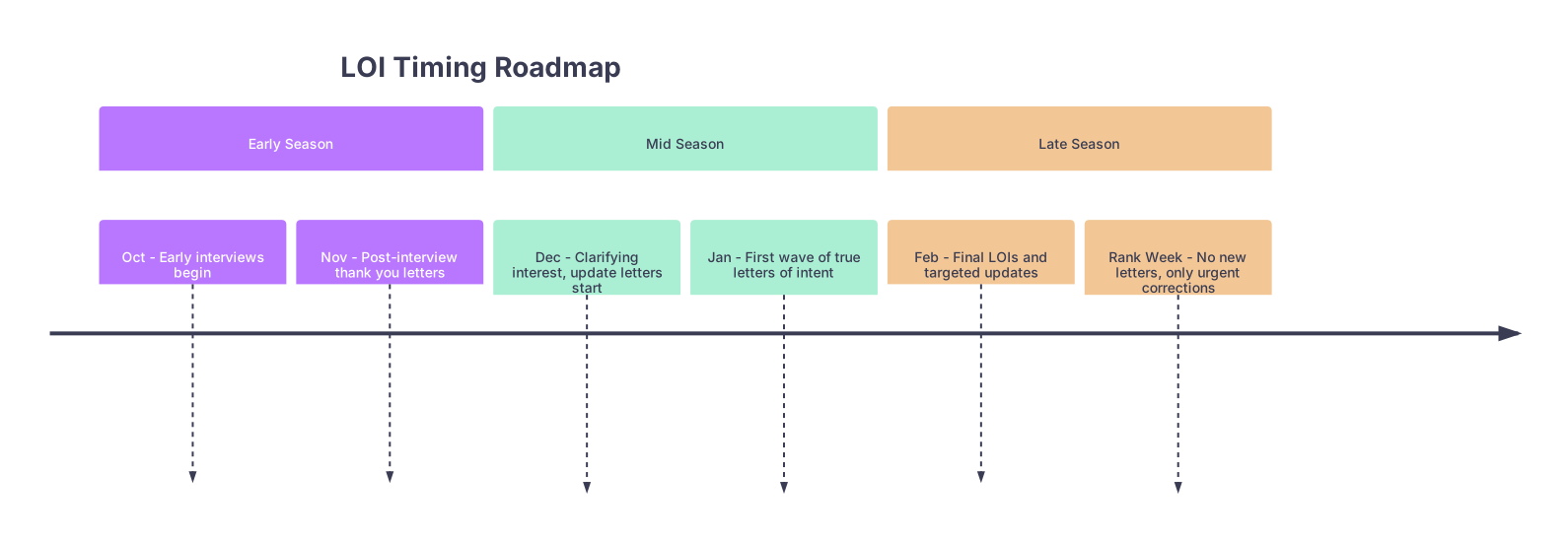
Big Picture: Your LOI Strategy by Month
First, zoom out. Interview season has a predictable rhythm. Your letter timing should match that rhythm, not fight it.
At this stage, understand the hierarchy:
- Thank you email = courtesy, low stakes
- “Letter of interest” = you like them, but not necessarily #1
- True Letter of Intent (LOI) = “If you rank me, I will rank you #1” (only one program should get this)
Most applicants blur these lines and sabotage themselves. You will not.
Phase 1: Pre-Interview & Early Season (October – Mid November)
At this point, you should prepare templates, not send declarations.
1–2 Months Before First Interviews
You’re not sending LOIs yet. You’re building the infrastructure.
At this point you should:
- Draft:
- A thank-you email template (you’ll personalize after each interview)
- A generic “letter of interest” framework (for later)
- A generic “update letter” framework (for later)
- Decide:
- Which programs are plausible LOI targets (maybe your home program, a dream city, or best fit specialty niche)
- How many “strong interest” notes you’re willing to send (typically 3–6)
You’re laying the pipes so later you’re just plugging in details, not writing from scratch in a panic at 1 a.m. on a Monday.
Phase 2: Early Interviews – Thank You Season (Late October – Late November)
Right now, your only “letters” should be thank you emails. Not intent. Not rankings. Gratitude and connection.
At this point you should:
- Send a brief thank-you email within 24–48 hours of each interview day
- Aim for:
- One email to each interviewer (ideal), or
- One consolidated email to the PC/PD mentioning multiple interviewers if individual emails aren’t possible
Your thank-you email should:
- Reference 1–2 specific moments from your conversation (“our discussion about the safety-net population in clinic”)
- Reinforce fit, not ranking (“I could see myself thriving in your tight-knit program”)
What you should not do in November:
- Do not promise they’re your top choice
- Do not send a capital-L “Letter of Intent” to your very first interview because you felt “chemistry”
- Do not mass email every program with the same “you’re my favorite” nonsense
Right now, your main job is to leave a clean impression and not overplay your hand.
Phase 3: Mid-Season Calibration (Early December – Holiday Week)
This is where strategy actually starts. You’ve done several interviews. You have data. Program directors also have data. Everyone is adjusting.
At this point you should start sending early “interest” and “update” notes, not full LOIs.
Early December (Weeks 1–2)
By now you probably have:
- A sense of:
- Top 3–5 programs you’re very excited about
- Programs you liked but need to learn more about
- Some mild anxiety about “letting programs know”
Here’s the structure for this window:
Targeted “Letter of Interest” (low-commitment version)
For 3–6 programs you’re seriously considering but not ready to crown #1.Timing:
- About 1–3 weeks after your interview
- Or early December if you interviewed back in October/early November and haven’t followed up since the thank you
Content (3 short paragraphs, max):
- Paragraph 1:
- Remind them when you interviewed
- Express genuine appreciation
- Paragraph 2:
- 2–3 specific reasons they stand out (ex: “your robust critical care exposure with ECMO experience,” “the depth of addiction medicine training,” “the 4+2 schedule and strong mentorship culture”)
- Paragraph 3:
- Clear but non-binding enthusiasm:
- “Your program remains one of my top choices.”
- “I am very interested in training at your program.”
- Clear but non-binding enthusiasm:
This is not an LOI. No “#1.” No “I will rank you first.” You’re just staying on their radar.
Neutral Update Letters
If something meaningful changed, this is your window.Examples worth updating:
- New first-author publication accepted or in press
- Award, leadership position, or major QI outcome
- Step 2 CK score if it’s strong and not yet available to them
- Completed a sub-I/elective at a related institution with strong evaluations
Timing:
- As soon as the news is official
- If you have multiple items and they’re close together, consolidate into one meaningful update instead of 5 tiny ones
This is your “I still exist and I care about you” phase. No rankings promised yet.
Phase 4: Peak Interview Season – First True LOIs (January)
Now we’re in the serious part. You’re still interviewing, but you’re also building your rank list in your head.
Program directors are starting to meet about rank lists. Your timing matters.
Early January (First 1–2 Weeks)
At this point you should:
Finalize your true #1 (or a shortlist of 2 you’ll decide between within 1–2 weeks).
You cannot drag this into late February and still expect your LOI to matter.Send early “very strong interest” notes to a few top programs
Not yet promising #1, but clearly upgrading from generic enthusiasm.Language:
- “Your program is among my very top choices.”
- “I could see myself ranking your program extremely highly.”
Timing:
- Within 1–2 weeks of your interview date OR
- For earlier interviews, first half of January to re-surface right as ranking discussions heat up
These messages should go to maybe 3–6 programs. Not 15. If you tell everyone they’re “very top,” the phrase means nothing.
Phase 5: Committing Your #1 – The Real LOI (Mid to Late January)
This is the part everyone obsesses about—and usually gets chronologically wrong.
Most programs start building real rank lists from mid-January through mid-February. You want your LOI to land when they’re actively discussing, not after they’ve finished.
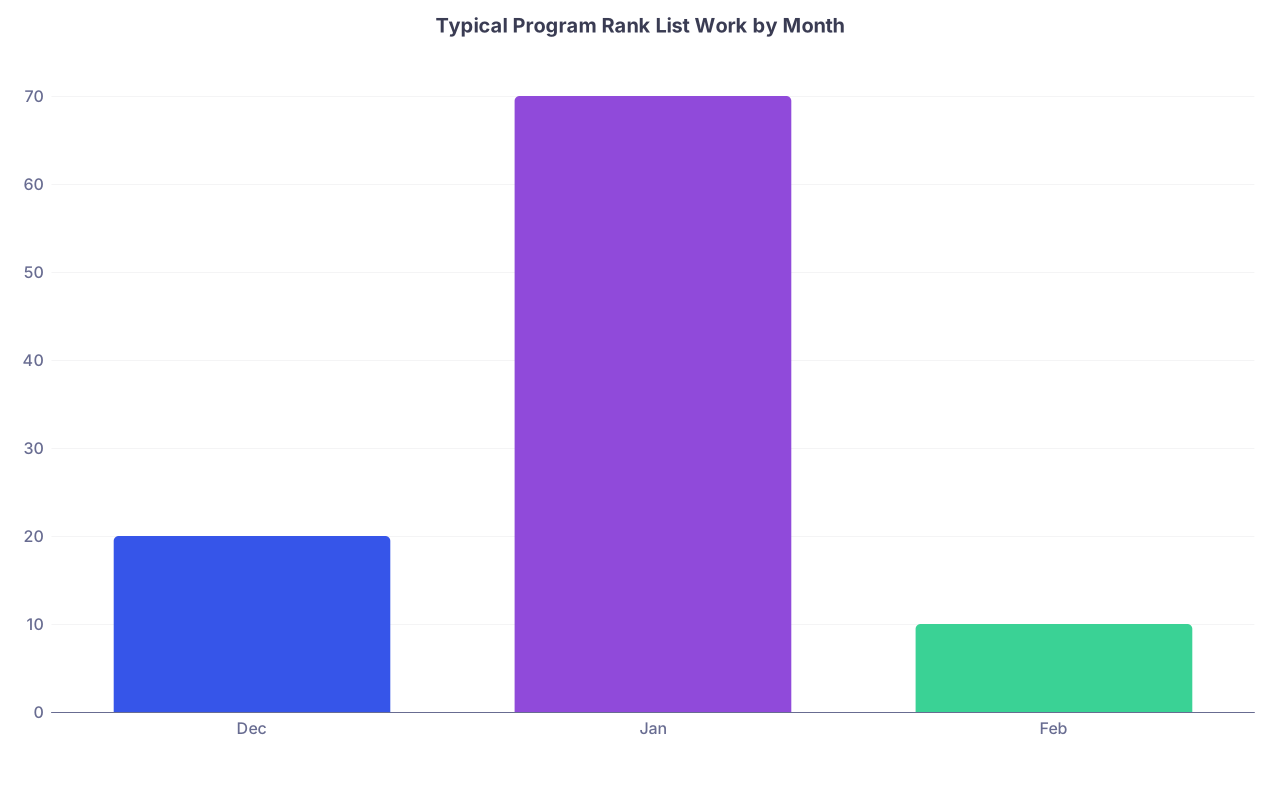
| Category | Value |
|---|---|
| Dec | 20 |
| Jan | 70 |
| Feb | 10 |
When to Send Your One True LOI
At this point you should:
- Choose your single true #1 program. Yes, just one.
- Send your LOI roughly:
- 2–4 weeks after your interview, and
- Ideally between mid-January and early February, depending on when they interview
If you interviewed in:
- November → LOI around mid-January
- December → LOI late January
- Early January → LOI very late January or first days of February
You want to balance:
- Not so early that you change your mind later
- Not so late that their rank meeting already happened
What a True LOI Must Include
This is not a “maybe.” You are making a clear commitment.
A solid LOI hits:
Subject line that signals it clearly
- “Letter of Intent – [Your Name], [Specialty] Applicant”
Explicit #1 language (no games):
- “I am writing to state clearly that your program is my first choice, and I will rank [Program Name] #1 on my rank list.”
3–4 specific, differentiated reasons this program is your top choice:
- Not “great culture” and “strong training.” Everyone says that.
- For example:
- The 1:1 clinic preceptor model
- Specific research mentor you already spoke with
- Your ties to the city and desire to stay long term
- The program’s track record of placing grads into a particular fellowship
Reinforcement of fit
- Tie their strengths to your trajectory:
- “My long-term goal is to work as a clinician-educator, and your dedicated teaching track and formal medical education curriculum align directly with that path.”
- Tie their strengths to your trajectory:
Optional brief update
- One paragraph max if you have new, relevant accomplishments
You send this to:
- Program Director
- CC Program Coordinator
- Optionally CC an APD you had a deep connection with or the chief you worked with—but keep the To/CC list tight.
And then you stop. No second LOI to somewhere else. No “I changed my mind” email if you get spooked. Commit like an adult.
Phase 6: Late Season – Final Touches and Secondary Signals (February)
Programs are closing in on rank submissions. You still have a narrow window to clarify interest with non-LOI messages.
At this point you should:
Early to Mid-February
Send “Very High on My List” notes to 2–4 other top programs
These are for places you genuinely might rank #2–5 and still love matching at.
Language examples:
- “I want to share that your program is among the very top on my rank list.”
- “While I have committed to a single program as my first choice, your program remains one of my highest ranked options.”
Key rule:
- Do not say “#1” or “first choice” to anyone except your LOI program.
- But yes, you can tell more than one program they’re “very high” or “near the top.”
Send final updates only if they’re meaningful
- Big publication? OK.
- Poster acceptance? Maybe, if strong or directly relevant.
- “I shadowed two more shifts” or “Still excited” with no new info? Skip it.
Late February / Rank Week
This is where people do dumb, desperate things. You won’t.
At this point you should:
- Avoid new LOIs or drastic changed promises. Programs are basically done.
- Only email if:
- There’s a major correction to something in your file
- A huge, truly impactful update drops (e.g., grant, major award, national presentation)
- You realize there was a misunderstanding that significantly misrepresented your interest or background
Most of you should send nothing in this final week. Just submit your rank list and walk away.
What to Send to Whom, and When
If you like clear structure, here’s your practical LOI calendar:
| Timeframe | What You Send | Typical Volume |
|---|---|---|
| 24–48 hrs post-interview | Thank-you emails | Every program |
| 1–3 weeks post-interview | Letter of interest (no #1 language) | 3–6 programs |
| Rolling (Dec–Feb) | Update letters (meaningful only) | 1–3 total |
| Mid Jan–Early Feb | One true LOI (#1 program) | 1 program |
| Early–Mid Feb | “Very high on my list” notes | 2–4 programs |
If your interview season is compressed (all in January, for example), you’ll compress these too. But the order stays the same.
A Few Hard Rules So You Don’t Torch Your Credibility
I’ve watched people blow this. Do not be that person.
-
- Program directors talk.
- They remember the applicant who told three places “You’re my #1.”
Don’t send LOIs in November.
- You don’t know enough yet.
- They aren’t ranking yet. Your letter gets buried.
Do not spam monthly “still very interested” emails.
- You become noise.
- 1–2 well-timed, specific communications beat 7 generic ones.
Keep the tone adult.
- No begging. No emotional manipulation.
- Respect that they’re choosing colleagues, not approving a loan.
Know your specialty culture.
- Some specialties (like derm, plastics) are heavier on signaling and networking; LOIs sometimes carry more weight.
- Others (like EM, some IM programs) lean more on standardized metrics and SLOEs; LOIs might be polite background noise.
- But the timeline logic still applies.
Day-by-Day Snapshot for a Typical Interview Month
Let me give you a concrete mini-timeline so you see the rhythm.
Assume you interviewed at Program X on Monday, January 8.
Jan 9–10 (Tue–Wed)
- Send personalized thank-you emails. Short, specific.
Jan 22–26 (2–3 weeks later)
- If Program X is one of your strong contenders:
- Send a brief “letter of interest” reaffirming enthusiasm, with 2–3 specific reasons they stand out.
- If Program X is one of your strong contenders:
By Feb 5–10
- If Program X becomes your clear #1:
- Send your formal LOI with explicit #1 language.
- If Program X becomes your clear #1:
Everything tied to one interview. Simple, predictable, professional.
The Quiet Part: Your Internal Rank List Timeline
All of this fails if you don’t do the internal work on schedule.
At this point you should build and revise your rank list on a schedule:
- End of November – Rough “Top / Middle / Lower” tiers
- Late December – Tentative top 5–8
- Mid January – Clear top 3; choose likely #1
- Late January – Commit #1 and send LOI
- Early February – Lock rough rank order
- Rank Week – Final small tweaks, then submit
If you wait until the final week to seriously think about this, every LOI or interest letter you sent will feel random even to you.
Open your calendar app right now and block 30 minutes this week to do one thing: list your top 5 programs as of today and write down one specific reason for each. That’s the skeleton of your future LOI and interest letters—and it locks your timing decisions onto something real instead of anxiety.