
You are here
It is late January. Interview season is in full swing.
You have:
- 9 interviews done
- 3 more scheduled
- 2 programs you thought were “dreams” that suddenly feel very average in person
- 1 surprisingly great mid-tier program you cannot stop thinking about
Your inbox has slowed. The “maybe more invites will come” optimism is fading. You keep hearing seniors say: “Send a letter of intent to your top program,” but your “top” has changed three times since November.
At this point, mindless loyalty to your September list is a mistake. So is panic-switching every time you have a good pre-interview dinner.
You need a timeline-based, logical reassessment of where your LOI (letter of intent) should go – and when to stop changing your mind.
Let’s walk through it chronologically.
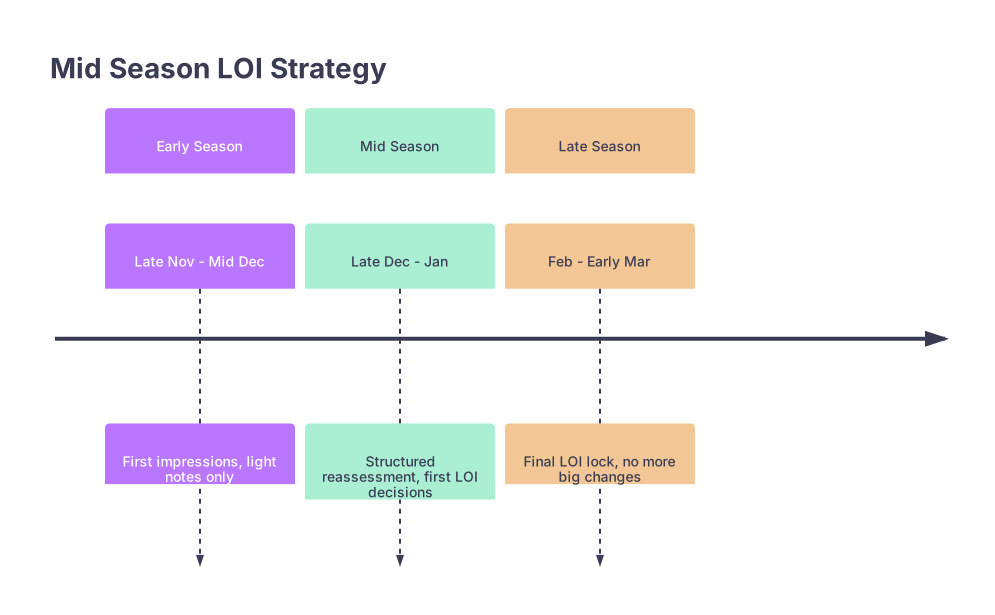
Phase Overview: When You Should Be Reassessing LOI Targets
| Period | Event |
|---|---|
| Early Season - Late Nov - Mid Dec | First impressions, light notes only |
| Mid Season - Late Dec - Jan | Structured reassessment, first LOI decisions |
| Late Season - Feb - Early Mar | Final LOI lock, no more big changes |
At each window, your task shifts:
- Late Nov – Mid Dec: Collect data, do not commit
- Late Dec – Jan: Rank reality check, pick likely LOI target
- Feb – Early Mar: Final update, send definitive LOI, stop tinkering
I am going to break this down with “by week” and “by step” guidance.
Step 1 (Early Season: Late Nov – Mid Dec): Set Up Your Decision Infrastructure
At this point you should not be sending LOIs yet, unless you are in a very fast-moving specialty or an unusually early cycle. But you should be building the system that will keep you from making emotional, last-minute decisions.
Week 1–2 of Interview Season: Build Your Tracker
Make a single source of truth. Spreadsheet, Notion, whatever. Just one place. Minimum columns:
| Column | Purpose |
|---|---|
| Program name | Obvious, but keep consistent names |
| City / region | Lifestyle + support considerations |
| Interview date | For time-weighting recency bias |
| Pre-interview interest (1–5) | How excited you were before visiting |
| Post-interview score (1–10) | Overall gut + structured rating |
| Mentor fit (0–3) | Faculty alignment with your goals |
| Research/procedural fit | Quick note on alignment |
| Training rigor (0–3) | How strong you think training will be |
| Gut feel / “vibe” | 1–2 sentence note only you understand |
At this point you should:
- Fill this out within 24 hours of each interview
- Force yourself to write something concrete: “PD talked about wellness but seemed burned out,” “Residents openly complained about call,” “Secondary to tertiary referral center mix is perfect”
If you are not logging in real time, you will absolutely overvalue the last 2–3 interviews you had. I have seen so many people swear Program A was their #1, then two late, shiny programs show up and completely hijack their ranking because they did not write anything down earlier.
Week 3–4: Define Your Priority Weights Before the Panic
Before mid-season doubt starts, you decide what matters. Not after.
Make yourself assign point weights:
- Location / support system: 0–3
- Academic vs community focus: 0–3
- Research / fellowship pipeline: 0–3
- Procedural or case volume: 0–3
- Culture / resident happiness: 0–3
- Schedule / call burden: 0–3
- “I could see myself here for 3–7 years”: 0–5
Then set your weights once:
Example — you care about fellowship and research:
- Location: 2
- Academic focus: 3
- Research pipeline: 3
- Culture: 3
- Case volume: 2
- Schedule: 1
- “Could see myself here”: 5
Lock it. Do not keep re-weighting after every interview. That is how you rationalize bad fits.
Step 2 (Mid-Season: Late Dec – Early Jan): Reality Check and First LOI Shortlist
By this point, you usually know:
- You are probably done getting the bulk of your invites
- Which programs actually felt like you could train there
- Which places looked good on paper but felt wrong in person
This is your first serious LOI reassessment window.
Late Dec: Build a Shortlist of 3–5 LOI Candidates
At this point you should:
Score each program using your weights
- Multiply each factor by your weight
- Sum to a total out of, say, 25–30
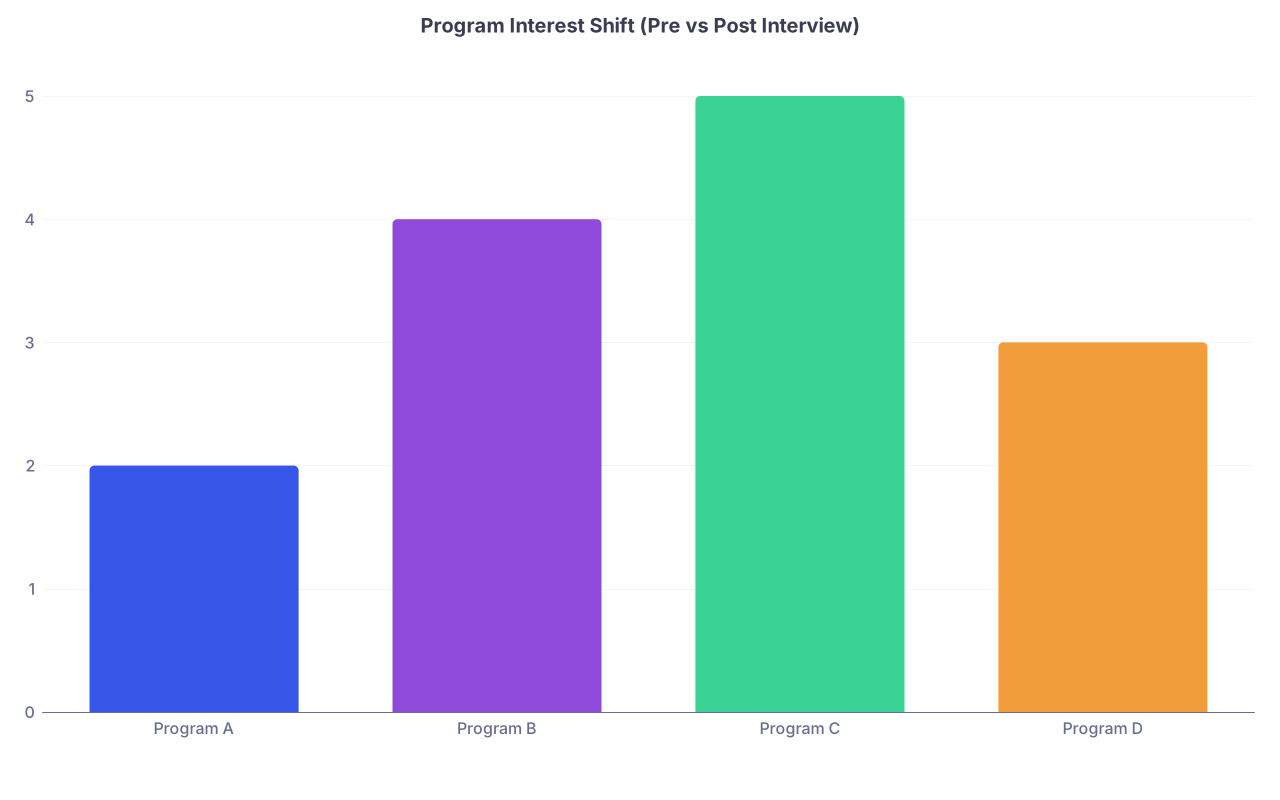
Compare “pre-interview interest” vs “post-interview score”
- Programs that plummeted: drop from LOI consideration
- Programs that rose sharply: promote them
| Category | Value |
|---|---|
| Program A | 2 |
| Program B | 4 |
| Program C | 5 |
| Program D | 3 |
Let me be blunt:
If you went into Big-Name University thinking it was your destiny, and you walked out feeling lukewarm, do not send your LOI there just because of the logo. That is how people end up miserable and stuck.
Your shortlist by the end of December should be:
- 1–2 high-reach / aspirational programs where you felt like you belonged
- 1–2 strong, realistic programs where you had excellent vibes and fit
- Maybe 1 more “wild card” that surprised you in a great way
Early Jan: Filter with Match Probability (Be Honest)
This is where most applicants either get delusional or overly pessimistic. You want neither.
Ask yourself, for each program on your LOI shortlist:
- Did any faculty or PD say things like:
- “We think you would be a great fit here”
- “Please keep in touch” with specific follow-up
- “I hope we see you here in July”
- Did you have:
- Home affiliation or strong away rotation there
- Research with their faculty
- Clear geographic or family ties
Now, cross-reference with competitiveness. For your specialty and your profile, you should know:
- Where your scores / research put you (top, middle, lower range)
- How many interviews you received relative to peers
Create 3 buckets for your LOI candidates:
- Bucket 1: Reach but plausible – dream-ish, but there are signals
- Bucket 2: Strong realistic – alignment + solid interview + reasonable odds
- Bucket 3: Safety-ish but excellent fit – where you would be genuinely happy
Your LOI should almost always live in Bucket 1 or Bucket 2. If your LOI target is “total moonshot, no signal, no connection,” that is fantasy, not strategy.
Step 3 (Mid-Season: Mid–Late Jan): Decide Where the LOI Goes (for Now)
This is the point you are probably at right now.
You have done 70–80% of your interviews. You know your gut top 3–4. Now you have to pick a provisional LOI target.
Week-by-Week Guidance
Week 1 (mid-Jan): Draft Your Provisional LOI
At this point you should:
- Identify which program is currently #1 on your actual, not aspirational, rank list
- Draft an LOI that states clearly:
- They are your top choice
- You will rank them #1
- Why (with specific, program-based reasons, not clichés)
Do not send yet if you still have a few high-priority upcoming interviews that could realistically change your mind. But have the draft ready.
Week 2–3 (late Jan): Apply the “Two-Interview Rule” Before Changing LOI Targets
Your brain overweights the most recent experience. To counter this, use what I call the two-interview rule:
- You only allow yourself to change your “true #1” after you have completed at least two more interviews following the one that dazzled you
- Then you compare that new favorite’s score against your prior #1, side by side, using your weighted system and your notes written within 24 hours of each interview
If, after those two subsequent interviews and a calm review, the new program still wins on:
- Objective scoring
- Gut “could live here” factor
- Training and career alignment
…then it is allowed to dethrone your previous LOI target.
If not, you chalk it up to recency bias and move on.
Step 4 (Late Season: Early–Mid Feb): Lock the LOI and Stop Changing Targets
This is the phase where endless tweaking becomes harmful.
Early Feb: Final Reassessment Window
At this point you should:
- Freeze your interview list – Assume no more major invites
- Recalculate final scores with your original weights
- Put programs into final categories:
- Tier 1: Would be thrilled to match
- Tier 2: Would be happy / satisfied
- Tier 3: Acceptable but not ideal
Now, rank them as if you were submitting your list today. No LOI considerations, just “Where would I actually rather train?”
Your LOI target should be the program at the very top of that honest list.
If it is not, you are lying to yourself, or chasing prestige, or trying to “game” the match. The algorithm does not care about your games. It just reflects your real preferences and the program’s.
Mid Feb: Send the LOI and Commit
Once you have:
- Done all realistically status-changing interviews
- Completed your final scoring
- Chosen your true #1
At this point you should:
- Send one LOI. To one program. Stating clearly:
- “I will rank your program first on my rank list.”
Not:
- “I am very interested and ranking you highly”
- “You are among my top choices”
Those are generic “interest” emails, not LOIs. Do not call something an LOI if it does not actually commit.
How to Handle Changing Your Mind Late (Edge Cases Only)
Yes, it happens. You sent an LOI. Two weeks later, you visit a program that just blows everything up.
I have seen this. It is messy, but let’s be practical.
When It Might Be Justified to Pivot
You consider moving your LOI target only if:
- The new program is dramatically better fit (training, location, culture)
- You had a meaningfully stronger interaction (PD loved you, explicit strong signals)
- Your life circumstances change (partner match, family health, etc.)
Not just: “This place was slightly nicer than I expected.”
If You Pivot: The Least Bad Way
If you are going to change your LOI target after sending one, you have two options, both imperfect:
Silent internal change, no new LOI
- You keep your original LOI on record
- You simply rank the new program #1
- You do not send a second LOI to anyone
- Ethically cleaner than lying twice
Transparent correction (rare, but honest)
- You email the first program: brief, respectful note that your rank list has changed because of [specific life reason or new information], and you will not be ranking them first after all
- Then send a new LOI to your actual #1
Option 2 is extreme and usually overkill. Option 1 is what most rational people do if they end up in this unfortunate corner.
But let me be clear: if you are constantly tempted to pivot your LOI, you did not do the earlier phases of structured reassessment properly.
Where LOIs Fit in the Bigger Picture: Match Algorithm Reality
You are not “gaming” the match with an LOI. You are:
- Clarifying your true top choice
- Giving that program a reason to feel more confident ranking you highly if they liked you
That is it.
Programs vary:
- Some care a lot about LOIs and keep private spreadsheets
- Some barely glance at them
- Some explicitly ignore them
But the match algorithm is stable: it favors applicant preferences. Your actual rank list matters more than any email you send.
So the smart mid-season LOI strategy is:
- Use the LOI to enforce clarity and honesty in yourself
- Use it as one signal among many for the program
- Do not treat it as magic or ignore it completely
Quick Example: A Realistic Timeline Walkthrough
Let me put this into a concrete sketch.
December 5
- You have interviewed at: Midwest State, Coastal Med Center, Metro Academic
- Pre-season “dream” was Metro Academic
- Your post-interview scores:
- Midwest State: 23/30
- Coastal: 27/30
- Metro: 22/30
At this point you should:
Record, do nothing LOI-related yet. Just note that Coastal unexpectedly jumped.
January 10
- Now you have 8 total interviews done
- Your top scores are:
- Coastal: 27
- City University: 26 (interview Jan 3)
- Midwest State: 23
You build your shortlist: Coastal, City University, Metro (for name), and Regional Academic.
You realize:
- You had strong PD interaction at Coastal and City
- Metro interview felt flat, no one remembered you, and the residents looked tired
You drop Metro from LOI consideration. That is the logical move.
January 25
- You have only one more interview left, at a distant but “big-name” program
- Your honest preliminary rank list:
- Coastal
- City University
- Midwest State
You draft an LOI for Coastal but hold it until after the last interview.
February 5
- You did your final interview.
- It was good, not life-changing. You score it 24/30.
You re-run all scores. Coastal stays on top, with the best mix of training, research, geography, and clear enthusiasm from faculty.
At this point you should:
- Send the LOI to Coastal: “You are my first choice. I will rank your program #1.”
- Stop analyzing LOI targets. Your job here is done.
Two Final Guardrails
Do not send multiple LOIs.
If you are emailing three programs that they are all your “top choice,” you are not being strategic. You are just lying and diluting your credibility.Do not let prestige override your own data.
If your structured notes, scores, and gut all point toward a slightly “less famous” program that clearly fits you better, believe your own analysis. You are the one doing the residency, not your CV.
Key Takeaways
- Treat LOI targeting as a timeline process, not a last-minute impulse. Early: collect data. Mid: shortlist. Late: commit.
- Use a structured scoring system and the two-interview rule to protect yourself from recency bias and prestige blindness.
- Send one honest LOI to your true #1 by early–mid February, then stop reshuffling. Your real rank list – grounded in your own priorities – matters far more than any single email.