
The worst LOIs of late January are pointless love letters sent into a vacuum.
You are too late to play the “please notice me” game. But you are right on time to play the signal clarity game—if you do it with precision and timing.
This is your step‑by‑step, late‑January strategy for final letters of intent (LOIs) and key communications before your rank list locks in. I will walk you week by week, then day by day in the final stretch. No fluff. Just what still moves the needle and what is now a waste of time.
Where You Stand Right Now: Late January Reality Check
At this point in the cycle:
- Most programs have completed interviews.
- Many rank meetings are happening now or in the next 2–3 weeks.
- You are juggling:
- Uncertainty about where you stand.
- Confusion about who deserves your “true #1” LOI.
- Anxiety that silence = doom (it does not, always).
Here is the blunt truth:
- A single, clear, credible LOI to your true #1 can still matter.
- Targeted update/interest emails to a very short list of programs can still keep you on their discussion radar.
- Spray‑and‑pray “you are my top choice” messages will hurt you if programs compare notes or your tone sounds copy‑pasted.
Before we time-box actions, you need a structure for your communication strategy.
| Type | Purpose | How Many |
|---|---|---|
| True LOI (#1 program only) | Explicit commitment to rank #1 | Exactly 1 |
| Strong interest email | Signal high ranking, not #1 | 3–6 programs |
| Update-only note | Provide new, meaningful info | As needed (few) |
| Silence | Default for lower priorities | Everyone else |
Late January: Week‑by‑Week Strategy Map
Think in three chunks:
- Week 1 (Late January, ~Jan 22–28): Clarify priorities and draft.
- Week 2 (Very late Jan / early Feb, ~Jan 29–Feb 4): Send key messages.
- Week 3 (Early–mid Feb, ~Feb 5–14): Light follow‑through, finalize rank list logic.
Here is the overall timeline:
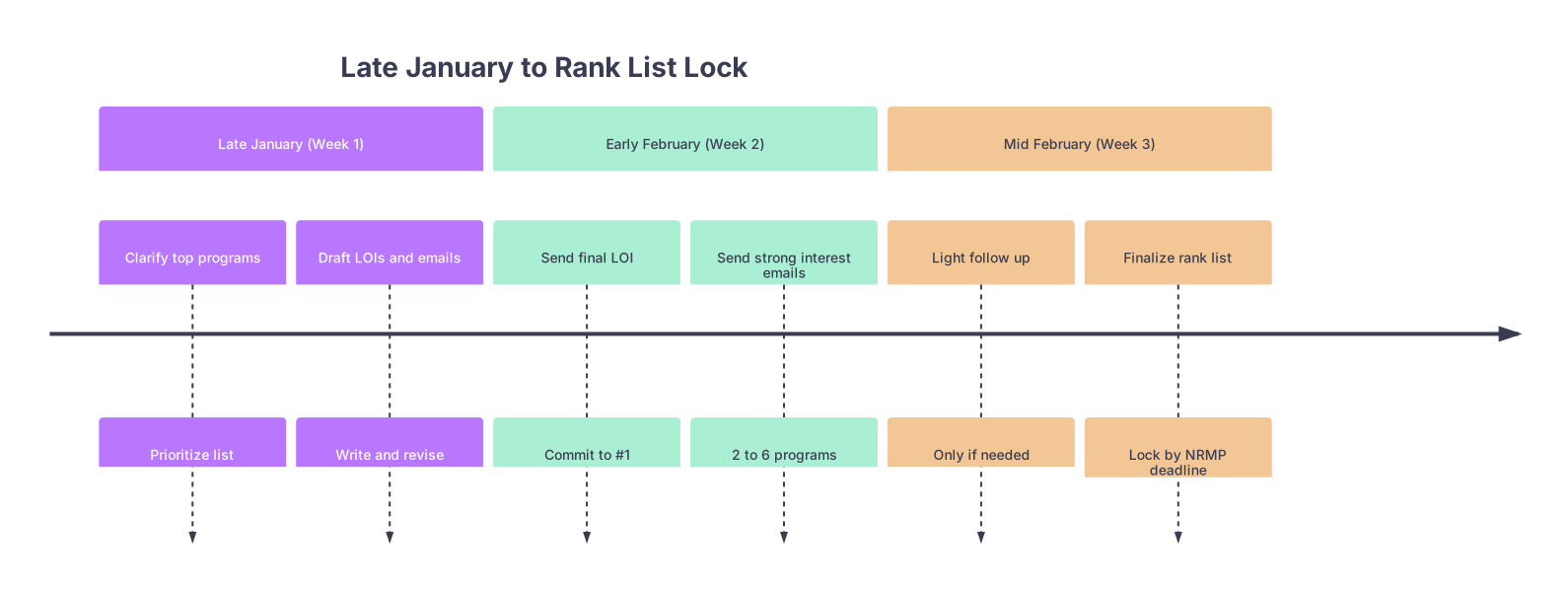
| Period | Event |
|---|---|
| Late January (Week 1) - Clarify top programs | Prioritize list |
| Late January (Week 1) - Draft LOIs and emails | Write and revise |
| Early February (Week 2) - Send final LOI | Commit to #1 |
| Early February (Week 2) - Send strong interest emails | 2 to 6 programs |
| Mid February (Week 3) - Light follow up | Only if needed |
| Mid February (Week 3) - Finalize rank list | Lock by NRMP deadline |
Week 1 (Late January): Decide, Then Draft
Step 1: Lock your internal hierarchy before you start writing
By now you should already have a rough list. Late January is not the time to “see what happens”; it is the time to decide what you actually want.
By the end of this week you should:
Rank your top 10 on paper (for yourself, not ERAS/NRMP yet).
- Force comparisons:
- Program A vs B: which would you choose if both offered you a guaranteed spot?
- Repeat that thought experiment down your list.
- Force comparisons:
Identify three categories:
- Tier 1: Top 3–4 programs where you would be genuinely excited.
- Tier 2: Solid, acceptable programs where you will be fine.
- Tier 3: Safety / “I would go, but would not be thrilled.”
Decide on your true #1.
- You are not sending an LOI until this is clear.
- If you are “tied” between programs, you do not have a #1 yet. Sit with it. Re‑review your notes. Call mentors. Do a 10‑minute gut check: imagine Match Day at each program—who actually makes you relieved?
At this point you should:
Have one clear “true #1” and 3–6 programs where a strong interest email is honest.
Step 2: Draft your true LOI (for your #1 only)
This letter does one thing: clearly states you will rank them #1.
Non‑negotiables:
- Sent to exactly one program.
- Sent to the program director, cc the coordinator if appropriate.
- States in plain language: “I will be ranking [Program] as my number one choice.”
Structure your LOI like this:
Opening (2–3 sentences)
- Re‑identify yourself succinctly: “I interviewed at [Program] on [date]…”
- Clear, direct statement of intent:
- “I am writing to let you know that I will be ranking [Program] as my number one choice in the Match.”
Why them, specifically (2 short paragraphs)
- Name 2–3 distinctive things:
- A rotation or clinic you saw.
- A specific faculty member’s teaching style.
- Culture you noticed: resident camaraderie, patient population, unique call structure.
- Make it sound like you actually remember the day. Because they can spot generic fluff immediately.
- Name 2–3 distinctive things:
Why you fit them (1 short paragraph)
- One or two points that align your background with their strengths:
- “My experience at a safety‑net hospital…”
- “My ongoing QI project in sepsis management aligns with your focus on…”
- One or two points that align your background with their strengths:
Closing (2–3 sentences)
- Reiterate the commitment, briefly:
- “I would be honored to train at [Program] and I will be ranking you first.”
- Professional sign‑off.
- Reiterate the commitment, briefly:
Do not:
- Hedge your language with “strongly considering ranking you very highly.”
- Mention that you are also sending other interest letters.
- Overly gush. Polite, professional enthusiasm is enough.
At this point you should:
Have a clean draft LOI to your #1, not yet sent, and sitting ready for final review.
Step 3: Draft “strong interest” emails (Tier 1 and top of Tier 2)
These are not LOIs. They are:
- Signals that:
- You will rank them highly.
- You remain very interested.
- You are engaged and thoughtful.
These are best suited for:
- Programs you could realistically rank #2–6.
- Places where you had a strong interview day but limited follow‑up.
- Programs that have historically valued communication (smaller, mid‑sized, or community/academic hybrids often do).
Template skeleton:
- Identifying line:
- “I interviewed at [Program] on [date] and wanted to thank you again for the opportunity.”
- Strong interest line:
- “Your program remains one of my top choices, and I intend to rank [Program] very highly on my list.”
- Specific detail:
- One or two aspects you appreciated.
- Brief fit statement:
- One sentence about how your goals match their strengths.
- Professional close.
You need to sound like a serious, reflective adult. Not a fan.
At this point you should:
Have a list of 3–6 programs for strong interest emails, each with a short, program‑specific draft.
Week 2 (Very Late January / Early February): Send with Precision
Now we move from planning to execution. Timing starts to matter.
When to send your true LOI
Ideal window: Late January to early February.
Why?
- Many programs are holding rank meetings from late January through mid‑February.
- You want your LOI on record before or during their early ranking discussions, not after lists are essentially set.
If you are reading this:
- Before Feb 1: You are on time. Send your LOI within the next 3–4 days.
- Feb 1–10: Still potentially useful; send as soon as your decision is firm.
- After ~Feb 10–12: Impact declines; only send if:
- You know the program’s rank meeting is later.
- Or you have had a recent update (new publication, award, major role).
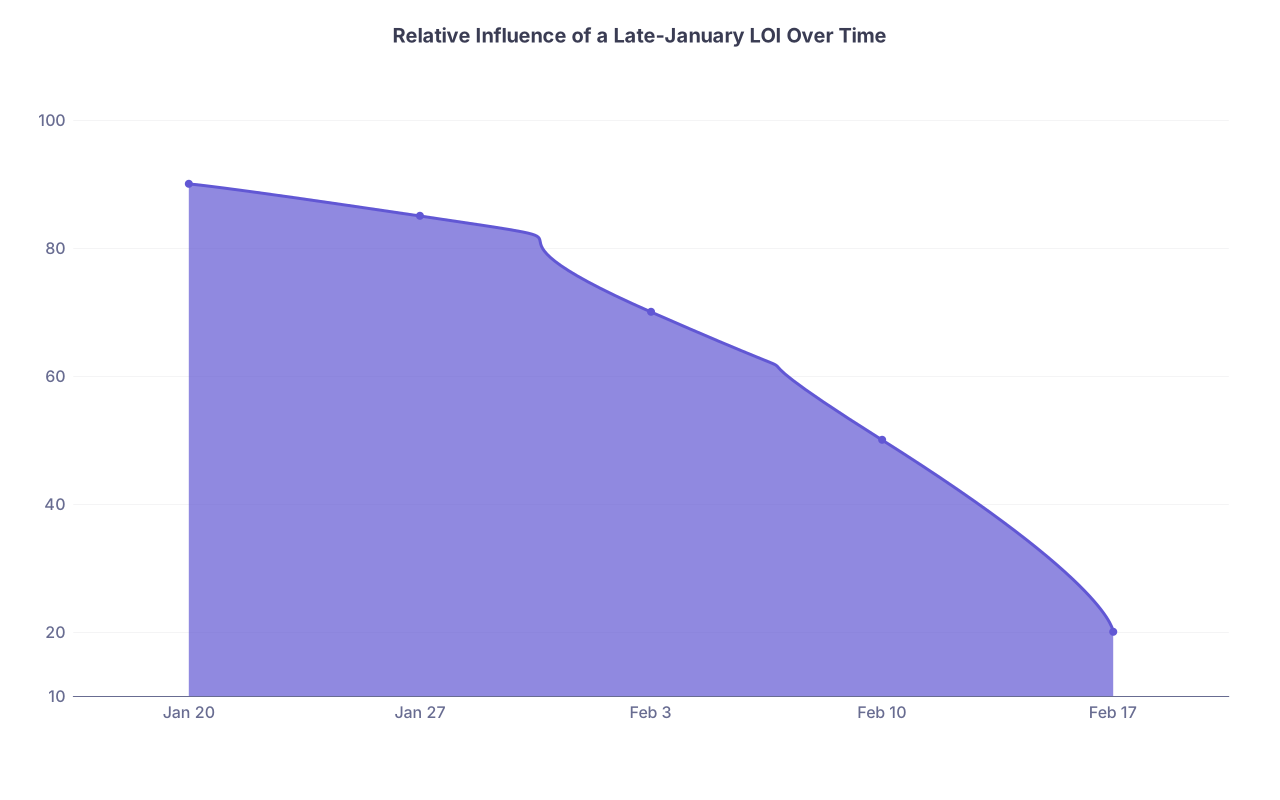
| Category | Value |
|---|---|
| Jan 20 | 90 |
| Jan 27 | 85 |
| Feb 3 | 70 |
| Feb 10 | 50 |
| Feb 17 | 20 |
(Values are conceptual, not real data. The curve is the point: earlier in this window is better.)
At this point you should:
Have sent your LOI to your #1 program, with a date you can remember and document.
When and how to send strong interest emails
Send these within 3–5 days of your LOI, not weeks apart.
Order:
- Day 0–1: Send LOI to #1.
- Day 1–3: Send strong interest emails to 3–6 other top programs.
Why this order?
- You do not want to accidentally oversell elsewhere before you have committed your #1.
- Your #1 deserves the first, clearest signal.
Target audience:
- Program director (PD).
- Possibly associate PD if they were actively involved in your interview.
- CC the coordinator when in doubt; they often route and track messages.
Reasonable subject lines:
- “Continued strong interest – [Your Name], [Specialty] applicant”
- “Thank you and ongoing interest – [Your Name]”
What you should not do this week:
- Send daily or repeated emails to the same program.
- Ask directly, “Where am I on your rank list?”
- State or imply you are ranking more than one program #1. Someone will catch that.
At this point you should:
Have all primary communications (LOI + strong interest emails) sent by the end of this week.
Week 3 (Early–Mid February): Light Follow‑Through and Rank List Logic
Now the focus shifts from outbound emails to your own internal rankings and only very selective follow‑up.
What is appropriate follow‑up?
This late in the game, follow‑up is minimal:
Genuine updates only
- New, significant accomplishments since your interview:
- Accepted publication.
- Major award.
- Match‑relevant leadership role.
- You can send a short update email that:
- States the new item.
- Reaffirms your continued strong interest (or #1 commitment if this is that program).
- Do not send “updates” about small things just to create contact.
- New, significant accomplishments since your interview:
Clarifying questions
- If you have a specific question that affects your ranking decision:
- Call structure.
- Research time for a particular pathway.
- Moonlighting rules (for advanced residents).
- One targeted email is fine. Do not start a back‑and‑forth conversation thread.
- If you have a specific question that affects your ranking decision:
Silence is acceptable
- Many programs simply do not respond in this phase.
- Their silence does not mean you are ranked low. It often just means everyone is swamped.
At this point you should:
Be shifting mental energy from “how do they feel about me?” to “how do I want to rank them?”
Day‑by‑Day: Final 10 Days Before Rank List Certification
Assume rank lists are due in late February. Here is how to use the final 10 days intelligently.
Day 10–8: Reality check and consolidation
- Pull out:
- Your interview notes.
- Any post‑interview communications.
- Your initial “gut ranking” from late January.
- For your top 8–10 programs, write one sentence each:
- “I want to train here because ___.”
If you cannot complete that blank with something specific, that program probably does not belong at the top.
At this point you should:
Have a clean, draft rank order you could submit if forced to, even if it is not perfect.
Day 7–5: Stress test your ranking
Use three simple tests:
Regret test
- For each adjacent pair (Program A vs B):
- “If I match at B and never get to A, will I feel real regret?”
- If yes → A should be above B.
- For each adjacent pair (Program A vs B):
Life logistics test
- Quick, cold look at:
- Cost of living.
- Partner/family constraints.
- Visa considerations if applicable.
- Do not ignore these in the name of prestige.
- Quick, cold look at:
Future self test
- “Future me, on July 1 intern year, where would I actually be happier to wake up?”
If those tests consistently contradict your existing order, adjust.
At this point you should:
Have a ranking that makes sense emotionally and practically, and is at least 80–90% final.
Day 4–3: Technical sanity check and last‑chance updates
NRMP / Match portal check
- Confirm:
- You can log in.
- Your account shows your correct specialty track(s).
- You know the exact certification deadline (date and time, including time zone).
- Confirm:
Program list reconciliation
- Confirm:
- Every program you care about is listed correctly (prelim vs categorical, etc.).
- No duplicates, no missing programs.
- Confirm:
Last possible update email (if truly significant)
- This is your “break glass in case of real news” window.
- Only use it for:
- Big publications or awards.
- Genuine program‑defining information that might raise your rank in their discussion.
- If used, keep the email short and not needy.
At this point you should:
Be functionally done with communication unless something dramatic changes.
Day 2–1: Final certification
This is not the moment for new LOIs. That ship has sailed.
Your job:
- Re‑read your rank list once. Slowly.
- Ask yourself:
- “If I match at my #1, will I be happy?”
- “If I match at my #2 or #3, will I be at peace?”
- If the answer is yes, you are ready.
Then:
- Certify your list at least 24 hours before the deadline.
- Take a screenshot or note the confirmation.
At this point you should:
Have a certified rank list and zero pending communications.
What Not To Do in Late January and February
You are tempted to over‑optimize. Do not. These are common mistakes that backfire:
- Sending multiple LOIs claiming #1 to different programs
- Programs talk. Faculty move. Coordinators forward emails. I have seen PDs share screenshots at national meetings.
- Mass‑mailing generic “you are a top choice” to 20+ programs
- Transparent. Desperate. Useless.
- Writing emotional, oversharing LOIs
- This is a professional process, not a diary.
- Asking programs to reveal their rank list
- Ethical violation red flag. Also awkward.
- Trying to negotiate
- This is not a job contract negotiation. The algorithm does not care how many emails you sent.
Use LOIs and interest emails as fine‑tuning tools, not as a Hail Mary to overturn a weak application.
Quick Reference: Late‑January LOI Strategy at a Glance
| Time Window | Action | Max Volume |
|---|---|---|
| Late Jan (Week 1) | Decide true #1, draft LOI | 1 LOI draft |
| Late Jan / Early Feb | Send LOI to #1 | 1 sent |
| Same window | Send strong interest emails | 3–6 programs |
| Early–Mid Feb | Send true updates only | Few, targeted |
| Final 10 days pre-deadline | No new LOIs, finalize rank list | 0 new LOIs |
Visual: Your Communication and Ranking Flow

| Step | Description |
|---|---|
| Step 1 | Clarify top programs |
| Step 2 | Choose true number one |
| Step 3 | Draft and send LOI to #1 |
| Step 4 | Identify 3 to 6 high interest programs |
| Step 5 | Send strong interest emails |
| Step 6 | Monitor for any major updates |
| Step 7 | Refine personal rank list |
| Step 8 | Technical check in NRMP |
| Step 9 | Certify rank list before deadline |
FAQs
1. What if I already told more than one program they were my “top choice”?
Then your priority now is damage containment and future integrity.
Do not send any more #1 LOIs. For programs where you previously used fuzzy language like “top choice” or “top program,” you can still send a clarifying email if you want:
- “I remain very interested in [Program] and plan to rank you very highly.”
But if you explicitly told more than one program they were your number one, you do not fix that with more email. You fix it by not repeating the mistake in future cycles and by being precise now: send exactly one, unambiguous LOI going forward and let the rest stand.
2. Does a LOI guarantee a higher spot on a program’s rank list?
No. And anyone who tells you it does is lying or naïve.
A well‑timed, sincere LOI can:
- Nudge a borderline applicant into a discussion.
- Break a tie between similarly ranked applicants.
- Reinforce interest at programs that care about “commitment to our location.”
But:
- It does not override weak interview performance.
- It does not force a program to rank you to match.
- It is one small signal among many.
Your real leverage remains: your entire application, your interview, and how you build your own rank list.
Today, your concrete next step is simple:
Open your personal rank spreadsheet, circle your true #1, and start a precise, single LOI draft that clearly commits to ranking them first.