
It’s mid-January. You just left a residency interview that felt… different. The chief resident said, “We’d love to have you here.” You clicked with the PD. You can actually picture yourself in that call room.
On the train back, your phone buzzes with a GroupMe chat about “LOIs” and “updates” and “thank-you etiquette.” Somebody claims you have to send a letter of intent in 24 hours or you’re done. Somebody else says LOIs are pointless.
Here’s the truth: your communication does matter between interview day and rank list certification. But timing, content, and honesty matter much more than volume.
I’m going to walk you through it chronologically: from 24 hours pre‑interview all the way to rank list lock. At each point: what to send, what not to send, and when silence is actually the smart move.
Big Picture: What Programs Actually Notice
Let’s set the frame before we get timeline‑nerdy.
Programs notice:
- Professional, timely thank‑you notes
- Clear, honest top choice signals (to one place)
- Concise, relevant updates
- Red flags: spammy emails, copy‑paste fluff, blatant lying (“You are my #1” to five programs)
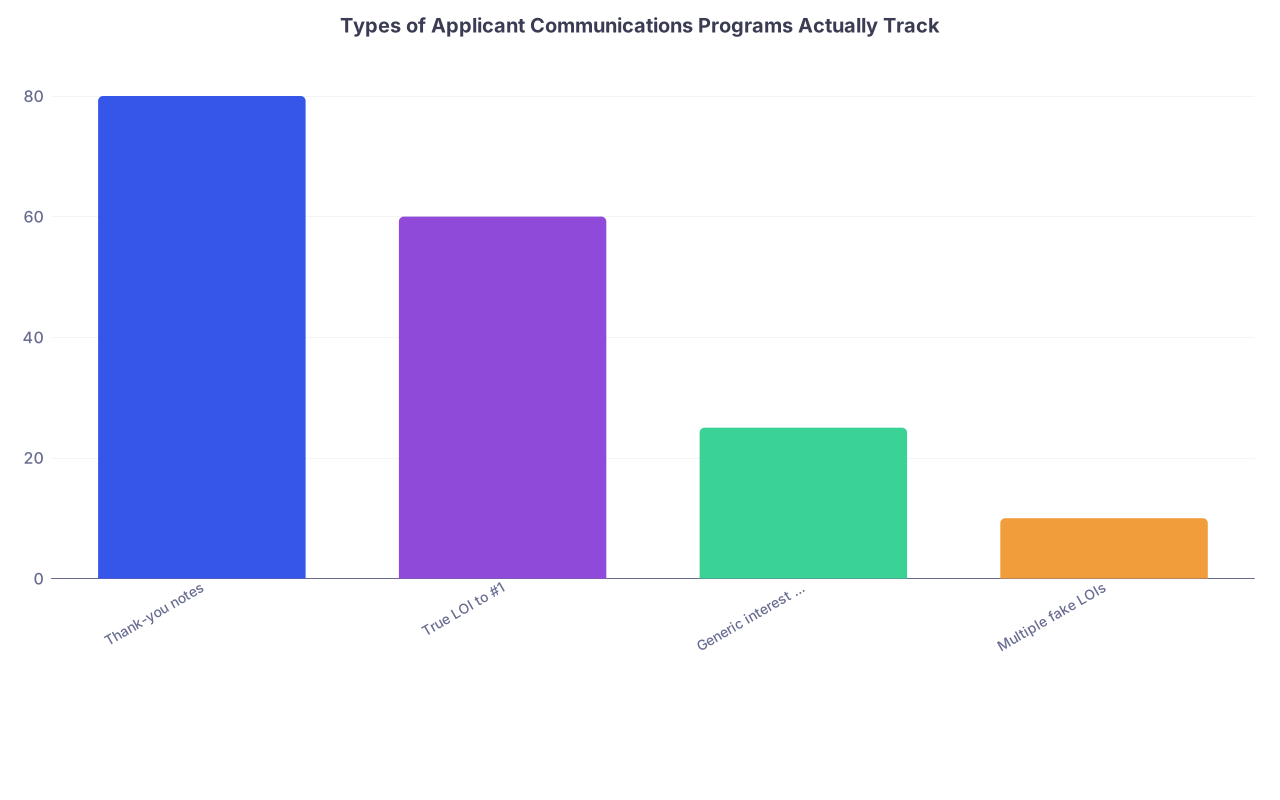
| Category | Value |
|---|---|
| Thank-you notes | 80 |
| True LOI to #1 | 60 |
| Generic interest emails | 25 |
| Multiple fake LOIs | 10 |
Those numbers aren’t perfect, but they’re directionally right based on what PDs tell residents over lunch. Most places:
- Track gratitude and professionalism.
- Make note of one clear LOI.
- Do not change rank lists for every “this is my strong interest” email.
So your job is signal, not spam.
Phase 1: Interview Day −1 to +2 Days
Goal: Professional closure, lay groundwork. Not lobbying.
At this point you should be:
- Focused on the actual interview, not scheming LOI language.
- Gathering details so any later LOI is specific and believable.
Day −1: Prep for future communication
Before interview day:
- Create a simple doc or note template where you’ll later jot:
- PD name and key points from their talk
- Residents you clicked with
- Program specifics that matter to you (curriculum quirks, research, patient population)
- Draft a generic thank‑you note skeleton you can customize (saves time when you’re exhausted afterward).
You’re not writing the LOI yet. You don’t know your #1 before you’ve actually seen all the programs. Or you shouldn’t.
Interview Day: Capture details in real time
During interview day, right after each interview block, scribble quick bullets:
- One thing that stood out about the program
- One personal interaction you might reference later
- Any phrase someone used that stuck with you (“We really protect your education,” “We’re a resident‑driven service,” etc.)
These become your raw materials. Good LOIs are specific. Bad LOIs read like ad copy.
Days 0–2: Thank-you notes window
Within 24–48 hours after the interview:
You send thank‑you notes, not LOIs.
Minimum baseline:
- PD/Chair (if you met them)
- Your main interviewer(s)
- Program coordinator (optional but smart; they run everything)
Content guidelines:
- 3–6 sentences. No essays.
- One specific detail from the conversation or day.
- No promises you cannot keep.
Example skeleton:
Dear Dr. Smith,
Thank you for the opportunity to interview with the XYZ Internal Medicine Residency on January 14. I especially appreciated our discussion about resident autonomy in the ICU and your emphasis on developing confident, independent decision-makers.
The combination of strong clinical training at County Hospital and the opportunity to work with underserved patients aligns strongly with how I hope to practice. I’m very grateful for your time and for learning more about the program.
Best regards,
[Name], [AAMC ID]
What not to do in this window:
- Don’t say “You are my top choice” to anyone. You haven’t seen all your interviews yet.
- Don’t ask “Where will I be on your rank list?” Ever.
- Don’t send the same generic paragraph to every program. They can tell.
Phase 2: Post‑Interview Month (First 2–4 Weeks After)
Goal: Keep doors open, gather information, do light signaling
This phase usually runs from roughly late November–early February, depending on specialty.
At this point you should be:
- Tracking your impressions in a spreadsheet or notebook.
- Starting to see a top tier of 2–5 places emerging.
- Communicating occasionally, not constantly.
Weeks 1–2 Post‑Interview: Light updates and clarifications
If something meaningful changes, you can send a brief update. Examples:
- New publication accepted or major poster presentation
- Step 2 score released and is significantly stronger than Step 1
- New leadership role or award
Timing:
- 1 update email per program, max, unless they explicitly invite more.
- Send between 1–3 weeks after interview. Not the same day.
Content skeleton:
- 1–2 sentence thank‑you reminder
- 1–3 bullet points of real updates
- Close with “I remain very interested in [Program] and look forward to finalizing my rank list.”
That’s it. You’re not promising anything yet. You’re just staying on their radar.
Watch for program‑specific policies
Some programs explicitly say:
- “We don’t track post‑interview communication.”
- Or “Please don’t send LOIs or updates; they will not affect ranking.”
If they say this, believe them. At those places:
- Thank‑you notes are fine.
- Major factual updates might still be okay if you keep it short.
- LOIs and repeated “just checking in!!” emails make you look like you didn’t read directions.
Phase 3: Rank List Shaping (4–6 Weeks Before Rank Deadline)
Goal: Decide your true #1, and plan your single LOI
This is the part everyone wants to skip to. Don’t.
At this point you should be:
- Done interviewing or very close to it.
- Realistically assessing where you would be happiest if they all ranked you first.
Step 1: Build your honest internal rank draft
- Make your own list before thinking about competitiveness:
- Where would you be happiest if match was guaranteed? That’s the real #1.
- Then sanity‑check:
- Don’t game the algorithm by moving “safety” programs up artificially. That’s how people end up miserable.
- Identify:
- Clear #1
- Tier of programs you’d still be happy at
- Lower tier that’s more “I can tolerate this”
| Tier | Example Criteria |
|---|---|
| Clear #1 | Location + culture + training all ideal |
| Strong Tier | Would be happy, minor trade-offs |
| Middle Tier | Solid training, some lifestyle concerns |
| Backup Tier | Would go if needed, not excited |
Your LOI goes to the clear #1. Not the place you think is “most realistic.” The algorithm rewards your honest preferences.
Step 2: Decide your LOI timing
You want your LOI to land when:
- Programs are actively working on rank lists
- But before they’ve finalized them
For many specialties:
- Rank deadline is late February / early March.
- Programs start serious rank meetings 2–4 weeks before that.
So optimal LOI window:
- Roughly late January through mid‑February for most DR/IM/EM/etc.
- Specialty‑specific, so ask your residents or advisors how your field usually runs.
Phase 4: The Actual LOI (Letter of Intent)
Goal: One clear, honest, specific signal to your #1 program
This is where people either help themselves or blow credibility.
At this point you should be:
- Crystal clear on your #1 program.
- Accepting the fact that you will not send this same promise to anyone else.

| Step | Description |
|---|---|
| Step 1 | Finish Interviews |
| Step 2 | Draft Personal Rank List |
| Step 3 | Revisit notes and talk to mentors |
| Step 4 | Check program communication policy |
| Step 5 | Skip LOI, send brief interest email |
| Step 6 | Send single LOI to #1 |
| Step 7 | Clear number one? |
| Step 8 | LOIs allowed? |
LOI core rules
Only one true LOI.
- “You are my first choice and I will rank you number one.”
- You don’t say that to two programs. Ever. People talk. PDs know each other.
Address it to the PD.
- CC the program coordinator.
- Optional: CC APD you connected with strongly.
Keep it one page max.
- Realistically 3–6 short paragraphs. This isn’t a personal statement.
LOI structure
Opening: Direct and honest (no coy language)
- State that you’re writing a letter of intent.
- State clearly they’re your top choice.
Middle: 2–4 program‑specific reasons
- Clinical training structure
- Culture / resident support
- Research or fellowship pipelines that actually match your plans
- Geographic or family reasons (if real, not fabricated)
You‑specific angle
- What you bring that fits their vibe (teaching, QI, languages, underserved experience).
Closing: Polite, no demands
- Reaffirm intent.
- Thank them, again.
Example core line (no fluff):
I am writing to share that the ABC Internal Medicine Residency is my unequivocal first choice, and I will be ranking your program number one.
Avoid hedging phrases that sound like you’re trying to bluff multiple programs:
- “You are one of my top choices”
- “I intend to rank you very highly”
- “I could see myself ranking you #1”
Those are strong interest emails, not LOIs.
Phase 5: Strong Interest Notes to Other Top Programs
Goal: Show genuine interest without lying
You have a #1. You still like 2–4 other places a lot.
At this point you should be:
- Sending different messages to them than to your #1.
- Being honest about your intent without saying “number one.”
What you can say:
- “Your program is among my top choices.”
- “I will be ranking your program highly.”
- “I would be thrilled to train at [Program].”
These carry some weight but do not cross into LOI territory. Programs understand the code.
Timing:
- Same general window as LOI (2–4 weeks before rank deadline).
- Each program gets 0–1 of these emails. No weekly check‑ins.
Content:
- Similar structure to LOI but shorter (1–3 paragraphs).
- Focus on specifics you liked and how you’d fit.
- No promise language.
Phase 6: Final 7–10 Days Before Rank Deadline
Goal: Lock your list, avoid last‑minute panic emailing
This is where people do dumb things.
At this point you should be:
- Done sending any major communication.
- Re‑reading your list for you, not for “strategy.”
Day −10 to −5: Quiet review and sanity check
You:
- Review notes from each program.
- Revisit your LOI and the promises you made.
- Confirm your #1 still feels right. If it doesn’t, that’s a problem—you shouldn’t have sent the LOI so early.
Do not:
- Send a second LOI to someone else.
- Try to “revoke” your LOI in writing because you changed your mind casually. That burns bridges.
If something major changed (truly major: partner got a job elsewhere, family crisis, etc.), talk to a trusted advisor before you email anyone. You might simply adjust your rank list and accept that your signal doesn’t match your final preference anymore. Not ideal, but also not the end of the world.
Day −5 to −1: Lock and leave it alone
Once your rank list feels right:
- Certify it.
- Close the ERAS/NRMP tab.
- Stop reading anonymous Reddit threads about “late LOI strategies.”
Last‑minute “just checking in to reiterate my interest” emails rarely change anything. Programs are in rank meetings; they’re not rewriting the list because of a 3‑sentence email from someone they already interviewed.

What About After the Rank List Deadline?
Short answer: you’re done. The game is over.
- LOIs after the deadline are meaningless.
- Trying to “update” programs is just noise.
- At that point, your energy is better spent preparing for Match outcomes and planning contingencies.
Common Mistakes on the LOI Timeline (And How to Avoid Them)
Sending an LOI before finishing all interviews
- You fall in love early, send an LOI, then like a later program better.
- Fix: Wait until at least 80–90% of interviews are done before promising anything.
Multiple LOIs
- PDs absolutely talk. Your reputation follows you into fellowship applications.
- Fix: One LOI. Several strong‑interest emails if you want. That’s it.
Walls of text
- PDs are reading these at 11 pm after a full clinic or OR day.
- Fix: Short, structured, specific. No life story.
Generic buzzword soup
- “Your excellent clinical training, diverse patient population, and supportive environment…” (this describes 80% of programs)
- Fix: Use details only a real interviewee would know—particular rotations, conferences, residents’ comments.
Ignoring explicit “no communication” policies
- You think you’re the exception. You’re not.
- Fix: Read the email and website. If they say no LOIs, respect it. Your professionalism is the impression they’ll remember.
Quick Timeline Snapshot
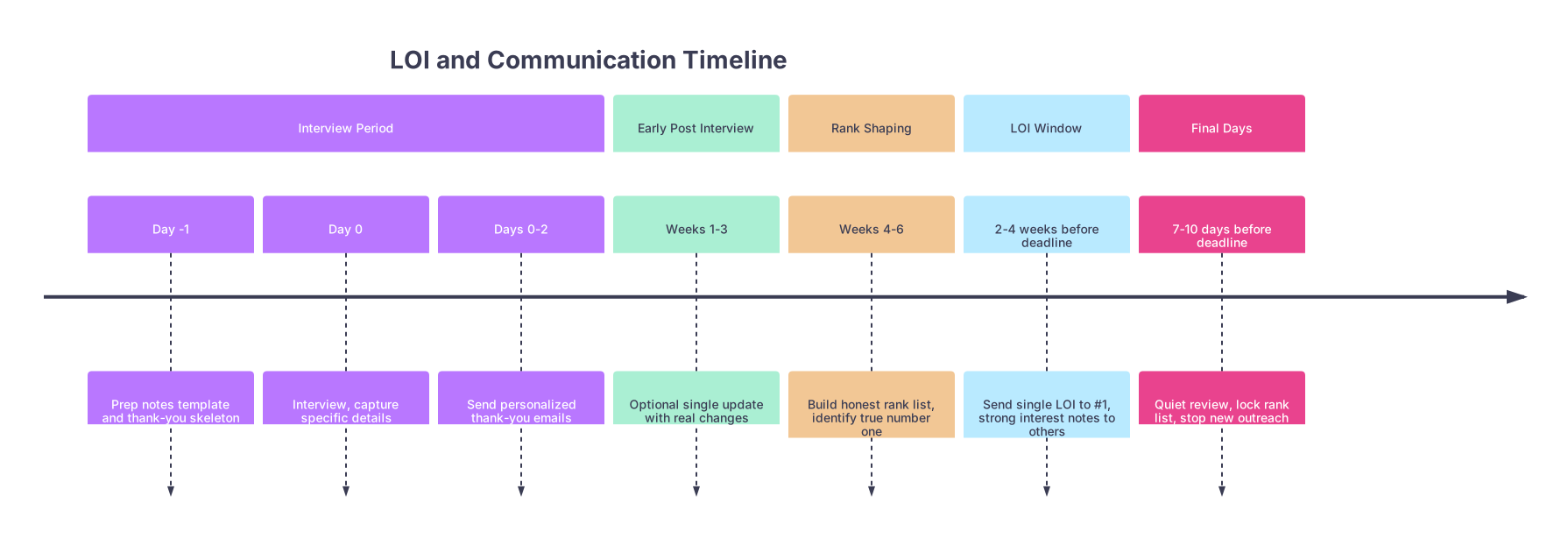
| Period | Event |
|---|---|
| Interview Period - Day -1 | Prep notes template and thank-you skeleton |
| Interview Period - Day 0 | Interview, capture specific details |
| Interview Period - Days 0-2 | Send personalized thank-you emails |
| Early Post Interview - Weeks 1-3 | Optional single update with real changes |
| Rank Shaping - Weeks 4-6 | Build honest rank list, identify true number one |
| LOI Window - 2-4 weeks before deadline | Send single LOI to #1, strong interest notes to others |
| Final Days - 7-10 days before deadline | Quiet review, lock rank list, stop new outreach |
FAQ (Exactly 2 Questions)
1. Does a letter of intent actually change how programs rank me?
Sometimes. If you’re already in a program’s “middle/upper middle” bucket, a clear, honest LOI can nudge you up within that band, especially at smaller programs where PDs know applicants more personally. It will not usually drag you from the bottom of the list to the top just because you said “you are my #1.” Think of it as a tiebreaker, not a magic spell.
2. What if my preferences change after I send a letter of intent?
It happens. That’s why I push you to wait until you’re almost done interviewing. If your ranking changes for serious reasons, you can quietly adjust your rank list and accept that your signal no longer matches your final choice. I would not send a “just kidding” email; that only damages your professionalism. Use it as a reminder next time (for fellowship, jobs) to send intent letters later, when you’re more certain.
Key points to carry with you:
- One true LOI to your real #1 program, timed 2–4 weeks before rank deadline.
- Specific, concise, honest communication beats frequent, generic noise.
- The algorithm rewards your true preferences—align your LOI and your rank list with where you’d actually want to train.