The biggest mistake applicants make after interviews is silence.
Programs remember the people who close the loop quickly and professionally. In the first 24 hours after an interview, a short, sharp “mini-LOI” style follow-up can nudge you from “good” to “we should talk about this person again.”
Here’s how to handle that 24-hour window step by step.
0–1 HOURS AFTER THE INTERVIEW: DO NOT TOUCH YOUR EMAIL YET
At this point you should not be writing anything.
Your brain is buzzing. You’re replaying your awkward joke, that one resident’s comment about night float, the PD’s question about AI in medicine. You’re not objective yet, and rushed, emotional emails read exactly like that.
In the first hour:
Capture raw details, not polished prose.
Grab a notebook or your phone and jot:- Faculty you met (names + roles): “Dr. Ramirez – PD, pulm/crit”
- Unique things they said: “Emphasis on resident autonomy early PGY-2”
- Specifics about the program: “Weekly M&M run by PGY-3s”, “Dedicated AI in EMR QI track”
- Anything personal you connected on: “Both did undergrad in Texas”, “Talked about rural telehealth”
Mark your genuine interest level.
Be honest with yourself. Use a 1–3 scale:- 3 = “I could absolutely see myself here”
- 2 = “Solid. In the mix, not top”
- 1 = “Probably not ranking highly unless things change”
This matters because your tone in a mini-LOI should match your actual enthusiasm. Fake “You’re my #1” vibes are obvious.
Stop. Walk away.
Take 30–60 minutes. Eat. Commute home. Call a friend. Whatever. Just don’t send anything yet.
1–3 HOURS POST-INTERVIEW: DECIDE IF THIS DESERVES A MINI-LOI-STYLE FOLLOW-UP
At this point you should decide: is this program “signal-worthy” in your inbox?
The 24-hour follow-up I’m talking about is not a generic “thanks!” email. It’s short, targeted, and strategic—a mini letter of intent that says:
- “I understand who you are.”
- “Here’s specifically why we fit.”
- “You’ll hear from me again if I decide you’re a top choice.”
You don’t send that to all 30 programs.
Triage your programs
Use a simple filter:
Tier A (Top 3–5 realistic programs)
You absolutely send a mini-LOI-style follow-up within 24 hours. No question.Tier B (Strong but not top)
You send professional thank-you notes (lighter, less committal) within 24–48 hours, not full mini-LOIs.Tier C (Backup / not likely to rank high)
You can still send brief thank-you notes, but do not waste emotional energy crafting faux-commitment language.
| Tier | Interest Level | Follow-Up Type |
|---|---|---|
| A | Possible top choice | Mini-LOI style email |
| B | Solid middle choice | Standard thank-you |
| C | Low priority / backup | Optional brief thank |
If the program is Tier A, keep reading. That’s where the mini-LOI comes in.
3–6 HOURS POST-INTERVIEW: BUILD THE SKELETON OF YOUR MINI-LOI
At this point you should outline, not wordsmith.
You’re crafting something that sits between a simple thank-you and a full LOI. Think 2–3 short paragraphs, ~150–200 words total. Not more.
Structure it like this:
Opening line – gratitude + anchor to the day
One sentence. Direct.- “Thank you for the opportunity to interview with the Internal Medicine residency at [Program] today.”
- “I appreciated the chance to speak with you and your residents about [specific theme from the day].”
Middle – 2–3 specific alignment points
This is where you echo LOI energy without overpromising. You’re not ranking them yet. You’re signaling fit.Hit:
- A training philosophy match
- A concrete feature (curriculum, track, schedule)
- A personal thread you discussed
Closing – future-facing without ranking promises
Hint that they’re high on your list without lying or violating match rules.- “Our conversation confirmed that your program will be a serious contender on my rank list.”
- “I look forward to staying in touch as I finalize my rank list this season.”
Write this structure in bullet points or fragments. Do not polish the sentences yet.
6–12 HOURS POST-INTERVIEW: WRITE THE ACTUAL EMAILS (PROGRAM LEADERSHIP + KEY FACULTY)
At this point you should write the real thing—but still hold off on sending until you’ve cooled down and proofread.
Who gets the mini-LOI style follow-up?
For a Tier A program, you usually send:
- One “mini-LOI” style email to the PD (or APD if they were your main interviewer).
- Shorter, more personal thank-you notes to other interviewers (faculty, chief, residents).
The PD email can carry the “mini-LOI” weight. The others stay lighter.
Here’s a concrete template for the PD mini-LOI style email:
Subject: Thank you for today’s interview
Dear Dr. [Last Name],
Thank you for the opportunity to interview with the [Specialty] residency at [Program Name] today. Speaking with you and the residents gave me a much clearer picture of the culture and training environment at [Hospital/System].
I was especially drawn to [specific feature: e.g., your emphasis on early autonomy in the ICU, the dedicated time for QI projects in PGY-2, and the close collaboration with your hospitalist group]. Our discussion about [specific topic you discussed – e.g., incorporating AI tools into clinical decision-making, caring for a diverse immigrant population] matched closely with the kind of physician I’m working to become.
Based on our conversation and what I saw on interview day, I can see myself thriving in your program, and [Program Name] will be a serious contender on my rank list. I would be excited to train in an environment that [brief restatement of what makes them unique].
Thank you again for your time and for the warm welcome from your team.
Sincerely,
[Your Name], [Med School]
AAMC ID: [xxxxxxx]
Notice what this does:
- It names specifics.
- It uses future-looking language (“I can see myself thriving… serious contender on my rank list”) without breaking NRMP rules.
- It reads like a condensed LOI—clear preference, clear fit—but stops short of “I will rank you #1.”
Emails to other interviewers (faculty, chief residents)
These should be shorter and more targeted:
- 3–5 sentences.
- One specific callback to your conversation.
Example:
Dear Dr. [Last Name],
Thank you for speaking with me during my interview day at [Program Name] today. I enjoyed our conversation about [specific clinical or academic interest] and appreciated your perspective on how residents at [Program] are supported in [research/teaching/community work].
Our discussion reinforced my impression that [Program] offers the type of training environment I’m seeking, especially with [1 specific feature you mentioned together].
Thank you again for your time and insight.
Best regards,
[Name]
You’re echoing the mini-LOI theme—“I fit here; I’m serious”—but calibrating the intensity.
12–18 HOURS POST-INTERVIEW: EDIT WITH A COLD EYE
At this point you should strip out the fluff and accidental desperation.
Sleep on it if you can. Then:
Check for over-commitment language.
Do not say:- “You are my top choice.”
- “I will rank you first.”
- “I am committed to matching at your program.”
That’s full LOI territory. You don’t know yet, and programs have long memories.
Eliminate generic lines that could apply anywhere.
If a sentence would be true at 20 different programs, either:- Anchor it with a specific detail, or
- Delete it.
Example transform:
- Weak: “I’m excited by your diverse patient population.”
- Better: “The chance to care for a large uninsured population at [County Hospital Name], as the residents described, is exactly the type of experience I’m seeking.”
Confirm names, titles, and spellings.
Get this wrong and everything else looks sloppier.- PD name and title
- Program name exactly as they brand it
- Any specific hospital or clinic names you mention
Standardize your sign-off.
Include:- Full name
- Med school
- AAMC ID (for residency) or ERAS ID
- Phone (optional but fine)
This is where your mini-LOI goes from “emotional thank-you” to “strategic signal.”
18–24 HOURS POST-INTERVIEW: HIT SEND (AND TRACK IT)
At this point you should send the emails. Waiting longer pushes you into the generic “thanks for the interview yesterday/last week” pile.
Timing
- Best window: 12–20 hours after the interview
- For morning interviews → send that evening or early next day.
- For afternoon interviews → send next morning.
You want:
- Enough time to be thoughtful.
- Soon enough that the faculty still remember your face and conversation.
Track what you sent
If you’re interviewing at 12–20 programs, you’ll lose track fast. Spend 10 minutes now to avoid chaos later.
Keep a simple log:
- Program
- Date of interview
- Emails sent (PD, APD, faculty, residents)
- Key phrases you used (so you don’t repeat exact same LOI-style sentences later)
- Interest tier (A/B/C) and if you might send a full LOI closer to ranking
That last part matters. You don’t want to send:
- A mini-LOI today
- A full LOI in February that completely contradicts your language to another “top” program
HOW THIS 24-HOUR MINI-LOI FITS INTO YOUR BIGGER LOI STRATEGY
Your 24-hour note is not the final word. It’s the opening move.
Think of the season like this:
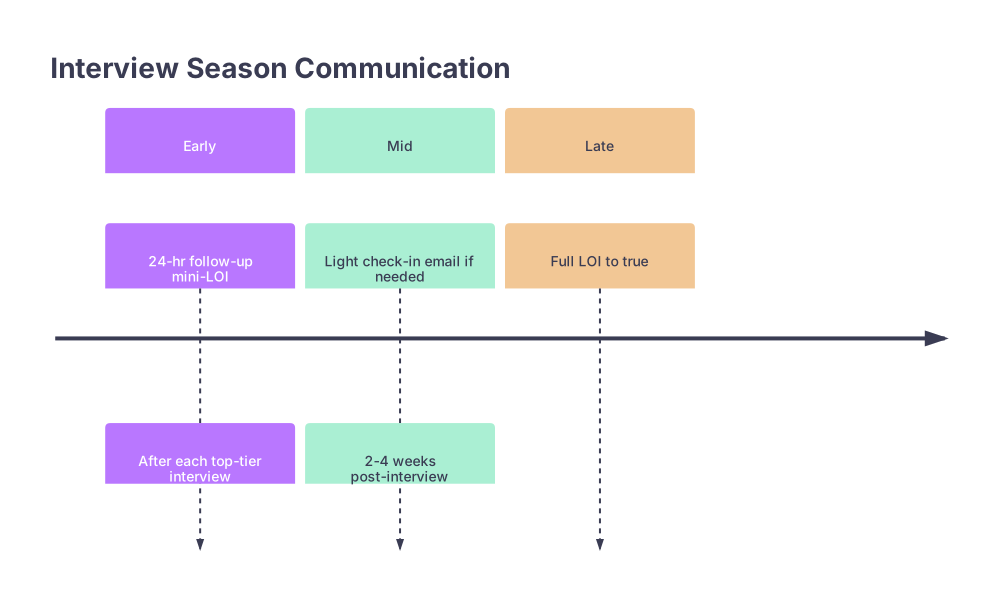
| Period | Event |
|---|---|
| Early - 24-hr follow-up mini-LOI | After each top-tier interview |
| Mid - Light check-in email if needed | 2-4 weeks post-interview |
| Late - Full LOI to true #1 program | 1-3 weeks before rank list due |
The roles:
24-hour mini-LOI:
You were memorable. You closed the loop. You signaled serious interest and fit.Mid-season light check-ins (optional):
If you interviewed early and ranking is months away, a brief update (new publication, leadership role, sub-I feedback) can keep you on the radar—especially at programs that feel quiet.True LOI near rank deadline:
You pick one program. Singular. You tell them they’re #1 and that you will rank them first. That’s different from the mini-LOI. That’s a promise.
Your 24-hour note should be written with that in mind. Firm but flexible. Strong interest without absolute commitment.
EXAMPLES: GOOD VS LAZY 24-HOUR FOLLOW-UPS
Let me be blunt: most follow-ups are useless because they’re vague.
Here’s what not to send:
Dear Dr. Smith,
Thank you for the opportunity to interview at your program. I enjoyed meeting you and learning more about [Program]. I was very impressed by the residents and faculty. I look forward to hearing from you.
Sincerely,
[Name]
That could be sent to literally any program in the country. It tells them nothing.
Now compare that with a tight, mini-LOI style message:
Dear Dr. Smith,
Thank you for the opportunity to interview with the Emergency Medicine residency at City General today. Hearing how your residents manage high-acuity patients from day one, and how you support them with 1:1 faculty backup early in PGY-1, made a strong impression on me.
I’m particularly excited about the chance to work in your busy county ED and to participate in the ultrasound and simulation curriculum you described. Our conversation confirmed that City General offers the combination of autonomy, supervision, and patient volume that I’m seeking, and I can see myself thriving there as a resident.
Thank you again for your time and for the warm welcome from your team.
Sincerely,
[Name]
[Med School] | AAMC ID [xxxxxxx]
Same length. Completely different weight.
COMMON MISTAKES WITHIN THE 24-HOUR WINDOW
At this point you should also know what not to do. I see these every year:
Mass-copying the same paragraph across programs.
Faculty talk. They rotate. Your “deep alignment” paragraph about community health shows up at two places that know each other. They notice.Apologizing in writing.
“Sorry I was nervous” or “I don’t think I answered X well” does not help you. If you truly botched a factual question (e.g., gave wrong data about your research), a short correction is fine later, but not in this 24-hour mini-LOI.Over-explaining your ranking intentions.
You do not need to say, “You’re currently in my top three but I’m still deciding between you and X.” That’s neurotic applicant brain talking. Keep that to yourself.Writing a full essay.
Once your email crosses ~250 words, faculty start skimming or skipping. This is not your personal statement. It’s a quick, memorable impression.Being weirdly transactional.
Don’t ask about ranking policies, second looks, or odds of matching in this email. The point is to reinforce fit and interest, not to extract information.
WHERE THE “FUTURE OF MEDICINE” PIECE ACTUALLY HELPS YOU
Programs are watching for one thing now: people who understand where medicine is going and want to grow with it.
If your interview day touched on:
- AI decision support
- Telemedicine expansion
- Population health and data
- Health equity, structural competency
- Interprofessional team models
…your mini-LOI is an easy place to subtly reinforce that you’re thinking ahead.
Example angle:
“Our discussion about integrating clinical decision support tools into routine care resonated with my experience working on an EHR-based sepsis alert project. I’m eager to train in a program that is actively adapting to how technology is reshaping bedside medicine rather than resisting it.”
You’re signaling: I’m not just a test score. I’m aligned with where your department is going in 5–10 years.
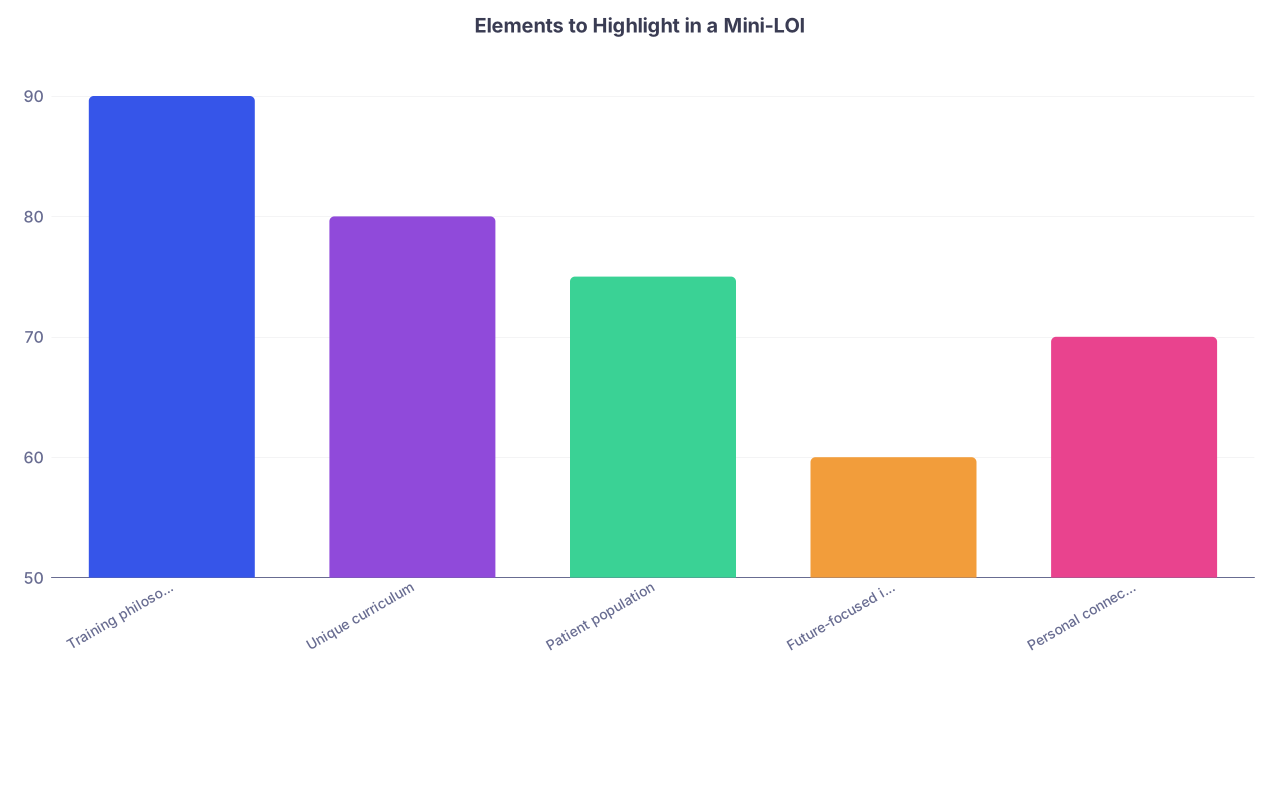
| Category | Value |
|---|---|
| Training philosophy | 90 |
| Unique curriculum | 80 |
| Patient population | 75 |
| Future-focused initiatives | 60 |
| Personal connection | 70 |
You don’t need all of these in one email. Two or three is plenty. But if a program obviously prides itself on innovation or community work, it’s a mistake not to mention that.
FINAL SNAPSHOT: YOUR 24-HOUR PLAYBOOK
You do not need 50 tricks. You need a clean sequence.
- 0–1 hours – Brain dump details of the day. Don’t email.
- 1–3 hours – Decide if this is Tier A. If yes, earmark for mini-LOI follow-up.
- 3–6 hours – Outline a short PD email: thanks → specifics → clear, non-committal interest.
- 6–12 hours – Draft PD email + targeted thank-yous to key faculty/residents.
- 12–18 hours – Edit down, remove generic fluff, confirm facts, align tone.
- 18–24 hours – Send, log what you wrote, and move on to the next interview.
If you remember nothing else:
- Silence after an interview is a missed opportunity.
- A tight, specific, mini-LOI style email in the first 24 hours is enough to separate you from the noise.
- Do not overpromise. Signal strong interest and fit now; save the single true LOI for when you actually know who’s number one.