
Your attending just dropped the bombshell. They're leaving the institution. Maybe they took an industry job. Maybe they got pushed out. Maybe they burned out and quit. Either way, they're gone, and one of your most important letters of recommendation is sitting in limbo on their laptop.
Don't spiral. I've watched this happen to applicants in three consecutive cycles, and the ones who recovered weren't smarter or better connected. They were faster. They treated the situation like a logistics problem, not a personal crisis. Here's how you do the same.
If you are concerned about how this transition impacts your overall file, see also: what if my mentor retires or moves before i apply to med school.
The panic is real, but the application doesn't care about your panic. The application cares about whether the letter is uploaded on time, on letterhead, with a credible signature. That's it. Your job over the next few weeks is to make sure those three things happen, regardless of what's happening on your mentor's end.
The Mid-Cycle Crisis: What You're Actually Facing
Let me be direct: most applicants handle this badly. They freeze, they send one awkward email, they hope for the best, and then they email me in October wondering why their letter slot still shows "not started." That's how you end up explaining to program directors why you're submitting an incomplete application.
The goal here isn't to guilt your mentor into staying or to put pressure on someone in the middle of a career transition. It's to facilitate a clean handoff of your letter while the institutional memory still exists. That's a different problem, and it requires a different mindset.
I'm calling this the "Situation Handler" mindset, and it boils down to one principle: proactive communication beats passive waiting every single time. Don't wait for them to reach out. Don't assume the letter will magically appear. Don't prioritize their comfort over your application timeline. Be polite, but be aggressive about the process.
Here's what the next few weeks actually look like, broken into five concrete moves.
Step 1: Rapid Verification and Status Check
Before you send a single email, you need data. Specifically, you need to know three things:
- Did the mentor actually leave, or did they just change roles within the same institution?
- Do they still have access to the letter portal and their institutional email?
- What state is your letter currently in, uploaded, draft, or not started?
For more on securing a replacement that meets committee standards, see also: how to rescue a weak mentor pool after switching majors before application.
The first question matters because there's a massive difference between "Dr. Smith resigned and is moving to a biotech startup" and "Dr. Smith transitioned to the affiliated VA hospital." One of those mentors is still reachable through normal academic bureaucracy. The other one might have already had their institutional email deactivated. Don't assume.
Check the portal first. Log into the letter service you're using (AMCAS, ERAS, AACOMAS, whatever) and look at the status of your recommendation slot. Most portals show whether the letter has been uploaded, is sitting in draft, or hasn't been touched. This tells you exactly what you're working with.
If the letter is already uploaded, congratulations, you're done. Don't touch it. Don't ask them to "update" it. Don't stir the pot. The letter is in, the signature is valid, and you're moving on.
If it's in draft, you're in the gray zone. The mentor probably started writing, hit save, and walked away. They have the content, but they haven't submitted. You have time, but not infinite time.
If it's not started, you have a real problem. Either they never began writing, or they were planning to do it at the last minute. Either way, you can't assume this letter is coming. Trigger your backup plan immediately, more on that in Step 4.
Also verify their email. Send a test message to their institutional address. If it bounces, escalate fast.
Step 2: Proactive Outreach to the Mentor

Now you reach out. But here's where most applicants screw up: they either send a wishy-washy "Hey, just checking in!" email that gets ignored, or they send a guilt-laden "I know you're busy but my entire career depends on this" message that gets archived.
Neither works. You need to send a clear, professional, time-bound email that respects their transition while making your ask unmistakable.
Here's the template I wish someone had given me years ago:
Dear Dr. [Last Name],
I hope this finds you well as you transition to your new role. I'm writing to confirm the status of my letter of recommendation for [school name/application cycle]. The submission deadline is [date], and I want to make sure the letter is uploaded in time without creating any unnecessary burden on you during this transition.
If you've already submitted the letter, thank you, please disregard the rest of this message. If it's still in progress, I'd be grateful if you could finalize it by [date two weeks before actual deadline]. I'm happy to provide any updated materials, CV, personal statement draft, or a summary of our work together, that might help.
If for any reason you're unable to complete the letter, please let me know as soon as possible so I can adjust my application strategy accordingly.
Thank you again for your mentorship. I genuinely appreciate the time you've invested in my training.
Notice three things. First, the deadline you give them is two weeks before your actual deadline. That buffer exists because portal uploads fail, emails get lost, and life happens. Build it in now or regret it later.
Second, you offer to resend materials. Mentors in transition often lose files, forget which document is which, or simply can't locate the right version of your CV. Make their job easy. Attach everything they might need in one email. Don't make them dig.
Third, you give them an escape hatch. The line about "if you're unable to complete the letter" is critical. Some mentors will take it. That's not a failure on your part, that's information. And information is what you need to pivot.
Step 3: Institutional Leverage and Administrative Support
If your mentor goes silent, you're not helpless. The institution that just lost them still has infrastructure, and you can use it.
Start with the student affairs office or the dean's office for your medical school. These people handle "mentor transition" issues constantly. They know which faculty are leaving, which emails get forwarded, and which department chairs can step in to mediate. They also know whether your mentor's letterhead is still considered valid.
That last point, letterhead validity, is something most applicants never think about. Here's the reality: a letter signed on institutional letterhead from a faculty member who held that title at the time of writing is generally accepted by programs, even if the writer has since left. The signature represents a credentialed assessment of your performance during a defined period. It doesn't matter if they're currently at Big Pharma or sitting on a beach.
But you need to confirm this with your student affairs office, because some programs, particularly competitive ones, may have specific policies. Better to ask now than to discover a flag on your application in December.
If the mentor remains unreachable, loop in your clerkship director or department chair. These senior faculty have institutional authority to step into mentorship gaps. A "co-signed" letter, one that adds a current faculty signature to the original letter, can preserve the substance while addressing concerns about currency. This isn't cheating. It's standard practice for handling transitions.
Here's the conversation you should have:
"Dr. [Clerkship Director], my letter writer for [specialty] has transitioned out of the institution, and I'm having trouble reaching them to confirm submission. Could we discuss whether a co-signed letter or an alternative writer would be the cleanest path forward?"
Direct. Professional. Solves a problem. That's all you need.
Steps 4 & 5: The Pivot Strategy and Backup Planning
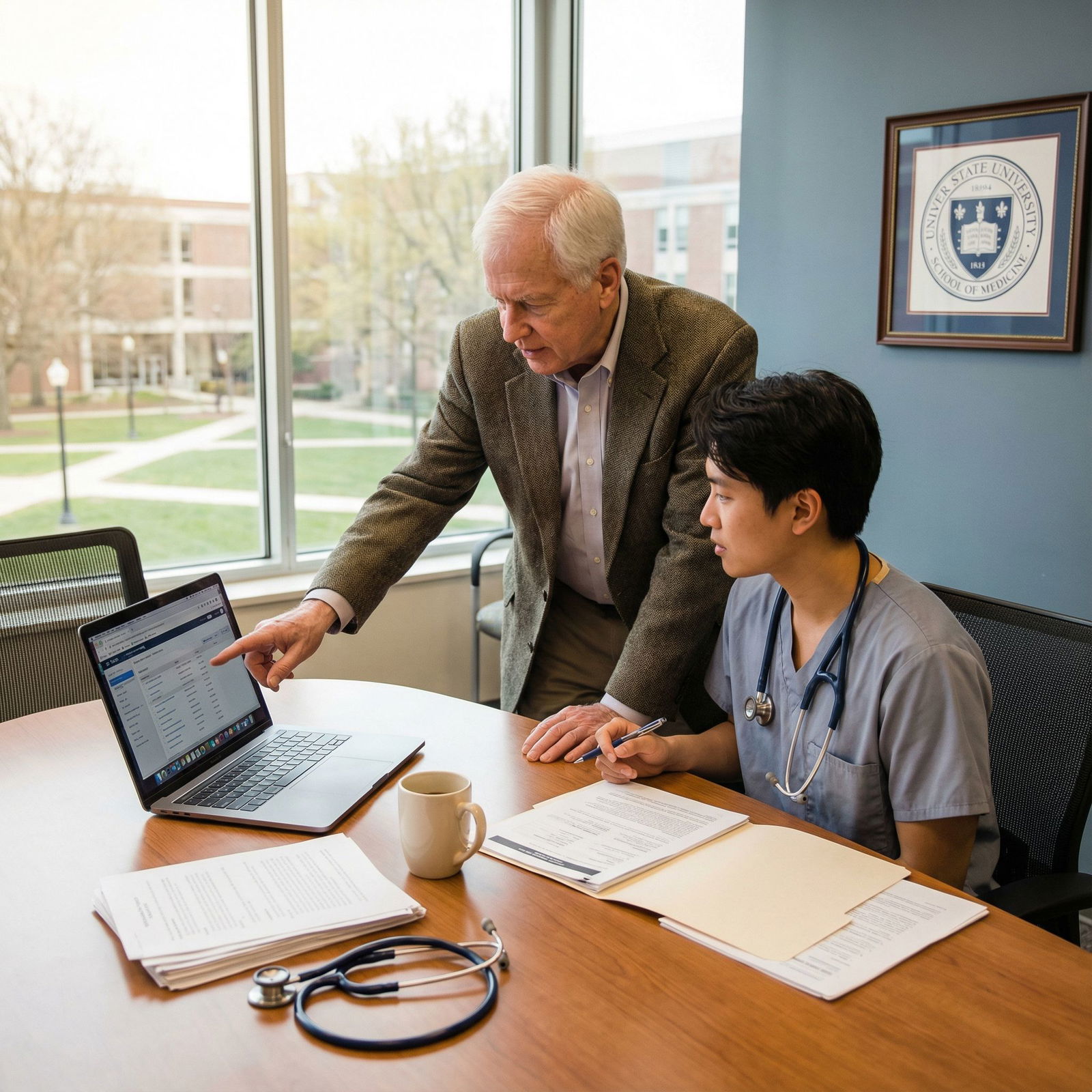
If Step 2 and Step 3 didn't produce a letter, you're at the pivot. Accept it, and move fast.
Step 4: Identify Your Next-Best Writer. You need someone who knows your work well enough to write a substantive letter in the time you have left. Don't grab whoever has the fanciest title. Grab whoever can speak to your clinical performance with specifics.
Ask yourself: who has seen me work with patients? Who can comment on my clinical reasoning, my teamwork, my growth over time? That's your next writer. It might be a senior resident, a different attending from the same rotation, or a research PI who observed your clinical work. The title matters less than the substance.
Reach out to them with the same template from Step 2, but be transparent: "My original letter writer is no longer reachable, and I'm asking because you've directly observed my clinical performance during [rotation]." Honesty here isn't weakness. It's how you get a real letter instead of a generic one.
Step 5: Manage the Portal Without Flagging Yourself. Here's the part nobody talks about. When your letter slot is "empty" or "not started," it shows up on your application's verification report. Some applicants panic and try to explain it in their personal statement or secondary essays. Don't do that. Program directors don't need an essay, they need a letter.
Instead, contact the letter service and request that the original writer be removed from the slot. Most services (AMCAS, ERAS, etc.) allow this. The slot will simply show "no letter assigned" until your new writer uploads. This is normal. It happens to thousands of applicants every cycle for reasons completely unrelated to them, writer illness, family emergency, institutional issues. You're not a red flag. You're a person handling a transition.
If your application has already been verified with the empty slot showing, you can add a brief note in the "Additional Information" section explaining that your original letter writer transitioned institutions mid-cycle and a replacement letter has been requested. Keep it to one or two sentences. No drama, no over-explaining.
Now here's the part that actually matters: focus on the quality of the replacement letter. A glowing, specific letter from a current faculty member who saw your work beats a tepid, rushed letter from a former mentor trying to remember you from 18 months ago. Every time. The pivot isn't a downgrade if you execute it right.
Key Takeaways
If your mentor disappears mid-cycle, remember these three things:
Maintain a secondary verification source. Don't rely solely on your mentor's personal email to track letter status. Use the portal, the student affairs office, and your own outreach as a triangulation system. The moment one channel goes dark, you have two more.
A letter from a departed mentor is still valid. Provided it speaks to your clinical performance and is signed on official letterhead with the title they held at the time of writing, it remains a credible piece of your application. Don't have them re-write it or re-sign it. Don't touch it. Let it stand.
Over-recruit letter writers. This is the prevention move. Every cycle, ask one more person than you need. If your specialty requires three letters, cultivate five relationships. The extra writers aren't just backups, they give you flexibility when a top writer goes dark.
A mentor leaving mid-cycle feels catastrophic. It isn't. It's a logistical problem with a known playbook. Run the verification, send the outreach, leverage the institution, and pivot when you have to. Do those four things in that order and your application will be fine.
Stop reading this and go check your portal.