The person who knows you best might leave before you even apply. And it’s not the disaster your brain is telling you it is.
You’re thinking: “What if my PI retires? What if my favorite professor moves institutions? What if my clinical mentor steps down? Does my whole application just… fall apart?”
Let me be blunt: this happens all the time. Professors retire. PIs change universities. Clinicians switch hospitals or get promoted to roles where they barely see patients, let alone premeds. Admissions committees are not shocked by this. You’re not the first, and you won’t be the last.
But I get why it feels catastrophic. In your head, this one mentor is the pillar of your entire story. They’re the only one who “really knows” you. You’ve spent months (years?) building this relationship, and now your timeline doesn’t line up with theirs.
Let’s go through this in a way that calms your brain and gives you a concrete plan.
First: What Actually Happens When a Mentor Leaves?
Let’s strip away the drama your mind is adding and talk mechanics.
If your mentor retires or moves:
- Their institutional email might change.
- Their title and position will change (e.g., Associate Professor at X → Professor Emeritus at X, or to Another University).
- Their physical availability to you will probably drop.
- But one key thing usually doesn’t change: their ability to write you a letter.
Admissions committees care about:
- Who you are
- What you’ve done
- How well someone credible can speak to those things
They do not care whether your letter writer has an active office on your old campus. They care if the person:
- Supervised you
- Knew you well
- Can give specific, credible examples
Retired professor? Fine. Moved to another institution? Also fine. Emeritus status? Totally normal. I’ve seen letters signed:
- “Professor Emeritus, Department of Biology, [University]”
- “Former Director of Undergraduate Research, now Professor, [New University]”
- “Former Attending Physician, [Hospital], now [New Institution]”
No one bats an eye.
Your brain is screaming “this destroys the continuity of my narrative.” Admissions committees are thinking, “Oh, their mentor retired. Okay, next.”
How To Protect Yourself Now (Before They Leave)
This is the part people skip because it feels awkward… until it’s too late.
You need to future-proof the relationship.
1. Have the slightly uncomfortable conversation early
If you even suspect your mentor might:
- retire soon
- move institutions
- go on sabbatical
- or you just know you’re applying in 1–3 years
Say something like:
“I’m planning to apply to medical school in [year]. I’ve really appreciated your mentorship, and I was wondering if you’d feel comfortable supporting me with a letter when the time comes, even if you’ve retired or moved by then?”
Most mentors will say yes. They might add:
- “Of course, I write letters all the time for previous students.”
- “Just remind me and send me your updated CV and personal statement when you’re ready.”
- Or: “I’m retiring, but I’ll still keep my institutional emeritus email.”
If they look hesitant, believe them. That’s a sign you either:
- need more time to build the relationship, or
- should not be relying on this person as your “anchor” letter
2. Ask for their personal contact info
Not just “[email protected]” that might die the moment they retire.
Ask for:
- Personal email (Gmail, Outlook, etc.)
- Possibly LinkedIn (yes, academics use it more than they admit)
- Any future anticipated institutional address if they’re moving
You can frame it as:
“Would it be alright if I also kept your non-university contact, just in case I need to reach out after you transition/retire?”
Normal. Reasonable. Not pushy.
3. Request a “master” letter while you’re fresh in their mind
Here’s the sneaky-but-legit trick:
You don’t need to wait until your exact application year for them to write something.
You can say:
“Since I’ll be applying in a year or two, would you be willing to draft a letter now while my work with you is still recent, and then we can update it later if needed?”
Many mentors already do this. They keep a template or base letter on file, then tweak the date and a couple sentences later when you’re actually applying.
The point: you’re capturing their memory of you while it’s still sharp, instead of hoping they remember details three years and a dozen mentees later.
How Letters Work If They’re Gone When You Apply
This is what you actually care about at 3 a.m. when you’re spiraling.
Scenario 1: They’ve retired but are still reachable
This is the most common situation.
What it looks like:
- You email their personal or emeritus email.
- You explain your upcoming application timeline.
- You send them your CV, draft personal statement, and a short “reminder” summary of what you did in their lab/class/clinic.
- They submit through:
- AMCAS letter service
- A premed committee letter system
- Interfolio or another dossier service
Letter signature might look like:
- “Professor Emeritus of Chemistry, [Former University]”
- “Former Director, [Program], now Retired”
No one cares. Really.
Scenario 2: They’ve moved to another institution
Zero issue. Honestly, this might even make them look more “active” and impressive.
They just use their current title and affiliation, and somewhere in the body they can mention:
“I supervised [Student] at [Old University] from 2022–2024 in my role as [Old Role].”
Admissions committees can follow that perfectly fine.
Scenario 3: They’re extremely slow or overwhelmed
This is the real risk. Not the retirement. Not the move. The responsiveness.
Look, I’ve seen this:
- Mentor promises a letter
- You remind them 3 times
- Deadlines loom
- They still haven’t submitted
And now your chest is tight and you’re refreshing the portal like it’s a vital sign.
Your defense against this:
- Don’t rely on one crucial letter writer.
- Have at least 1–2 backups who also know you well.
- Build redundancy like you would for a critical exam grade.
How Admissions Committees Actually View These Letters
Here’s what’s running through your mind:
“If my mentor is retired or gone, does that make my experiences look less legit? Will they think I exaggerated? Will they even trust the letter?”
No.
Adcoms read letters with two main lenses:
- How well does this person know the applicant?
- How specific, credible, and detailed are the examples?
If the letter writer clearly:
- supervised your research
- taught you in a small class
- worked with you clinically
- met with you regularly
Then their current employment status is basically background noise.
I’ve seen letters from:
- A retired physician who supervised scribing 5 years ago
- A PI who left for another country (!) but still wrote letters
- A professor who had left academia entirely for industry
No one flagged it. No one wrote, “Hmm, applicant’s mentor is now at a different company—suspicious.”
The only time it becomes a yellow flag is if:
- The letter is extremely generic (“[Name] was in my class and got an A…”)
- The writer clearly barely remembers you
- The letter conflicts with your stated timeline or experiences in a confusing way
Which, frankly, could happen even if they’re still actively at your institution and sitting in their office 50 feet from your lab bench.
Concrete Steps If You’re Already In This Situation
Let’s say the worst has already happened:
- Your mentor retired last semester
- Or they left the university suddenly
- Or you lost touch and now you’re panicking because primaries open in 3 months
Here’s what you do, step by step.
Step 1: Locate a working contact
Try:
- Their old department page (often lists “Emeritus” faculty with updated contact info)
- Google: “Dr [Name] [Field] [Old University]”
- Academic social profiles (ResearchGate, Google Scholar with an email listed)
- Ask the department staff: “Hi, I used to work with Dr. [Name] and am trying to reach them for a reference; is there a current contact email?”
Staff are usually way more helpful than you think.
Step 2: Send a clear, guilt-free email
Something like:
Dear Dr. [Name],
I hope you’re doing well and that your transition to [retirement/new institution] has been going smoothly. I’m reaching out because I’m applying to medical school this upcoming cycle (submitting primaries in [month/year]), and your mentorship in [lab/class/clinic] was extremely formative for me.
If you still feel you know me well enough, I’d be very grateful if you’d be willing to write a letter of recommendation on my behalf. I’ve attached my updated CV and a draft of my personal statement, and I can also send a brief summary of the projects I worked on with you to refresh your memory.
Application letter portals can send a direct link to whichever email is most convenient for you.
Thank you again for the guidance you gave me during my time at [Institution].
Best,
[Your Name]
You’re not bothering them. This is extremely standard.
Step 3: Set internal deadlines and build backup
Don’t pin everything on them coming through in time.
Give yourself:
- A personal deadline 2–3 weeks before schools need the letters
- If they haven’t submitted by then, shift your mindset: they’re a bonus, not a requirement
Meanwhile:
- Ask another professor / PI / clinician who knows you well
- Prioritize people you have active contact with

When It Might Make Sense Not To Use the Retired/Moved Mentor
You don’t have to cling to this person just because you’re emotionally attached to the idea of them being The Letter.
There are legitimate reasons to pivot:
- They’re impossible to reach or notoriously slow
- They didn’t actually know you that well in the first place
- Your role with them was short or superficial
- Another mentor knows your recent work much better
A slightly “less big-name” but more detailed letter almost always beats a big-name but generic one.
If your gut is saying:
- “They kind of forgot who I am.”
- “We haven’t talked in years and I barely worked with them.”
- “They seemed annoyed last time I emailed.”
Then don’t force it. Your anxiety is probably picking up on a real risk.
How To Build Redundancy So You’re Not Held Hostage by One Person
This is the part you can still fix, even if your main mentor is 50% likely to vanish into retirement-land.
Think of your letters like a call schedule: you want coverage.
Try to cultivate at least:
- 1–2 science faculty who know you well
- 1 additional non-science faculty or mentor (humanities, social science, writing-intensive course)
- 1 clinical supervisor/physician if possible
- 1 research PI or work supervisor
Not all of them need to write letters. But you want options. Because:
- People get sick
- People retire
- People forget
- People overcommit
And you do not want your entire cycle hinging on whether Dr. Almost-Retired-For-5-Years remembers to check their email.
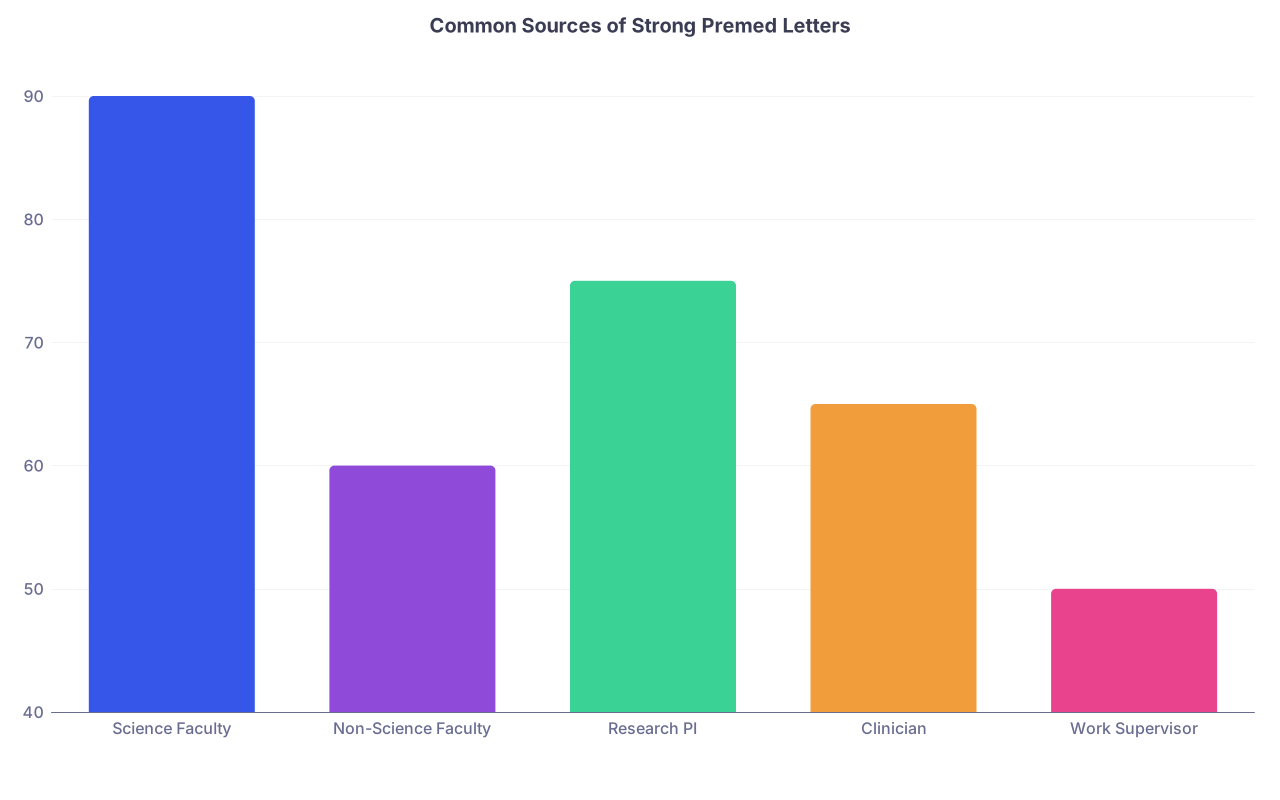
| Category | Value |
|---|---|
| Science Faculty | 90 |
| Non-Science Faculty | 60 |
| Research PI | 75 |
| Clinician | 65 |
| Work Supervisor | 50 |
(Those numbers? Rough sense of how often I see each one used successfully, not some formal statistic. Just to give you a picture: science faculty and PIs are very common, but the others are absolutely normal.)
The Emotional Part: Letting Go of the “Perfect Scenario”
Here’s the hardest truth:
Your application will never be the perfectly orchestrated, carefully timed masterpiece you see in your head.
Someone will submit late.
Someone will move.
A class won’t go the way you thought.
An MCAT date will get messed up.
You’re trying to build this clean, linear narrative where every mentor stays in place until you’re done needing them. That’s not real life. And med schools know that.
What they’re actually watching is:
- Can you adapt when stuff shifts under your feet?
- Do you problem-solve or do you freeze?
- Do you communicate clearly with mentors and handle logistics like an adult?
If your mentor retires or moves and you:
- Reach out
- Get their updated info
- Ask clearly for what you need
- Build backup plans
You’ve already shown the exact behavior they expect from a future physician: managing moving parts under less-than-ideal conditions.
Years from now, you won’t remember every late-night spiral about this one letter. You’ll remember which problems you actually took action on—and how that quietly proved to you that you could handle much bigger ones.
FAQ (Exactly 6 Questions)
1. Will schools think it’s weird if my letter writer is retired or “Professor Emeritus”?
No. This is completely normal. Admissions committees see tons of letters from emeritus faculty and retired clinicians. As long as the letter clearly explains how they knew you and for how long, it doesn’t hurt you at all.
2. Should my mentor use their old institution or new institution on the letter?
They should use their current affiliation in their signature (or “Professor Emeritus” if retired), and mention in the body that they supervised you at the previous institution. That’s enough context for adcoms; they’re used to careers and affiliations changing over time.
3. What if my mentor forgets about me or doesn’t remember details?
That’s where you help them. Send a concise reminder: your role, dates, specific projects, any presentations, and what you’re hoping they might highlight (work ethic, independence, teamwork, etc.). If they still seem fuzzy or hesitant, don’t rely on them as a primary letter—ask someone who genuinely remembers you well.
4. Is it okay to ask for a letter a year or two before I apply?
Yes, and honestly it’s smart. You can ask them to write a general letter now while their memory of you is fresh, then lightly update it later if necessary. Some mentors keep a base letter on file for exactly this reason. The date on the letter doesn’t have to match your graduation date perfectly.
5. What if my premed office says letters must come from current faculty only?
Some schools or committees have their own internal rules for committee letters, but medical schools themselves don’t usually require “currently employed” only. If your advising office is strict, you can still often submit additional individual letters directly through AMCAS/AACOMAS/TMDSAS from retired or moved mentors. Clarify with your premed office how many external letters you’re allowed to send.
6. I’m scared to “bother” my retired/moved mentor—am I being annoying?
You’re not. Writing letters is a core part of academic and professional life. As long as your email is respectful, organized, and you give them plenty of lead time (ideally 4–6 weeks), you’re being reasonable. If they don’t want to do it, they’ll tell you. Silence is more often about busyness and inbox chaos than about you being unwanted.
Years from now, you won’t remember whether the letter was signed from “Professor, University X” or “Professor Emeritus, University Y.” You’ll remember that things went off-script—and you still found a way to move forward anyway.