Let me tell you about Maya. 514 MCAT, 3.8 GPA, research publications, two mission trips, glowing letters. Rejected from twelve schools. Then there's James, who walked into his state school with a 508 and a personal statement about growing up in a single-parent household watching his mother manage Type 2 diabetes without insurance. Accepted at eleven. Same cycle. Same applicant pool. Same committee infrastructure.
You want to know what happened? Maya's score was a number. James's score was a chapter in a story. And here's what admissions committees will never put in writing: they're not comparing numbers. They're comparing narratives, and the MCAT is just the doorbell to a party you haven't been invited to yet.
The MCAT has a margin of error, and it's not the kind the AAMC publishes. There's the statistical margin, sure, around plus or minus one point, depending on which psychometrician you ask. Then there's the interpretive margin, and that one's much, much wider. Committees never talk about the soft buffer, the way your score gets filtered through assumptions about your school, your zip code, your demographic category, and whether your file looks risky or safe. They don't talk about how a 508 in the right context carries more weight than a 518 floating without context.
I'm going to walk you through the inside mechanics of how committees actually treat your MCAT, where the real power lies, and how you can use the hidden margin to your advantage.
The Secret Life of Your MCAT Score: It's Not the Number You Think
I sat on an admissions committee for six years at a mid-tier MD program. We never once discussed the statistical confidence interval of an MCAT score. Not once. We talked about "tiers," "bands," "risk profiles," and "narrative fit." The number on the report became a proxy for a hundred different things, none of which were actual cognitive ability.
Here's the secret: your MCAT is interpreted through a lens of risk, not achievement. A 522 from an applicant who went to a top-15 undergrad with a 4.0 GPA and biomedical research? Low risk. Expected outcome. The committee moves on. A 508 from a first-generation student who worked thirty hours a week through undergrad and showed a clear upward trend? Different conversation entirely. That applicant signals something about perseverance, time management, and resourcefulness that a 522 from a legacy admit never will.
This is the dirty truth: committees don't reward achievement as much as they reward contextualized achievement. Your score isn't a number. It's a story fragment. And most applicants treat it like a SAT score, obsess over it like a stock ticker, and miss the entire point.
The real story, the one nobody tells you at your pre-med advising meetings, is about how your score gets weighed against the arc of your application. A 510 with a coherent story of overcoming adversity, a clear specialty interest tied to personal experience, and meaningful clinical depth? That's a different data point than a 510 from a generic applicant with cookie-cutter extracurriculars.

The Hidden Margin: Why a 512 and a 518 Are Often Viewed as Equally 'Safe'
Let's talk numbers. The AAMC says your MCAT has a standard error of measurement around one point. Fine. But committees apply a much larger interpretive margin, sometimes as wide as five to seven points, depending on the strength of the rest of your file.
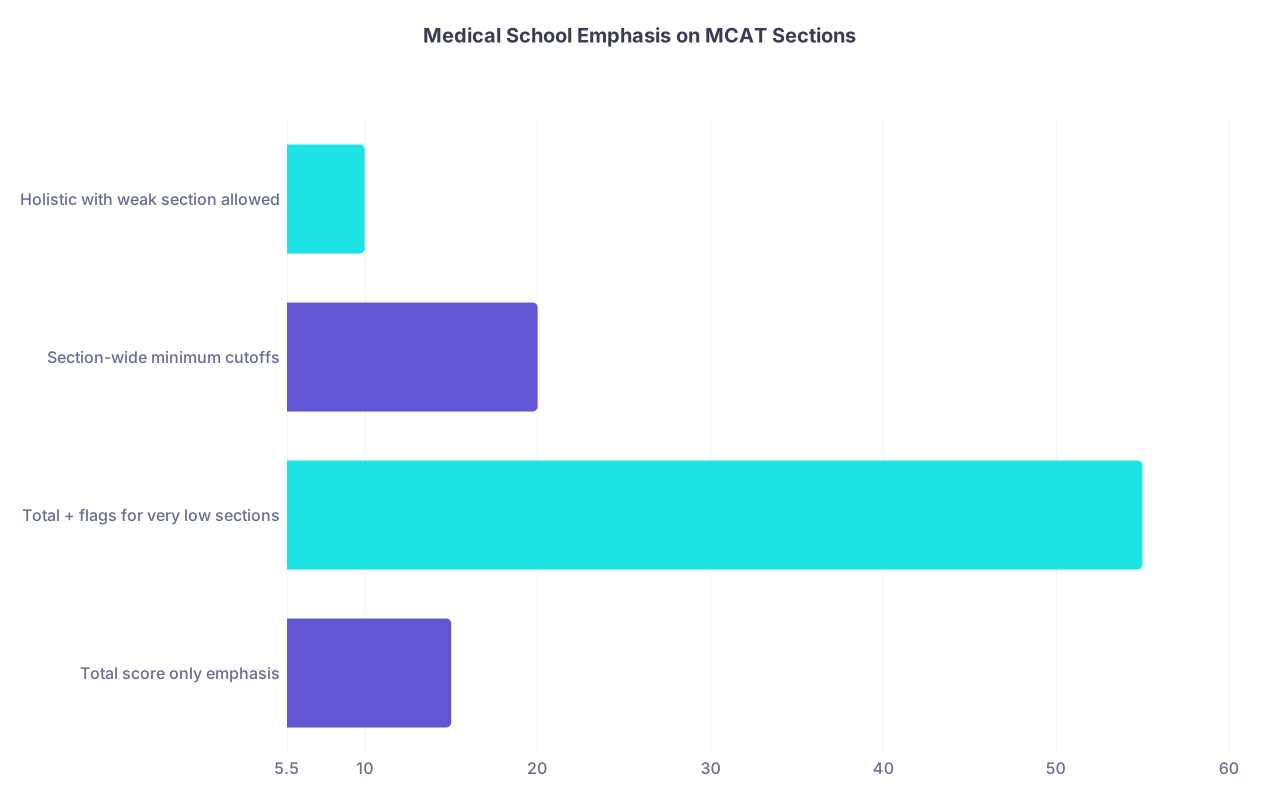
Most programs have what insiders call a "soft cutoff," a band of scores where the MCAT essentially functions as a checkmark rather than a differentiator. At my program, that band sat around 508 to 515. If you scored in that range with a solid GPA and a coherent narrative, your MCAT stopped being a conversation topic. It became background noise. Once you crossed the threshold, the marginal value of additional points dropped off a cliff.
This is something applicants refuse to believe. They think every point matters. They think a 518 is materially better than a 514. In the aggregate, sure, more points open more doors. But within the soft band, within the comfort zone of a particular school, the difference between a 512 and a 518 is functionally zero. The committee already cleared you. They're looking at other things now.
Top-20 programs have a narrower band. They can afford to be picky because they have thousands of applicants with 518s. Mid-tier programs have a wider band because they need to build a class that matches their mission, and that class might need first-generation students, rural applicants, or people who speak three languages. The MCAT band widens because the institution is optimizing for fit, not for raw cognitive horsepower.
Look at the curve below. Notice how the marginal utility of your MCAT on interview probability flattens hard after the 90th percentile. Every additional point above 515 buys you almost nothing in terms of interview odds, because the committee has already decided you're "smart enough." What they're hunting for now is "right enough."
The shaded region between 510 and 515? That's the hidden margin. That's the zone where your MCAT is doing the least work, where the rest of your application has to carry the load, and where the smartest applicants focus their energy.
What They're Actually Looking For: The Score Is Just the Doorbell, Not the Party
Here's the part admissions folks will whisper at conferences but never put in print: your MCAT is a first-round filter. After that, they're hunting for what I call "second-look qualities," the things that make a committee member lean forward and say, "I want to meet this person."
Holistic review is a real thing, but it's also risk-adjusted. Your MCAT gets weighed against your school's reputation. A 510 from a school known for grade inflation is interpreted differently than a 510 from a school known for brutal weed-out curves. Your GPA trend matters more than your MCAT in some contexts. A 3.4 with an upward trajectory from a 2.8 freshman year tells a different story than a flat 3.7.
The "red flag discount" is real and ruthless. A high MCAT cannot save a lukewarm letter of recommendation. A 522 will not rescue a personal statement that reads like a generic essay from a template. I watched a committee member skim a beautifully written personal statement, glance at three generic LORs, and put the file in the "no" pile without hesitation. The MCAT was 519. Didn't matter. The letters smelled like they were written by someone who barely knew the applicant.
The "narrative premium" is the flip side. If your story is compelling, a few points below the median gets forgiven. If your story is bland, even a 522 won't spark interest. The committee has read a thousand bland applications. They're not excited by another one with a high number attached.
The Strategy That Programs Use, and How You Can Turn It to Your Advantage
Every committee has what we called the "positive review bias." Once your file passes the initial screen, the reviewer is actively looking for reasons to say yes. They're not searching for flaws to reject you. They're scanning for justification to champion your application in the committee meeting. This is when your narrative, your most meaningful experience, your most specific detail becomes critical.
Here's something most applicants never learn: your score isn't compared against all applicants equally. It's compared against your peer cluster. If you went to a small liberal arts college, your file gets mentally grouped with other small liberal arts college applicants. If you're a non-traditional applicant with a career gap, you're in a different cluster than the traditional senior. This means a 508 in your cluster might be weighted differently than a 508 in another cluster.
Many programs use a banding technique. They pre-rank applications into three or four tiers based on MCAT and GPA, then within each tier, they rank by mission fit, narrative strength, and reviewer discretion. The exact score within the band matters far less than how you present yourself once you're in that band.
The actionable insight here is brutal and liberating: stop obsessing over two points. That energy you're spending on retake prep, on grinding one more practice test, on squeezing out a 514 instead of a 512? Redirect it. Spend it on your most meaningful experience description. Spend it on a personal statement that makes a committee member remember you three files later. Spend it on cultivating a relationship with one professor who can write a letter so specific it feels like a character study, not a form letter.
The Unspoken Truth About Retakes: When a 508 Might Trump a 522
Retakes are where the hidden margin becomes a story about character, not cognition.
Committees love an improvement narrative. A 498 on your first attempt, a 508 on your second, and a clear explanation of what changed in between? That's a signal of self-awareness, resilience, and grit. The committee reads that and thinks, "This person figured out what was wrong and fixed it. That's exactly the kind of doctor we need."
But the score plateau trap is real and ugly. If you retake and only improve by two points, committees see a red flag. Poor judgment. Coaching dependence. Someone who couldn't diagnose their own weaknesses. I watched a committee debate an applicant with three attempts at 510, 512, 511. The MCAT was fine. The narrative was poison. The committee read it as someone who threw money at prep courses instead of doing the hard work of self-assessment.
Multiple retakes, three or more, get viewed skeptically unless there's a clear upward arc. A 498 to a 508 to a 518? That's a compelling story. A 510 to a 512 to a 514? That's a concerning pattern.
Here's the case study that proves this point. A 508 with a clean upward trend and a mission-driven personal statement about rural healthcare access beat out a 522 with a generic application at a service-oriented state school. The 522 applicant had better stats. The 508 applicant had a better story. The committee chose the story.

Your Personal Margin of Error: How to Build a Buffer They Can't Ignore
Here's your action plan, and I mean it as a literal sequence.
First, know your target school's true score band. Don't look at the median. Look at the 25th to 75th percentile range. That's your real target zone. If your score sits comfortably in that band, your MCAT becomes a checkmark. If it sits below, you need narrative strength to compensate. If it sits well above, you're wasting your statistical advantage on a school where the rest of your application might not match their mission.
Second, identify your swing factors. Every application has two or three elements that can tip the decision from "maybe" to "yes." For most applicants, it's the personal statement, the most meaningful experience description, and the interview. These are your leverage points. A mediocre MCAT with a knockout personal statement beats a stellar MCAT with a forgettable one. Every time.
Third, understand that after you get an interview, your MCAT becomes a tiebreaker. Performance and fit dominate. I've sat in committee meetings where two applicants had identical stats, and the interview performance decided everything. The MCAT was background noise. The committee was talking about how one applicant made them think differently about healthcare delivery, and the other gave safe, rehearsed answers.
Fourth, use the hidden margin strategically. Don't apply only to schools where your stats make you a "likely yes." Those schools rarely offer competitive aid, scholarship packages, or the kind of enrichment opportunities that shape your career. Apply to schools where your score sits comfortably in the band, where your narrative matches their mission, and where you'll actually thrive.
Fifth, see yourself as more than a score, but respect the procedural reality. Committees are human. They're tired. They've read eight hundred applications this cycle. They're looking for reasons to love you, not just to admit you. Make their job easy. Give them a narrative so specific, so grounded in lived experience, that it stands out in a stack of files that all start to blur together.
The hidden margin is real. It's wider than you think, and it's shaped by everything except your raw score. The applicants who understand this stop obsessing over points and start obsessing over the story. They build a buffer the committee can't ignore, a combination of mission fit, narrative coherence, and interview performance that makes their MCAT almost irrelevant within the band.
Here's the future you're heading into. Holistic review is expanding. Schools are experimenting with multiple mini-interviews, situational judgment tests, and broader competency assessments. The MCAT will remain a filter, but the gate is widening. The applicants who thrive in this environment will be the ones who treat the MCAT as one chapter in a much longer book, not the book itself.
Your score has a margin of error, and it's bigger than you realized. Use that margin. Stop chasing points. Start building the application that makes your score secondary. That's where the real leverage lives.