
Educational disclaimer: This article is for general educational purposes only. It discusses professional networking, career strategy, and potential long-term career outcomes, but it is not financial, legal, tax, or individualized career advice. Fellowship decisions and career planning should be discussed with your program leadership, mentors, and other qualified advisors familiar with your situation.
Networking is not charisma. It is not luck. It is not a gift handed to the loudest person in the room. It is a skill, and like every other skill in medicine, it gets better when you approach it with structure instead of wishful thinking.
Community program residents need to hear that plainly because the advice they often get is lazy. “Just go to conferences.” “Reach out to people.” “Be proactive.” Fine. But that is not a strategy. That is vague encouragement dressed up as mentorship.
If you are training in a community program, you may not have a hallway full of subspecialty researchers, a built-in pipeline to nationally known fellowship faculty, or weekly visiting professors from major quaternary centers. Your peers at large academic institutions often benefit from proximity alone. They meet the right people by existing in the right building. You may not. That does not make you less competitive. It means you need to be more deliberate.
I have seen community residents match extremely well into fellowships when they stop treating networking like social guesswork and start treating it like a professional campaign. Visibility matters. Relationships matter. A clear academic identity matters. And yes, having people who know your name before your application arrives matters more than applicants want to admit.
This is the promise of the article: seven practical ways to build that visibility, create real professional relationships, and develop credible mentorship even if your institution does not come with an automatic academic halo.
1. Start With a Fellowship Target Map, Not Random Outreach
Random outreach is the fastest way to waste energy and look unfocused. The resident who emails twenty people with a vague “I am interested in fellowship opportunities” message usually gets ignored. The resident who knows exactly what they are building gets responses.
Start with a target map.
Pick one to three fellowship paths. Not seven. If you are trying to decide between cardiology, pulmonary/critical care, and GI, fine. If you are also “open to heme/onc, rheum, and ID,” you are not networking. You are drifting.
Then match each path to the people and institutions that matter. Let me break this down specifically:
- Mentors: faculty in your hospital, nearby academic centers, alumni, subspecialists you worked with on electives
- Institutions: fellowship programs with a history of taking community residents, programs in your geographic target, places with your niche interest
- Societies: specialty organizations, trainee sections, committee groups
- Project themes: heart failure outcomes, ventilator liberation, IBD quality improvement, lymphoma case series; whatever fits your intended field
Networking works when people can place you somewhere mentally. “She is the resident interested in pulmonary hypertension outcomes.” That sticks. “He likes medicine and wants to keep options open.” That does not.
Build a simple spreadsheet with:
- Program name
- Key faculty
- Alumni from your residency or med school
- Conferences where they present
- Your current connection level
- Next action
That document becomes your map. It tells you who to contact, who to ask your program director about, and where to show up. Good networking is rarely broad. It is targeted and cumulative.
2. Use Your Program Leadership as an Internal Launchpad
Too many residents underuse the most obvious resource sitting in front of them: program leadership.
Your program director, associate program directors, department chair, and respected faculty can function as accelerants. Not because they can magically get you a fellowship, but because warm introductions beat cold outreach every time.
Ask for the right things.
Bad ask: “Can you help me get into cardiology?”
Good asks:
- “Could you give me honest feedback on my cardiology competitiveness?”
- “Are there alumni in cardiology fellowship you think I should speak with?”
- “Would you be willing to introduce me to Dr. Patel at State University? I am interested in outcomes work similar to hers.”
- “Do you know of a realistic QI or case-based project that would help me build a stronger profile for PCCM?”
That is professional. Specific. Easy to act on.
What residents get wrong is tone. They either sound apologetic or entitled. Both are bad. Do not approach leadership as if you are asking for a favor you do not deserve. Also do not approach them as if introductions are owed to you because you have decided to apply. The right posture is simple: clear goal, serious work ethic, openness to feedback.
A useful structure for that meeting:
- State your fellowship interest.
- Share why you are interested.
- Ask for an honest assessment of strengths and gaps.
- Request one or two concrete next connections or opportunities.
People advocate for residents who are prepared. If you show up with a current CV, a draft personal niche, and a few target programs, faculty will take you more seriously. I have seen this repeatedly. The resident who makes it easy for leadership to help gets help.
3. Turn Conferences and Grand Rounds Into Relationship-Building Opportunities
A conference is not a vacation with tote bags. It is not an excuse to collect lanyards and disappear into the back row. It is one of the few places where access becomes temporarily democratic. Use it properly.
Think in three phases: before, during, after.
Before the event
Do not arrive blind. Review the program and identify:
- Faculty in your intended fellowship niche
- Sessions relevant to your interests
- Poster presenters whose work overlaps with yours
- Society trainee events, receptions, workshops, and committee gatherings
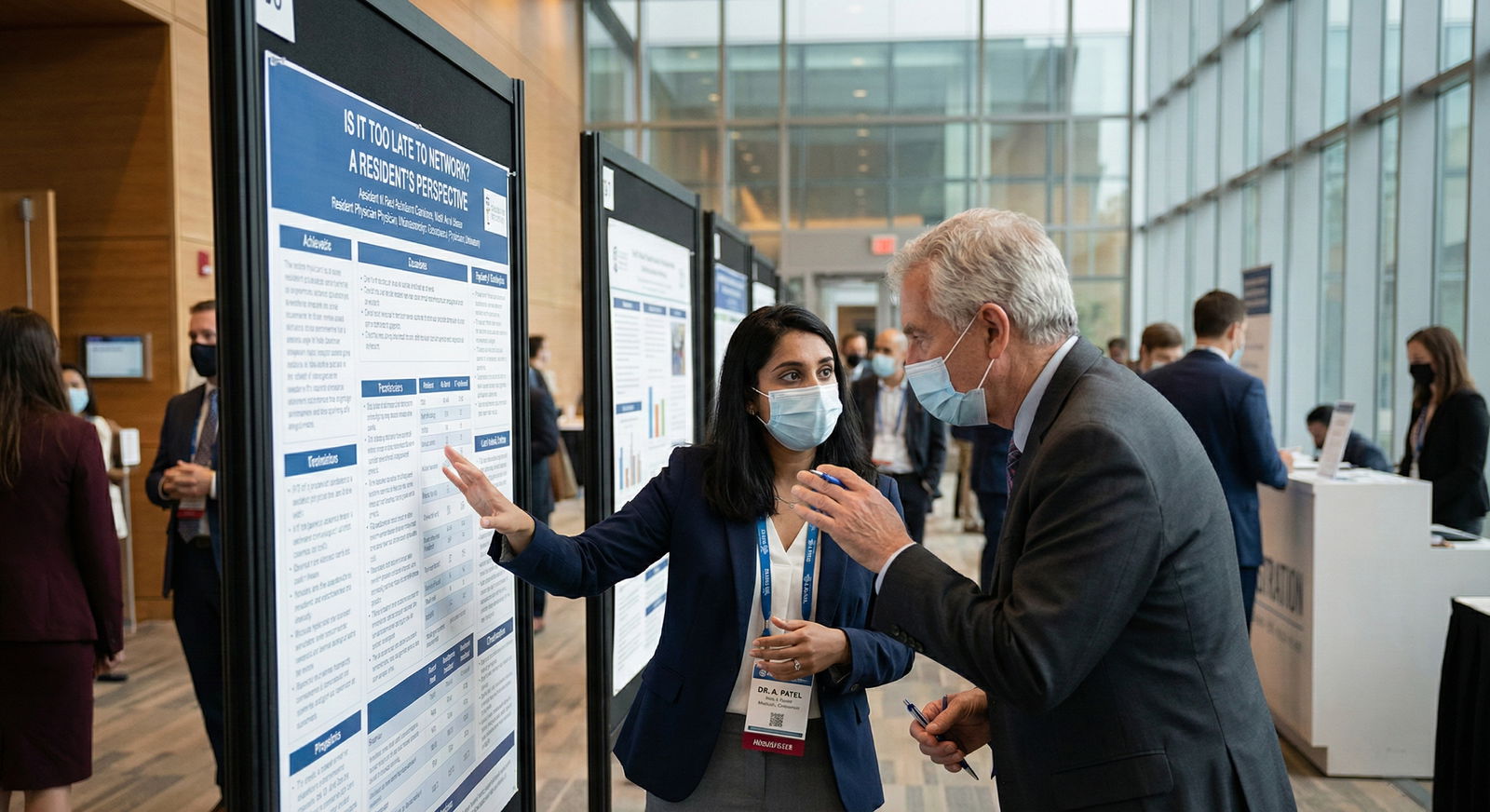
Then send one or two pre-conference emails if appropriate. Short and respectful. Example: you are a PGY-2 interested in GI, you read Dr. Shah’s abstract on IBD disparities, and you plan to attend her poster. Ask whether she might have five minutes after the session to offer advice. That is reasonable. Not creepy. Not overdone.
During the event
Best places to network:
- Poster sessions: easier conversation, lower stakes, naturally interactive
- Q&A after talks: ask one smart question, not a speech disguised as a question
- Workshops: smaller groups, repeated exposure
- Society trainee receptions: often underrated and packed with approachable faculty
- Grand rounds visiting speakers: a local version of conference networking, often with less competition
Your goal is not to impress people with brilliance. Your goal is to be memorable for the right reasons: thoughtful, specific, prepared.
A strong opener: “Dr. Lee, I am a PGY-2 at a community IM program. I appreciated your talk on shock phenotyping, especially the point about delayed hemodynamic reassessment. I am exploring PCCM and wondered what projects you think are realistic for residents without a large research infrastructure.”
That works because it shows you listened, know your context, and are asking a real question.
After the event
This is where most residents fail. They have a good five-minute conversation and then do nothing. Momentum dies fast.
Within 48 to 72 hours:
- Send a thank-you email
- Mention one specific point from the conversation
- Attach your CV only if invited or clearly relevant
- Suggest one small next step: a follow-up call, project question, article recommendation, or future check-in
Do not force intimacy. Just continue the thread. Professional relationships are built through repeated low-friction contact. One smart follow-up beats ten forgettable introductions.
4. Build a Reputation Through Small, Visible Academic Wins
You do not need a Nature paper to become fellowship-relevant. You need visible, aligned work.
This is where community residents often underestimate themselves. They assume that because they do not have a giant research engine behind them, scholarly credibility is out of reach. Wrong. Small wins travel.
The highest-yield academic products in many community settings are:
- Case reports
- Clinical vignettes
- Conference abstracts
- Quality improvement projects
- Retrospective chart reviews
- Brief narrative reviews with a mentor
These matter because they do three things quickly:
- They give people something concrete to associate with your name.
- They create reasons to contact outside faculty.
- They demonstrate follow-through, which is half the battle in academic medicine.
Pick projects that fit your intended fellowship. If you want ID, a stewardship QI project is smarter than a random endocrinology case report. If you want cardiology, a heart failure readmission initiative or arrhythmia case series makes more sense than generic hospital medicine work. Alignment is the point.
I have watched residents bury themselves in giant multicenter dreams that never finish. Terrible move. A completed case report presented at a regional meeting is more useful than a sprawling research fantasy that never leaves your hard drive.
Think in tiers:
- Tier 1: fast products, 1 to 3 months: case reports, image challenges, short abstracts
- Tier 2: medium products, 3 to 6 months: QI projects, retrospective studies
- Tier 3: longer-term products, 6 to 12 months: society committee work, multi-author reviews, collaborative manuscripts
What you are building is scholarly identity. When someone hears your name, they should have a reference point. “That resident presented the ECMO anticoagulation case.” “She did that QI work on colonoscopy follow-up.” Specificity creates credibility.
A clear identity also makes networking easier because faculty know how to plug you into opportunities. Nobody knows what to do with a resident whose interests are vague and constantly changing.
5. Network Through Professional Societies, Interest Groups, and Online Communities
Professional societies are one of the most underused equalizers for community residents. They flatten hierarchy better than almost any other space in medicine.
Why? Because societies are where fellowship faculty recruit, teach, notice motivated trainees, and quietly compare impressions. This is not officially called a marketplace, but functionally that is what it is.
Join the trainee section of your intended specialty society. Then do more than pay dues.
- Attend trainee webinars
- Go to mentorship sessions
- Volunteer for small committees
- Submit abstracts
- Apply for resident scholarships or travel awards
- Show up consistently enough that your name becomes familiar
That familiarity matters.
Online networking can help too, but most residents do it badly. They either vanish entirely or perform a strange version of personal branding that sounds robotic and desperate.
Use online spaces with restraint:
- LinkedIn: keep it updated, clean, and professional; list presentations, projects, committee roles
- X/Twitter: useful in some specialties for following conference conversations, paper discussions, and society announcements
- Listservs or Slack groups: often better than public posting because they are niche, practical, and less performative
Rules that keep you from looking foolish:
- Do not overpost
- Do not tag famous faculty constantly
- Do not jump into every controversy
- Do not pretend expertise you do not have
- Do contribute thoughtfully when you have something real to add
The best online presence is quiet competence. A polished profile. Occasional substantive engagement. Clear specialty interests. No cringe.
6. Ask for Mentorship the Right Way and Actually Maintain It
Residents often use the word mentorship too loosely. Not every helpful senior physician is your mentor. And not every mentor is a sponsor.
Here is the distinction:
- Informational conversation: a short discussion to learn about a field, pathway, or project
- Mentorship: an ongoing relationship with guidance over time
- Sponsorship: someone with influence actively advocating for you in rooms you are not in
You need all three. But you ask for them differently.
The first message matters. It should include four things:
- Who you are
- What you are aiming for
- Why you chose them specifically
- What you are asking for
Example structure:
“Dear Dr. Nguyen, I am a PGY-2 internal medicine resident at River Valley Community Hospital with a strong interest in pulmonary and critical care, particularly sepsis outcomes and ICU quality improvement. I heard your presentation at the state ACP meeting and was struck by your work on post-ICU recovery pathways. I wondered whether you might have 15 to 20 minutes for a brief call in the next few weeks so I could ask for advice on building a focused PCCM portfolio from a community program.”
That is good outreach. Specific. Respectful. Time-limited.
Now the part residents neglect: maintenance.
If someone helps you, update them.
- Send a thank-you
- Share outcomes of their advice
- Reach out every couple of months with concise progress updates
- Ask focused questions, not sprawling life-story emails
Senior clinicians are busy. They do not need another resident sending seven paragraphs and three attached drafts without warning. Respect their bandwidth. The fastest way to lose goodwill is to turn a generous mentor into unpaid administrative labor.
Reliable update cadence builds trust. It also slowly converts mentorship into sponsorship. That transition is where fellowship doors open.
7. Create Fellowship Momentum by Being Easy to Advocate For
This is the part people pretend is less important because it sounds boring. It is not boring. It is decisive.
You can be pleasant, bright, and ambitious, but if you are unreliable, slow to respond, disorganized, or vague about your goals, people will not advocate for you. They may like you. They still will not stick their neck out.
Networking is not just meeting people. It is becoming easy to recommend.
That means:
- Responding to emails promptly
- Showing up when you say you will
- Turning in drafts on time
- Following through on small tasks
- Keeping your CV updated
- Having a clean one-paragraph description of your goals
- Documenting accomplishments so letter writers do not have to guess
I have seen two residents with similar scores and similar résumés get very different results because one created confidence and the other created friction. Faculty remember friction. They also gossip about it more than applicants realize.
Make advocacy easy. Send mentors:
- An updated CV
- A short bio or “about me” paragraph
- Your fellowship interests
- Bullet points of recent projects and presentations
- Deadlines for letters or applications
This is not selfish. It is professional. Strong advocates are much more effective when they have your material at hand and know exactly what story to tell about you.
And yes, this matters directly in the final application phase. Fellowship selection is shaped by:
- Letters of recommendation
- Off-the-record phone calls
- Quiet endorsements from alumni
- Interview referrals
- Reputation transfer from trusted faculty
That last one is real. If a respected physician says, “This resident is dependable, thoughtful, and ready,” their credibility transfers to you. That is the endgame of networking.
Conclusion: A Practical 30-Day Networking Plan for Community Program Residents
If you want the short version, here it is: stop waiting for an academic ecosystem to appear around you. Build your own.
Your next 30 days should look like this:
- Week 1: identify one to three fellowship targets and build your target map
- Week 2: meet with your program director or a key faculty mentor and ask for honest feedback plus two introductions
- Week 3: send two thoughtful outreach emails and update your CV and LinkedIn
- Week 4: attend one conference session, grand rounds, society webinar, or specialty meeting and follow up with one person afterward
At the same time, pick one small academic product to move forward. One case report. One abstract. One QI idea. Something finishable. Something aligned.
That is how community residents create momentum. Not with charisma. Not with endless self-promotion. With specificity, repetition, and follow-through.
Consistency beats charm in this game. Every time. Start now.