
The fastest way to burn a bridge with a busy faculty member is to over-contact them. The second fastest way is to disappear. You need a rhythm in between.
Here’s the answer you’re actually looking for: most students should touch base with busy faculty every 4–8 weeks, unless you’re actively working together on something time‑sensitive. During active projects, it’s closer to weekly or every other week. The real trick is how you check in, not just how often.
Let’s break it down so you can stop guessing and stop annoying people who control your letters, projects, and future opportunities.
The Core Rule: Match the Frequency to the Relationship
Faculty aren’t one big category. How often you should check in depends on what they are to you right now.
Here’s the core framework I recommend:
| Faculty Role | Typical Check-in Frequency |
|---|---|
| Active research PI/collaborator | 1–2 weeks |
| Clinical supervisor (rotation) | 1 week |
| Career mentor (ongoing) | 4–8 weeks |
| Letter writer (post-agreement) | 6–12 weeks |
| Guest lecturer / loose contact | 3–6 months |
If you remember nothing else, remember this: your contact frequency should always reflect how much they’re currently invested in you.
- If you’re on their IRB-approved study and have tasks due → weekly or every other week is fine.
- If they helped once with an email introduction → maybe twice a year.
- If they agreed to write a letter → every 1–3 months until it’s submitted, with a reason.
What you don’t do is email the same faculty member three times in 10 days with “Just checking in again!” and nothing new to say. That’s how you quietly get moved to the “ignore” folder.
How Often to Check In by Scenario
Let’s make this very concrete.
1. You’re on a research project with them
You have an assigned role: data collection, chart review, stats, manuscript, whatever.
Baseline rhythm:
- If there are active tasks: every 1–2 weeks
- If it’s in a slow phase (waiting on IRB, co-authors, etc.): every 3–4 weeks
Your message must:
- State what you’ve done since last time
- Ask 1–2 specific questions or propose a concrete next step
- Be short enough to read in under 30 seconds
Example cadence:
- Week 1: “I’ve completed 50/200 charts; here’s the updated sheet.”
- Week 3: “Up to 150/200 charts; one data field needs clarification—quick question below.”
- Week 5: “Charts complete; I drafted Methods section—could you review when time allows?”
If you have nothing new to report, you don’t email “Any updates?” Just don’t. Instead, wait until:
- You’ve completed something
- A promised deadline from them has clearly passed (e.g., they said “I’ll review this by next week” and it’s now week three)
Then a single, polite nudge is fine.
2. They’re your “career mentor” but you’re not on an active project
This is the classic question: “How often should I check in with my mentor so they don’t forget me, but I also don’t become That Student?”
Target: Every 4–8 weeks. More often if they’re very involved, less if it’s more big-picture career advice.
Your job is to bring substance:
- A brief update on progress since last time
- 1–2 focused questions or decisions you’re wrestling with
- Occasionally, a thank-you and “result” of previous advice they gave
Example rhythm:
- Early MS2: Email every 8 weeks with updates on specialty interest, research progress, Step prep strategy questions.
- Late MS3: Every 4–6 weeks as you narrow specialties, need letter plans, and schedule away rotations.
Frequency red flags:
- If you catch yourself writing, “Just checking in” with nothing else → wait.
- If every email asks for a new favor (introductions, letters, special scheduling) → space them out and add value in between.
3. They agreed to write you a letter of recommendation
Now timing really matters.
Once they’ve explicitly agreed to write a letter for residency, a scholarship, away rotations, etc.:
General rule:
- Initial request: at least 6–8 weeks before the deadline
- Follow-up if no confirmation after 7–10 days
- Once confirmed: update every 4–8 weeks or at key milestones
- Final reminder: 10–14 days before deadline if letter still not marked complete
Your check-ins could look like:
- “Thank you again for agreeing to support my residency application. Since we last spoke, I’ve completed my Sub-I and attached my updated CV and personal statement draft.”
- “Just a quick note that programs will start reviewing applications next week; no action needed now if you’ve already submitted the letter—just wanted to keep you posted and say I appreciate your support.”
The line you don’t cross: weekly nagging about the exact same deadline. One polite reminder after a missed internal “soft” date is enough, then one before the hard deadline.
4. You met once (lecture, grand rounds, networking event) and want to keep the connection alive
This is light-touch networking, not active mentorship.
Timeline:
- Same day or within 48 hours: a brief thank-you email referencing something specific you discussed.
- Next (optional) contact: 3–6 months later with a real update or thoughtful question.
- After that: every 6–12 months if you have a real reason.
Good reasons to reach out:
- You read or cited one of their new papers and had a focused question
- You’re applying to their institution/program
- You have a concrete ask that clearly fits their interests (and you’re not asking out of nowhere)
This is where many students overdo it. You don’t need quarterly “just wanted to stay in touch!” emails with no content. Once or twice a year is enough to stay on their radar if the contact is actually meaningful.
5. You’re between phases (e.g., waiting on Step scores, waiting to hear back about opportunities)
Silence makes students anxious. They compensate by over-emailing. Don’t.
If:
- You asked about a potential opportunity (research, shadowing, etc.)
- Faculty said something like “We might have something in a few months”
Then your cadence is:
- One follow-up 4–6 weeks later if you haven’t heard anything
- Another follow-up 2–3 months after that if you’re still interested and still have capacity
If you’ve followed up twice with no response, move on. They’re either genuinely too busy, not that interested, or bad at email. None of those will magically get better once you’re working with them.
How to Check In Without Being Annoying
Frequency matters. But content and tone matter more.
Here’s the formula that works with busy people:
Clear subject line
Examples:- “Quick update – cardiology project data 3/15”
- “Follow-up and brief question about away rotations”
- “Update + Letter timeline – [Your Name]”
One-line context
“I’m the MS3 you’ve been advising about EM vs IM,” or “I’m working with you on the sepsis QI project.”Bullet or short paragraph update (3–5 sentences max)
What you’ve done, what changed, what’s next.One focused ask
Not five. One. “Could we schedule 15 minutes in the next few weeks?” or “Can you confirm whether this deadline is still realistic?”Gratitude without groveling
“Thanks for your time” is plenty. You don’t need a paragraph of thanks.
What not to do:
- Attach five long documents without explanation
- Ask for major decisions by tomorrow
- Send “???” or “Any updates?” follow-ups
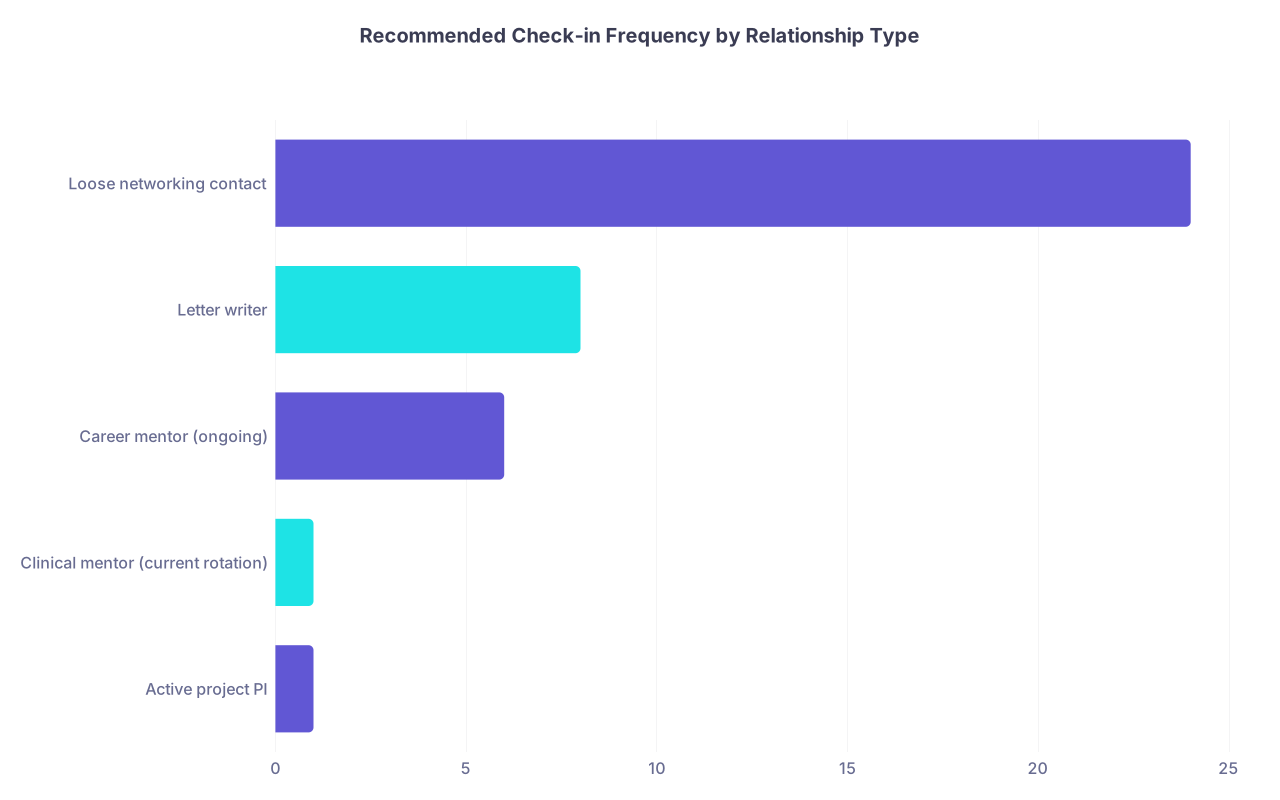
| Category | Value |
|---|---|
| Active project PI | 1 |
| Clinical mentor (current rotation) | 1 |
| Career mentor (ongoing) | 6 |
| Letter writer | 8 |
| Loose networking contact | 24 |
(Values in weeks: e.g., 1 = weekly, 6 = about every 6 weeks, 24 = about every 6 months)
Signs You’re Overdoing It (and How to Fix It)
You’re probably contacting faculty too much if:
- They start taking longer and longer to reply
- Their replies get shorter and more vague (“Sounds good.” “Ok.” “We’ll see.”)
- They stop suggesting concrete next steps
- You’re emailing more than once every 7–10 days without a genuinely new development
If you recognize yourself here, you don’t need an apology email. You need a reset:
Stretch the interval
Move from weekly to every 4–6 weeks unless you’re on a defined project timeline.Raise the bar for when you email
Ask: “Is this email solving a problem for them or only for me?” If it’s only for you and not urgent, sit on it.Use in‑person or scheduled meetings
Instead of 7 little emails, consolidate into one 20-minute meeting every month or two.
How to Avoid Being Forgotten Without Being Needy
The fear underneath your question is real: “If I don’t stay on their radar, they’ll forget me when I need a letter or opportunity.”
Here’s the thing: people remember students who:
- Did excellent work
- Communicated clearly when it mattered
- Showed up prepared and on time
- Followed through on what they said they’d do
They don’t remember students who:
- Sent lots of “checking in” emails
- Needed constant handholding
- Took more of their time than they returned in value
So instead of frequency, focus on quality:
- When you email, include something that respects their work: “I read your recent JAMA paper; your point about X changed how I think about Y.”
- When you update, close the loop: “You suggested I talk to Dr. Lee about nephrology; that conversation made me realize…”
Those are the things that stick.

| Step | Description |
|---|---|
| Step 1 | Want to email faculty |
| Step 2 | Wait and gather updates |
| Step 3 | Wait longer |
| Step 4 | Send concise email |
| Step 5 | Combine with future updates |
| Step 6 | Do I have a clear purpose? |
| Step 7 | Has it been at least 1 week? |
| Step 8 | Urgent or time sensitive? |
| Step 9 | New info or progress to share? |
Example Email Templates (Steal These)
Use these as starting points.
Light-touch mentor check-in (every 6 weeks)
“
Subject: Brief update – [Your Name], MS2 IM interest
Dear Dr. Smith,
I hope you’re doing well. I wanted to briefly update you and ask one quick question.
Since we last spoke, I finished my cardiology elective and started working on a small QI project about heart failure readmissions. It’s reinforced my interest in internal medicine, especially cardiology.
My question: I’m starting to plan for next year’s electives. Would you recommend prioritizing another subspecialty elective (like nephrology) or a general medicine rotation first?
Thank you again for your guidance – it’s been really helpful in shaping my plans.
Best,
[Your Name]
”
Research project update (every 1–2 weeks during active phase)
“
Subject: Sepsis project – data progress update
Hi Dr. Patel,
Quick update on the sepsis project: I’ve completed data abstraction for 85/150 charts and updated the REDCap database accordingly.
Two short questions:
- For cases with incomplete lactate data, would you prefer we exclude them or code them as missing?
- Are you still okay with our goal of finishing chart review by the end of next month?
If helpful, I’m happy to send a brief summary of preliminary findings once I’m at 100 charts.
Best,
[Your Name]
”
Letter writer check-in (6–8 weeks after agreement)
“
Subject: Residency letter update – [Your Name]
Dear Dr. Nguyen,
Thank you again for agreeing to support my internal medicine residency applications.
Since our last conversation, I’ve completed my Sub-I on the MICU service and attached an updated CV and personal statement draft. Applications will be released to programs on [date], but there’s no immediate action needed today if your letter is already in progress.
I just wanted to share these updates and re-affirm how much I appreciate your support.
Best regards,
[Your Name]
”
FAQ: Faculty Check-ins – 7 Common Questions
Is it okay to email a busy faculty member on weekends or late at night?
You can send it whenever you’re working; they’ll read it when they’re working. Just don’t expect immediate responses outside business hours and avoid “URGENT” subject lines unless it truly is.What if they never respond to my first email at all?
Follow up once after 7–10 days with a short, polite reminder. If there’s still no response, move on. Repeatedly emailing a non-responder won’t magically create a good mentoring relationship.How long should I wait before following up on an unanswered research email?
If you’re on an existing project: 7 days is reasonable. If you’re cold-emailing about joining research: 10–14 days. One follow-up is plenty. After that, assume no.Can I text instead of email if they gave me their number?
Use text sparingly, for time-sensitive logistics (e.g., “Running 5 minutes late,” “I’m outside clinic, where should I wait?”). Anything that’s not urgent or that requires thought should still go by email.Do I need to ask permission to keep updating them periodically?
Not explicitly, but you can set expectations once: “Would it be okay if I check in a few times a year with updates and questions?” Most will say yes, and now your occasional emails feel expected, not random.What if I feel like I’m bothering them every time I email?
If your message is concise, purposeful, and not excessively frequent, you’re probably fine. The solution to anxiety isn’t silence; it’s better emails sent at reasonable intervals.Is it better to batch questions into one longer email or send smaller ones more often?
Batch when you can. One well-structured email with 3 numbered questions is far better than 3 separate emails over a week. Busy faculty prefer fewer interruptions with more substance.
Key takeaways:
- Match your check-in frequency to the role: weekly for active projects, every 4–8 weeks for mentors, every 3–12 months for loose contacts.
- Never email just to “check in” – always bring an update, a question, or a clear purpose.
- When in doubt, stretch the interval, improve the content, and don’t chase people who repeatedly don’t respond.