
It’s 9:45 p.m. You’re in a tiny resident workroom in a community hospital that no one brags about on Twitter. Your co-resident is dictating a discharge summary, your attending left an hour ago, and somewhere on your screen is an email about “networking opportunities” from your specialty society that feels like it’s meant for people at MGH, not for you.
Your PD is nice but not famous. Nobody on faculty has a name you’ve seen on big guidelines or NEJM papers. When you ask about fellowship or jobs in another state, the answer is some version of: “You’ll figure it out.” Translation: we do not have a built-in pipeline for you.
You’re in a community program, with few obvious connections, and it feels like you’re already behind.
You are not behind. You just don’t have scaffolding. So you’re going to have to build your own.
Here’s exactly how.
Step 1: Get Extremely Clear on What Network You Actually Need
You are not trying to “network in medicine” in some vague inspirational way. You need something specific, and that defines the network you’re trying to build.
Ask yourself three hard questions and write the answers down:
What do I want in the next 3–5 years?
- Fellowship? What specialty? What tier?
- Hospitalist job? Academic vs pure community?
- Private practice in a particular city?
Where are those people right now?
- At certain programs (e.g., cardiology at UAB, GI at Mayo, hospitalist groups at large systems like Kaiser, Cleveland Clinic community sites).
- In particular professional societies and subcommittees.
- On regional conference faculty lists.
What proof will they need from me to say yes?
- Strong letters from people they trust.
- Evidence I can do academics (posters, QI, maybe a paper).
- Evidence I can do volume and be reliable (for community jobs).
Once that’s clear, your “network” stops being abstract and starts being a target list:
- Future fellowship attendings
- Name-recognized faculty in your niche
- Recent grads from your program who got where you want to go
- Leaders in your specialty society’s sections relevant to your interest
This is who you’re trying to meet. Not “everyone.”
Step 2: Extract Every Ounce of Network From Your “Unconnected” Program
Your program probably has more hidden connections than anyone explicitly tells you. They’re just not formalized.
You need to mine them.
A. Systematically map your program’s real network
Do this like a little investigative project.
Start with faculty bios:
- Where did they do:
- Med school
- Residency
- Fellowship
- Any prior jobs (VA, academic institutions, big systems)?
- Any committee roles (hospital, regional, national)?
- Where did they do:
Then track your alumni:
- Ask your chief: “Can you send me a list of the last 5–10 years of grads and where they ended up?”
- If they say they don’t have one, that just means it’s not organized. Ask: “Can I help build one?” Then pull:
- Past class photos
- Old schedules
- Email old grads via institutional email or LinkedIn.
- Build a simple sheet with:
- Name
- Class year
- Current practice (fellowship, job, city, type of practice)
- Email/LinkedIn
| Name | Grad Year | Current Role | Location |
|---|---|---|---|
| A. Patel | 2020 | Cardiology fellow | Ohio State |
| J. Nguyen | 2019 | Hospitalist | Kaiser, California |
| L. Garcia | 2021 | GI fellow | Univ of Colorado |
| M. Brown | 2018 | Community IM | Local group |
| S. Lee | 2022 | Pulm/CC fellow | UAB |
Now you have the beginnings of a network map. It does not have to be pretty. It just has to exist.
B. Ask targeted questions in real words
When you’re on rounds or after a calmer clinic session, ask your attendings targeted, simple questions:
- “Where do our grads usually go for fellowship/jobs?”
- “Who do you still know at your old program?”
- “If someone wanted to get to [X fellowship / city], who would be the 1–2 people you’d email?”
Do not underestimate modest attendings. I’ve seen a quiet hospitalist in a 200-bed community hospital casually email their Hopkins co-fellow and get a resident an interview.
You are not asking them to “help you network.” That’s vague and useless. You are asking:
“Would you be willing to send a brief email introducing me to your colleague at [Target Program] when the time is right?”
That’s concrete. People say yes to that a lot more often than you think.
Step 3: Use Conferences and Societies Like a Leverage Machine
If you’re at a community program, national and regional events are where you level the playing field. The big-name residents are there, sure, but nobody’s name badge says “I go to a famous program.” You’re just all attendees.
Choose 1–2 main organizations and commit
Example: You’re internal medicine, interested in cards.
- Core: ACC for cardiology, AHA is bonus.
- Also stay loosely engaged with ACP/Society of Hospital Medicine if you’re still open to hospitalist work.
You don’t need eight memberships. You need one or two that you actually show up in.
, [Research/QI Work](https://residencyadvisor.com/resources/networking-in-medicine/on-a-research-year-away-from-home-institution-preserving-your-network)](https://cdn.residencyadvisor.com/images/articles_svg/chart-typical-time-allocation-for-effective-networking-a-2858.svg "Typical Time Allocation for Effective Networking Activities")
| Category | Value |
|---|---|
| Conferences & Societies | 25 |
| Local Hospital/Faculty | 35 |
| [Cold Outreach & Online](https://residencyadvisor.com/resources/networking-in-medicine/networking-emails-that-annoy-attendings-10-phrases-to-never-use) | 20 |
| [Research/QI Work](https://residencyadvisor.com/resources/networking-in-medicine/on-a-research-year-away-from-home-institution-preserving-your-network) | 20 |
Get something accepted – anything
You don’t need an R01. You need a reason to be there and a line on your CV.
- Ask your PD or QI director: “What projects are ongoing that need a resident to help push them to a poster?”
- Aim for:
- Case reports
- Simple QI (reducing order set errors, improving vaccine rates)
- Retrospective chart reviews
Deadline strategy:
- Look up abstract deadlines for your main society’s:
- National meeting
- Regional/state meeting
- Work backward at least 3–4 months.
You are not trying to save the world with your project. You are trying to create:
- A poster that puts you in front of people
- A shared product you and an attending can talk about
How to actually network at the conference (without being weird)
Basic rules that work:
Go to the smaller sessions:
- Subspecialty breakouts
- Early-career panels
- “Meet the Professor” sessions
- Committee open meetings
Ask normal, specific questions:
- “I’m a resident at a community program in [City]. I’m interested in [X]. For someone not at a big academic center, what’s one thing you’d do in PGY-2/PGY-3 to be competitive for [fellowship/job type]?”
Have a 10-second self-intro ready:
- “I’m [Name], PGY-2 in internal medicine at a community program in [City], really interested in [specific niche: advanced heart failure / ECMO / outpatient diabetes, etc.].”
Follow up within 48 hours:
- “Dr. Smith, great to meet you at the ACC early-career session. I’m the PGY-2 from [Hospital] who asked about coming from a community program. I appreciated your advice about getting involved with [X committee / regional meeting]. I’d love to stay on your radar as I work toward [goal].”
They may or may not respond in depth. That’s fine. You’re building a weak tie. Weak ties are where a surprising amount of opportunity comes from.
Step 4: Cold Outreach That Doesn’t Suck
If your local ecosystem is thin, you’re going to have to send emails to people who have never heard of you. That’s not a failure. That’s the job.
Most residents send terrible emails. Too long, too vague, too needy. Fix that, and your odds go up instantly.
Who to target
- Fellowship program directors and associate PDs.
- Faculty listed as “Fellowship Selection Committee” or “Program Leadership.”
- People with research or clinical focus that matches your interest.
- Alumni from your med school or undergrad now working where you want to go.
A reasonable cold email template
Subject: Resident at [Hospital] interested in [X] – quick question
Body:
Dear Dr. [Last Name],
I’m a PGY-[1/2/3] in [specialty] at a community program in [City]. I’m very interested in [specific field, e.g., interventional cardiology / academic hospital medicine with a QI focus] and am planning to apply for [fellowship/jobs] in [year].
I’ve been working on [1–2 concise bullets: a QI project, a poster, clinical interest]. I’m trying to understand how applicants from community programs can best position themselves for [fellowship/jobs] at programs like yours.
If you have 10–15 minutes for a brief Zoom or phone call in the next few weeks, I’d be very grateful for any advice you’re willing to share. If not, even 2–3 quick pointers by email would be extremely helpful.
Thank you for your time,
[Full Name]
PGY-[X], [Program]
[Cell] | [LinkedIn or simple CV link if you have it]
Two key points:
- You’re explicitly labeling yourself as community. Honest and disarming.
- You’re asking for advice, not a shortcut or “special consideration.”
If they say yes, great. If they ignore you, you lost nothing but 5 minutes.
Step 5: Turn Clinical Work Into Networking Capital
You can’t live on Zoom calls and conferences. Your day job is still the hospital or clinic. But you can make it work for you.
Intentionally impress the right people
Look at your attending list. Circle:
- Subspecialists who also work at academic centers part-time.
- Any faculty who did fellowship at strong programs.
- The one or two attendings who seem to be “the person” everyone goes to for letters.
With them:
- Show up prepared.
- Ask for feedback before they give it to you.
- At the end of the rotation, say: “I’m thinking about [career path]. Can I send you my CV and get your thoughts about how I look on paper and what gaps I should work on?”
That signals you’re serious. And it plants the seed for a future letter or email on your behalf.
Convert cases into conversations
Let’s say you have an interesting case you present at morning report. Don’t stop there.
Next step:
- Email an attending with academic leanings:
- “I presented this at morning report today. Do you think this could be turned into a case report or short write-up?”
- Volunteer to do most of the grunt work:
- Literature search
- Draft
- Submission paperwork
You’re giving them something: scholarly output with minimal lift. In return, you get:
- A co-author
- A reason to email them in 6 months: “By the way, I’ll be applying to [X]—would you feel comfortable writing a strong letter or connecting me with [Y]?”
This is how a random pneumonia case turns into a future phone call from them to a fellowship director.
Step 6: Use Online Presence Without Embarrassing Yourself
You do not need to be a #MedTwitter star. In fact, please don’t try if you’re not genuinely into it. But you should exist in a way that a potential mentor or PD can find and quickly understand you.
Minimum viable online presence:
LinkedIn:
- Clean headshot.
- Current role: “PGY-[X] [Specialty] Resident – [Hospital, City].”
- Short summary: “Community-based training with interests in [X, Y, Z].”
- Add your posters, simple publications, society memberships.
Professional email address:
- Some variant of firstname.lastname or similar. Not the Gmail you made in high school.
Optional: low-key professional Twitter:
- If your field is very active there (cards, EM, critical care), it’s not crazy to:
- Follow key people.
- Occasionally retweet or comment thoughtfully.
- Share when your poster is accepted, tag your co-authors and conference.
- If your field is very active there (cards, EM, critical care), it’s not crazy to:

If you’re not going to maintain it, keep it minimal and boring but correct.
Step 7: Play the Long Game With a Short List
Networking gets overwhelming when you treat it like collecting business cards. Instead, build what I’ll call a “tight 12.”
Twelve people who actually know your name and trajectory, across these buckets:
- 2–3 from your own institution (PD, APD, key attendings)
- 2–3 alumni from your program in places you’d like to be
- 3–4 external faculty you’ve met through:
- Conferences
- Cold outreach calls
- Collaborative projects
- 2–4 peers (co-residents, fellows) who are ambitious and externally connected
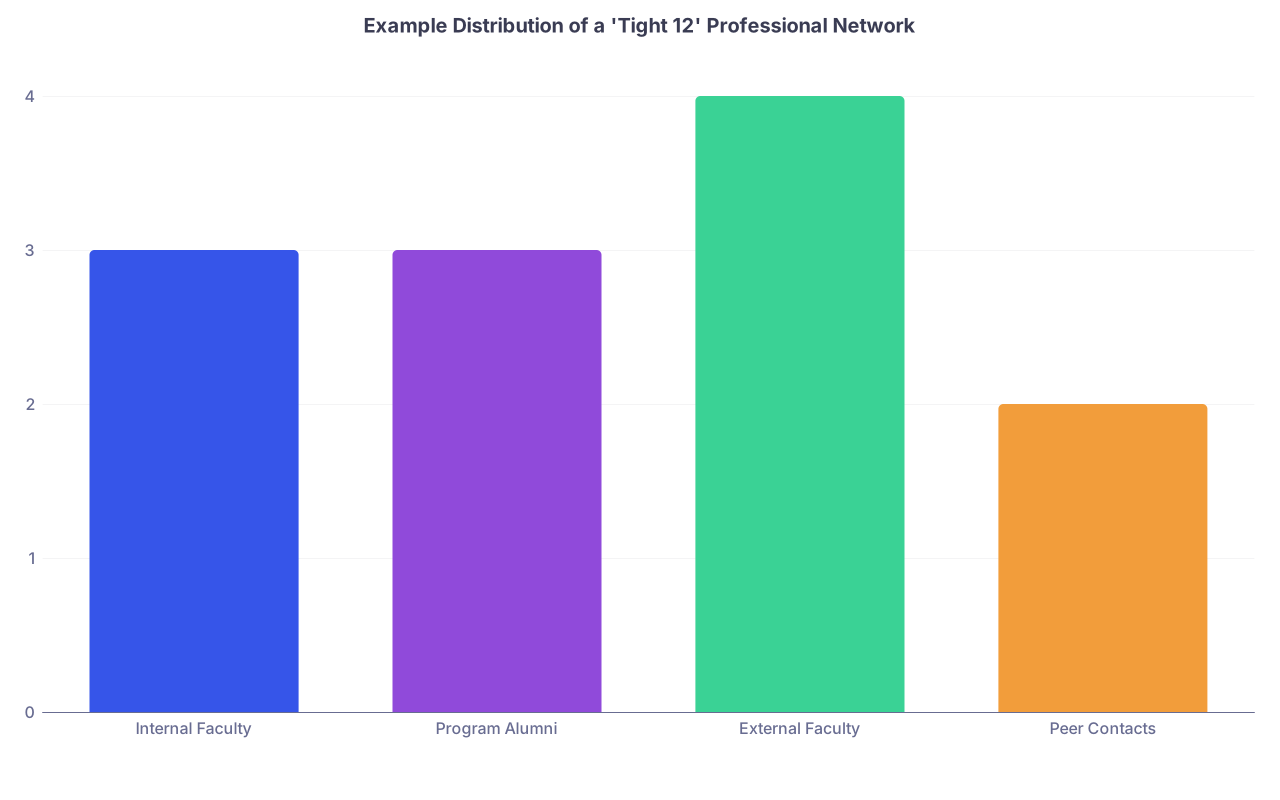
| Category | Value |
|---|---|
| Internal Faculty | 3 |
| Program Alumni | 3 |
| External Faculty | 4 |
| Peer Contacts | 2 |
You maintain this group like this:
- Twice a year, send a short update email.
- “Quick update from [Your Name] – PGY-2 at [Program]”
- 3 bullets:
- Rotation highlights
- Any posters/papers accepted
- Application timetable (“Planning to apply to [X] in [cycle/year]”)
- One short thank you or question if appropriate.
This is not spam. This is you making it easy for people to remember who you are when it’s time to:
- Forward a job posting
- Mention your name at a fellowship selection meeting
- Reply “Happy to talk” when someone asks, “Do you know any strong residents from community programs?”
Step 8: Accept the Constraints, Then Outsmart Them
There are some realities you can’t wish away:
- Your program name may not ring bells.
- Your faculty may not already sit on national selection committees.
- You may have less ready-made research flow.
Fine. So you compensate, deliberately:
- You will probably need to apply to more places.
- You will probably need slightly stronger objective stuff (Step 2, in-training exam, letters that explicitly say “top X% of residents I’ve worked with”).
- You will probably need at least one “bridge” advocate—someone not at your program whose name carries weight and is willing to attach that name to you.
Stop waiting for your program to solve this. It won’t. Most community programs barely have the infrastructure to run noon conference, forget long-term faculty development pipelines.
That doesn’t mean you’re stuck. It means you’re operating on “self-serve.” Once you accept that, things actually get simpler:
- You identify your targets.
- You build your tight 12.
- You create 2–4 tangible outputs (posters/QI/papers).
- You show up consistently for 2–3 years.
I have seen residents from truly no-name programs match into:
- Cards at places like UAB and Ohio State.
- GI at strong university affiliates.
- Competitive hospitalist gigs in big urban systems. And it wasn’t magic. It was this exact pattern.
Simple Example Timeline: PGY-1 to Fellowship/Job
Just so you can see how this looks laid out:
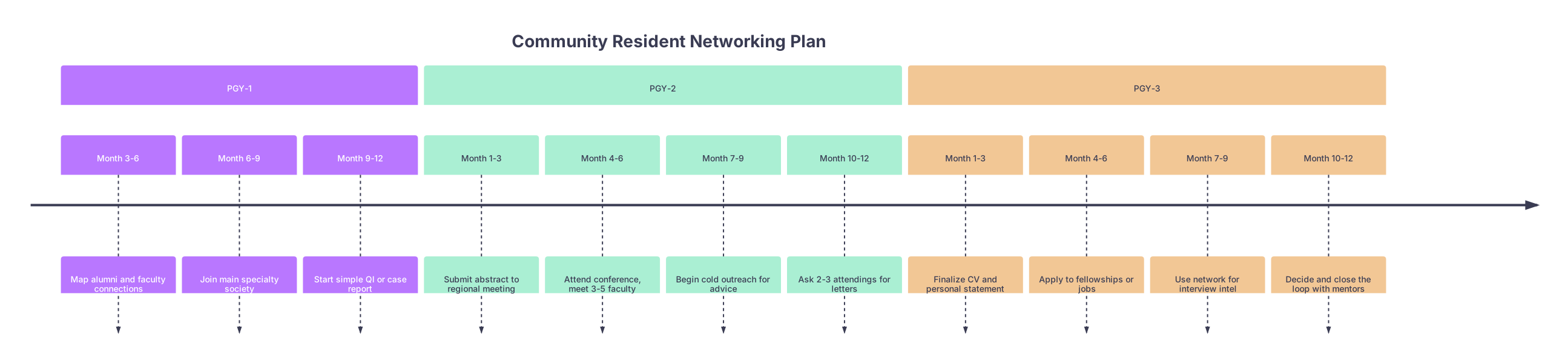
| Period | Event |
|---|---|
| PGY-1 - Month 3-6 | Map alumni and faculty connections |
| PGY-1 - Month 6-9 | Join main specialty society |
| PGY-1 - Month 9-12 | Start simple QI or case report |
| PGY-2 - Month 1-3 | Submit abstract to regional meeting |
| PGY-2 - Month 4-6 | Attend conference, meet 3-5 faculty |
| PGY-2 - Month 7-9 | Begin cold outreach for advice |
| PGY-2 - Month 10-12 | Ask 2-3 attendings for letters |
| PGY-3 - Month 1-3 | Finalize CV and personal statement |
| PGY-3 - Month 4-6 | Apply to fellowships or jobs |
| PGY-3 - Month 7-9 | Use network for interview intel |
| PGY-3 - Month 10-12 | Decide and close the loop with mentors |
Is it perfect? No. Does something like this consistently work better than “just hope”? Yes.
Common Mistakes That Kill Networking From Community Programs
I’m going to be blunt here because I’ve watched people sabotage themselves:
Hiding your ambition because “no one here does that”
- Say what you want out loud. To your PD. To your attendings. To alumni. Nobody can help you if you’re pretending you’re fine staying local when you’re not.
Waiting until PGY-3 to care
- If you start thinking about cards fellowship in October of PGY-3 with no national presence, no external advocates, and no projects, you’ve made life very hard. Not impossible. But unnecessarily hard.
Sending generic “please advise” emails
- Non-specific, copy-paste emails get ignored. Make your outreach sharp: who you are, what you want, why you’re asking that person.
Trying to “network” with everyone
- You don’t need 100 loosely acquainted attendings. You need 8–12 people who would actually pick up the phone or reply to an email about you.
FAQ (Exactly 4 Questions)
1. My PD is supportive but has no external connections. How do I work around that without offending them?
You do both. Keep your PD fully in the loop: tell them your goals, ask for honest feedback, get their letter. Then say, “I know we don’t send many people to [X]. I’m planning to reach out to faculty at [some programs] for advice and to see what’s realistic. I’ll keep you updated so we’re aligned.” Most PDs respect the hustle if you’re transparent and not implying they’re inadequate. You want them on your side, not surprised later.
2. I’m introverted and hate small talk. Can I still build a strong network?
Yes, but don’t copy extrovert tactics. Play to your strengths: thoughtful 1:1 conversations, good follow-through, and written communication. Aim for a small number of deeper relationships instead of working a room. At conferences, set a goal of 2–3 real conversations per day. Use email follow-ups heavily. You don’t have to charm a whole crowd; you just have to connect with a few people and then maintain that connection.
3. How many conferences should I realistically attend as a resident at a community program?
If money and coverage are tight, 1–2 per year is enough, and sometimes even 1 big one total can be useful if used well. Prioritize: (1) your main specialty society national meeting once, (2) a regional or state meeting where you’re more likely to actually talk to speakers and leaders. Go when you have something to present if possible. If you get travel support, great. If not, pick the single most strategic meeting and treat it like a mission, not a vacation.
4. What if I do all this and still don’t land my dream fellowship or job on the first try?
Then you reassess and play a two-step game. Maybe you take a strong hospitalist job with research/teaching opportunities for 1–2 years, build more concrete output and references, and reapply. Or you match into a mid-tier fellowship with a known track record of sending people to advanced fellowships/jobs afterward. Coming from a community program, sometimes the path is not one giant leap but two well-planned moves. The network you built does not disappear—it compounds. And applying from a place where you now have stronger mentors and output often changes the result.
Key points to walk away with:
- You’re not doomed by being at a community program, but you are responsible for building the scaffolding others get for free.
- Aim for a small, intentional network (your “tight 12”) instead of vague “connections.” Maintain it deliberately.
- Use every lever you’ve got—faculty histories, alumni, conferences, cold outreach, clinical work—to create a few strong advocates and tangible output over 2–3 years.


