

You are standing in a crowded hotel ballroom at 7:45 PM. Your badge says “PGY-2” and the subspecialty society logo is hanging from your lanyard. Around you, people are greeting each other by first name, laughing about last year’s meeting, and casually mentioning multi-center trials like they are weekend plans. You are holding a drink, you do not know where to stand, and the thought “I should network” is colliding with “I want to go back to my room.”
This is the problem: everyone tells you to “network early” in subspecialty societies. No one teaches you how to do it without feeling fake, lost, or like an annoying student hovering near the cheese table.
Let me break this down specifically.
1. What “Networking” Actually Means in Subspecialty Societies
In subspecialty societies, networking is not “collect as many business cards as possible.” That is amateur hour. In reality, for trainees, it means three things:
Getting on the radar of people who:
- Write the guidelines
- Run the big fellowships
- Control the serious multicenter projects
Converting brief interactions into ongoing, concrete relationships:
- Co-authorships
- Committee roles
- Letters of recommendation
- Informal mentorship
Doing all of this while not burning time, energy, and money on random small talk that never turns into anything useful.
You are not trying to “be known by everyone.” You are trying to be known by the right dozen people, in the right niche, over several years.
Let me be even more blunt: in many subspecialties, the same 30–50 people show up repeatedly in:
- Editorial boards
- Major guideline papers
- NIH study sections
- Fellowship program leadership
Those are the people you want to orbit.
2. Before the Meeting: Targeted Prep Instead of Vague Hope
The biggest mistake I see trainees make: they show up to a national meeting with zero plan and hope that proximity will magically create connections. It will not.
You need a short, surgical pre-game.
2.1 Define Your “Networking Objective” in One Sentence
If you cannot answer this clearly, you will drift.
Examples:
- “I want to identify 3–4 potential mentors in advanced heart failure who might take me for research elective or fellowship.”
- “I need to meet at least one person on the education committee who can help me get involved in curriculum work.”
- “I want to find someone doing health services research in inflammatory bowel disease who is open to multi-center database projects.”
If your goal is “just meet people,” you will waste the meeting.
2.2 Map the People, Not Just the Sessions
Two weeks before the meeting, stop scrolling random abstracts and do this instead:
Pull the program PDF.
Highlight:
- Named lectures
- Panel moderators
- Course directors
- Committee meetings that are open to attendees
For your niche (say, pediatric epilepsy, structural heart, interventional pulm), make a list of:
- 5–10 “A-list” names (the people whose names are on guidelines, trials, classic reviews)
- 10–15 “B-list” names (mid-career people who run busy programs, sit on committees, or are clearly rising)
Google them quickly:
- Where are they now?
- What are they publishing in last 3–5 years?
- Any ongoing multi-center work?
You are building a hit list, not a phone book.
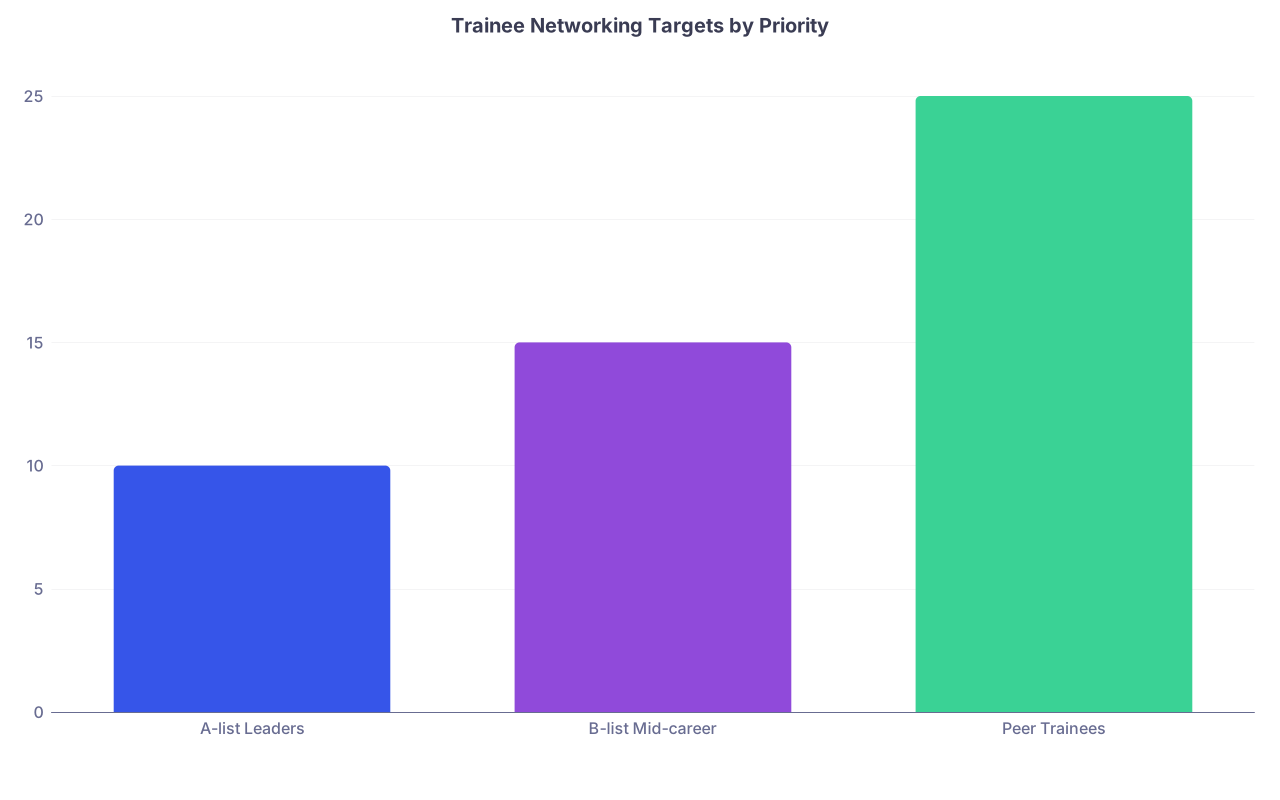
| Category | Value |
|---|---|
| A-list Leaders | 10 |
| B-list Mid-career | 15 |
| Peer Trainees | 25 |
2.3 Email a Few Targets Before You Go (Correctly)
You do not blast 50 people. You send 4–6 highly targeted emails.
Basic template:
- Subject: “Trainee interested in [specific niche] attending [meeting name] – brief hello?”
- First line: Who you are in one sentence (PGY, institution, intended subspecialty).
- Second: One specific reason you are reaching out (paper of theirs you read, trial you followed, committee work you admired).
- Third: A concrete ask that is reasonable:
- “If you have 10 minutes for a quick hello after your [session name], I would value the chance to briefly introduce myself and ask 1–2 questions about [X].”
Keep it under 150 words. No attachments. No CV yet. You are asking for 10 minutes, not a job.
If two reply, that is already a win.
2.4 Load Your “Conversation Ammo”
You need 3–4 topics you can credibly talk about that are adjacent to their work.
For example, if you are going to the American Epilepsy Society meeting and you want to meet a leader in SUDEP research:
- Read one of their recent papers (not the one from 1998 everyone cites).
- Write down 2 specific questions or comments:
- “Your paper on nocturnal monitoring and SUDEP risk made me think about how we handle this in our community hospital patients, where resources are thin. Has anyone looked at low-cost screening approaches at scale?”
This is how you avoid the deadly “I really like your work” with no follow up. That line is useless.
3. On-Site: How to Act like You Belong (Without Faking It)
I have watched this play out in hotel conference centers for years. There is a predictable difference between trainees who network well and those who hover in the back with their co-residents.
3.1 Rule One: Do Not Travel in a Trainee Pack
If you wander everywhere with 3 co-residents, you will not talk to anyone important. You form a social wall.
Meet your friends for meals, fine. But during key sessions, breaks, receptions—split up. You are not in undergrad orientation.
3.2 Where the Real Networking Actually Happens
Not where you think.
It is rarely during the big plenaries. It is:
- At the microphones after a contentious session
- In the 10 minutes after a smaller symposium when speakers step off the stage
- During poster sessions, especially late when the crowd thins
- At early-morning committee or interest group meetings
Those “Interest Group” or “Working Group” sessions buried at 7:00 AM on the schedule? That is where the future insiders are.

| Step | Description |
|---|---|
| Step 1 | Check Program |
| Step 2 | Identify Small Symposia |
| Step 3 | Find Interest Group Meetings |
| Step 4 | Poster Sessions |
| Step 5 | Talk to Speakers After |
| Step 6 | Introduce to Chairs |
| Step 7 | Visit Targeted Posters |
3.3 How to Approach a Senior Person without Being Awkward
Scenario: They just finished moderating a session. There is a small cluster of people waiting to talk.
Here is the sequence that works:
Stand within 3–4 feet, slightly off to the side. Not directly behind like a stalker.
When there is a natural gap, step in with:
- “Dr. X, thank you. I am [Name], a [PGY-2 IM resident at ____] interested in [your niche]. I had a quick question about your point on [specific detail].”
Ask one focused, specific question. Max 30–40 seconds.
Listen to the answer without interrupting.
Then:
- “This is very helpful. I am hoping to go into [field] and would appreciate the chance to follow your work more closely. Are you open to a brief follow-up email so I can ask you a couple of questions about training paths?”
Get their card or ask for their email directly.
Exit. Do not cling.
You are signaling: you are respectful of their time, serious about the field, and not trying to squeeze 20 minutes out of them in a hallway.
3.4 Using Posters as Networking Weapons
You presenting a poster? Good. Most trainees squander this.
First, timing:
- Be at your poster early.
- Stay for the full assigned time.
- Avoid constantly looking at your phone. It screams “I do not want to be here.”
Second, the 20–30 second script:
When someone stops:
- “Hi, I am [Name], PGY-[x] in [specialty] at [institution]. This is a [retrospective / pilot / QI] project on [1-line problem]. We found that [headline finding]. The next step we are exploring is [brief future direction]. I would welcome your thoughts, especially on [point you actually want input on].”
That is it. Then let them respond.
Third, identity scanning:
- Glance at badges. If you see “Program Director,” “Fellowship Director,” or big-name institutions, you slow down, engage more deeply, and end with:
- “Would you be open to me emailing you this poster and a brief question about how to expand this work in a multi-center way?”
Your poster is a conversation starter, not a result in isolation.
Now, flip it. You visiting other posters:
- Go to posters in your niche outside your institution.
- Ask the trainee: “Who is your PI on this? Are they here?” If yes, talk to the PI too.
- When you find a PI doing something aligned with your interest:
- “I am looking for opportunities to contribute to work like this during residency. Do you ever involve external collaborators on data tasks or secondary analyses?”
One such conversation can yield a remote project and a future co-authorship.
4. Subspecialty Societies: Committees, Working Groups, and How to Get Inside
Joining the society and paying trainee dues is nothing. That is table stakes. The leverage comes from committees and working groups.
4.1 Understand the Structure
Most serious subspecialty societies have:
- Standing committees: Education, Research, Guidelines, Diversity, Trainee Affairs
- Sections / SIGs (Special Interest Groups): e.g., “Advanced Heart Failure,” “Neuroimmunology,” “Interventional Pulmonology”
- Task forces: Short-lived groups for a guideline, statement, or position paper
You want to insert yourself where:
- Trainee membership is explicitly allowed
- Work product gets published or widely disseminated
| Option Type | Yield for Trainees |
|---|---|
| Education Committee | High – talks, curricula |
| Trainee Section | Medium – peer network |
| Guideline Taskforce | Very High – publications |
| SIG / Working Group | High – niche visibility |
| Social Media Team | Medium – fast but shallow |
4.2 How to Actually Get on a Committee
People imagine there is some secret nomination ritual. There usually is not. It is more mundane:
- There is a call for volunteers on the society website / member email.
- Chairs quietly ask known colleagues, “Do you have any good trainees?”
- Rarely, someone meets you at a meeting and thinks, “This person seems serious and articulate. I can use them.”
Your strategy:
- Identify 1–2 committees or SIGs that match your stated interests and CV.
- Email the chair after meeting them once in person or at least after seeing them in action at a session.
Email structure:
- Line 1: Who you are (again, compress your identity to 1–2 lines).
- Line 2: What you are already doing locally that is relevant. They do not want theoretical interest; they want evidence of action.
- Line 3: A specific way you can contribute:
- “I have experience building resident-level curricula and would be happy to help with slide sets, trainee resource pages, or survey-based projects for the committee.”
You are offering labor. Real work. That is your currency as a trainee.
If the society has a formal trainee application form, fill it out, then still send a personal note to the chair. Both.
4.3 The “Small Job, Done Perfectly” Principle
If you manage to join a committee, your first assignment will be small. A paragraph for a newsletter. Data collation. Drafting a survey. Editing slides.
Do not treat this as grunt work. This is your audition.
Do it:
- Early (not “on time”—early).
- Clean.
- With one or two value-adding suggestions.
Then explicitly close the loop:
- “Attached is the draft survey with your requested changes. I also suggested adding 2 questions on [X] because I have seen this be relevant in our local program. Happy to revise further.”
People remember who is low-friction and high-output. Those are the trainees they invite onto papers and later onto bigger roles.
5. Turning One-Off Encounters into Ongoing Relationships
Most networking fails in the follow-up. Trainees collect emails, have good 5-minute conversations, then vanish.
5.1 The Follow-Up Email: 24–72 Hours
Within 1–3 days after the encounter (ideally while the meeting is still ongoing):
Subject: “Thank you – brief chat after [session name] at [meeting]”
Structure:
- Line 1: Thank them and anchor the context (“We spoke briefly after your session on [X] at [meeting].”)
- Line 2: Repeat one concrete thing you learned or appreciated.
- Line 3–4: One specific follow-up question OR a concrete ask:
- “Would you be open to a 15-minute Zoom in the next month so I can ask you about how you built your career focusing on [niche] as a clinician-investigator?”
- Or, “If you ever look for extra help on [type of project], I would be extremely interested in contributing, even at a grunt-work level (data cleaning, chart review, etc.).”
Include your CV as an attachment quietly. Do not pitch it. Let them open if they care.
5.2 The “Every 3–6 Months” Touch
You do not spam them. You do not disappear either.
Good reasons to email:
- You published or presented something in their area.
- You saw a new guideline or paper they wrote and have a thoughtful question.
- You are about to apply for fellowship and would value a 10-minute perspective on programs.
Example:
- “I wanted to share a brief update – we just presented a small retrospective series on [topic] at [regional meeting]. Your earlier suggestion about [X] helped shape the analysis. If you have any thoughts on how to make this more multicenter in the future, I would be very grateful.”
This is not small talk. It is progress reporting.
5.3 When to Ask for a Letter of Recommendation
Not after one hallway conversation. That is rude and transparent.
You ask for letters from subspecialty society contacts when:
- You have worked with them on at least one concrete project OR
- You have had multiple deep conversations over 6–12 months and they know your trajectory, plus you have strong home-institution letters already.
When you ask, you must say:
- “Would you feel comfortable writing a strong letter of recommendation for my [fellowship / grant] application, based on [our work on X / your knowledge of my Y]?”
Give them an out. If they hesitate, back off. A lukewarm letter from a famous name hurts more than it helps.
6. Remote Networking: Between Meetings and in a Post-Zoom World
Society meetings happen once a year. Your career does not. You cannot hibernate between conferences.
6.1 Use Webinars and Virtual Events Intelligently
Almost every subspecialty society now runs:
- Quarterly webinars
- Virtual case conferences
- Online journal clubs
Most trainees watch passively with cameras off. That is fine if you just want content. If you want connection, you:
- Turn your camera on when appropriate, especially in smaller meetings.
- Ask one concise question in the chat or live Q&A that shows you did some thinking.
- Afterward, email the speaker:
- “I was the resident who asked about [X] during your webinar. Thank you again for your insights on [Y]…”
You are converting a nameless chat question into a touchpoint.
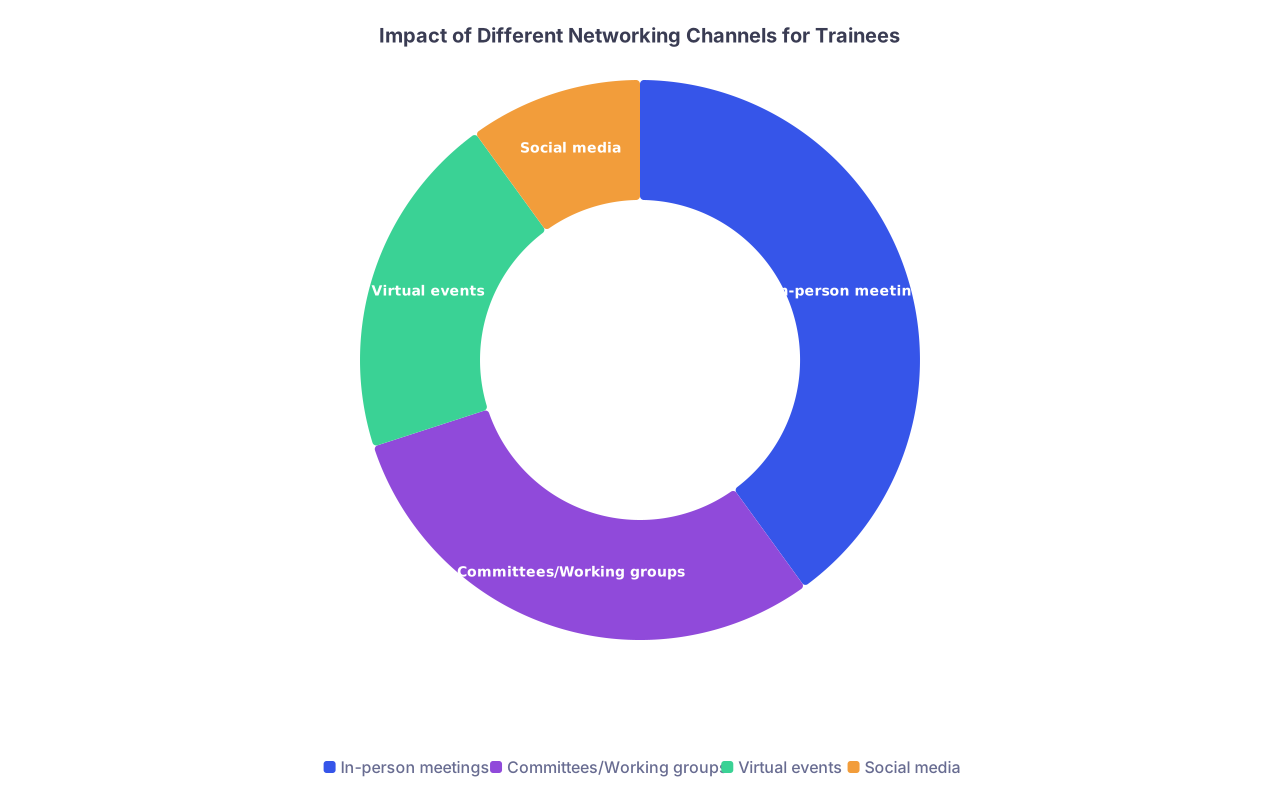
| Category | Value |
|---|---|
| In-person meetings | 40 |
| Committees/Working groups | 30 |
| Virtual events | 20 |
| Social media | 10 |
6.2 Social Media: Use, Do Not Live There
Twitter/X, LinkedIn, and even specialty Slack groups have become partial extensions of subspecialty societies.
Use these platforms to:
- Follow key leaders and society accounts.
- Occasionally comment intelligently on threads about new papers or guidelines.
- Share your work (when you have something, not every quiz question you answered at 2 AM).
Bad use:
- Replying sycophantically to every tweet from a big name.
- Arguing aggressively with senior people without grounding in data.
When someone you respect posts a new paper:
- You quote-tweet or reply with: “Really interesting approach to [X]. I especially appreciated the [specific method]. Curious how you see this influencing [clinical scenario].”
Then, over time, if you meet them at an in-person meeting, you have a bridge:
- “We have interacted briefly on Twitter about your [topic] paper. I am [Name]…”
7. Common Mistakes Trainees Make (And How to Avoid Them)
I am going to be direct here. I see the same errors every year.
7.1 Mistake: Being Vague and Generic
“Hi, I am interested in [very broad field]. Do you have any advice?”
This is lazy. You will get generic, forgettable answers.
Fix:
- Ask specific, context-rich questions:
- “For someone at a mid-sized program without a [specific lab/service], what is the best way in residency to get exposure to [technique] that matters for fellowship?”
7.2 Mistake: Over-Talking, Under-Listening
Trainees nervous-ramble. They tell their entire life story in 3 minutes. Senior people mentally check out.
Fix:
- Think: 60–70% listening, 30–40% talking.
- Your “who I am” intro should be under 20 seconds.
- If you notice yourself talking for more than 45–60 seconds uninterrupted, stop and flip it back: “How do you think about…?”
7.3 Mistake: Trying to Network with “Everyone”
Quantity over quality. Collecting 20 business cards, remembering none.
Fix:
- Identify 5–10 strategic people in your micro-niche.
- Aim for 2–3 meaningful interactions with a subset of them over 1–2 years.
- Accept that deep networking is slow.
7.4 Mistake: Being Transactional Too Early
This is where you blow relationships.
Examples:
- “Can you help me get a fellowship at your program?” after one meeting.
- “Can you put me on a paper?” as the second email.
Fix:
- Offer help before asking for favors.
- Let the first 1–2 interactions be about learning and contribution, not extraction.
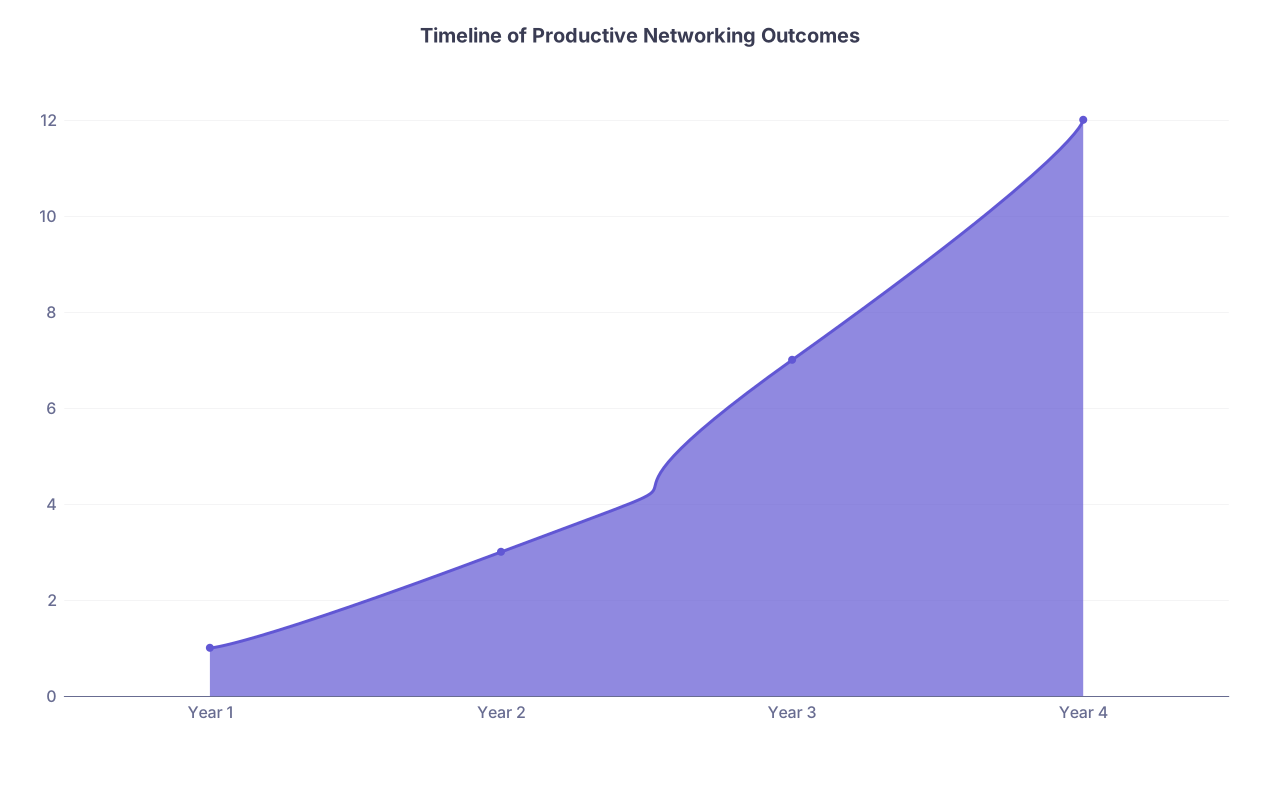
| Category | Value |
|---|---|
| Year 1 | 1 |
| Year 2 | 3 |
| Year 3 | 7 |
| Year 4 | 12 |
8. Putting It Together: A Concrete 12-Month Plan
Let me give you a realistic, not-theoretical sequence for a PGY-2 aiming at a competitive subspecialty.
Month 0–1:
- Join the relevant subspecialty society as a trainee.
- Identify 1–2 SIGs and 1 committee you might fit (often education or trainee-related).
- Start reading 1–2 recent guideline papers and identify repeating author names.
Month 2–3:
- Attend a virtual webinar; ask one smart question.
- Email the speaker afterward, short and specific.
- Ask your local mentor who in that society they know and can introduce you to by email.
Month 4–6:
- Submit an abstract (even small) to the annual meeting.
- Reach out to 3–4 targeted people 2–3 weeks pre-meeting asking for a 10-minute hello.
- Block your schedule at the meeting for:
- Your poster
- One SIG / Interest group
- One committee open session
Month 7–9:
- Follow up with 3–5 people you met at the meeting.
- Apply formally for a trainee spot on a committee or working group.
- Volunteer for something concrete: survey build, education resource, small writing task.
Month 10–12:
- Deliver excellent work on whatever you were given.
- Present progress at a virtual committee meeting.
- Begin discussing, with 1–2 mentors from the society, how to position yourself for fellowship applications and potential multi-institution projects.
Walk this through for 2–3 years and you stop being “random trainee from [X] program” and start being “that resident/fellow who is always well-prepared and helpful in [niche] group.”



FAQ (Exactly 4 Questions)
1. I am introverted and hate receptions. Can I still network effectively in subspecialty societies?
Yes, but you need to lean into formats that suit you. Smaller settings—interest group meetings, committee calls, one-on-one coffees—are far more efficient than noisy receptions anyway. Aim for targeted, pre-arranged 10–15 minute conversations, structured emails, and real work (committee tasks, collaborative projects) where your output speaks louder than your ability to mingle.
2. How early in training should I start engaging with subspecialty societies?
Earlier than you think, but with proportional expectations. As a MS3/MS4, you focus on exposure: attend one meeting if you can, present a poster, observe the major players. As a PGY-1/2, you start actual engagement: abstracts, virtual webinars, occasional emails. By PGY-2/3, you should be positioning for committee roles and real mentorship. Waiting until the fall before fellowship applications is late and forces desperation.
3. What if my home institution is not “famous” in my target subspecialty?
Then subspecialty societies are even more critical for you. They level the playing field somewhat. Your job: over-prepare, show up consistently, and volunteer for visible but manageable tasks in society work. I have seen residents from completely unrecognized programs end up with national mentors through guideline taskforces or SIG work, then match into top-tier fellowships. It is harder, but absolutely doable if you treat the society as your broader academic home.
4. How do I avoid coming across as fake or opportunistic when networking?
You focus on three things: specificity, contribution, and continuity. Specificity means you approach people with real questions tied to their actual work, not flattery. Contribution means you offer your time and skills on projects instead of just asking for favors. Continuity means you maintain light but consistent contact over years, not intense bursts around application season only. Do that, and most serious people in your field will see you as committed, not opportunistic.
Key points:
- Target a small number of high-yield people and groups in your subspecialty; do not try to “network with everyone.”
- Convert brief meeting encounters into concrete follow-ups, committee work, and ongoing mentorship over 1–3 years.
- Your main leverage as a trainee is doing small, unglamorous tasks reliably and well—inside subspecialty societies, that is how you stop being invisible.


