

Most trainees use Twitter like spectators; the ones who get mentors use it like a surgical instrument.
Let me break this down specifically: academic Twitter (call it #MedTwitter if you want) is not about “being active online.” It is a tactical networking platform where senior faculty, program directors, editors, and grant reviewers are already talking in public. If you show up correctly, you stop being invisible.
You want mentors. Not followers. Not “engagement.” Actual humans in your field who will answer your DMs, send your name to a search committee, invite you onto a project, or quietly tell you, “Do not apply there; the culture is toxic.”
That requires structure, intent, and a little courage. Not a social media personality.
1. Understand What Mentors Look For On Twitter
Mentors are not scrolling Twitter hunting for random mentees. They are doing three things:
- Staying current in their niche (articles, methods, policy).
- Tracking who consistently adds value in those conversations.
- Remembering names that keep showing up with useful, respectful, well-framed contributions.
So your job is to be:
- Discoverable
- Legible (people can tell who you are and what you care about)
- Consistently useful in a narrow slice of medicine
The three kinds of presence mentors notice
In practice, mentors tend to notice:
The Curator
The person who reads, summarizes, and organizes new literature in a focused niche.
Example: “Resident who always threads key ICU trials in clear language with actual numbers, not vague takes.”The Builder
The person who shares what they are making: QI projects, simple figures, teaching slides, code, small datasets, clinic tools.
Example: “Fellow posting short videos of point-of-care ultrasound tips with citations.”The Connector
The person who reliably points others to opportunities, calls for papers, relevant threads, and tags appropriate experts without being annoying.
You can be some combination of these, but pick 1–2 lanes at first. Scattershot doesn’t work. “Sometimes I tweet sports, sometimes derm, sometimes crypto” reads as noise to the exact people you want to impress.
2. Build a Profile That Signals “Serious, Safe, Specific”
If your profile looks like a meme account, no mentor with a reputation to protect will touch it. Fix that first.
Handle, name, and photo
Keep it boring-professional:
Handle: some combination of your name and role.
Examples:@SarahKimMD,@AhmedCardioFellow,@JLee_IMresidentDisplay name: real name + short identifier
“Jordan Patel, MD | EM PGY-2”Photo: a clear, non-cheesy headshot. Not a group photo, not you with a cocktail, not a graduation selfie with ten relatives in frame.
Bio: build instant context
Your bio should answer three questions in 5 seconds:
- Who are you (training level, institution roughly, or region)?
- What are your clinical/academic interests?
- What will you talk about here?
A clean template:
IM resident | Interested in hospital medicine, sepsis outcomes, med ed.
Tweets: new papers, FOAMed, notes from conference talks. Views my own.
If you have one or two concrete things (pending manuscript, education project, small leadership role), add them. Do not lie. Do not oversell.
Link your institutional page, personal website, or Google Scholar if you have one. If you do not, a simple LinkedIn is fine.
Pinned tweet: your “elevator pitch”
Pin a tweet that acts as your intro thread. Something like:
- Short intro (who you are, current role)
- Your interests (2–3 specific areas)
- How you use this account (paper highlights, questions, project updates)
- A soft invitation: “Always happy to connect with others in #MedEd and #HospMed.”
That way, when someone clicks your profile from a reply, they get the full picture without digging.
3. Choose and Own Your Niche
Mentors do not help “generic med student who likes research.” They help “MS3 interested in geriatric cardiology and implementation science who keeps posting sharp takes on polypharmacy and readmissions.”
Niche is non-negotiable.
Narrow down properly
Use a simple three-part formula:
Clinical area + Academic angle + Method or theme
Examples:
- “Critical care + medical education + simulation-based training”
- “Neurology + health disparities + community engagement”
- “GI + quality improvement + endoscopy safety metrics”
Your tweets should make this niche obvious after a week of activity.
Use the right hashtags — sparingly
Hashtags on academic Twitter are more like “rooms” than SEO tricks. Overuse looks amateur.
Good field anchors:
- #MedTwitter
- #MedEd
- #FOAMed
- #CardioTwitter, #NephTwitter, #PulmTwitter, etc.
Use 1–3 max per tweet. A tweet with eight hashtags screams “I am new and trying too hard.”
4. What To Actually Tweet: A Practical Content Blueprint
Here is where most people collapse. They create a profile, follow 500 accounts, then freeze because they do not know what to say.
You do not need to be original. You need to be consistently valuable.
Start with three core content types
For the first 3–6 months, rotate among:
- Micro–literature reviews
- Live or semi-live conference notes
- Build-in-public project updates
1. Micro–literature reviews that do not annoy people
Take one new or important paper. Write 4–8 tweets:
- Tweet 1: Why this matters in one sentence
- Tweets 2–3: Patient population and main method in plain language
- Tweets 4–5: Core results with real numbers (absolute risk differences, NNT, etc.)
- Tweet 6: How it might change practice, or why it will not
- Optional: final tweet linking to the article, tagging first or last author
Example opening:
New RCT in JAMA on early vasopressors in septic shock that actually reports meaningful patient-centered outcomes.
TL;DR: modest mortality benefit, bigger OR time difference than I expected.
#MedTwitter #CritCare
Mentors notice:
- You actually read the paper
- You can summarize without hype
- You bother with absolute numbers
2. Conference notes that make you “the eyes in the room”
Whether you are at ATS, ASCO, or a tiny regional meeting, you can become useful to others.
Strategy:
- Before: tweet you are attending, list main tracks you care about
- During: for 3–5 sessions, write short, structured summaries (thread per session)
- After: 1 summary thread of “5 things I am taking back to my practice / project”
When live-tweeting a talk, tag the speaker if they are on Twitter and include the official conference hashtag. Do not paraphrase sloppily or misrepresent their data; this gets back to them.
Mentors see this and think: “This person shows up, pays attention, and synthesizes. Maybe I want to work with them.”
3. Project updates that prove you execute
You probably do not have an R01 and a dozen first-author papers yet. Fine. You can still show that you take ideas to completion.
Example sequence over weeks:
- “Starting a small QI project in our clinic to reduce missed lab follow-up. Looking at delayed lab result notifications and PCP response times. Suggestions for helpful papers?”
- “Drafted fishbone diagram on why lab follow-up fails in our clinic. Next step: run chart of missed results over 6 months pre-intervention.”
- “Early data from our clinic’s new lab follow-up checklist: missed results down from 7% to 3% over 3 months. Will present at our local QI day. Any #QI folks with tips on writing this up?”
You are not bragging. You are documenting work like a professional.
Frequency: enough to be seen, not enough to be exhausting
Aim for:
- 1–2 original tweets per day on average (or threads a few times a week)
- 3–10 thoughtful replies to others per day (more on that soon)
You do not need to tweet 20 times a day. That is how you burn out and start posting nonsense.
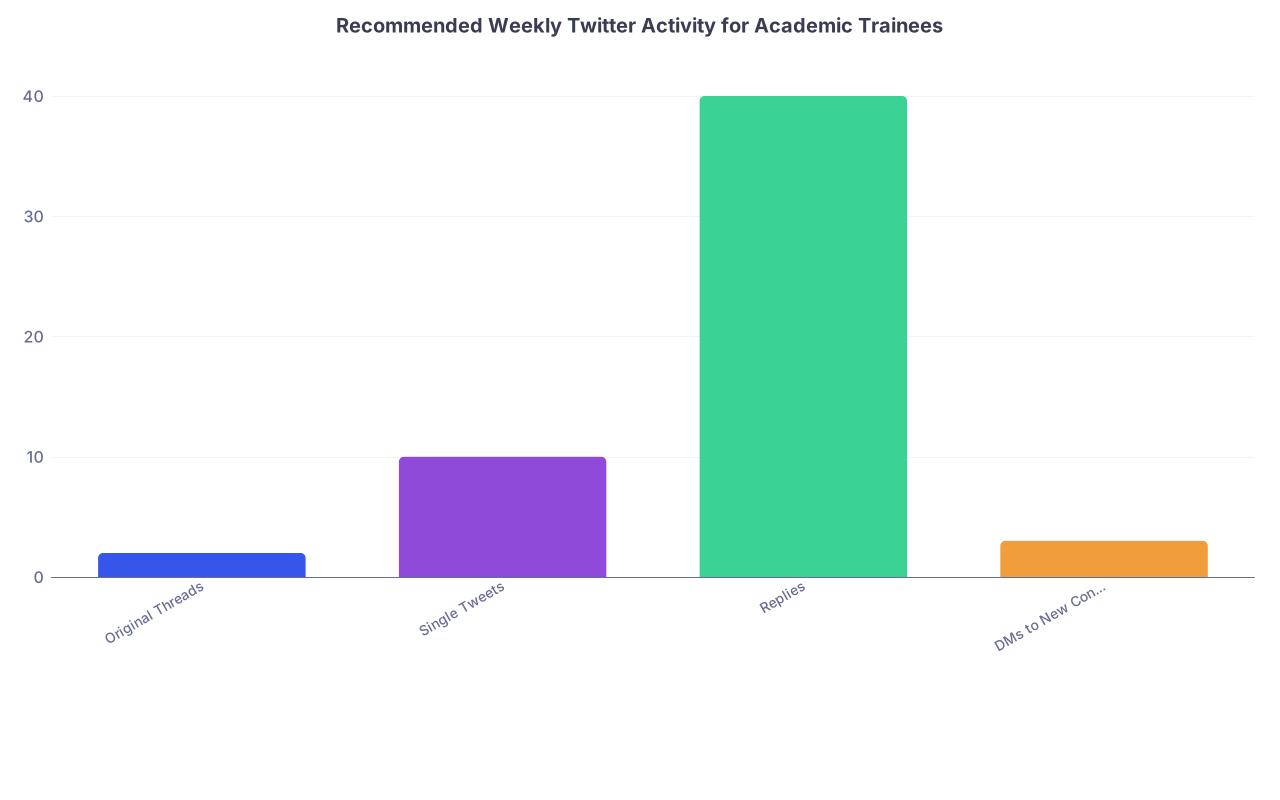
| Category | Value |
|---|---|
| Original Threads | 2 |
| Single Tweets | 10 |
| Replies | 40 |
| DMs to New Contacts | 3 |
5. How To Interact With Senior People Without Being Awkward
This is the delicate part. Passive tweeting is not enough. You need to enter existing conversations without coming off as a fan, a troll, or a spammer.
The reply strategy: contribute, do not perform
Most mentors notice you first in their replies, not their DMs.
Good replies look like:
- “Thanks for sharing. In our community hospital, we struggle to apply this because XYZ — have you seen any data in lower-resource settings?”
- “Really like your point about structured handoffs. We started using I-PASS last year and saw a decrease in near-misses, though still battling acceptance from some seniors.”
Bad replies:
- “Please follow me back!”
- “I love your work!!!” with nothing else
- Aggressive arguing with zero nuance or reading of the paper
You want to sound like a junior colleague at a conference coffee line, not a fan at a celebrity signing.
Quoting senior people without clout-chasing
Quote tweets are visible to their followers and yours. Use them surgically:
- Add clinical context: “Agree with X that this trial changes Y. In our system, the barrier will be Z (prior auth, staffing). Curious how others see this.”
- Add a missing reference: “Nice thread. For folks interested in underlying method, this 2018 paper gives a great explanation.”
Do not just quote with “This!!!” and five emojis. You are not in high school.
Cold DMs that actually get answered
You should not DM every person you admire. But if you have engaged with someone’s work publicly and they have liked or replied to you several times, you have a small window.
A good cold DM has:
- Context (“I am the IM resident who replied about the sepsis triage workflow yesterday”)
- Specific ask that takes <5 minutes to answer
- An easy “no” option
Example:
Dr. Smith,
I am a PGY-2 in IM at [Institution]. We have briefly interacted on Twitter about sepsis triage and QI.
I am designing a small resident-led QI project on early sepsis recognition in our ED. Would you be open to recommending 1–2 key papers or toolkits you think every team should read before starting?
If your time is limited no worries at all. I appreciate the work you share publicly here.
Best,
[Name]
That gets answered more often than you think.
Do not DM:
- Your CV asking for a fellowship spot
- Draft manuscripts asking for free full review
- Personal crises; use your actual support system and institutional resources
6. Use Twitter Lists and Search Like a Professional
Most people’s timelines are chaos. You should not rely on the default feed if you are using Twitter for serious networking.
Build targeted lists
Create private lists for:
- “My field – senior” (attendings, PIs, program directors)
- “My field – peers” (students, residents, fellows with similar interests)
- “Journals & editors” in your specialty
- “Conferences & societies”
Check these lists intentionally. It is like curated journals. Easier to participate in the right conversations.
Use advanced search to find your people
Twitter’s search can be filtered by keywords, hashtags, and people. Use it like PubMed for humans.
Example: you are into diabetic kidney disease.
Search:
"diabetic kidney" (filter: people)– find folks with it in their bio#NephTwitter "albuminuria"– see active conversationsfrom:[journal handle] "diabetic kidney"– see recent papers they posted
Engage selectively under those threads.

| Step | Description |
|---|---|
| Step 1 | Define niche |
| Step 2 | Search hashtags |
| Step 3 | Identify active seniors |
| Step 4 | Add to private list |
| Step 5 | Reply to 2 to 3 tweets weekly |
| Step 6 | DM small ask after rapport |
7. Publishing, Preprints, and Threads: Using Your Work as Magnet
Once you start having anything remotely sharable—poster, small paper, med-ed handout—you can use Twitter to make it visible to the exact people who might mentor you.
Sharing publications without being obnoxious
When your paper or abstract is out:
- Post a short thread: “Why we did this, what we found, what surprised us.”
- Include 1–2 simple figures or a visual abstract if allowed.
- Tag co-authors (with their permission) and the journal.
- If your paper is in a niche area, tag 1–2 senior people who have published a lot in that niche, but only if you have interacted before.
Example opening:
Our team just published a small retrospective study on missed follow-up of abnormal LFTs in an academic primary care clinic.
TL;DR: abnormal labs get lost more than we admit, and EHR “solutions” are not magic.
Short thread on what we found and how we are trying to fix it. #QI #MedTwitter
You are showing that:
- You can push a project to completion
- You are thinking about implementation, not just p values
Mentors like that combination.
Preprints and posters as conversation starters
You do not need a NEJM paper. Even a poster has networking value.
Ways to share:
- “Poster accepted at [regional conference] on our ED overcrowding project. Would love thoughts from others working on throughput metrics.”
- Attach a de-identified, allowed-to-share figure or poster image.
- Invite specific types of feedback: “Biggest gap we have is defining balancing measures.”
Trainees who do this correctly often get:
- Suggestions for better metrics
- DMs from people doing similar work
- The occasional “If you ever consider fellowship in X, reach out” from attendings you have never met
8. Guardrails: What To Avoid So You Do Not Nuke Your Reputation
I have seen residents sink fellowship chances with one idiotic tweet. Academic Twitter is public, searchable, and archived. Program directors read it. Journal editors remember handles.
You are building a professional signal, not venting into the void.
Lines you should not cross
- PHI. Never. No “funny cases” with enough detail for a patient to recognize themselves.
- Bashing your colleagues, nurses, or staff. Venting about systems, fine; targeting people, no.
- Mocking patients. This is an instant red flag for anyone considering mentoring you.
- Hot political takes unrelated to healthcare you would not say in front of your PD. I am not saying “stay apolitical.” I am saying, if your future chair reads this, you should not be embarrassed.
The performative outrage trap
Academic Twitter loves outrage cycles. You will see pile-ons about papers, institutions, individuals.
Joining these:
- Rarely helps your career
- Often signals that you act first, think later
- Makes senior people wary of being anywhere near your feed
You can critique ideas and structures without amplifying drama.
Example of mature critique:
I share the concerns others have raised about the lack of racial subgroup analysis in this trial, especially given the disease burden in Black patients.
Curious if anyone is aware of ongoing studies that center this question more explicitly.
Calm. Specific. Not personal.
Time and burnout
If you are on Twitter enough to build something real, you are close to being on too much.
Use some simple constraints:
- No Twitter during direct patient care
- No notifications; you check on your schedule
- One or two short windows a day (e.g., commute, lunch, post-call)
Once a month, scroll back 30 days. If your timeline looks unhinged, step away for a week.
9. Turning Twitter Connections Into Real Mentorship
The biggest mistake: assuming a few DMs equals mentorship. It does not. You need to graduate conversations off-platform when it makes sense.
The escalation ladder
Think of this as progressive steps:
- Consistent public interaction (replies, quotes, likes)
- Occasional DM with small, specific questions
- Zoom call or brief meeting at a conference
- Concrete collaboration (small project, co-author, panel)
- Ongoing check-ins → actual mentorship
Do not jump from step 1 to step 4.
Asking for a call without being a time-leech
After several positive interactions:
Dr. Lopez,
I have appreciated our exchanges here about palliative care in the ICU. I am an IM resident strongly considering a fellowship in palliative care with a focus on ICU communication.
If you ever have 15–20 minutes, I would be grateful for brief advice on how you approached fellowship applications and early career choices in this space. Completely understand if your schedule does not allow.
Thank you,
[Name]
You are not asking “Will you be my mentor?” You are asking for one concrete conversation. Many mentors enjoy that.
During the call:
- Ask 2–3 prepared questions
- Listen more than you talk
- End with: “Is there anyone else you think I should talk to?”
- Follow up once with a thank-you and any action taken based on their advice
If they keep engaging, suggest something small and tangible:
- “Would it be OK if I sent you a draft of the abstract once it is done for quick high-level feedback?”
- “Our team is putting together a short survey; if we draft it, would you be open to a brief look to ensure we are not missing something obvious?”
If they say yes and follow through more than once, you are in early mentorship territory.
Respecting boundaries
Some very senior people have “DMs closed” to avoid exactly this. Do not try to route around it. Interact publicly and see if they open the door later.
Remember: mentors owe you nothing. The more you show up as someone who does work, takes feedback, and does not demand constant attention, the more people will invest.

10. A Realistic 90-Day Plan To Become “Visible”
Let me give you something you can actually follow, not just theory.
Days 1–7: Setup and observation
- Clean your profile (photo, bio, pinned tweet).
- Follow 100–200 accounts: mix of senior people in your field, journals, societies, and a few peers.
- Create 3–4 private lists.
- Do not tweet much; just watch how conversations work.
Days 8–30: Start contributing lightly
- 2–3 short tweets per week summarizing a paper, podcast, or clinical pearl.
- 1–2 small threads (4–6 tweets) by day 30.
- 3–5 thoughtful replies per day to people in your lists.
Days 31–60: Establish your niche
- Commit to one main recurring pattern (e.g., “One paper a day” or “Weekly teaching threads”).
- Do at least 1 substantive thread per week.
- Reply or quote-tweet senior voices in your niche 3–7 times per week, adding real content.
- Soft-DM 1–2 people with very small asks if you have had several public interactions.
Days 61–90: Test mentorship doors
- Identify 3–5 senior people who seem aligned with your interests and responsive.
- For 1–2 of them, send a message like the “15–20 minute chat” template above.
- Share any small project you have underway or completed with a thread, inviting input.
- Start planning conference-attendance tweets (if you have upcoming meetings).
By 90 days, if you have done this consistently, you are no longer invisible. People in your niche will recognize your handle. Some will think of you when they see opportunities.
| Timeframe | Main Goal | Concrete Output |
|---|---|---|
| Week 1 | Set foundation | Profile optimized, lists created |
| Weeks 2-4 | Light contribution | 3–5 threads, 30+ quality replies |
| Weeks 5-8 | Niche visibility | Weekly threads, recurring pattern |
| Weeks 9-12 | Early mentorship outreach | 1–3 brief calls or DM exchanges |


