

You are a PGY-1 on night float. It is 2:30 a.m. You just patched together a workaround for yet another broken discharge process—again no meds to bed, again the same pharmacy delay, again an avoidable bounce-back risk. Your senior shrugs and says, “Yeah, we have been flagging that for years. It just never changes.”
That sentence—"it just never changes"—is exactly where most people stop. They rant on group chat, drop a line in the handoff, maybe put something in an incident report, then move on.
The small group of people who do not stop there? They end up on committees. They learn how the hospital actually makes decisions. They get their names attached to quality improvement projects and policy changes. And 5–10 years later, they are the ones other people email when they want something fixed.
This is about how you get into that group early. And more importantly, how you use hospital committees as a networking engine for a serious career in quality improvement (QI) rather than another time‑sucking “volunteer” line on your CV.
Why Hospital Committees Are the Hidden QI Network
Let me be blunt. Real quality improvement power does not live in:
- Your residency program’s “QI curriculum”
- A one‑off PDSA poster at the annual research day
- Some random online QI certificate you pay $500 for
It lives in badges, distribution lists, and standing meetings. Specifically:
- Pharmacy & Therapeutics (P&T)
- Quality and Safety Committee
- Sepsis/Code Blue/Resuscitation committee
- Readmissions committee
- Morbidity and Mortality (M&M) oversight
- Antimicrobial stewardship
- Infection prevention / CLABSI / CAUTI
- ED throughput / patient flow
- Transfusion committee
- Falls / pressure injury / nursing quality councils
These committees are not “nice to have.” They are where:
- Metrics are reviewed (CLABSI rates, door‑to‑needle times, readmissions)
- Root causes are debated
- Interventions are chosen
- Resources are allocated
- Policies are written and approved
- Pilot projects get institutional cover
If you are serious about QI, that is the ecosystem you need access to. Not later. Early.
The networking angle people miss
Everyone talks about “networking with attendings.” Fine. But committee networking is different:
- You meet cross‑departmental allies: nursing leadership, pharmacy, informatics, risk management, case management, rehab, social work, finance. These people actually operationalize your project.
- You see who truly drives change: not necessarily the most published person, but the one who chairs three committees and “just gets things done.”
- You learn the language of administration: ROI, denominator capture, case mix, benchmark data, regulatory requirements, Joint Commission standards.
Over a couple of years, that turns into a quiet but very real reputation: “Oh, they are serious about QI. They show up, they close the loop, they understand the system.” That is networking at the system level, not just social.
Step 1: Understand the Landscape Before You Walk In
Most trainees wander in blind. You should not.
Before you join anything, map what exists at your institution. You do not need an org chart, you need a working mental model of where decisions actually get made.
Ask two questions:
- “Who owns X metric here?”
- “Which committee signs off on changes that affect X?”
X can be: sepsis bundle compliance, CLABSI, door‑to‑balloon times, readmissions, length of stay, falls, pressure injuries, opioid prescribing, transfusion thresholds, anticoagulation reversal.
Then, quietly build yourself a list.
| Committee Type | Typical Trainee Role Potential |
|---|---|
| Quality & Safety | Project lead, data presenter |
| Sepsis / Code / Rapid Resp | Protocol audit, education rollout |
| Antimicrobial Stewardship | Antibiotic use review, order set input |
| Readmissions / Transitions | Discharge process project lead |
| Patient Flow / Throughput | ED–inpatient handoff optimization |
| Infection Prevention | CLABSI/CAUTI bundle compliance audits |
Now, very specific tactics.
How to find these committees without looking clueless
- Ask your program director: “Which hospital quality or safety committees have resident/fellow members? Who chairs them?”
- Email the hospital’s quality office: “I am very interested in QI. Is there a list of standing quality/safety committees, and do any have trainee representation?”
- Ask senior residents: “Who are the QI people here that actually get things done? Which committees should I try to sit in on?”
Do not lead with “I want to do a project.” That comes later. Lead with: “I want to understand how we improve outcomes here and where decisions are made.”
Step 2: How to Get on a Committee Without Being Token Trainee #4
The usual way trainees join committees is pathetic:
Someone sends a mass email: “We need a resident rep on the falls committee. Anyone interested?”
One person reluctantly volunteers. They show up, sit quietly, maybe bring donuts, then disappear six months later.
You can do much better.
Targeted ask, not random signup
Once you know which committee matches your interests and your schedule, you reach out to the chair directly.
- Be short
- Signal that you already understand something about the topic
- Offer value
- Commit to showing up consistently
Example:
Dr Smith,
I am a PGY‑1 in internal medicine with a strong interest in sepsis care and hospital quality. I heard from Dr Lee that you chair the Sepsis/Code Response Committee.
On nights I have noticed several recurring delays in antibiotic administration and fluid orders for suspected sepsis patients, especially during shift changes. I am interested in learning how the hospital approaches these issues and would like to attend the committee as a trainee member if there is room at the table.
I can commit to attending the monthly meetings this year and would be happy to help with data pulls, chart reviews, or small PDSA cycles between meetings.
Would it be possible to join the next meeting or talk briefly about whether this might be a good fit?
Best,
[Your Name]
You are not saying “I want to put this on my CV.” You are saying, “I have a specific lens, I noticed it on the ground, and I will do work.”
Chairs remember that.
Step 3: Work the Room Like a QI Person, Not a Student
Once you land a seat, the worst thing you can do is sit silently for six months and then ask for a letter. You are not there to be wallpaper.
You are there to:
- Learn the real constraints
- Spot feasible project angles
- Build relationships with people who control data, workflows, and approvals
Here is how you do that in practice.
First 2–3 meetings: shut up strategically
Do not start with “I have a project idea!” on day one. You have not earned the right. For the first few meetings:
- Read the agenda thoroughly before each meeting.
- Look for recurring agenda items: “CLABSI update,” “sepsis core measures,” “readmission trends.”
- Note who speaks with authority. Usually: the committee chair, nursing leadership, QI analyst, and that one crusty attending who knows all the backstory.
In the meeting:
- Take structured notes: metric, current performance, barriers mentioned, potential interventions.
- Pay attention to what gets deferred: “We need better provider buy‑in,” “IT bandwidth is limited,” “We need to pilot that on one unit first.”
Those phrases tell you what is actually possible.
Then, after 1–2 meetings, you start asking short, well‑aimed questions. Not speeches.
Examples:
- “Do we know how performance differs between day and night shifts on that metric?”
- “Has anyone looked at whether the order set is being used when these patients are admitted?”
- “Is the issue more about identification or about delays after identification?”
That is how you signal value without pretending you are running the place.
Step 4: Convert Committee Access Into Real QI Projects
Here is the payoff. Committees are idea factories, but most ideas die in the minutes. Your job is to catch the ones with legs.
Common pattern in a meeting:
- “We keep missing the 3‑hour sepsis bundle window at night.”
- Everyone nods.
- Someone says, “We should look into that.”
- Next agenda item.
You follow up with a very specific email:
Dr Smith,
At yesterday’s sepsis committee, there was discussion about delays in meeting the bundle at night. If no one is already working on this, I would be interested in doing a focused chart review of recent night‑time sepsis cases to identify where the delays occur (identification, order entry, pharmacy, bedside administration).
Would that be useful to the committee? If so, could I work with [QI analyst name] to define a case list and pull data?
Best,
[You]
You have:
- Framed a very tight, feasible first step
- Offered to do the grunt work
- Plugged yourself into the data people and the committee’s workflow
Do that a few times and you stop being “the resident” and become “the person we can ask to examine this issue.”
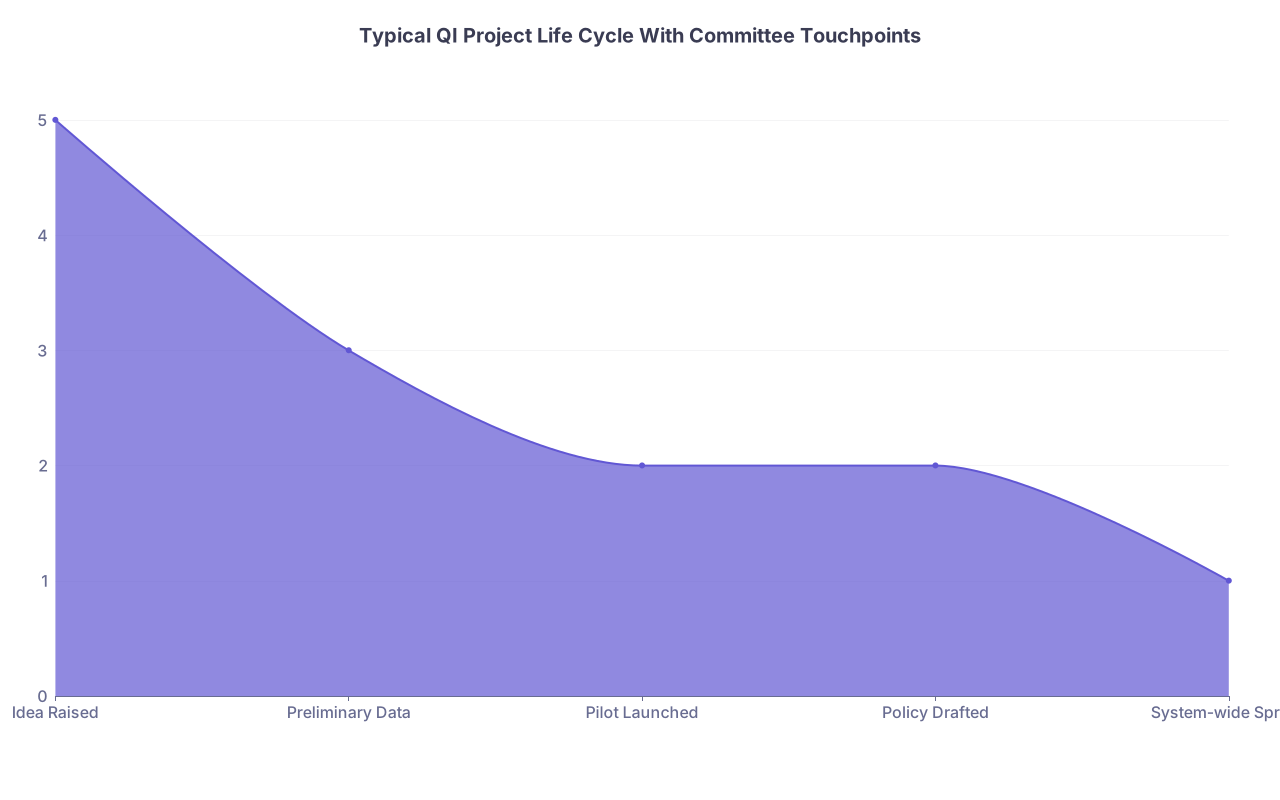
| Category | Value |
|---|---|
| Idea Raised | 5 |
| Preliminary Data | 3 |
| Pilot Launched | 2 |
| Policy Drafted | 2 |
| System-wide Spread | 1 |
That chart is how most ideas die. Five ideas raised. Three get preliminary data. Two make it to a pilot. One spreads hospital‑wide. Committees are the places where you can push something from stage 1 to stage 3 if you are persistent.
How to pick projects that will not die instantly
You want projects that:
- Align with existing institutional priorities (readmissions, sepsis, CLABSI, patient flow)
- Have clear, measurable endpoints
- Do not require massive IT build from day one
- Have a natural “pilot” unit or population
Examples of good starter projects:
- Increasing use of an existing sepsis order set on nights in the ED.
- Decreasing unnecessary daily labs on a single general medicine service.
- Improving documentation of indications for urinary catheters to support CAUTI work.
- Standardizing discharge instructions for a single diagnosis (heart failure, COPD) to support readmission work.
Weak starter projects:
- “Improve patient satisfaction.” Too broad.
- “Fix EHR workflow for everything.” Too big.
- “Change hospital policy on X controversial topic.” Too political.
If you are not sure, ask the chair directly: “From the committee’s perspective, what is the one or two small but meaningful QI questions that no one has time to tackle right now?”
You will get an answer. And probably a partner.
Step 5: Turn Committee Work Into Real Relationships
You are not networking if all you do is sit at the same table every month. Relationships form in the follow‑up.
Concrete moves:
After someone makes a sharp point in a meeting—say the QI analyst who knows the data inside out—email them:
“Your breakdown of the CLABSI data by device day was really helpful. If you ever have time, I would like to learn more about how you structure those reports. I am trying to build better data skills for QI.”When a nurse manager mentions a barrier on their unit, follow up:
“You mentioned during the meeting that night nurses are worried about sepsis alert fatigue. Would it be useful to get a couple of residents and nurses together to walk through the current alert logic and pain points?”When an attending leads a successful project:
“I saw your readmissions project discussed at committee. This is exactly the kind of work I want to do long term. If you are open to it, I would appreciate a brief conversation about how you got initial buy‑in and what you would do differently starting over.”
You are doing three things simultaneously:
- Learning practical QI tactics
- Getting informal mentorship
- Putting your name in their mental list under “people who care about this stuff”
That is networking. No cocktail reception needed.
Step 6: Protect Yourself From Being Used as Free Labor
Now the dark side. Hospital committees will happily absorb your time and energy without giving you authorship, recognition, or a seat when it matters.
You must manage this like an adult.
Red flags you are being used
- You are doing all the chart reviews, but only attendings present the results.
- Your name never appears on slides or documents, even for work you drove.
- You are “the resident rep,” but your comments are brushed off consistently.
- When you ask about authorship or presentations, everyone suddenly gets vague.
If you see this pattern, you do not need to throw a fit. You need to be explicit, early, and professional.
Before taking on substantial work, say something like:
“If I do the chart review and initial analysis on this subset, and we develop this into a QI project or abstract, would it be reasonable to list me as a co‑author / presenting author?”
Or:
“I am happy to help with this pilot. Could we clarify upfront how authorship would be handled if we write this up for a conference or journal?”
Reasonable leaders will respond well. If someone bristles at that question, that is data about whether you should keep investing your limited time there.
Step 7: Document What You Are Actually Doing (So It Counts Later)
You will forget details. Chairs will forget details. Your CV will turn into a vague graveyard of “Member, Quality Committee.”
Do not let that happen.
Maintain a simple one‑pager per committee:
- Committee name
- Dates of involvement
- Role (member, trainee representative, project lead)
- Specific contributions:
- “Led chart review of 50 sepsis cases to characterize night‑shift delays”
- “Co‑designed and implemented new discharge checklist for HF patients on Unit 5B”
- “Presented quarterly readmission data to committee and facilitated provider feedback sessions”
This makes it straightforward later to:
- Write strong, specific bullet points on your CV
- Prompt letter writers: “Here are the projects we worked on together and my specific role.”
- Talk convincingly in interviews: “On the hospital sepsis committee, I…” (and then you have receipts)

Phase‑Specific Advice: Student, Resident, Fellow, Early Attending
The phrase in your prompt—“tapping hospital committees early”—matters. What “early” looks like changes by phase.
Medical students
Most students either overreach (“I want to sit on the system‑wide quality council”) or underreach (“I am just a student, no one wants me there”).
The sweet spot:
- Join department‑level QI meetings or M&M planning sessions.
- Attach yourself to one attending who is visibly embedded in committees and ask to sit in on a few meetings as an observer.
- Offer to do very concrete pieces: data collection, process mapping, patient or provider surveys.
You are not there to lead. You are there to see how this world works and get early exposure to the politics and vocabulary.
Residents
This is prime time. You actually see the frontline pain points and have enough status to push small changes.
Your goals:
- Sit on at least one serious hospital‑level committee by PGY‑2.
- Lead at least one QI project that is explicitly tied to that committee’s agenda and data.
- Present your work at the committee and at least one external venue (local, regional, or national meeting).
You want to leave residency with a narrative: “I did not just do a residency research day poster. I was consistently involved in institutional QI structures.”
Fellows
Now the stakes are higher. You are close to job‑hunting.
You should be positioning yourself as:
- A subspecialist who understands system‑level quality issues (e.g., in ICU, cardiology, oncology)
- A bridge between frontline clinical practice and hospital leadership
- Someone recruitable as “our ICU QI person” or “our sepsis champion”
That means deeper engagement:
- Chair or co‑chair a subcommittee or working group.
- Take an existing hospital priority issue and move it meaningfully—documented improvements in a metric.
- Publish or present multi‑year or multi‑unit work.
At this stage, you should also be explicitly asking mentors: “If I want a future role as medical director for quality / patient safety, what committee and project experience will hiring committees expect to see?”
They will tell you.
How Committees Connect to the Future of QI (and Your Career)
Quality improvement is not static. The future is messy: AI‑driven risk scores, real‑time dashboards, value‑based payment models, increasingly aggressive regulatory metrics. Those things surface and get operationalized through committees.
If you want a future in:
- Hospital administration (CMO, CQO, VP of Quality)
- Clinical informatics
- Patient safety leadership
- Population health management
- Value‑based care / ACO leadership
Then early committee exposure is not optional. It is your apprenticeship.
You learn:
- How to balance regulatory demands (CMS core measures, Joint Commission) with daily realities.
- How to translate data into workflows (and vice versa).
- How to move clinicians, not just metrics. Getting that one curmudgeonly senior doc to actually use the order set is sometimes the hardest part.
And more subtly: you build a reputation as someone who understands both the clinical trenches and the boardroom view.
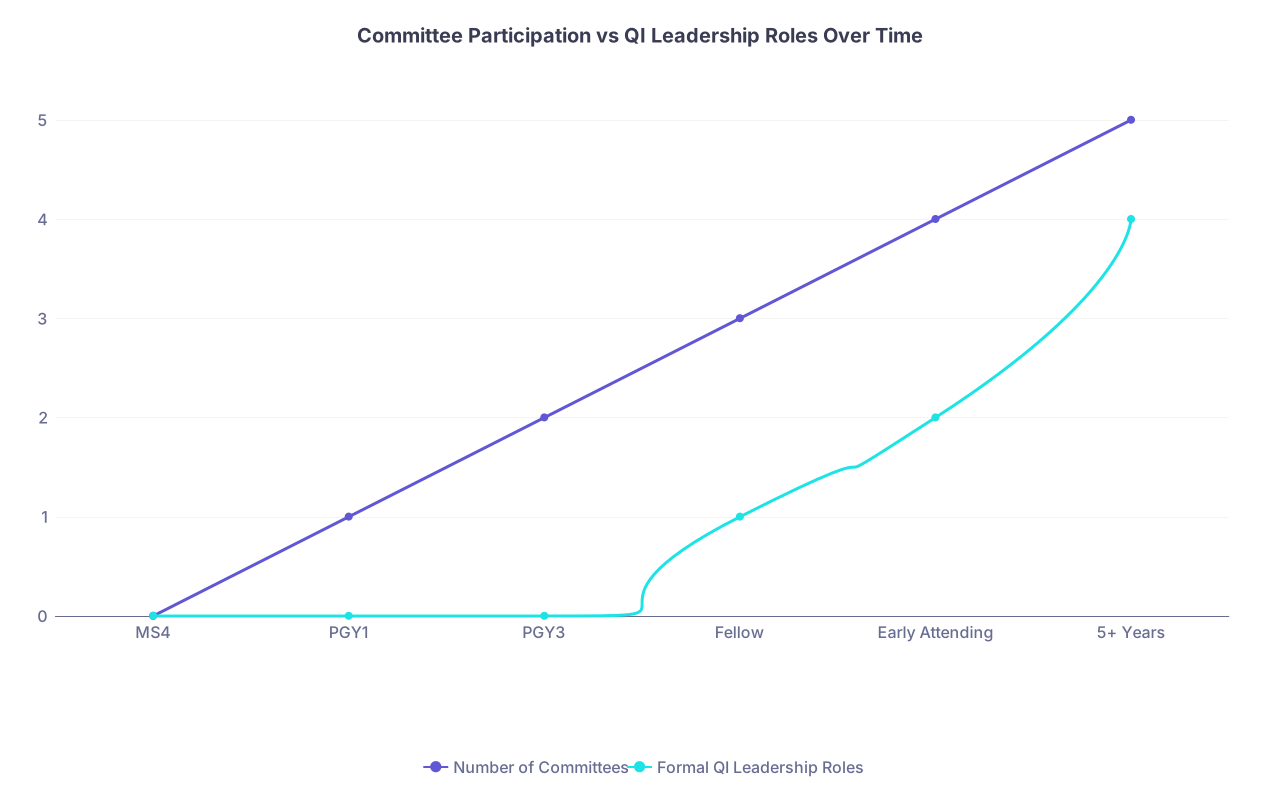
| Category | Number of Committees | Formal QI Leadership Roles |
|---|---|---|
| MS4 | 0 | 0 |
| PGY1 | 1 | 0 |
| PGY3 | 2 | 0 |
| Fellow | 3 | 1 |
| Early Attending | 4 | 2 |
| 5+ Years | 5 | 4 |
Trajectories like that do not happen randomly. They start with one email to one committee chair sometime in PGY‑1, when everyone else is just complaining on night float.
Common Mistakes That Kill Your QI Networking
Quick rundown of ways people sabotage themselves:
- Overcommitting: Joining three committees at once and making it to none consistently. Better to be indispensable on one than a ghost on three.
- No follow‑through: Volunteering in the meeting, disappearing afterward. That reputation spreads faster than you think.
- Grandstanding: Trying to “fix the whole system” as a PGY‑1, ignoring constraints, lecturing people twice your age. You will get tuned out.
- Ignoring non‑physicians: Treating nurses, pharmacists, and analysts as support staff, not core partners. That is how you end up with pretty slides and zero implementation.
- Treating it as pure CV padding: People can smell it. The mindset should be: “I want to learn how to make care safer and more effective, and I am willing to do unglamorous work to get there.”
If you avoid those, you are already in the top 10% of trainees dabbling in QI.
Where to Start This Month
If you want something actionable, here is a minimal, high‑yield sequence you can start now:
- Identify 1–2 hospital committees that match your interests and schedule. Ask your PD and one senior resident which ones actually matter.
- Email one committee chair with a specific, concise ask to attend and help. Offer to do real work.
- Attend 2–3 meetings, observe sharply, and then line up one small but concrete project that plugs into an existing agenda item.
- Follow through, document your contributions, and present your work back to the committee.
You do that for a year, you will not just “have done QI.” You will be known by name in the rooms where QI lives.
Key Takeaways
- Hospital committees are the real engine of quality improvement and the best networking environment for a QI‑focused career. Get in the room early.
- Do not just sit there. Ask sharp questions, volunteer for specific tasks, and align your projects with the committee’s existing priorities and data.
- Protect your time and your credit, build real relationships with non‑physician stakeholders, and document everything so the work you do actually counts for the next phase of your career.


