

The biggest myth about cross‑institution research collaborations is that they “just happen” if your science is good enough. They do not. They’re built—deliberately, politically, and with unglamorous logistics.
Let me break this down specifically.
Why Cross‑Institution Collaborations Are Harder Than They Look
Most people underestimate how many friction points exist before the first shared dataset ever appears.
You are fighting:
- Different IRBs and regulatory cultures
- Incompatible data models and EHRs
- Misaligned incentives between institutions (and between PIs)
- Authorship politics
- Budget and contracts departments that move at glacial speed
And on top of that, you need trust. Trust that the other group will not sit on your data, not scoop you, not disappear after a leadership change.
So, if you treat collaboration as “we should work together sometime” small talk at a conference poster, you will end up with nothing. The people who consistently lead cross‑institution work approach it as a project in itself—with its own pipeline, tools, and strategy.
Step 1: Choosing the Right Partners (Not Just the Famous Ones)
Most junior investigators mess this up: they chase brand names, not operational partners.
What actually matters in a cross‑institution partner
You need three things more than a big name:
- Operational reliability
- Aligned scientific interest and timeline
- Institutional backing for multi‑site work
The PIs who make the best cross‑institution collaborators are rarely the most famous person in the field. They are:
- The associate professor who quietly runs every registry in that disease
- The early‑mid career methodologist who responds to emails within 24 hours
- The clinical champion who controls access to the patient population you need

How to systematically identify good partners
Do not rely on “people I’ve met once.” Use structure.
Look at:
- Recent multi‑center trials and registries in your niche. Who are the co‑authors that appear repeatedly? Those are the reliable operators.
- NIH Reporter / national funding databases. Who holds the cooperative agreements, data coordinating centers, or network grants in related topics?
- Professional society working groups (e.g., AHA, ASCO, IDSA sections). Who is doing committee work that clearly requires herding multiple institutions?
Then score potential partners ruthlessly on:
| Criterion | Why It Matters |
|---|---|
| Data access | Realistic access to the population |
| Operational support | Coordinators, REDCap, grants office |
| Responsiveness | Email and meeting follow-through |
| Prior multi-site work | Proof they can deliver |
| Institutional buy-in | CTSA hub, research office, contracts |
If someone scores low on responsiveness or prior multi‑site work, I do not care how many first‑author NEJM papers they have. They will slow you down.
Step 2: Initiating Contact Without Sounding Vague or Desperate
A surprising number of “collaboration” emails are useless: no specific project, no ask, no clear benefit to the recipient.
How to write a first‑contact email that actually gets traction
Structure it like this:
- One‑line context tying you to them
- One‑sentence very specific project concept
- Why you need their institution specifically
- Very concrete next step
Example (tight, no fluff):
Subject: Multi‑center EHR phenotyping study in AF – potential collaboration?
Dear Dr. Lopez,
I enjoyed your presentation at HRS on AF recurrence prediction models, and I have been following your work with the Midwestern AF registry.
I am leading the development of a multi‑institution EHR‑based cohort to examine early rhythm control outcomes in high‑risk AF patients. We have IRB approval and local data extraction underway at [Your Institution], but our cohort is currently limited in Hispanic and rural populations, where I know your center has strong representation.
Would you be open to a 20‑minute Zoom in the next 2–3 weeks to discuss whether adding your site as a data‑contributing partner could be mutually beneficial? I have a 1‑page concept sheet and a draft analysis plan I can share ahead of time.
Best,
[Name / role / key link]
Notice what this does:
- It shows you are not sending a mass request
- It signals you have already moved past the “idea” stage (IRB, plan)
- It points out what they stand to gain (representation, co‑authorship, etc.)
- It asks for a small, clear next step
If you cannot summarize your collaborative ask in two sentences, you are not ready to email.
Step 3: Moving From “We Should Collaborate” to a Concrete Protocol
The biggest dead zone in collaboration is the gap between a nice Zoom call and an actual protocol.
You must compress this interval aggressively.
Use a simple but explicit framework
On that first or second call, you should lock down four things, verbally and in writing:
- Research question and primary outcome
- Minimal required data elements per site
- Timelines for each site’s deliverables
- Authorship and leadership expectations
Follow it up with a short concept sheet (2–3 pages max). Not a full grant. Something like:
- Background (half page)
- Specific aims (bullet points)
- Study design and inclusion / exclusion
- Data elements table
- Preliminary roles / authorship plan
You send that within 7 days of the call. If you wait 3 weeks, momentum is gone.

| Step | Description |
|---|---|
| Step 1 | Initial email |
| Step 2 | Intro Zoom |
| Step 3 | Thank and exit |
| Step 4 | Draft concept sheet |
| Step 5 | Agree on data elements |
| Step 6 | Define roles and authorship |
| Step 7 | Site letters of support |
| Step 8 | Mutual interest? |
If a potential partner cannot agree on a basic outcome, data list, or rough authorship outline in 1–2 meetings, that is a bad sign. I have never seen those projects suddenly become smooth later.
Step 4: Handling the IRB and Regulatory Mess Upfront
Multi‑site IRB can kill a project if you pretend it is an afterthought.
Models that actually work
You realistically have three options:
- Single IRB (sIRB) with reliance agreements
- Local IRBs at each institution separately
- De‑identified aggregate data analyzed at a central site under one IRB
If your institutions are CTSA hubs or used to NIH multi‑site work, push for sIRB. It saves months.
But do not assume their IRB office understands the project. You need a short “regulatory one‑pager” you can give every site’s IRB / research office:
- Study purpose
- Data categories (PHI vs limited vs de‑identified)
- Whether there is any intervention or only observational
- Where data will be stored and how shared
- Who is the sIRB, if applicable
Get your own IRB approval first, with flexible enough language to accommodate additional sites and minor protocol changes. Then share your approved protocol and consent (if applicable) as the template.
If one site’s IRB starts adding wildly different requirements, you have a decision: carve them out with a slightly different local process, or drop them. Sometimes the politically smart choice is to let one slow site go to prevent the entire project from stalling.
Step 5: Data Sharing, Governance, and Avoiding Future Fights
Data is where collaborations often become ugly. Not at the start—two years in, when someone wants to use the dataset for a secondary analysis you did not anticipate.
You prevent that now.
Create a simple data use and governance structure
You do not need a 40‑page legal document. You do need the following written and circulated:
- Who “owns” the combined dataset (often the steering committee, not a single PI)
- Where data are stored (secure server, coordinating center)
- Who can request extracts, and how approvals are granted
- Ground rules for secondary analyses:
- Proposal format
- Who gets to lead
- Authorship minimums for contributing sites
- Publication review process
| Element | Minimal Standard |
|---|---|
| Data custody | Named coordinating PI and institution |
| Access control | Steering committee approval required |
| Secondary use | Written proposal and site opt-in |
| Authorship rules | Predefined thresholds and rotation |
| Dispute handling | Chair or external arbiter named |
Send this as a 1–2 page “Data Governance and Publications Policy” early, not after the first manuscript submission. I have watched collaborations implode because a junior PI found out at submission that they were seventh author on the dataset they helped build.
Step 6: Authorship and Credit – Decide Before Anyone Touches a Dataset
People get weird about authorship. Especially when their Dean starts asking, “Why are we contributing data if you are not first author on anything?”
You must disarm this pressure before it builds.
Practical authorship strategies that do not poison collaboration
Use a model that is explicit and mechanical where possible:
- Lead author: rotates across sites for different papers, depending on topic and work
- Senior / last author: often the coordinating PI for the main paper; can rotate for sub‑studies
- Site PIs: guaranteed authorship on all main papers if they meet ICMJE criteria (which, frankly, they almost always will if you structure engagement correctly)
- Trainees: can be lead on predefined secondary analyses with mentor support
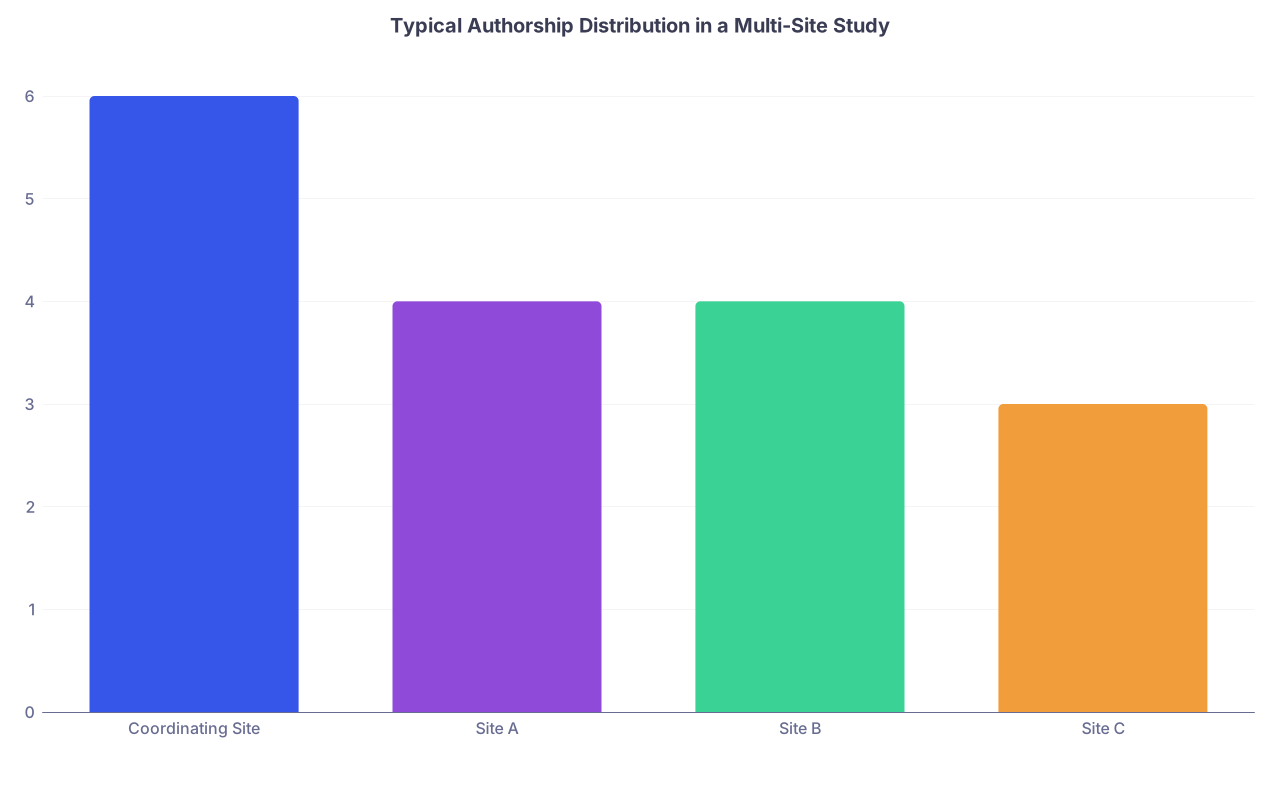
| Category | Value |
|---|---|
| Coordinating Site | 6 |
| Site A | 4 |
| Site B | 4 |
| Site C | 3 |
Spell this out in an email recap and, ideally, a short “Authorship and Publications” section within your governance document.
And then stick to it. Changing rules mid‑stream because a senior person suddenly shows interest and wants last author is the fastest way to lose your collaborators’ trust.
Step 7: Operational Infrastructure – The Boring Stuff That Actually Makes This Work
Ideas do not run collaborations. Coordinators do.
If there is no identified operations lead, your collaboration is already in trouble.
Minimum operational backbone
You need, at the coordinating site:
- One person who wakes up in the morning thinking about this project (often a project manager or senior coordinator)
- A shared project space (Teams, Slack, or even a structured email list with consistent subject tags)
- A centralized data capture or file transfer plan (REDCap, SFTP, established CDM extract formats)
- A simple but rigid meeting schedule:
- Quarterly steering committee
- Monthly operations / coordinators
- Ad hoc analysis working groups
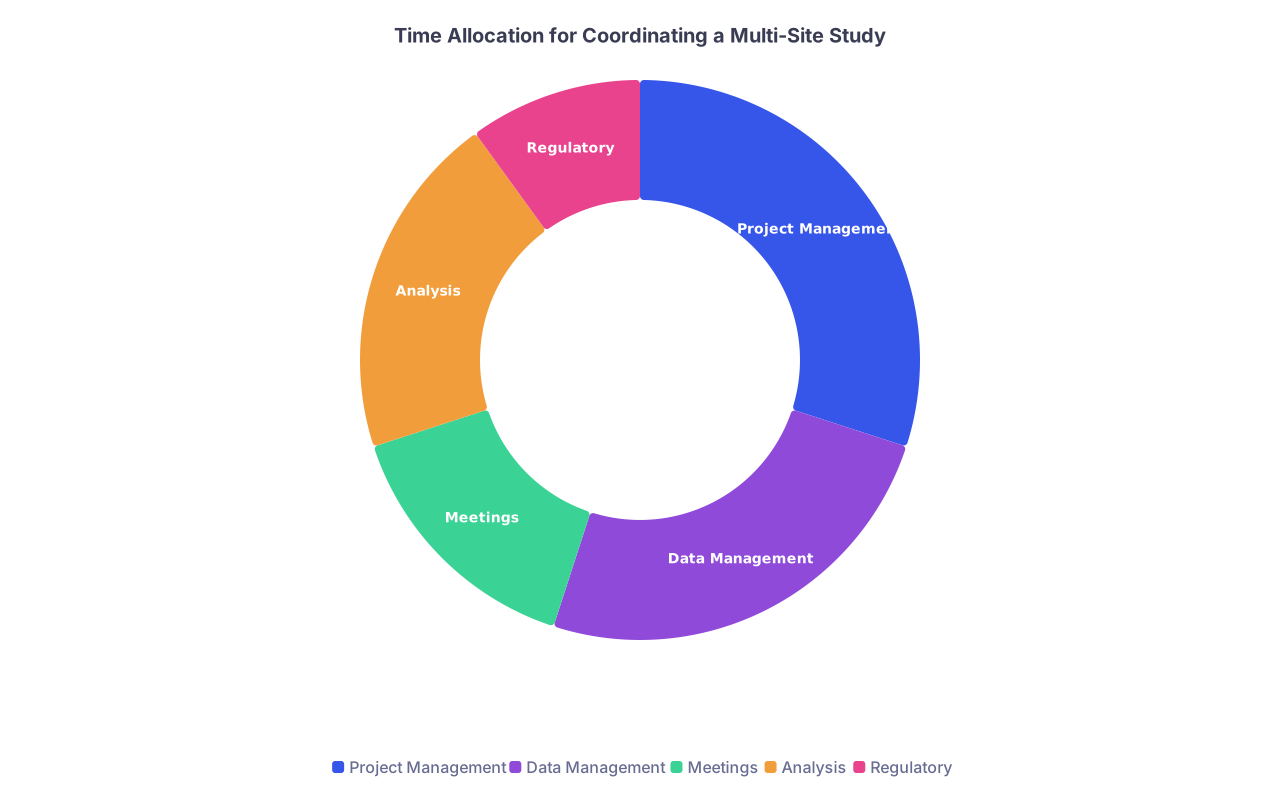
| Category | Value |
|---|---|
| Project Management | 30 |
| Data Management | 25 |
| Meetings | 15 |
| Analysis | 20 |
| Regulatory | 10 |
If you cannot fund a coordinator through a grant yet, steal 10–20% of one from another project with institutional blessing. That will do more for your collaboration’s success than any clever statistical method.
Also: write down standard operating procedures (SOPs). Even scrappy ones. For:
- How sites enroll or identify patients
- How data are validated and cleaned
- How missing data are handled
- How protocol deviations are logged
The first time someone says, “Oh, we interpreted that definition differently,” you will wish you had taken two hours to draft an SOP.
Step 8: Communication Patterns That Keep People Engaged (And Honest)
If you only call people when you need more data, they will disengage. They are not your vendors; they are co‑investigators.
You maintain engagement by:
- Sharing interim results early and often
- Highlighting individual sites’ contributions specifically (“Site C enrolled 40% of our rural cohort”)
- Rotating who presents data or updates at steering calls
- Being transparent about delays and setbacks—even when they are your fault

Also, document decisions. After every key meeting:
- Send a short summary with decisions and next steps
- Include timelines and responsible persons
- Store these in a shared, versioned folder
You are not doing this for bureaucracy. You are future‑proofing against memory drift and leadership turnover.
Building Collaborations as a Long‑Term Career Strategy
There is a deeper game here. Cross‑institution collaborations are not just about a single paper. They are infrastructure for your next decade of work.
When done right:
- You build a standing network that you can “turn on” for future projects
- You become the de facto hub for a disease registry, methods platform, or data coordinating function
- You create natural pipelines for multi‑PI grants, training grants, and industry partnerships
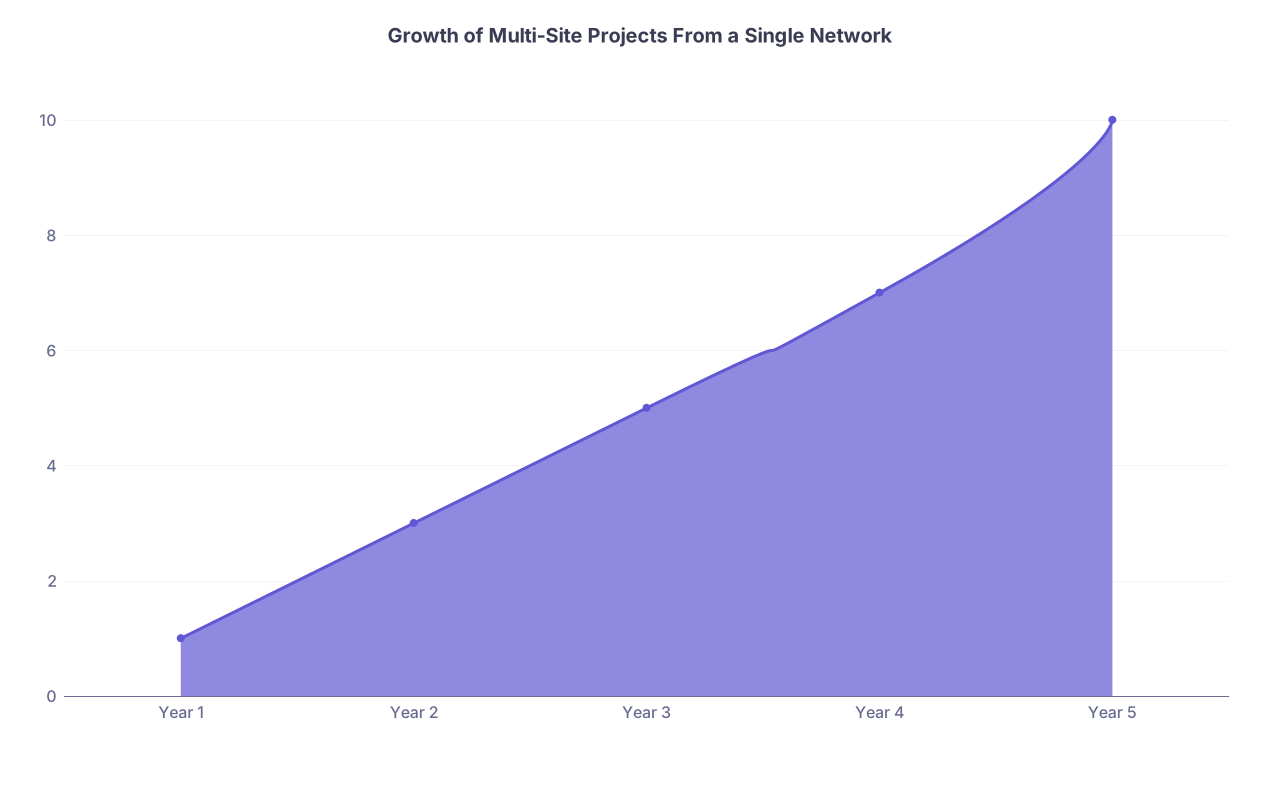
| Category | Value |
|---|---|
| Year 1 | 1 |
| Year 2 | 3 |
| Year 3 | 5 |
| Year 4 | 7 |
| Year 5 | 10 |
If you are a fellow or early faculty, you will not lead the huge network from day one. What you can do is:
- Attach yourself to existing collaborations as the person who “gets things done”
- Lead sub‑studies and analyses that cross institutions
- Co‑author the governance documents, SOPs, and infrastructure that make you indispensable
This is how people quietly move from “junior collaborator” to “co‑PI on the next U01” without shouting about it.
The Future: Where Cross‑Institution Collaboration in Medicine Is Headed
The future of collaboration will not be twenty sites emailing CSV files back and forth. That model is already aging.
Trends you should pay attention to
Federated and distributed analytics
Data staying behind institutional firewalls, with standardized models (OMOP, PCORnet) and shared code that runs locally. Reduces privacy headaches, increases scalability, but demands higher informatics competence at each site.National and international research networks
Think PCORnet, OHDSI, N3C, specialty‑specific consortia. The individuals who understand how to operate inside these ecosystems—query, govern, publish—will have disproportionate leverage.Industry and real‑world evidence (RWE) partnerships
Cross‑institution networks are increasingly courted for post‑marketing surveillance, device registries, AI validation. That brings money and complexity. Also legal scrutiny.AI‑assisted cohort building and phenotyping
Multi‑site natural language processing, imaging networks, and algorithm validation efforts are inherently cross‑institutional. No single center has enough variety to make robust AI.

The point: if you do not learn to build and operate in cross‑institution collaborations, you will be locked out of the most consequential research over the next 10–20 years.
Three Tactical Mistakes to Avoid
Let me be blunt about a few common failures I see over and over:
Vague proposals.
“Let’s build a registry” is not a project. “Let’s build a 2‑year registry of 600 mechanically ventilated patients with predefined daily respiratory and hemodynamic variables” is.Underestimating legal and contracts delays.
Budget, data use agreements, material transfer—these eat months. Involve your research office early and push for standard templates. If a site insists on bespoke language for everything, think hard about whether they are worth the drag.Overpromising to too many partners.
Bringing 15 sites into a first‑time collaboration when you have never managed more than one external partner is a recipe for chaos. Start with 3–5. Prove you can deliver. Expand later.
FAQs
1. How many sites should I include in my first cross‑institution study?
For a first real multi‑site effort, 3–5 sites is the sweet spot. Enough heterogeneity and credibility to call it “multi‑center,” but not so many that operations implode. I would only consider 10+ sites after you have run at least one smaller collaboration successfully and have a dedicated coordinator.
2. Do I always need a formal contract or DUA between institutions?
If you are sharing any identifiable or limited PHI data, yes, you need a data use agreement or similar contract. For fully de‑identified aggregate data, some institutions will still require a DUA, others will not. Do not guess—loop in your research or legal office early and standardize on a template if possible.
3. As a fellow or junior faculty, how can I realistically start a collaboration?
You do not need to start by leading a ten‑site registry. Start by proposing a two‑site project with a mentor’s existing collaborator. Or volunteer to coordinate a sub‑study in an existing network. Your angle is being operationally excellent: writing protocols, harmonizing variables, running analyses. That gets noticed.
4. How do I handle a site that is consistently late or non‑responsive?
First, have a private, direct conversation with the site PI to clarify barriers and reset expectations. If performance does not improve and is compromising timelines, you have three options: downgrade their role (e.g., fewer authorships), exclude their incomplete data from primary analyses, or formally drop them from the collaboration. The key is to anchor actions in pre‑agreed participation expectations you communicated at the start.
5. What if multiple investigators want to lead papers on overlapping topics?
This is where your publications policy and steering committee earn their keep. Require short written proposals for each analysis, compare scopes, and either merge overlapping ideas with co‑first or co‑senior authorship, or sequence them (e.g., one does clinical outcomes, another cost or implementation). The worst move is to avoid the conflict and let people work in parallel on nearly identical manuscripts—that guarantees resentment.
Key takeaways: Cross‑institution collaborations do not succeed on scientific merit alone; they rise or fall on operations, governance, and trust. Choose partners for reliability over fame, lock down data and authorship rules early, and invest in a real coordinating backbone. If you treat “collaboration” as its own discipline—not a side effect—you will build networks that carry your research career much farther than any single paper.


