
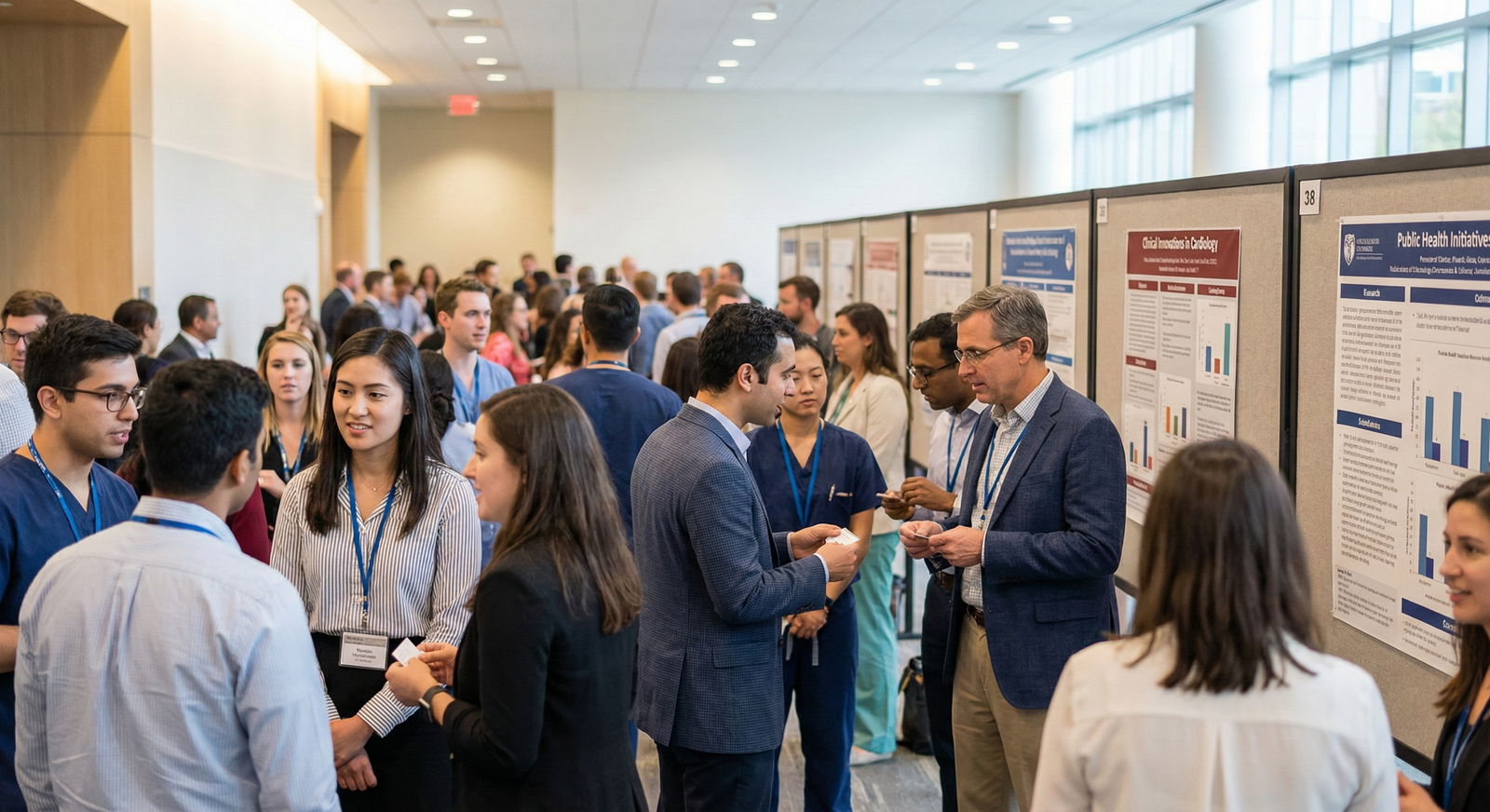
Most young physicians trying to “get into research” are chasing the wrong doors. Clinical trial networks do not invite random CVs; they recruit proven operators.
Let me break that down specifically.
You are not trying to “get published.” You are trying to become someone that established trialists and networks trust with patients, data, timelines, and reputational risk. That is a very different game.
This is the playbook I wish someone had handed to every PGY‑1 who told me, “I want to get involved with trials, but I do not know where to start.”
1. Understand What Clinical Trial Networks Actually Are
Before you can get invited in, you need to know what room you are trying to enter.
Clinical trial “networks” are not just vague collections of academics. They are usually structured, contract‑bound ecosystems with clear roles and incentive flows.
Think of four major archetypes:
Academic investigator networks
Examples: oncology cooperative groups, HF trial consortia, stroke networks.
These typically center on:- A few high‑volume, influential PIs
- Multiple academic sites
- Shared protocols, steering committees, publication committees
Industry‑sponsored site networks
Think: the 10–50 “go‑to” hospitals or private groups that pharma calls first when there is a new pivotal trial in a given disease area.
These sites have:- Proven track record of enrollment
- Clean regulatory audits
- Dedicated research infrastructure (CRC, regulatory coordinator, data team)
Practice‑based or community research networks
Examples: primary care practice‑based research networks (PBRNs), EMR‑embedded pragmatic trial networks (PCORnet style).
They rely on:- Large patient volumes
- Standardized workflows
- EMR data extraction capabilities
Device / procedural innovation networks
Common in cardiology, interventional radiology, surgery, orthopedics.
Often revolve around:- Early adopter surgeons / interventionalists
- Volume of complex cases
- Ability to support registries, first‑in‑human or post‑market studies
Here is the uncomfortable truth: these networks already have people they trust. You are trying to displace someone or expand the circle. No one is eagerly waiting for “another junior person who likes research.” They are waiting for:
- Someone who reliably delivers enrollment
- Someone who does not screw up monitoring visits
- Someone who answers emails and signs documents on time
- Someone whose name does not appear in adverse audit reports
You need to position yourself as that person.
| Role | What They Actually Care About From You |
|---|---|
| Principal Investigator (PI) | Enrollment, protocol adherence, low drama |
| Study Coordinator / CRC | Responsiveness, clarity, not making their job harder |
| Industry Medical Monitor | Clean data, timely queries, safety vigilance |
| Academic Network Leadership | Site performance, reliability, potential new sites through you |
| Hospital Research Office | Compliance, billing integrity, not attracting regulators |
If your “networking” does not make life easier for one or more of these people, you will never get inside the real circle.
2. The Ladder: From Nobody To “Go‑To” Trialist
You do not start as PI for a Phase III multi‑center trial. If you try, you just signal that you do not understand the game.
There is a fairly standard progression that gets people into the network:
- Sub‑investigator (sub‑I) or co‑investigator on existing studies
- Lead enroller / “workhorse” at a high‑performing site
- Local PI for small, lower‑risk or registry trials
- Recognized site PI for multi‑center industry or cooperative trials
- Steering committee / endpoint adjudication / advisory roles
Your early objective is simple: become indispensable at step 1–2, so people feel comfortable pulling you into 3–4.
What you do at each rung
As a sub‑investigator:
- Show up physically for screening visits and consents. Do not “cover” by phone from your office.
- Read the protocol front to back. Twice. Know inclusion/exclusion cold.
- Answer coordinator questions the same day. Not “when I get a chance”.
- Learn the monitoring rhythm. Be present for at least part of monitoring visits so the CRA knows your name and face.
As the lead enroller / workhorse:
- You become the person who always seems to “find” appropriate patients.
- You build little mental triggers: “This new HF admission? Check if they fit Trial X before hospital day 2.”
- You push colleagues with a simple line: “That 58‑year‑old you admitted actually qualifies for our trial; can I talk to them?”
At this stage, PIs and coordinators start saying your name in a specific way:
“He / she gets things done.”
That is when doors open.
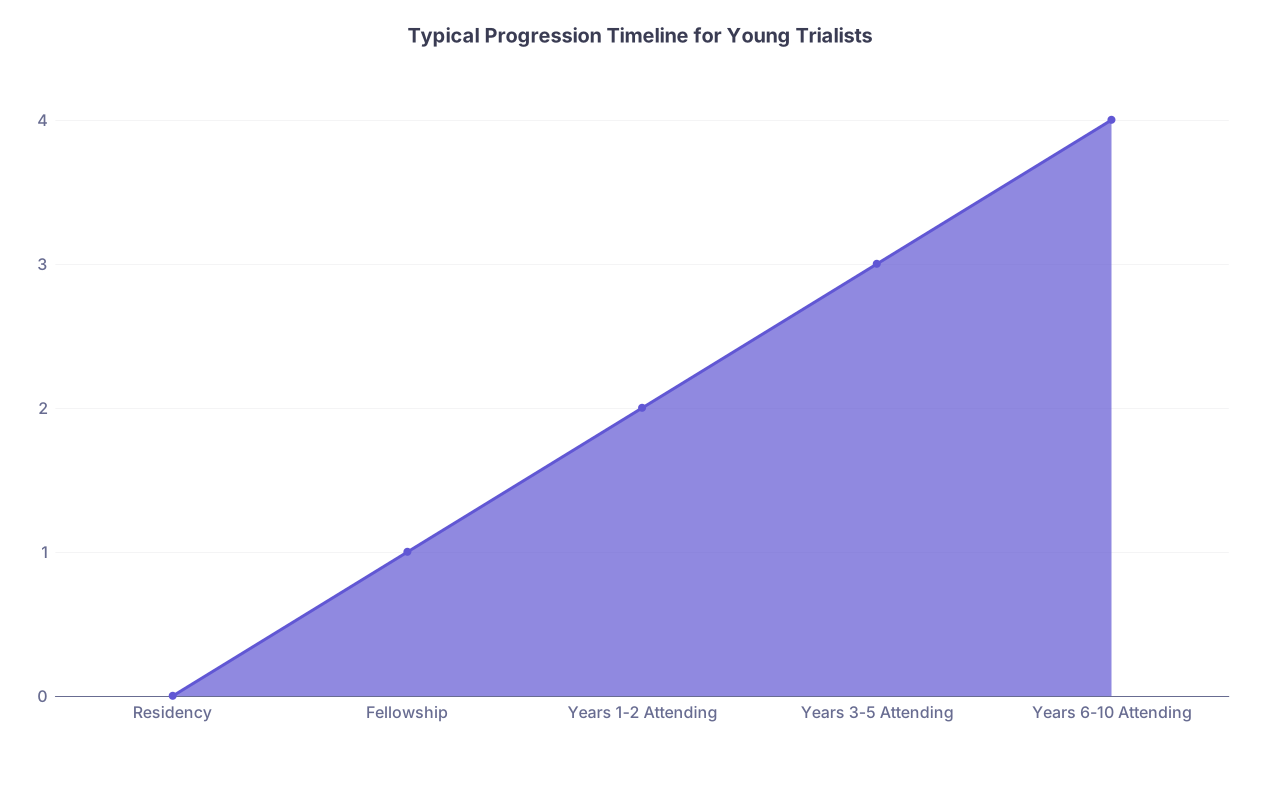
| Category | Value |
|---|---|
| Residency | 0 |
| Fellowship | 1 |
| Years 1-2 Attending | 2 |
| Years 3-5 Attending | 3 |
| Years 6-10 Attending | 4 |
The numbers here are “network depth” on a rough scale (0=no involvement, 4=steering roles). Many people stall at 1–2 because they never consciously climb.
3. Targeting: Choosing The Right Trial Ecosystems
Trying to “get into clinical trials” generically is useless. You need to target a specific ecosystem where you can credibly add value.
Ask yourself:
- What pathology do you already see in high volume?
- Which division at your institution is already trial‑heavy?
- Where is industry money actually flowing right now?
If you are a young cardiologist, the ecosystems are obvious: HF, interventional, EP, structural.
If you are in general internal medicine at a community hospital, it may be diabetes, obesity drugs, anticoagulation, or COPD.
You want an intersection of:
- High patient volume you can touch directly
- At least one existing or recent trial at your site
- A specialty where regulatory and infrastructure requirements are manageable for a junior person
Quick reality check by setting
| Setting | Most Realistic Entry Point |
|---|---|
| Academic Tertiary Center | Sub-I on ongoing industry/co-op trials |
| Community Hospital | High-enrollment pragmatic or registry trials |
| Large Multi-specialty Group | Industry-sponsored outpatient trials |
| Solo / Small Private Practice | Join external site network or refer to trial sites |
If your hospital does not have a research office or a single active trial, you are not “one networking step” away. You are three infrastructure steps away. In that scenario, your move is often to affiliate with an existing external trial site, not to build a trial ecosystem from scratch as a PGY‑3.
4. Ground Game: How To Make Yourself Visible To The Right People
Sitting in your office hoping someone “taps you” is fantasy. You need a deliberate introduction strategy. The good news: the bar is low because most people never bother.
Inside your own institution
Your highest-yield move is internal.
Here is the script I have seen work:
Find the active trials in your interest area.
- Go to your institution’s clinical trials office website.
- Filter by specialty.
- Note the PIs, sub‑Is, and coordinators.
Email the PI and the lead coordinator. Short and concrete:
Subject: Interest in getting involved with [trial name] as sub-I
Dr [PI],
I am a [PGY‑x / fellow / junior attending] in [department]. I have a strong interest in [disease area], and I see [x] patients per week admitted with [relevant condition].
I noticed you are PI for [trial]. I would like to help with screening and enrollment as a sub‑investigator. I am happy to:
– Pre-screen my patients for eligibility
– Assist with consent discussions
– Be available for study-related clinical questionsIf helpful, I can start by shadowing the team during a screening or monitoring visit to understand the workflow.
Best,
[Name]Follow up with the coordinator separately:
Hi [Coordinator], I just emailed Dr [PI] about helping with [trial]. I would love to learn how you are screening and how I can be useful without slowing you down.
That last line matters. Coordinators are the gatekeepers you are underestimating. I have watched PIs say yes, while coordinators quietly block a junior person who made more work than they saved.
Conferences and specialty meetings
You can waste entire conferences in poster halls and random sessions and come home with zero meaningful connections.
Instead, you should:
Identify 3–5 key trialists in your area (based on who is on steering committees, big trial presentations, or first/last author positions).
Attend the sessions where they are speaking about ongoing or recently-completed trials.
Ask one intelligent question publicly or in the line afterward. Not, “How can I get involved?” but something like:
“In your experience across sites, what distinguished the top-enrolling centers from the ones that struggled? I am trying to build something similar at my institution.”
People remember that kind of question. It signals you are thinking like a trialist, not like a CV‑builder.
Then the ask, 1:1, hallway or after-session:
I am early in my career at [institution], we see a lot of [disease area], and I am trying to grow our trial activity. Would you be open to my sending you one email summarizing what we see and you telling me if we could realistically contribute to any of your upcoming studies?
That is it. You are not pitching yourself as a steering committee member. You are pitching site potential.
5. Proving Value: Metrics That Make Networks Pay Attention
Networks care about numbers. You need to speak their language.
These are the metrics that actually matter to trial leadership and sponsors:
- Enrollment per month per site
- Screen failure rate
- Time from site activation to first patient in
- Query rate per patient
- Lost to follow‑up rate
- Major protocol deviations
You, as a young physician, cannot change all of these. But you can influence several, and you should track them.
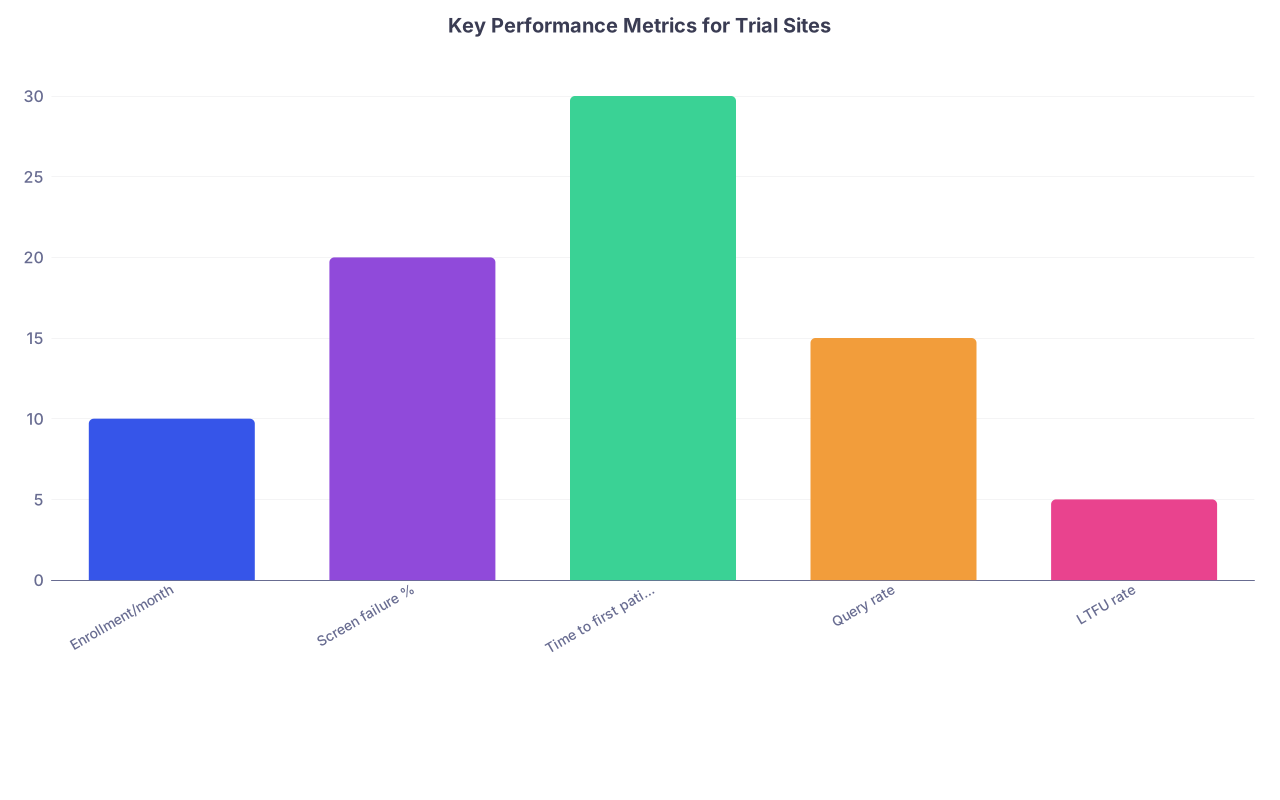
| Category | Value |
|---|---|
| Enrollment/month | 10 |
| Screen failure % | 20 |
| Time to first patient | 30 |
| Query rate | 15 |
| LTFU rate | 5 |
The numbers above are illustrative, but the categories are real.
If, in a few years, you can truthfully say to a sponsor or network lead:
- “Our site enrolled 25 patients in 10 months for [Trial X], with a screen failure rate of 15%, and we were first‑quartile for time to first patient.”
You have their attention. They know what those numbers mean.
How to build that track record deliberately
Become obsessive about pre‑screening
Stop casually asking, “Any studies they might be eligible for?” during rounds. Instead:- Maintain a simple screening checklist integrated into your own patient notes.
- Build quick EMR filters where possible (e.g., reduced EF, age ranges, lab cutoffs).
Be ruthless about not enrolling obviously borderline patients just to hit numbers
High screen failure and protocol deviation rates are why some sites never get invited back.Partner tightly with your coordinator
A 10‑minute huddle each morning on potential trial candidates will outperform a “let me know if you see anyone” approach by an order of magnitude.
6. Reputation: What Gets You Quietly Blacklisted (And What Gets You Pulled In)
Networks talk. Sponsors absolutely talk. If you want more invitations, avoid the blunders that spread quickly.
Behaviors that get you frozen out
I have seen junior attendings make every one of these mistakes:
- Signing on as a sub‑I and then not responding to emails for weeks
- Missing or rescheduling monitoring visits repeatedly for trivial reasons
- Enrolling a patient they barely consented properly, leading to complaints
- Being rude to coordinators or CRAs
- Treating research visits like “lesser work” that can always be bumped
You might think, “It is just one study.” Sponsors do not see it that way. They maintain mental (and sometimes literal) blacklists. Once a site is known for messy data and poor communication, you do not get onto the “initial feasibility survey” lists for new trials.
Behaviors that get you fast-tracked
On the flip side, young physicians who rise quickly in networks tend to:
- Over‑communicate when problems arise (AE clusters, site staffing changes, etc.)
- Volunteer for unglamorous tasks like endpoint adjudication or chart reviews
- Send concise, solution‑oriented emails, not 2‑page essays
- Protect patient safety even if it hurts enrollment; sponsors actually take note
If you rescue a trial during a painful period—say, your site doubles enrollment after a slump—that story will be retold in pharma circles for years. That is how you go from local sub‑I to being “on the radar.”
7. Leveraging Institutional and External Structures
You do not need to build everything alone. Smart people ride existing structures.
Inside your institution
Three offices you should intentionally know:
Clinical Trials Office (or equivalent)
- Ask what therapeutic areas are priorities.
- Ask what industry sponsors frequently approach them.
- Ask which PIs are known for strong performance.
Grants / Contracts Office
- Understand your institution’s stance on industry money.
- Learn typical timelines for budget negotiations and contracting.
- Ask who handles feasibility questionnaires from sponsors.
Compliance / Billing
- Understand what counts as standard of care vs. research billing.
- You do not need to master this, but you need basic literacy to avoid disasters.

| Step | Description |
|---|---|
| Step 1 | Identify Interest Area |
| Step 2 | Find Active Trials at Institution |
| Step 3 | Meet PI and Coordinator |
| Step 4 | Sub-I Role on Ongoing Trial |
| Step 5 | Prove Enrollment and Reliability |
| Step 6 | Local PI for Small Trial |
| Step 7 | High Performing Site Metrics |
| Step 8 | Invited to Multi Center Trials |
| Step 9 | Network and Steering Roles |
This is the actual process, stripped to its skeleton. Most people get stuck between C and D because they never explicitly ask for a sub‑I role or never actually show up.
Outside institutional walls
You have three main external rails into networks:
Specialty societies
Many have research committees, young investigator programs, or trial working groups. Volunteer for the boring committees. Policy, registry oversight, guideline evidence review. That is where you meet the real inner circle.Cooperative / consortia groups
Depending on your field, look for cooperative groups that run multi‑center trials. They often:- Have membership processes for institutions
- Offer junior investigator slots, travel awards, or abstract programs
Show up repeatedly, not once.
Industry relationships
Not “let me meet the rep and ask for a trial.” That is amateur hour.
Instead:When a sponsor is already running a trial where you are sub‑I, get to know the medical monitor and project manager professionally.
Ask after 6–12 months, when you can show performance:
“If we continue to perform well, how can I best position our site to be considered for future trials in this space?”
Every sponsor has a short list of “default” sites and PIs. Your aim is to get your name onto that list.
8. Special Cases: Residents, Fellows, and Community Docs
Let me be specific because the path looks different depending on where you are.
Residents
No one is making you PI, and that is fine. Your objectives:
- Attach yourself to one high‑functioning trial team in your interest area.
- Learn the workflow end‑to‑end: screening, consent, visits, AE reporting, monitoring.
- Show enough initiative that the PI writes you detailed letters: “This person is rare; they operated like a junior faculty member.”
You are not building your own network yet; you are building credibility and skills.
Fellows
This is the sweet spot. Here is the move:
- Get your name on IRB submissions as sub‑I for 1–3 relevant trials.
- Make yourself the “default” person for overnight or weekend trial coverage.
- Identify at least one trial where you functionally run the day‑to‑day enrollment.
- Co‑author at least one abstract or secondary analysis using trial data, if permitted.
When you apply for faculty jobs, you want to be able to say:
“I have actively screened and enrolled patients for [Trial A, B], handled protocol‑driven management, and collaborated with industry monitors and coordinators. Our site ranked top quartile for enrollment.”
That is what turns hiring committees’ ears, especially at places that want to grow their trial portfolio.
Community physicians
You are often ignored in discussions like this, which is a mistake. You have something precious: volume.
Your leverage points:
Join established site networks that contract with multiple community practices.
These groups bring sponsors, protocols, and infrastructure; you bring patients and clinical judgment.Become a referring partner to nearby academic or dedicated trial centers.
If you consistently refer suitable patients to their HF trial, guess who they think of when the next outpatient pragmatic trial opens?Invest in at least one research coordinator if your practice is large enough.
Sponsors do not work well with “doc will do it all.” They need a point person.
9. The Long Game: From “Helpful Junior” To Network Insider
The first invitations you get will be modest: sub‑I on another trial, maybe a local PI role for a small registry.
The temptation is to chase prestige too early. “Can I be on the steering committee?” “Can I be first author on the main paper?”
Hold that impulse. The inner circle is watching how you handle the middle rungs.
Over 5–10 years, the progression typically looks like:
- You become the person your institution’s research office calls first when a new study in your niche appears.
- Sponsors start approaching you directly instead of through a senior PI.
- You get asked to:
- Sit on advisory boards
- Join endpoint adjudication committees
- Help design feasibility criteria for upcoming trials
At that point, you are not trying to “network into” existing networks. You are the network.
FAQ (Exactly 4 Questions)
1. I am a PGY‑2 in a non‑academic hospital with no active trials. Is it even realistic to aim for clinical trial work?
Yes, but not in the “next year I will be a sub‑I” sense. Your near‑term move is to (a) learn research methods and trial design, and (b) position yourself to train or work later at a site with trial infrastructure. If your current hospital has zero trials, zero research office, and no history of industry relationships, you are not going to build a trial network as a resident. Use this time to read protocols, do observational or registry‑based projects, and aim for fellowship or an early attending job in a trial‑active environment.
2. How many publications do I need before trial networks take me seriously?
Far fewer than you think. Networks care much more about operational performance than PubMed counts. One or two meaningful papers or abstracts arising from trial involvement, combined with a reputation for strong enrollment and clean data, are more valuable than 15 low‑impact retrospective chart reviews. Do not hide your trial metrics behind publication FOMO. Sponsors want people who can execute protocols, not literary celebrities.
3. Should I pay for “clinical research certificate” programs to help me get into networks?
Generally, no. They may help you understand terminology, but they rarely move the needle on invitations. If you like structured learning, fine, but do not confuse certificates with credibility. Real credibility comes from having been in the trenches of actual trials. Time spent working closely with a coordinator on one active trial is worth more to your career than any online “research certificate” line on your CV.
4. I worry that being too aggressive about trials will annoy people. How hard can I push?
You should be assertive, not obnoxious. Asking clearly for a sub‑I role, showing up, and following through is not “too much.” Pestering PIs weekly after a clear “not right now” is. A good rule: every ask should be paired with an offer that reduces workload for someone. “Can I help screen your patients and bring you only the clearly eligible ones?” lands differently from “Can you make me co‑investigator?” If people see you as a net decrease in work, not an ego looking for a title, the invitations will come.
With this mental model and concrete playbook, you are no longer just “interested in research.” You are on a deliberate path to become the person clinical trial networks call first. The next step is choosing your disease niche and your first trial team. Once you have that anchor, then we can talk about crafting your first protocol and moving from executing trials to designing them—but that is another chapter.


