

The biggest mistake clinicians make in multi-site health systems is thinking “the org chart is the network.” It is not. The real power nodes are almost never the ones on the glossy leadership PDF.
You want to move projects, shape your schedule, protect your time, or build a cross-campus career? You need to understand how multi-site systems actually move information, money, staffing, and reputation. That means knowing who the functional power nodes are and how to plug into them.
Let me break this down specifically.
1. How Multi-Site Systems Really Work (Not How They Say They Work)
Most large health systems talk about “integration,” “standardization,” and “system-ness.” Under the hood, what you actually have is:
- A few central control hubs (finance, IT, quality, legal).
- A set of semi-autonomous fiefdoms (major hospitals, big service lines).
- A cloud of periphery sites and clinics that feel like afterthoughts.
Power travels along a few predictable highways:
- Money (operational budgets, service line margins, RVUs).
- Data (quality metrics, dashboard reports, regulatory risk).
- Reputation (flagship programs, star clinicians, system-wide initiatives).
- Bottlenecks (scheduling, OR time, beds, IT, credentialing).
Your “network” has to connect you to the people who sit at the junctions of those highways. Those are the power nodes.
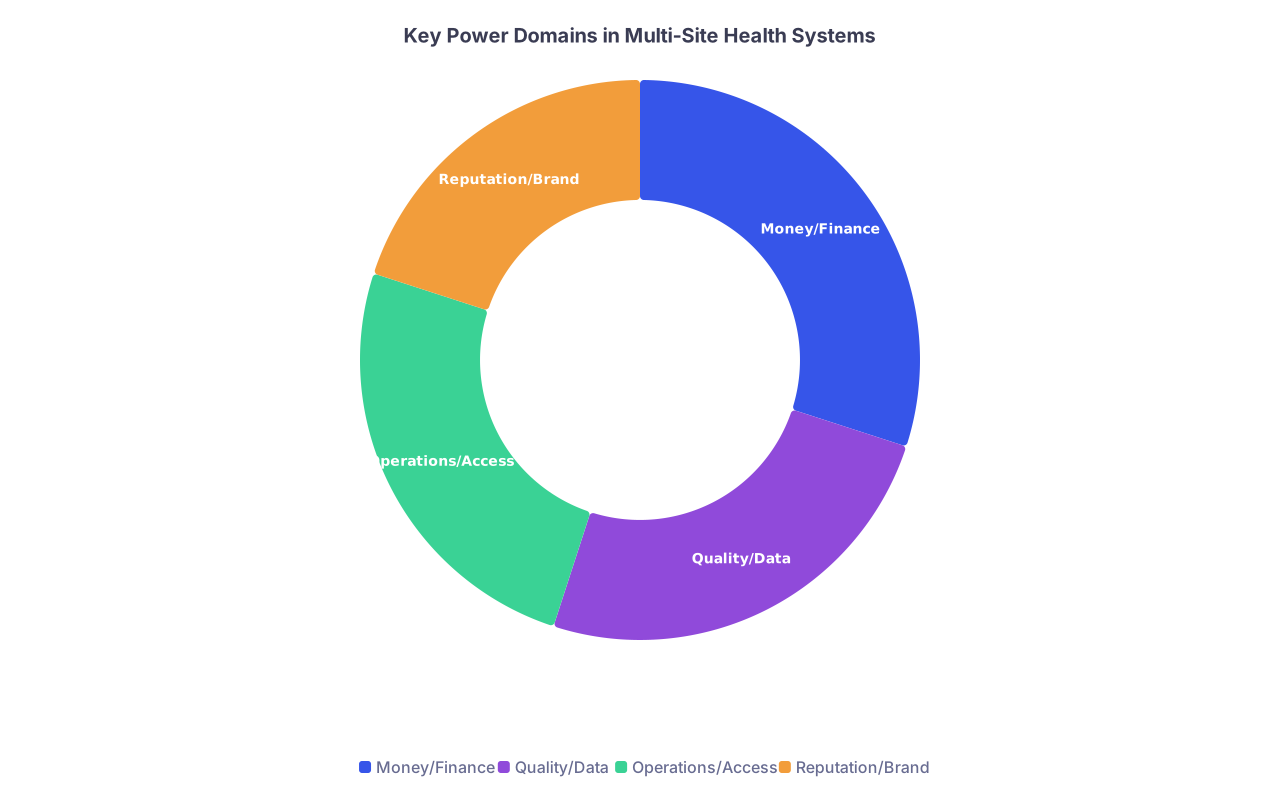
| Category | Value |
|---|---|
| Money/Finance | 30 |
| Quality/Data | 25 |
| Operations/Access | 25 |
| Reputation/Brand | 20 |
At a practical level, that means you stop asking “Who is the VP of X on the org chart?” and start asking “Who actually decides:
- Where patients go when one site is full?
- Which pilot projects get funded and scaled?
- Who gets protected time for system-wide work?
- Which metrics show up on the CEO’s dashboard?”
The people behind those levers are your targets.
2. The Core Power Nodes You Must Know
I am going to be blunt: if you work in a multi-site system and you do not know at least one person in each of the following categories, you are operating with the parking brake on.
2.1 System-Level Clinical Leadership (Not Just Your Chair)
These are the people whose email subject line can get instant responses across three hospitals:
- Chief Medical Officer (CMO) / System CMO
- Chief Quality Officer (CQO)
- System Service Line Leads (e.g., System Director of Cardiology, Oncology, Ortho)
Their formal titles matter less than their scope. You want the ones whose portfolios explicitly say “system” or “enterprise.”
Why they are power nodes:
- They control or influence system-wide policies and pathways.
- They decide which sites are “centers of excellence” vs feeder sites.
- They can move resources (NPs, scribes, navigators, call coverage) across campuses.
How to network with them without being annoying:
- Do not start with “I want a leadership role.” That screams amateur hour.
- Start with: “We’re seeing X problem at our site; I think there’s a system-wide version of this. Can I share 1–2 data points and a possible small pilot?”
- Bring data and a clear ask that is small, testable, and scalable if it works.
You are positioning yourself as: useful, not needy; scalable, not parochial.
2.2 The Quiet Operational Fixers
Most of the real power in large systems sits with people who never present at Grand Rounds:
- System director of patient flow / bed control
- Multi-site access manager / centralized scheduling director
- Transfer center leadership
- Nursing operations / float pool managers
- Physician enterprise COO or ambulatory ops leads
These people can:
- Guarantee (or choke) your referral stream.
- Decide if new clinics open at your location or 40 minutes away.
- Wreck your day with badly designed schedules—or fix it in one meeting.
I have seen a single friendly relationship with a centralized scheduling manager salvage an entire service line’s volumes after an EMR change. No title change. No committee. Just someone who cared enough to tweak the template logic.
How to connect:
- Ask to shadow their operation for half a day “to understand how our orders / referrals / discharges look from your side.”
- When they fix something for you, send a short, precise thank-you email copying their boss: “X solved Y problem, which reduced our no-show rate from 18% to 9% in two weeks.”
- Occasionally invite them to debrief a complex, multi-site case or flow problem at your division meeting (but be respectful of their time).
These people remember who treats them as peers vs ticket-takers.
2.3 System IT / EMR Configuration Insiders
If your health system runs Epic, Cerner, or any enterprise EMR, there is a small inner circle who:
- Decide which order sets get built.
- Control which alerts you see.
- Determine how productivity and quality are measured.
Some key roles:
- CMIO / Associate CMIOs
- Clinical informaticists embedded in service lines
- EMR application managers / analysts assigned to your specialty
- Data warehouse / analytics leads
Why they matter:
- The EMR is the nervous system of a multi-site organization. If you are not wired into the people who configure it, you are at the mercy of whoever shouts the loudest.
- They choose which sites are “pilots” for new workflows. Pilot sites tend to get resources and attention.
How to work with them like a grown-up:
- Bring them three things: (1) a clear workflow problem, (2) a quick mockup or example, (3) an outcome metric you care about.
- Learn to speak their language at a basic level: workqueues, routing rules, order set governance, change windows.
- Co-author simple project charters with them so your needs go into their official queue, not just email purgatory.
I have watched junior faculty accidentally become “the system person for EMR X in specialty Y” by doing one scoped, data-backed EMR improvement with the right informaticist.
3. Financial and Strategic Power Nodes (Follow the Money)
If you ignore finance in a multi-site system, you become one of two things: a cost center or background noise. Neither gets what it wants.

3.1 Service Line Finance and Strategy Partners
Most big systems run on a service line model:
- Cardiovascular, cancer, women’s health, neurosciences, orthopedics, etc.
- Each has a finance partner and often a strategy / planning lead.
- They see cross-site volumes, margins, market share, and growth plans.
These are power nodes because they control:
- Which campus gets the “big new thing” (robot, hybrid OR, cath lab, infusion expansion).
- Where recruitment focuses.
- Which site gets branded as the flagship vs “community affiliate.”
You should know:
- Who is the finance partner for your service line across the system.
- Who is the strategy / planning person for your region or specialty.
- What your service line’s current 3–5 year plan is (and where each site fits).
How to become someone they actually call back:
- Ask for a one-hour session: “Help me understand the system-level picture of [specialty] across our sites.”
- Come prepared with 2–3 specific questions: “Are we trying to grow inpatient at Site A or shift to outpatient at Site B?”
- Share 1–2 local ideas in their language: “If we add X at Site C, we could capture Y more cases and avoid Z transfers to Competitor Hospital.”
You are not trying to be a mini-CFO. You are demonstrating you know the game they are playing.
3.2 Grants, Philanthropy, and “Innovation” Offices
In multi-site systems, a shocking amount of discretionary money sits outside the traditional clinical budget:
- Philanthropy / foundation offices
- “Center for Innovation” or “Transformation Office”
- Population health / value-based care teams
- Academic or research institutes within the system
These are second-order power nodes: they may not control your day-to-day schedule, but they can:
- Fund your cross-site pilot project.
- Create a titled role (even 0.1 FTE) that gives you system access.
- Put you on system-wide committees, where the real relationships form.
Your move:
- Find 1–2 people in these spaces who focus on clinical initiatives (not just basic research).
- Pitch problems that are multi-site by design (e.g., hospital-at-home scaling, telehealth between sites, standardizing post-op pathways).
- Design your project so at least two campuses are involved from the start.
The system loves things that say “enterprise” and “scalable.” You make yourself inevitable by thinking beyond your home institution.
4. Reputation and Influence Nodes: Who Actually Gets Listened To
Titles are one axis of power. Reputation is the other. In many systems, these do not line up neatly.
| Category | Formal Title Example | Informal Power Role Example |
|---|---|---|
| Clinical Leadership | System CMO | Highly respected senior clinician |
| Operations | VP of Operations | Legendary bed control coordinator |
| IT / EMR | CMIO | Go-to physician builder |
| Reputation / Brand | Marketing Director | Star proceduralist with large volume |
| Quality / Safety | System CQO | Root cause guru everyone calls first |
4.1 The “Stars” and Legacy Clinicians
Every system has a handful of clinicians who:
- Built a program from scratch.
- Have referrals across three or four campuses.
- Have the CEO’s cell number.
They may or may not be official leaders. They are still power nodes because:
- Admin is afraid of losing them.
- Their opinion carries weight in closed-door meetings.
- They can make intros that bypass three layers of bureaucracy.
How to approach without being a sycophant:
- Start with specific admiration and a narrow ask: “I have watched how you built the valve program across sites. Can I get 20 minutes to ask how you navigated the multi-site politics?”
- Do not ask them to “mentor” you in the first conversation. That is like proposing on the first date.
- If they give you advice, follow up with a short note within a few weeks showing how you applied one concrete piece.
If they see you as someone who executes, not just talks, they may start volunteering your name in the rooms you are not in yet.
4.2 System Project Committees and Task Forces
Most physicians hate committees. That is why a few people quietly accumulate a ridiculous amount of soft power by sitting on the right ones.
You are looking for:
- System quality councils.
- EMR optimization steering groups.
- Multi-site clinical pathway or guideline committees.
- Professional practice / peer review bodies with cross-campus scope.
Why these matter:
- They are where cross-site standards are born.
- They are the one place where medical staff from different campuses interact regularly.
- They are watched by senior leadership, who scan for “people who get things done beyond their own silo.”
You do not need to be on ten committees. Two high-yield, cross-site ones beat six local time-sinks.
Pick committees that:
- Control something real (order sets, metrics, pilot sites, recruitment).
- Report up to people three levels above your direct boss.
- Publish minutes that actually get read.
5. Practical Networking Tactics Inside a Multi-Site System
This is where most clinicians overcomplicate things. You do not need LinkedIn posts and leadership books. You need deliberate, system-aware habits.

| Step | Description |
|---|---|
| Step 1 | Map Power Nodes |
| Step 2 | Identify 1-2 Per Domain |
| Step 3 | Request Short Meetings |
| Step 4 | Offer Data and Problems |
| Step 5 | Join 1-2 System Committees |
| Step 6 | Deliver on Small Projects |
| Step 7 | Become Go To Person |
5.1 Map Your System: A One-Page Power Map
Spend one focused hour and sketch this on paper:
- Rows: domains – Clinical leadership, Operations/access, IT/EMR, Finance/strategy, Quality/safety, Reputation/“stars”.
- Columns: main hospitals / regions in your system.
Fill in:
- Who you know personally.
- Who you “know of” but have not met.
- Total blanks.
Your goal for the next 6–12 months is not to know everyone. It is to have at least one reasonably strong contact in each domain, and ideally one per major campus that actually matters for your work.
This becomes your networking target list, not some vague “I should meet more people.”
5.2 Structured, Non-Cringey Outreach
When you reach out to someone you do not know in a big system, your email cannot look like spam or a time suck.
Good structure:
- Subject: “Quick question on [X] from [role] at [site]”
- 2–3 sentences max:
- Who you are.
- Why you are reaching out to them specifically.
- A concrete, time-bounded ask.
Example:
I am a hospitalist at East Campus working on reducing avoidable transfers between our sites at night. I saw you lead the transfer center across the system. Could I get 20–30 minutes on Zoom in the next few weeks to understand how you see patterns across all hospitals and share 2–3 cases from our end?
You are tying yourself to a system-wide problem, respecting their scope, and not asking to “pick their brain.”
5.3 Always Bring One Useful Thing
When you meet a power node, do not show up empty-handed. Bring at least one of:
- A small data slice they have not seen (“Here is our last 30 days of X, broken down by site.”).
- A frontline story that explains what their abstract metric feels like in real life.
- A one-slide sketch of a possible micro-pilot, including how you would measure it.
You will stand out immediately. Most people show up with complaints or vague “interest in leadership.”
6. Common Traps in Multi-Site Networking (And How To Avoid Them)
Multi-site systems are political ecosystems. You can tank your trajectory without ever doing something clinically wrong.
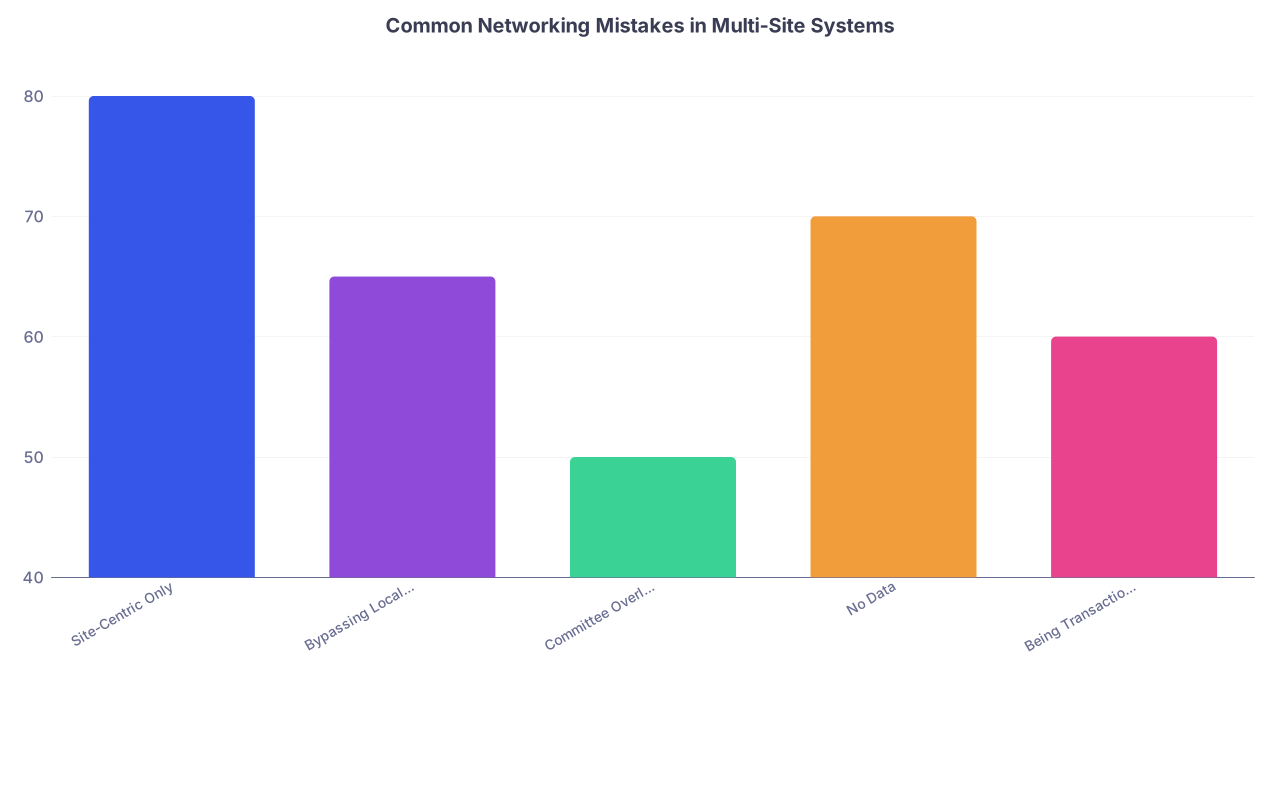
| Category | Value |
|---|---|
| Site-Centric Only | 80 |
| Bypassing Local Leaders | 65 |
| Committee Overload | 50 |
| No Data | 70 |
| Being Transactional | 60 |
6.1 Being “Your Site Only” in a System World
If every idea you bring is “better stuff for My Hospital,” you will be perceived as parochial. The system will route serious, cross-campus opportunities to people who naturally think enterprise-first.
Fix:
- Frame your problem at two levels in every conversation: “Here is what we see at North Campus; I suspect the system-wide pattern looks like X.”
- When you propose a solution, include at least one other site in the plan, even if it is tiny: “We could trial this at North and then add 10% of similar cases from West to see if it holds.”
6.2 Bypassing Local Leadership Stupidly
You do need system-level connections. But if you repeatedly go over your local chief’s head without even looping them in, your life can become unpleasant.
The right pattern:
- Inform your local leader early: “I plan to talk with the system CQO about X; I will share any takeaways and would like to mention that you are supportive of exploring this.”
- Give them small wins: “After talking to [system person], it sounds like they want a pilot; I proposed we start at our site with you as local lead.”
You are threading a needle: cultivating system contacts while not making your immediate boss feel undermined.
6.3 Taking On Symbolic Roles With No Real Levers
Common trap: accepting a “system title” that sounds impressive but has:
- No protected time.
- No budget.
- No direct influence over decisions.
Result: you burn out doing unpaid political work that accomplishes nothing.
Before saying yes, ask:
- “What is the decision authority of this role? What can I say yes/no to?”
- “How much time is budgeted? Where does that FTE sit?”
- “Who does this position report to in the formal chain?”
If you get vague answers, assume you are being asked to decorate a slide deck, not shape the system.
7. Building a Cross-Site Identity: How You Become a Power Node Yourself
The endgame here is not just “know the powerful people.” It is to become one of the nodes others seek out.

Here is what I have consistently seen in clinicians who become true cross-site players:
7.1 They Own One Cross-Site Problem Space
Examples:
- “The sepsis pathway person” across all hospitals.
- “The peri-op anticoagulation person” for the system.
- “The tele-stroke activation person” linking hubs and spokes.
They did not start with a title. They started with:
- A clearly defined problem that touches multiple sites.
- A few small wins with clean data.
- Good relationships with operations and IT to actually implement changes.
Then the system retrofitted a title and structure around them. Not the other way around.
7.2 They Are Relentlessly Reliable and Low-Drama
In a multi-site environment, leaders are drowning in chaos. The people they pull into bigger conversations tend to:
- Do what they say, on time.
- Communicate clearly, without theatrics.
- Bring problems paired with at least one realistic solution.
You want senior leaders to think, “If I loop them in, this will move forward without me babysitting it.”
7.3 They Build Horizontal Relationships, Not Just Vertical Ones
Vertical: knowing every VP in the tower.
Horizontal: knowing:
- The NP leads at two hospitals.
- The scheduler lead in your specialty across all clinics.
- The unit managers on three floors where your patients land.
- The analytics person who runs the weekly dashboard.
Horizontal networks are what let you actually execute. Vertical networks grant access and visibility. You need both.
8. A Concrete 6-Month Plan to Upgrade Your System Network
If you want a template, here is one. Six months. Not theoretical.
Month 1–2:
- Build your one-page power map.
- Identify two cross-site problems that bother you and that generate measurable pain (delays, transfers, readmissions, safety events).
- Have 3–4 short meetings with operations / IT / quality people touching those problems.
Month 3–4:
- Co-design one tiny pilot that touches at least two sites. Keep scope ruthlessly small.
- Present the plan and metrics to one system-level clinical or quality leader.
- Join one cross-site committee directly linked to your pilot domain.
Month 5–6:
- Execute the pilot.
- Capture outcomes in simple graphs and a one-page summary.
- Present at a system forum (not just your local M&M).
- In that presentation, explicitly credit 3–4 power nodes who helped, by name and role.
You have now:
- Solved a real problem.
- Built relationships in multiple domains.
- Shown up as a cross-site thinker.
- Become more visible to the people who actually move the levers in a multi-site system.
That is how you evolve from “random clinician at one site” to “someone we should loop into system conversations.”
FAQ (Exactly 4 Questions)
1. I am a resident / fellow in a big system. Is it too early to think about these power nodes?
No. You do not need to play high politics, but you should at least understand the terrain. Sit in on one system-level committee if you can. Shadow an access center or transfer center. Ask your program leadership who the key system figures are in your specialty. You are building pattern recognition, not angling for a vice chair role.
2. How do I avoid coming across as overly ambitious or political?
Anchor everything in patient care and system performance. Talk less about “leadership opportunities” and more about specific problems and outcomes. If your conversations sound like “We are seeing avoidable ICU transfers between Site A and B; here are the numbers; I think we can fix this,” people interpret your networking as responsible stewardship, not ladder-climbing.
3. What if my local chair is territorial and blocks system-level work?
This is common. Your job is to reduce their sense of threat. Emphasize how system work can bring resources, reputation, or recruitment to your home department. Offer to share credit and visibility. Keep them in the loop with brief updates. If they remain obstructive, sometimes the workaround is to start with lower-visibility, operational collaborations (with IT, scheduling, quality) that do not trigger their insecurity, and slowly build external credibility.
4. I am at a small peripheral site in a giant system. Do I even have a shot at being a meaningful node?
Yes, if you pick your battles wisely. Peripheral sites are often where system pain is most obvious: transfers, access problems, resource mismatches. If you become the person who reliably surfaces those issues with data and leads practical pilots that the core hospitals can learn from, you can absolutely become a valued cross-site connector. The key is to frame your work as “testing solutions at the edge that we can scale centrally,” not as “demanding center-level resources for our tiny site.”
Key points:
- Multi-site systems run on a few power domains—clinical leadership, operations, IT/EMR, finance/strategy, and reputation—and each has specific human nodes you must know.
- Real leverage comes from solving cross-site problems with small, data-backed pilots while building relationships both vertically (leaders) and horizontally (frontline operators).
- Your goal is not just to “network” but to become a reliable, system-minded problem solver—someone others naturally treat as a power node in their own right.


