
I hit 'submit' on my ERAS application at 2:14 AM. My finger hovered over the trackpad for a full, agonizing minute before I finally clicked the button. And there it was. The gray box. The pending Step 2 CK score. It's just sitting there, a blank, lifeless void in the middle of my application, mocking me. Every time I log in to check my status, my heart does a stupid little flutter, hoping the numbers have magically populated while I was sleeping. They haven't.
What if it comes back a 225? What if I completely bombed the biostats section and it tanks my percentile? I've played out the doomsday scenario so many times I can practically see the automated rejection emails filling my inbox. If the score is low, the program filters will just toss my app into the digital trash bin before a human being even reads my last name. It's terrifying. Your entire professional worth feels like it's suspended in limbo, held hostage by a testing center and a delayed scoring timeline.
If you are worried about how your score might impact your overall narrative, consider learning more about how to address multiple board exam failures in your residency personal statement.
I know I'm not alone in this. If you're staring at that same gray box, you're probably spiraling too. You're wondering if you should hold your application, if you should pivot to a less competitive specialty, if your entire medical career is over before it started. I've read every single thread on Student Doctor Network. I've listened to every residency advice podcast until my ears bled. I am desperately seeking reassurance that it's going to be okay.
But here's the hard truth I have to keep telling myself at 3 AM when I'm doom-scrolling Reddit: the personal statement is the one thing I actually control. The score is out of my hands. It's done. The narrative, though? That's mine. I have to build a story that can survive a bad number. I have to write something so undeniably human that a program director looks at a subpar score and thinks, "I still need to interview this person."
Crafting Your Narrative When Your 'Stats' Are Invisible
Remember that before finalizing your text, you should understand who should read your personal statement and when to involve them to ensure your feedback loop remains productive.
When your stats are invisible, you have to lean entirely on your "Why." I keep trying to mentally calculate my score to figure out what kind of specialty I can "afford" to apply to, but that's a massive trap. The personal statement needs to stand on its own two feet, regardless of the three-digit number that eventually pops up in that gray box.
The biggest mistake I see, and the one I'm most tempted to make when the panic sets in, is apologizing. I actually wrote a draft that started with, "Although my Step 2 score is currently pending, I assure you I am a dedicated and capable student..."
Stop. Just stop. Delete it. It reeks of desperation.
Program directors aren't stupid. They see the gray box. They know it's pending. You don't need to point it out, and you certainly shouldn't apologize for it. Over-explaining makes you look insecure. It makes it look like you're already bracing for a bad score. Instead of writing a defensive essay, I had to force myself to write an offensive one.
I shifted my focus to the times I actually showed up when it mattered. I stopped writing about my study habits and started writing about the code blue I ran on my internal medicine rotation. I wrote about the difficult family meeting where I had to translate complex medical jargon into plain English for a terrified daughter. Those moments prove I can be a doctor. A three-digit number just proves I can take a multiple-choice test. I need to show them the doctor, not the test-taker. Focusing on clinical resilience is the only real hedge against a fluctuating score. If my number is lower than I want, my narrative needs to scream that I am gritty, adaptable, and unbreakable.
The Anatomy of a High-Stakes Draft: What to Include (and Exclude)
Should I mention the board exam in the text at all? I've written and deleted three different paragraphs trying to smoothly weave in my study schedule or the fact that I took the exam late. It always sounds clunky. Unless you have a massive, unexplainable gap in your timeline that requires a direct explanation, leave the exam out of the text entirely. It's a distraction.
Instead, pivot hard to the humanistic traits that score reports cannot capture. Empathy. Grit. The ability to sit with a dying patient when there's nothing left to medically do. The NBME score report doesn't have a checkbox for "didn't run away when the patient started crying." That's what I'm writing about. That's what gets you an interview when the stats are borderline.
I'll admit, the anxiety got so bad that I employed a "Safety Strategy." I drafted two completely different introductions. One is my standard, confident opening about my passion for the specialty. The other is a slightly more humble, growth-oriented opening just in case the score comes back lower than I want and I need to pivot my tone at the last second before the rank list deadline. Is it incredibly neurotic? Absolutely. Does it make me feel like I have a backup plan if the worst happens? Yes. It keeps me sane.
But the hardest part of drafting isn't the writing itself. It's the psychological warfare of avoiding the forums. Student Doctor Network and medical school subreddits are toxic wastelands of gunners and doom-mongers. You'll see posts like, "If you don't have a 250 by September you should just give up and switch specialties."
Garbage. Absolute garbage.
I had to install a website blocker on my browser. I literally cannot access the forums. If I feel the physical urge to scroll and compare myself to anonymous strangers, I force myself to write one paragraph of my statement instead. Channel the nervous energy into the prose. Use the anxiety to fuel your writing momentum. When your brain wants to seek out worst-case scenarios on a message board, force it to build a best-case scenario on the page.
Final Reflections: Reclaiming Your Narrative
Waiting is pure agony. But I'm trying to reframe this period. It's the first time in four years I've actually had to sit with myself without a concrete, immediate metric telling me I'm "good enough." It forces a deeper reflection on why I'm even doing this in the first place. If I can't rely on a high score to carry my application, who am I as a physician?
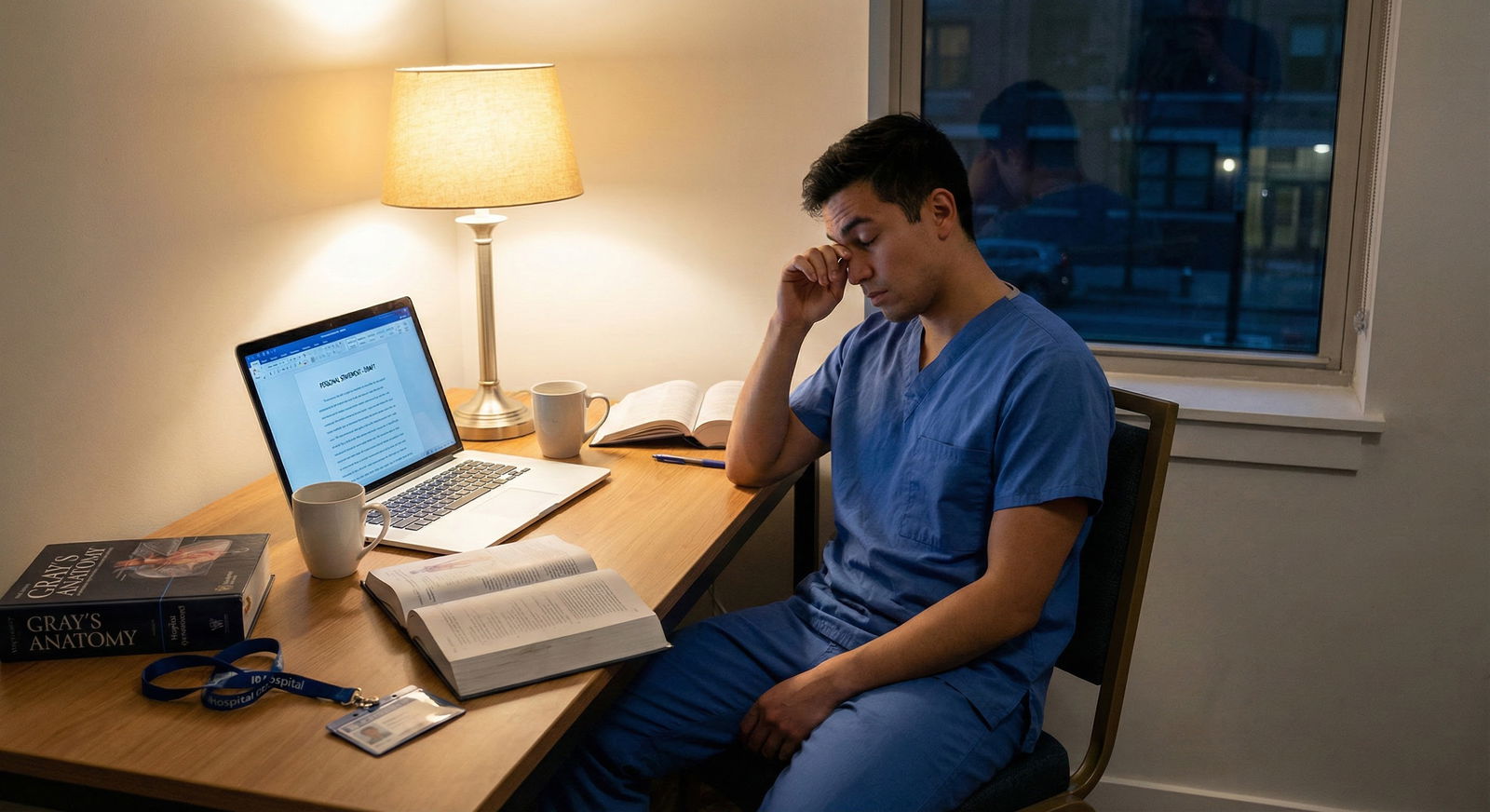
I have to accept that I cannot control the NBME's scaling. I cannot control the arbitrary filter settings some random community program uses to screen applicants. I can only control the quality of my writing. I can only control how I present my journey. Drafting while waiting is an exercise in professional maturity. It proves I can remain focused and productive under extreme uncertainty, which is exactly what residency is.
To the worried applicant reading this at 2 AM: trust the process, even when the process feels completely broken. Find peace in your identity outside of the board exam. I am not my Step 2 score. I'm the person who held the hand of the stroke patient when his family couldn't get there in time. I'm the person who stayed two hours late to fix the discharge meds because the pharmacy system was down. The test doesn't know that. But my personal statement does. And that has to be enough.
Key Takeaways for the Anxious Applicant
- Control the Controllables: Your personal statement is the only part of your application where you exert total, unmitigated control. Use it to tell a story the test cannot. Do not waste this space talking about the test.
- Anchor Your Worth in Reality: Do not anchor your self-worth to a pending number. Anchor it to the patients you have helped, the feedback you've received from attendings, and the tangible growth you have achieved on the wards.
- Embrace the Discomfort: Drafting while waiting is an exercise in professional maturity. Proving you can remain focused, reflective, and productive under extreme uncertainty is a core competency for a resident. Show them you have it.