
It’s August. You just finished an inpatient month that chewed you up, ERAS is open, and your co-intern says casually, “Honestly, I just reused my med school personal statement and tweaked a few lines. Program directors don’t read them anyway.”
You open your old AMCAS essay. It’s long, polished, sentimental. You’re exhausted. The idea of starting from scratch feels impossible.
So you start copy–pasting.
Let me stop you right there. Reusing your medical school essay for residency is one of those “seems efficient, actually dangerous” moves. Like reusing an old H&P template and forgetting to update the medication list. It looks fine—until someone actually reads it carefully.
I’ve seen this mistake enough times to tell you: programs do notice. And reusing that essay can quietly damage your application in ways you will not see coming.
Let’s walk through exactly why this backfires, the red flags program directors look for, and how to avoid sabotaging your residency application out of sheer fatigue.
Why Reusing Your Med School Essay Is So Tempting (and Why That’s a Problem)
You’re not stupid. You’re tired and overloaded.
You’re juggling:
- Clinical duties
- Step 2/Level 2 scores
- ERAS entries
- LORs and nagging attendings
- Interview planning, maybe away rotations
Of course the thought appears: “I already wrote a long, emotional, reasonably impressive essay once. Why reinvent the wheel?”
Here’s the trap: your medical school personal statement and a residency personal statement are not the same genre. They don’t have the same job, audience, or expectations.

Reusing that essay, even partially, signals three things you absolutely do not want associated with your name:
- You don’t understand what residency programs are looking for.
- You didn’t put in fresh effort for this next step.
- You might just be going through the motions.
None of those help you get ranked.
How Program Directors Actually Read Your Personal Statement
Let’s kill the myth first: “They don’t read personal statements.”
Some don’t read every word. Many skim. But enough of them read closely enough that a lazy or recycled essay hurts you. The personal statement isn’t the star of your application—but it is the easiest place to disqualify yourself.
Here’s how this usually goes behind the scenes.

| Step | Description |
|---|---|
| Step 1 | Open Application |
| Step 2 | Screen Out Early |
| Step 3 | Scan Experiences & LORs |
| Step 4 | Open Personal Statement |
| Step 5 | Lower on Rank List or Screen Out |
| Step 6 | Neutral/Small Plus |
| Step 7 | Scores & Transcript Reasonable? |
| Step 8 | Any Red Flags? |
The statement usually can’t save a weak application, but it can absolutely sink a solid one.
Program directors and faculty readers mainly use the personal statement to look for:
- Evidence you understand the specialty’s reality
- Signs of maturity and reflection since starting medical school
- Clear reasons you’re choosing this field
- Fit with their program’s culture or strengths
- Red flags: arrogance, lack of insight, clichés, weirdness, dishonesty
A med school essay reused for residency fails this test in very specific, predictable ways.
The Biggest Red Flags When You Recycle Your Med School Essay
Let’s get concrete. Here’s what raises eyebrows when someone recycles their medical school personal statement.
1. Time Warp: You Still Sound Like a Pre‑Med
Your med school essay was designed to answer: “Why medicine?”
Your residency essay must answer: “Why this specialty—and why you, now, as a near-physician?”
If your essay still sounds like:
- “I first became interested in medicine when my grandmother got sick…”
- “Shadowing Dr. X as an undergraduate showed me that physicians can truly impact lives…”
- “During my mission trip to [insert predictable country]…”
You’ve already lost ground.
Faculty reading this will think:
- “They haven’t updated their narrative since college.”
- “Where are their clinical experiences as a medical student?”
- “Do they even understand what internal medicine/surgery/psych actually looks like?”
You’re not an eager pre-med with idealized views anymore. You’ve written notes at 3 a.m., seen disasters, made mistakes, felt stupid on rounds, managed real human suffering. If none of that shows up? You look frozen in time.
2. No Specialty Focus = No Specialty Insight
A med school essay is broad. It sells you as someone who should be a doctor, somewhere, someday.
A residency essay must sell you as someone who should train in this specialty specifically.
When you reuse your med school essay, you almost always end up with one of two bad outcomes:
- You barely mention the specialty at all
- You slap the specialty name into a few sentences tacked onto the end
Both are obvious. Both are lazy.
Example problem lines I’ve actually seen:
- “I look forward to a future in medicine where I can combine patient care, advocacy, and lifelong learning.” (Great. Which field? Why?)
- “These experiences have confirmed my desire to pursue a career in [INTERNAL MEDICINE].” (Yes, I have seen people literally leave the bracketed placeholder.)
Here’s how it reads on the other side: you’re still in generic-doctor fantasy land, not specialty‑level reality.
Comparing Med School vs Residency Essays: They’re Not Interchangeable
To make this painfully clear, look at what each essay is supposed to answer.
| Aspect | Med School Personal Statement | Residency Personal Statement |
|---|---|---|
| Core question | Why medicine? | Why this specialty and why you now? |
| Point in training | Pre‑clinical / no MD yet | Near-graduation, with clinical exposure |
| Focus of stories | Undergrad, early exposures, motivation | Clerkships, sub‑Is, specific patient care moments |
| Evaluation lens | Potential to become a doctor | Fit and readiness for their specialty/program |
| Tone that works | Aspiring, idealistic (within reason) | Grounded, reflective, specialty-aware |
Trying to reuse the first for the second is like submitting a college essay for a job application and hoping HR won’t notice.
They notice.
The Subtle Ways Recycled Essays Undermine You
The danger isn’t just “someone catches a direct copy–paste.” It’s deeper than that. Reusing your old essay quietly makes you look less mature, less self‑aware, and less ready.
Here’s how.
1. Outdated Language and Naive Ideas
Your med school essay was probably full of things that read “fine” at that stage but sound naïve now:
- Over-romanticizing “saving lives”
- Vague talk about “helping people” with no nuance
- Zero mention of systems, teams, or realistic constraints
- Treating doctors as heroes, not humans who also fail and struggle
A seasoned PD reads that and thinks, “This person either hasn’t grown, or hasn’t reflected on their growth.” Both are bad.
2. No Evidence of Growth During Medical School
Residency programs want to see what you did with the time you were given in med school.
If your essay spends 80% of its time in:
- Childhood
- High school volunteering
- College shadowing
…then where is:
- The ICU night that changed how you think about end-of-life care
- The clerkship where you realized you enjoy complexity or continuity or procedures
- The mistake you made that taught you humility and responsibility
If your essay doesn’t show any leap from “pre‑med idealist” to “junior clinician with eyes open,” you’re telling them—implicitly—that not much happened.
That’s not a narrative you want.
3. Tone Mismatch: Too Polished, Not Real
Med school essays are often over‑edited by advisors, parents, consultants. They’re smoothed to death.
Residency readers are more allergic to fluff. They’ve seen thousands of “ever since I was a child” openings. They’re looking for someone who sounds like a person they’d trust on call, not someone performing for an admissions committee.
Recycled essays tend to read:
- Overly sentimental
- Overly vague
- Suspiciously polished and distant
They lack the raw, specific, slightly messy honesty that makes a strong residency statement work.
The Risk of Getting Caught Reusing (Yes, They Recognize It)
Some programs directly compare your med school application (which many schools keep on file and can see) with your residency one. Especially if you’re staying at the same institution or region.
Even when they don’t have your original file, certain recycled patterns stick out. People in academic medicine read hundreds of these over many years. They recognize:
- The “med school essay structure”
- Overused tropes from application workshops
- Phrases that sound like they were ripped from a pre‑med template
And here’s the thing that stings: they’re not mad. They’re just unimpressed.
You don’t get an angry email. You just get shifted quietly lower on the rank list because you looked like you didn’t care enough to do the work.
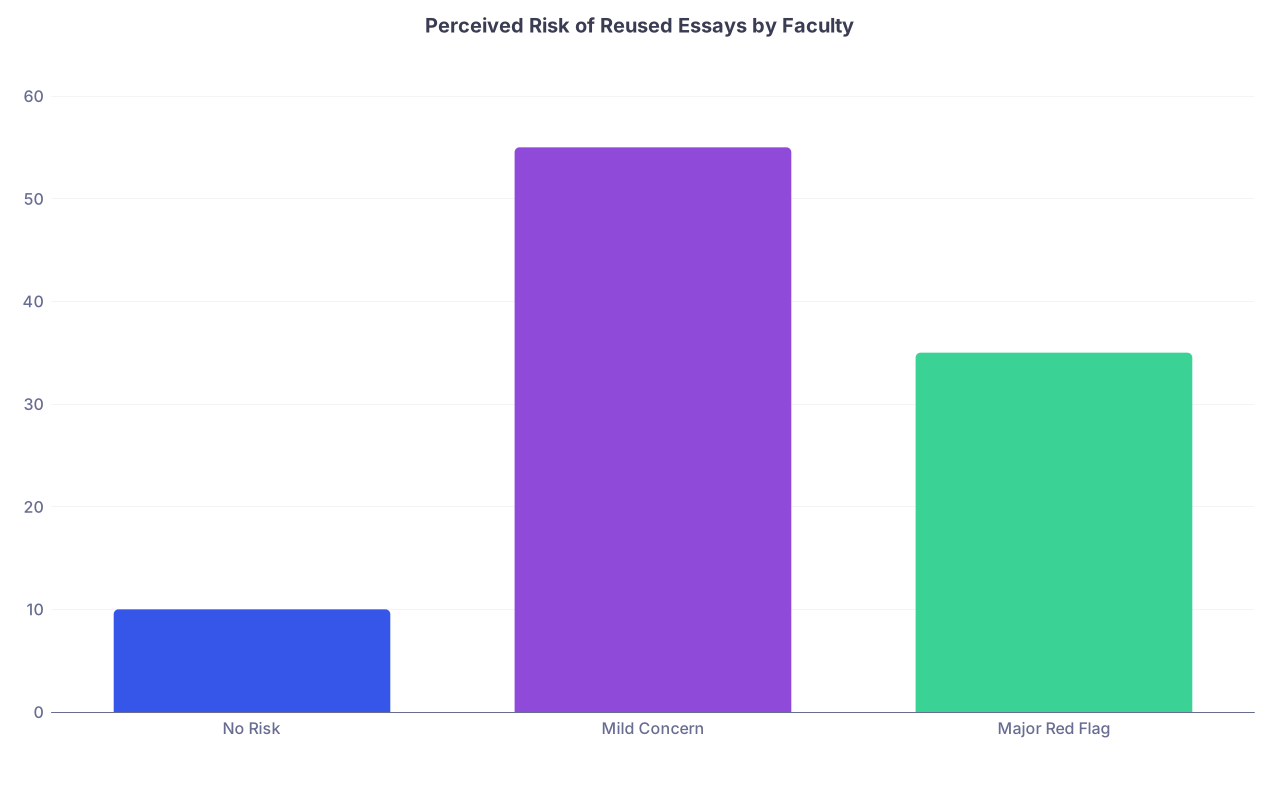
| Category | Value |
|---|---|
| No Risk | 10 |
| Mild Concern | 55 |
| Major Red Flag | 35 |
That “mild concern” and “major red flag” chunk is where your application can die—without you ever knowing why.
Common “Hybrid” Mistakes: The Fake Rewrite
A lot of people think they’re safe because they “rewrote” their essay. Except they didn’t really. They just committed a different version of the same mistake.
Here’s what I see over and over.
Mistake 1: The Cosmetic Edit
You:
- Change the first paragraph
- Add one paragraph about your chosen specialty
- Leave the rest basically intact
This reads like exactly what it is: a grafted‑on update to an old document. The voice even changes halfway through.
Mistake 2: The Copy‑Paste Story Bank
You take your old emotional story (“the patient who inspired me”) and drop it straight into the residency essay with minimal changes.
Problem: the story is from undergrad or early volunteering. It has nothing to do with your current clinical judgment, your role as part of a team, or your specialty choice.
Worse: the story often centers you far more than the patient or the team. PDs hate that.
Mistake 3: The Frankenstein Paragraphs
You stitch together:
- A couple old paragraphs from your med school essay
- A paragraph from a research statement
- A new paragraph about your sub‑I
Result: disjointed tone, repeated themes, and no unified arc.
If your statement feels like it was built from spare parts rather than written as a real narrative from where you’re standing now—you’re doing this.
How to Use Your Old Med School Essay Without Sabotaging Yourself
Now, I’m not saying your old essay is radioactive. You can use it—but only behind the scenes, as raw material. Not as the core.
Here’s how to do this safely.
Step 1: Read It Like a Stranger
Print your med school essay. Mark it up like you’re grading a stranger’s work.
Cross out:
- Any pre‑med level clichés
- Any story that stops before you entered med school
- Any sentence you’d be embarrassed to read out loud to an attending you respect
Circle only:
- Values that still matter to you (humility, curiosity, advocacy, etc.)
- Themes that truly survived med school (e.g., “I care about continuity of care,” “I like complexity,” “I need hands‑on procedural work”)
Those circled values can stay—as background DNA. The rest gets left behind.
Step 2: Start a Completely New Document
Do not “revise” your old file. That’s how you end up defaulting to it.
Open a blank document. Put your old essay in a separate window only as a reference for values, not structure or wording.
If you find yourself copy–pasting sentences, stop. That’s exactly the mistake we’re trying to avoid.
Step 3: Build Around Clinical Reality, Not Pre‑Med Fantasy
Your residency statement should be anchored in:
- Clinical rotations
- Sub‑internships
- Specific patient interactions where you had some actual role
- Moments where you learned something humbling or important about the specialty
Ask yourself:
- When did this specialty feel most right to me, even on a miserable day?
- What moments on the wards made me think, “I could do this for 30 years”?
- Where did I see myself growing—not just performing?
That’s the material you write from. Your med school essay might remind you of why you started medicine, but your residency essay must show who you’ve become.

Specialty-Specific Pitfalls If You Reuse Your Essay
Different fields catch different red flags when you recycle your med school essay.
Internal Medicine / Pediatrics / Psych
They’re watching for depth of reflection. They want to see that you actually like:
- Longitudinal care
- Complex multi‑problem patients
- Team discussions and uncertainty
If your essay is stuck at “I want to help people and I love science,” you sound like someone who hasn’t actually participated in any real family meeting, psych decompensation, or chronic disease management.
Surgery / EM / Anesthesiology
These programs are looking for:
- Comfort with acuity and procedures
- Resilience under stress
- Ability to function on teams under pressure
If you reuse a med school essay that’s heavy on abstract idealism and light on real‑world stress, they question whether you know what you’re getting into. They’ve seen too many students burn out because they fell in love with the idea of the field and never tested it.
Competitive Specialties (Derm, Ortho, ENT, etc.)
These are crowded fields. Everyone has numbers. Fit and seriousness matter even more.
If your essay reads generic enough that it could be plugged into any specialty with minimal changes, they assume:
- You’re applying broadly without a clear commitment
- You might not stick if things get rough
- You might be using them as a backup or status object
A recycled med school essay screams, “I’m here because I want to match somewhere fancy,” not “I understand and want this work.”
How Programs React When Your Essay Feels Off
No one sends you feedback. You just quietly lose ground.
Here’s what I’ve literally heard in committee rooms:
- “The statement sounds like a college applicant.”
- “I don’t think they understand what our field actually does.”
- “Generic essay. Nothing here that shows why they belong in this specialty.”
- “Good scores, but I don’t get a sense of them at all.”
You’re not being blacklisted. You’re just not giving them a reason to fight for you in a crowded pool.
And when someone else with similar scores and similar clerkship comments does have a statement that feels grounded, mature, and specific to the specialty? They get the interview. They slide higher on the rank list.
You don’t.
A Safer, Smarter Use of Your Energy
You’re right to want efficiency. You do not need to spend 60 hours agonizing over your personal statement. But you also don’t get to phone it in.
Here’s a middle path that respects your time and protects your application:
- Use your med school essay only as a values inventory, not a template.
- Write one solid, genuine residency statement built from clinical reality.
- Tailor very lightly only where it matters (program‑specific interests, certain niche fields). Don’t re‑invent the entire thing ten times.
That’s how you avoid the lazy trap and avoid burning out on endless drafts.
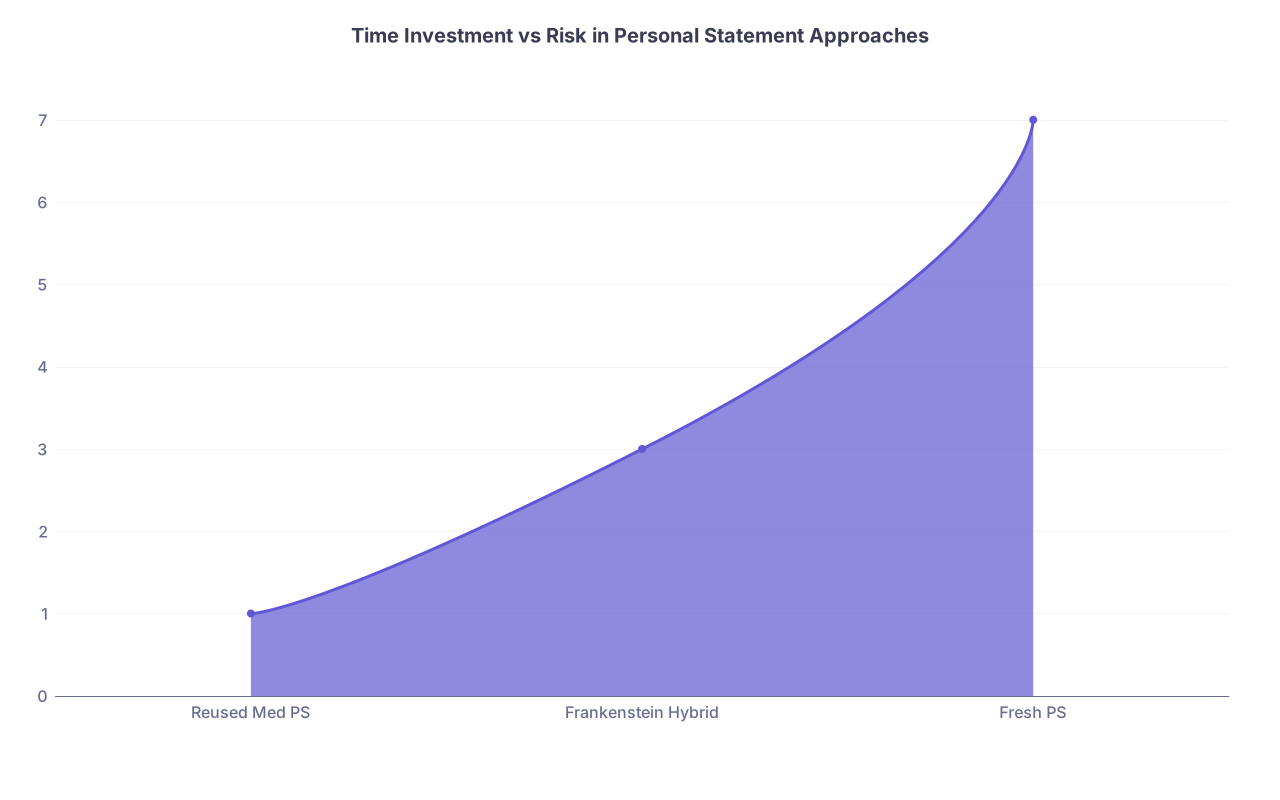
| Category | Value |
|---|---|
| Reused Med PS | 1 |
| Frankenstein Hybrid | 3 |
| Fresh PS | 7 |
(That’s an illustration of relative time spent, not exact hours. The point: the low‑effort path carries the highest risk.)

The One Question You Need to Ask Yourself
Before you hit submit, ask yourself this, bluntly:
“If a faculty member who knows me well read this, would they say, ‘Yes, this sounds like you now’—or would they say, ‘This sounds like something you wrote years ago’?”
If the answer is the second one, you’re playing with fire.
Key Takeaways
- Medical school and residency personal statements have different jobs. Reusing your med school essay signals you don’t understand that and haven’t grown.
- Programs may not “catch” you copy–pasting line by line, but they absolutely feel when an essay is generic, outdated, or pre‑med‑level—and they quietly penalize you for it.
- Use your old essay only as a source of core values, then write a new, clinically grounded residency statement that reflects who you are now and why you belong in this specialty.