
The biggest secret about personal statements is brutal: program directors stop reading most of them after 20–30 seconds.
Not because they’re cruel. Because they’ve seen the same mistakes so many times that the red flags practically glow on the screen. Once they see two or three, they move on. You get mentally tagged as “average,” “risky,” or “no” before you even reach your second paragraph.
Let me walk you through why they stop reading—and what’s really happening on the other side of that ERAS portal.
What PDs Are Actually Doing When They “Read” Your Statement
Here’s the first truth nobody tells you: your personal statement is rarely read like an essay. It’s scanned like a diagnostic test.
A seasoned PD or associate program director can triage a statement in under a minute. They’re not savoring your prose. They’re hunting for three things:
- Are you sane and socially normal enough not to blow up the team dynamic?
- Do you understand this specialty and its realities beyond clichés?
- Do you give me a reason—any reason—to remember you after I close this file?
If the answer to any of those is “no,” or if you trigger any of the known red flags, they stop. Sometimes hard stop. Sometimes they just skim the rest out of habit, but the decision is already made.
I’ve sat in offices where PDs literally said, “Nope,” halfway through the first paragraph and clicked Next. Not because of grammar. Because of what that first paragraph told them about judgment, self-awareness, and risk.
Let me unpack the red flags that actually make them do that.
Red Flag #1: The Trauma Dump and Emotional Overexposure
This is the single most common way applicants tank an otherwise decent application.
Here’s what sends PDs’ eyes straight to the bottom of the page—and then to the “No” column:
You open with a graphic or intensely personal trauma: parental abuse, sexual assault, severe mental health crisis, multiple hospitalizations, messy family situations—then spend 80% of the statement there.
Does that mean you can never mention hard things? No. But you need to understand how this reads behind the scenes.
In closed-door meetings, this is what I’ve heard faculty say word-for-word:
- “If this is what they put in the personal statement, what are they going to share with patients and staff?”
- “I don’t want to spend three years being their therapist.”
- “This is too raw. I’m worried they’re not stable.”
Cruel? Maybe. Real? Absolutely.
The problem isn’t that you’ve had trauma. Half the faculty has, too. The problem is judgment and containment. A personal statement is a professional document. When you overshare highly sensitive material, you’re accidentally signaling:
- Impaired boundaries
- Potential emotional volatility
- Risk for burnout, interpersonal drama, or professionalism issues
PDs don’t want to roll those dice.
The version they can tolerate: a brief, contained reference to adversity, framed around growth with no graphic detail, no unresolved anger, and clearly in the past. Two or three lines, max. Then back to who you are now and why you can function at a high level.
If you’re not sure if a detail is “too much,” it probably is. Save it for a trusted mentor or therapist, not your ERAS upload.
Red Flag #2: The “I Want to Save the World” Generic Humanitarian Essay
If your statement could be swapped with 500 other applicants by changing the name and specialty, it’s a problem.
PDs have a nickname for these: “template humanity” essays.
They all sound like this:
- “I have always wanted to help people.”
- “Medicine allows me to combine my love of science and service.”
- “Growing up, I saw health disparities in my community, and I knew I wanted to make a difference.”
On their own, those lines are not evil. The problem is they’re empty calories. There’s no specificity, no edge, no actual evidence that you’ve lived this, not just copied it from your school’s advising PowerPoint.
Behind closed doors, what faculty think reading this:
- “This applicant has no idea what this specialty actually is.”
- “They’re telling me what they think I want to hear.”
- “If they can’t be specific here, what will they be like with a SOAP note?”
This is where PDs stop reading because they’ve already decided: nothing unique here, just another mid-tier applicant with generic motivations.
The fix: ruthless specificity. Concrete scenes, precise responsibilities, clear examples. Not “I care about underserved patients,” but “I spent a year volunteering in a syringe-exchange clinic in [City], where I…”
They’re not expecting poetic genius. They are expecting evidence that you’ve actually been in the rooms and situations you’re describing.
Red Flag #3: The “Wrong Specialty Vibes” Problem
There are statements that are fine… for a different specialty. PDs call this “wrong vibes,” and it kills interest in seconds.
Example: Internal Medicine PD reading a statement that sounds like Ortho:
- Heavy focus on procedures, “fixing things with my hands,” “being in the OR”
- Barely any mention of longitudinal patient care, complexity, or diagnostic thinking
They read that and think: “This person missed their calling—or is using IM as a backup. Pass.”
Or Psychiatry PD reading a statement that could be Pediatrics:
- Cute kid anecdotes
- “I love working with children and their families” with zero real engagement with serious mental illness, transference, boundaries, risk assessment.
The underlying logic: residency is already hard enough with people who are all in. Why would I rank someone I suspect is “settling” for this field?
If you’re genuinely switching interest late, you need to aggressively scrub your statement of your previous specialty’s vibe and build a credible, grounded argument for this one. That means clear evidence: rotations, mentors, patients, research—something.
“During third year, I realized I liked X more than Y” with no actual story or exposure? PDs do not buy it. They stop reading and tag you as “backup applicant.”
Red Flag #4: Overcompensating and Over-selling Yourself
Every PD has horror stories about the applicant who wrote like a future Nobel laureate and then interviewed like a confused MS2. That candidate never gets ranked high again—and the PD remembers the tone of that statement.
So now they’re wary of ego.
Here’s the kind of phrasing that sets off alarms:
- “I am uniquely qualified to…”
- “I will be an exceptional resident because…”
- “My work ethic is unmatched.”
- “I have always been the hardest worker in the room.”
What they hear: lack of humility, poor insight, potential nightmare to teach.
I’ve seen PDs literally circle those sentences in red in printouts and write “No” in the margin.
They don’t mind confidence. They mind self-promotion with no grounding. If you’re truly strong, your CV and your examples will show it. You don’t need to declare it like a campaign slogan.
Subtle but equally toxic: turning every experience into a story about your greatness. “I led… I initiated… I revolutionized…” when the story is clearly about a standard QI project or a standard free clinic shift.
They know the difference between standard med student work and actual initiative. When you oversell the routine, you look either naïve or dishonest.
Red Flag #5: The “Too Much Psych” or “Too Much Therapy Speak” Statement
I see this a lot from applicants who’ve been in therapy, done a lot of introspection, or are heavy into wellness circles. They write a statement that sounds like a therapy session transcript:
- “I really had to sit with my discomfort.”
- “I did a lot of internal work around my perfectionism.”
- “I’ve been on a healing journey.”
- “Medical school forced me to confront my inner child, my triggers, and my need for external validation.”
Some PDs are fine with a light touch of this. Many are not. The reaction you do not hear publicly:
- “This sounds like a walking HR case.”
- “They’re too in their head.”
- “I worry about resilience.”
They are not selecting for untreated trauma. They are selecting for emotional stability under pressure, even if that stability is imperfect.
Mentioning therapy itself is not automatic death. But the way most students describe it is a problem: centered on ongoing fragility, unresolved crises, or very recent breakdowns without a clear sense that you’re on the other side of it and functioning.
If you absolutely must reference your own mental health struggles, it needs to be:
- Brief
- Past-tense
- Clearly integrated into a functioning present
If reading your statement makes the PD wonder, “Can this person handle nights, codes, angry families, bad attendings?”—you’re done.
Red Flag #6: Poor Judgment in What You Joke About or Criticize
Humor is high-risk, low-reward in a personal statement. When it works, you might get a smile. When it doesn’t, you get filtered out.
I’ve seen applicants:
- Make light of patient deaths “teaching them perspective”
- Joke about nurses, consultants, or other specialties
- Use sarcastic asides about “the system” that read like bitterness, not insight
Faculty remember this stuff. And they talk.
In ranking meetings you hear: “He made a weird joke in his statement about a noncompliant patient,” or “She sounded condescending about primary care.” That’s usually the end of that.
Same with criticism of your medical school or prior rotations. Anything that smells like you might trash-talk the residency in the future? Instant bad taste.
You don’t need to be bland. You do need to be safe to put on a team. PDs are selecting colleagues they have to sit next to in M&M conference and trust with complex social situations. If your writing shows poor social calibration, they’re not gambling on you.
Red Flag #7: The “Unstable Narrative” – Inconsistency with the Rest of Your Application
This is more subtle, but experienced readers pick it up immediately.
They’re reading your personal statement with your ERAS CV open right next to it. If the two don’t match, they stop reading and start doubting you.
Things that trigger that:
- You write passionately about underserved care but have zero sustained underserved experiences on your CV.
- You claim your “longstanding interest” in research, but there’s a single poster from M4 summer and nothing else.
- You describe someone as a “key mentor” and “major influence,” but that person isn’t writing you a letter… and is at a place you only rotated at for two weeks.
On committees, people literally say: “This feels constructed.” That’s a kiss of death phrase.
The story of your personal statement must be consistent with what your CV already shows. It can narrow the spotlight, interpret, and deepen. It cannot outright contradict the record.
If you have a late conversion into a specialty with thin CV support, your statement has to:
- Own that timing honestly
- Show credible exposure moments
- Avoid rewriting history to claim you always wanted this when everything says otherwise
They respect honesty more than spin. They hate being played.
Red Flag #8: Undigested Anger, Cynicism, or Resentment
Residency is full of pressure, unfairness, and bad behavior from above. PDs know that. But they don’t want to import bitterness into their program.
If your statement has any of these notes, they shut down fast:
- Angry rants about the healthcare system with no nuance or self-awareness
- “I saw how physicians didn’t care, and I vowed to be different” (reads as self-righteous and naïve)
- Complaints about your school, attendings, grading, or culture
- Overly dark or fatalistic tone about the future of medicine
Remember: they expect you to be tired and a bit jaded. They are too. What they want to see is whether you still have enough optimism and resilience to be teachable, collegial, and safe.
If your writing makes them think, “This person will be the resident stirring the pot in the workroom,” they’re out.
Red Flag #9: The “Life Story, No Specialty” Essay
Programs have a specific, practical question: Why this specialty, and why will you not regret it halfway through PGY-2?
A surprising number of applicants never answer that.
They tell their entire life story. Childhood, undergrad, volunteer work, Aunt’s illness, medical school rotations. Then spend about three lines on the specialty. All generic.
When PDs notice this, the internal comment is, “They’re applying to the specialty, not joining it.” Meaning: they haven’t really committed in their own mind.
For competitive specialties especially, that’s game over. They have a line of people who live and breathe this work. They’re not wasting a spot on someone who wrote a personal memoir with “and so I applied to [specialty]” pasted on at the end.
You need enough medicine-specialty content that if someone covered your name and demographic details, they could still plausibly guess your field from the themes you chose.
How PDs Actually Use Your Statement in Real Life
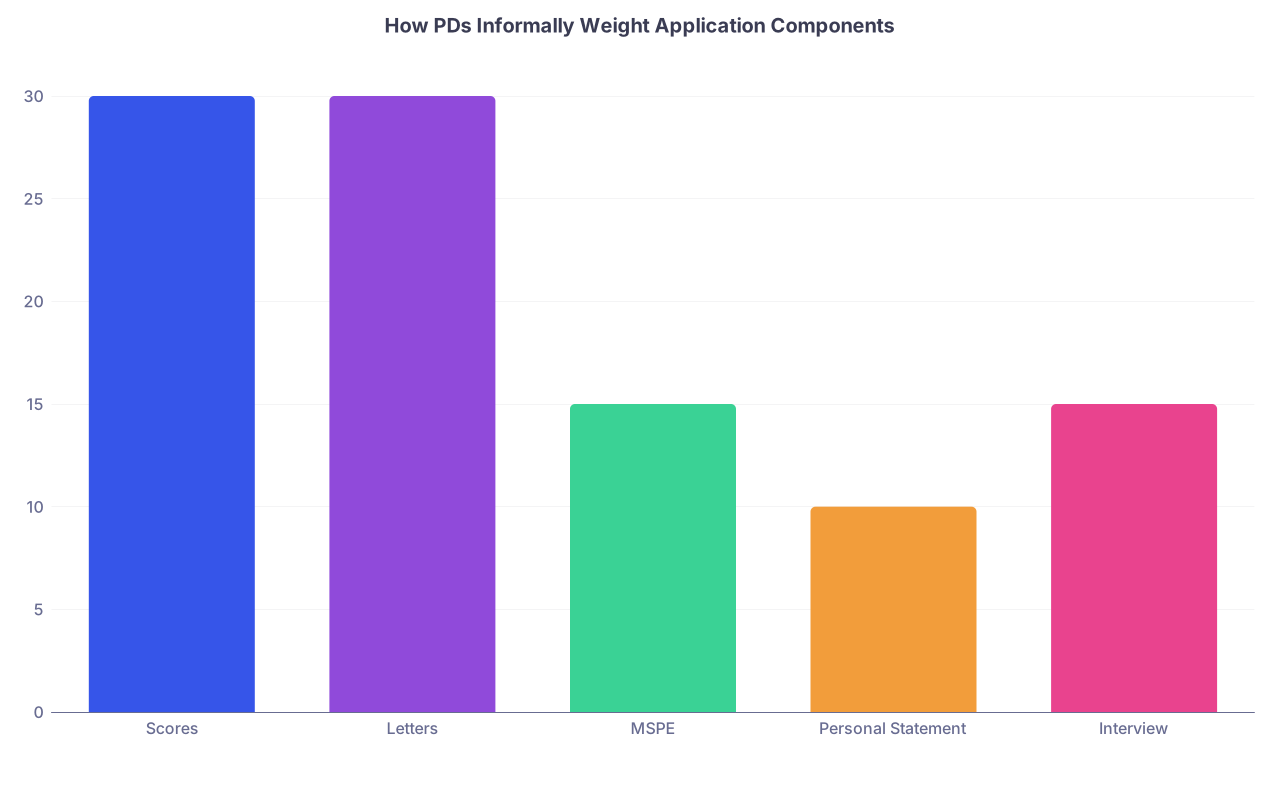
Let me clear up one misconception: the personal statement usually does not “get you the interview” in strong applicants. Your scores, letters, school, and experiences do most of that lifting.
Where the statement really matters:
- Borderline applicants: Can we justify giving them a shot? Or is this a hard pass?
- Red-flag files: Any explanation for that Step failure, LOA, or professionalism incident?
- Interview prep: Faculty skim your statement 5 minutes before they walk in to meet you. That’s often the only thing they actually read in depth.
| Category | Value |
|---|---|
| Scores | 30 |
| Letters | 30 |
| MSPE | 15 |
| Personal Statement | 10 |
| Interview | 15 |
A bad statement can absolutely bump you from “maybe” to “no.” A good statement won’t magically override awful scores, but it can move you from “generic mid” to “I kind of like this one, let’s meet them.”
The real power of the statement? Giving interviewers a coherent narrative they can hang questions on. If your statement is confusing, off-putting, or full of red flags, that carries straight into your interview day.
What a “Safe” but Strong Statement Actually Looks Like
Let me be blunt: PDs are not hunting for poetry. They’re hunting for red flags. If you avoid the minefield, you’re already in the top half.
A statement that reads well to faculty usually has:
- One or two concrete, specific clinical scenes or experiences
- Clear connection to the chosen specialty, with realistic understanding
- Professional tone with personality, but no drama dump
- Modest, grounded self-description supported by actual examples
- Internal consistency with the rest of the application
What it does not have:
- Graphic trauma or unresolved mental health crises
- Grandiose language about your greatness or destiny
- Generic humanitarian filler with zero specifics
- Resentment, cynicism, or obvious bitterness
- Vibes for a completely different specialty
You don’t have to be extraordinary on paper. You do have to be safe, coherent, and believable.

| Step | Description |
|---|---|
| Step 1 | Open Personal Statement |
| Step 2 | Stop reading Move to No/Low Rank |
| Step 3 | Mark as Interesting Boost for Interview/Rank |
| Step 4 | Neutral Depends on Scores/Letters |
| Step 5 | Any major red flag? |
| Step 6 | Any strong positive hook? |
Quick Reality Check: Competitive vs Less Competitive Specialties
Let me show you how brutally this can play out in different fields.
| Specialty Type | PD Use of Personal Statement |
|---|---|
| Very Competitive (e.g., Derm, Ortho, ENT) | Mostly used to screen OUT and to confirm strong interest; tiny missteps can hurt |
| Moderately Competitive (e.g., EM, Anesthesia, IM at big-name places) | Used to differentiate mid-tier applicants and flag problems |
| Less Competitive / Community Programs | Used more to assess professionalism, communication, and risk |
In ultra-competitive specialties, your statement is mostly a landmine field. They have 600 apps for 6 spots. They don’t need to fall in love with you. They just need reasons to discard you quickly.
In less competitive spots, your statement carries more weight in answering: “Are they going to be normal to work with for three years?” and “Are they serious about us and this field?”
In both cases, red flags are fatal. In only one case is your poetic brilliance potentially useful—and even then, they’d still pick a solid, normal-sounding applicant with great letters over a tortured artist with a gorgeous essay.

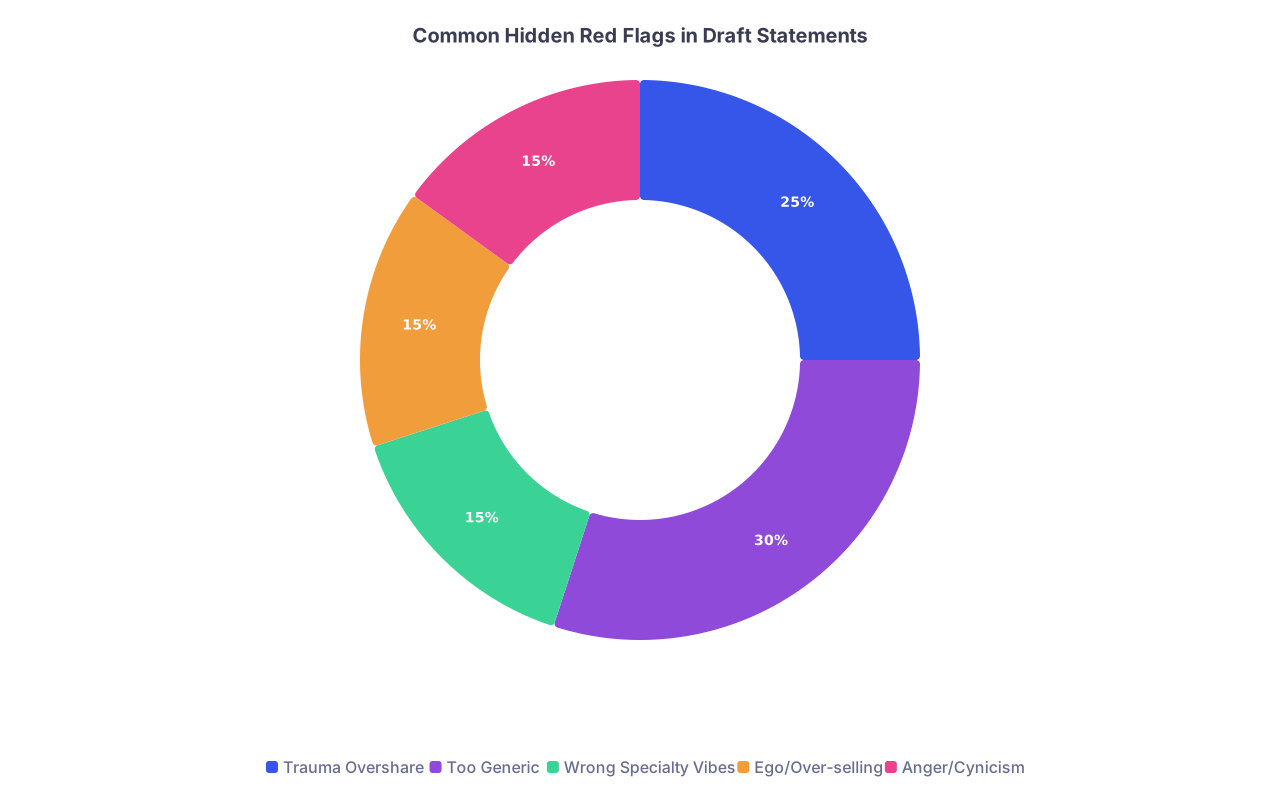
How to Know If Your Draft Has Hidden Red Flags
You’re too close to your own story to see all of this clearly. That’s normal.
The best informal screening is simple: show it to an attending or senior resident you trust and say, “Read this like a PD. Any reason you’d worry about me?”
Watch their face. Don’t just listen to their words.
If they say, “It’s good, very heartfelt,” but look a little pained or uncertain, dig. Ask:
- “Would you worry I’m oversharing?”
- “Does this sound like too much therapy talk?”
- “Do I sound bitter anywhere?”
Most faculty will not spontaneously tell you, “I would never interview you with this.” But they might say it if you give them direct permission to be blunt.
If you don’t have that person, at minimum ask yourself:
- Am I using this statement to process my own emotions, or to present myself professionally?
- Does this sound like something I’d be comfortable reading out loud in front of a room of attendings?
- Am I asking the reader for reassurance, sympathy, or validation?
If yes to any of those, you’re in the danger zone.
| Category | Value |
|---|---|
| Trauma Overshare | 25 |
| Too Generic | 30 |
| Wrong Specialty Vibes | 15 |
| Ego/Over-selling | 15 |
| Anger/Cynicism | 15 |

FAQs
1. Can I talk about my own mental health struggles or trauma at all?
You can, but most students do it badly and hurt themselves. If the event is central to who you are and you feel compelled to mention it, keep it brief, non-graphic, and clearly in the past. Focus 80–90% of the essay on how you function now, not what happened to you. If you’re still actively raw about it, it does not belong in this document. Use the MSPE addendum or a dean’s letter for more sensitive contextualization if truly necessary.
2. How do I show genuine interest in a specialty without sounding generic?
Stop declaring your interest and start demonstrating it. One specific clinic, one patient encounter, one project, one mentor conversation—described concretely—will do more than three paragraphs of “I am passionate about…”. Anchor your interest in actual experiences that are visible elsewhere in your application. Someone reading your CV alone should be able to guess the general themes your statement will hit.
3. Is it better to play it totally safe and boring than to take risks?
Yes. For residency, yes. You are not applying to an MFA program. A clean, slightly boring but professional and specific statement will outperform a bold, “creative,” emotionally risky one ten times out of ten. PDs are hiring colleagues, not storytellers. Your primary job is not to impress them—it’s to give them zero reasons to worry about you.
Key takeaways: PDs stop reading when they see red flags in judgment, stability, or sincerity, not when your writing is merely plain. Avoid trauma dumps, therapy-speak, bitterness, and generic fluff, and anchor your story in concrete experiences tied clearly to your chosen specialty. If your statement makes you look safe, grounded, and consistent with the rest of your application, you’ve already beaten half the field.