
Your personal statement is not read the way you think it is.
Most applicants imagine a quiet, contemplative faculty member savoring every sentence like literature. That’s fantasy. Inside the committee room, your personal statement is a tool—and it gets processed, sorted, and scored with brutal efficiency.
Let me walk you through what actually happens when your statement lands in front of the people who control your interviews.
How Your Personal Statement Is Really Used
Here’s the first ugly truth: at many programs, the personal statement is not the primary driver of interview selection.
Step scores. Class rank. Clerkship grades. Letters. Those are the heavyweights.
But dismiss the personal statement at your own risk. Because it is the tiebreaker, the red-flag detector, and the “do I actually want to work with this person at 2 a.m.?” filter.
At a mid-tier IM program I know well, the PD said this out loud in a committee meeting:
“If they’re in the maybe pile, the statement decides if I care enough to invite them.”
That’s the real function: it moves you from Maybe → Yes, or from Maybe → No thanks.
And one more thing: at a surprising number of places, the personal statement is scored. Numerically. On a rubric. Usually by people who are tired, behind on charting, and reading way too many applications.
| Category | Value |
|---|---|
| Screening | 10 |
| Interview Invite | 20 |
| Rank List | 30 |
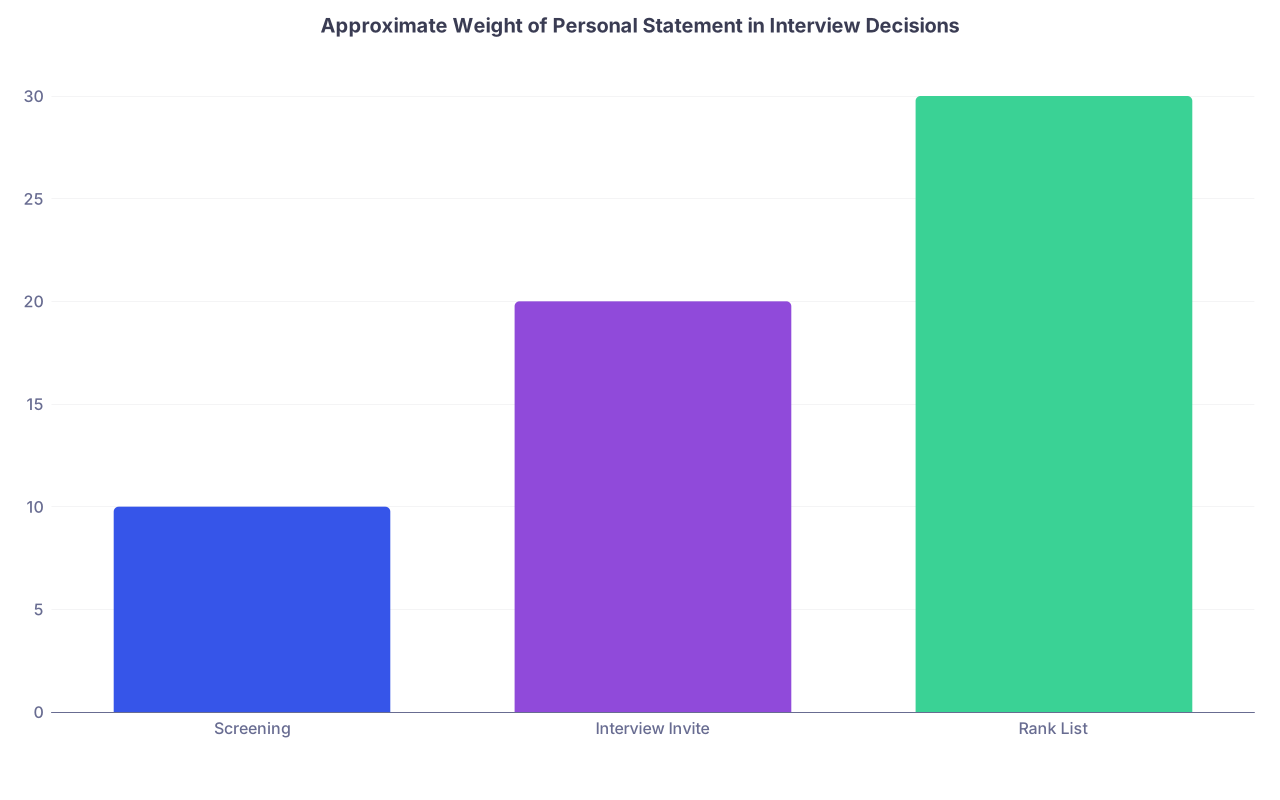
These numbers aren’t official, but they’re very close to what faculty quietly admit:
- During initial screening, the statement might be 10% of the decision.
- When deciding who to invite from the “borderline” pile, it can jump to 20%.
- On the rank list, when everyone’s stats look similar, it can feel like 30% or more.
Not because they “love your prose.” Because it’s one of the only places they can see how you think, what you notice, and whether you seem like a problem or a pleasure.
Who Actually Reads Your Personal Statement
You imagine the PD carefully reading your every word. Sometimes they do. Often they don’t—at least not first.
Here’s the usual cast of characters:
1. The Initial Screener
This might be:
- An APD
- A chief resident
- A senior faculty member
- Occasionally, a very trusted senior resident
They’re going through dozens, sometimes hundreds of files.
I’ve watched this live. Here’s what it looks like:
- Open ERAS.
- Skim scores, med school, class rank, red flags.
- Click personal statement.
- Read the first 4–6 lines.
- Scroll once. Maybe twice.
- Make a snap judgment: “Normal,” “Strong,” or “Uh oh.”
They’re not grading grammar. They’re deciding: Is this a grown, reflective human being? Or is there something off?
You get about 30–60 seconds. That’s your actual read time at this stage.
If something catches their eye—genuinely interesting story, nontraditional background, strong sense of purpose—they might mark you to the PD as “worth a closer look.”
If something feels weird—overly dramatic, self-congratulatory, arrogant, victim-y—you go straight into the “No” or “Only if we need to fill” pile.
2. The Fellowship-Minded Faculty
Every program has that one cardiologist, that one intensivist, that one surgeon who’s looking at your file thinking, “Could this person be my future fellow?”
They look at your statement very differently. They’re asking:
- Does this person actually like this specialty, or are they generic?
- Do they understand the work, or are they describing TV medicine?
- Are they curious? Do they think like someone who will keep learning?
They often give you an informal mental score that weighs heavily in discussions:
“This applicant is solid on paper, but their statement reads like a template. I don’t see any real curiosity.”
That sentence has killed plenty of borderline applications.
3. The Interviewer on the Morning Of
Many interviewers don’t read your full application until the night before or the morning of your interview. Some literally skim your statement between patients.
They’re not scoring you at that point. They’re cannibalizing your statement for talking points.
I’ve heard this more times than I can count:
“I just need three questions to ask them—family, some challenge, and why they picked this specialty. I’ll pull it from the statement.”
Which means if your statement is vague, generic, or empty, your interview will feel the same way.
The Hidden Scoring Rubric They Don’t Show You
No one hands out the real rubric. But I’ve seen the internal sheets and sat in the rooms. The categories repeat over and over with different labels.
Here’s roughly how your personal statement is actually scored or judged, even if it’s informal:
| Dimension | Typical Scale |
|---|---|
| Clarity & Coherence | 1–5 |
| Maturity & Insight | 1–5 |
| Fit for Specialty | 1–5 |
| Professionalism | 1–5 |
| Red Flags / Concerns | 0 (none) / 1 (present) |
Let’s unpack how people truly think through each.
1. Clarity & Coherence
This is not about poetic language. It’s basic questions:
- Can this person tell a story from start to finish without losing me?
- Do they organize thoughts logically?
- Do sentences make sense on first read?
I’ve seen faculty say, bluntly:
“If their statement is this hard to follow, I don’t trust their notes.”
That’s the connection. Clear communicator vs. confused narrator.
You don’t get extra points for flowery language. You get points for making your story easy to understand and easy to remember.
2. Maturity & Insight
This is where most applicants fail.
They describe events. They don’t show growth.
Committee members are looking for:
- Do you understand your own experiences beyond “this was hard”?
- Do you take responsibility or just blame systems/others?
- Can you reflect on a mistake without sounding defensive?
Compare these two kinds of lines:
- “This experience taught me the importance of communication and teamwork.”
- “After that code, I realized I had charted the wrong dose. Nothing catastrophic happened, but I saw how thin the margin is between ‘fine’ and ‘never the same again.’ I started double-checking every med with a resident, and I still do.”
The second one will make a room of attendings nod. They’ve been there. They see you learning in real time.
3. Fit for Specialty
This is big. Especially in competitive fields.
They ask themselves:
- Does this sound like someone who understands what we actually do?
- Are they describing the work of this specialty accurately?
- Does their motivation line up with reality?
If your EM statement talks only about “fast-paced adrenaline” and nothing about uncertainty, risk, or systems, the EM folks will see it as shallow. If your pathology statement reads like an IM statement with “internal medicine” swapped for “pathology,” you’re done.
I once watched a PD in EM say:
“This reads like they want Grey’s Anatomy, not our ED. Pass.”
That was over one paragraph. One.
4. Professionalism
This is the “would I trust them with my name under their orders?” test.
They’re watching for:
- Excessive blaming of others (schools, attendings, patients)
- Inappropriate language, jokes, or oversharing
- Weaponized vulnerability (“Look how much I’ve suffered, therefore pick me”)
- Minimizing serious issues (substance use, professionalism violations)
You can talk about hardship. You should sometimes. But if your tone feels like a therapy session instead of a professional reflection, people get uncomfortable and back away.
One PD’s exact phrase:
“If their boundaries are this loose on paper, what does it look like in the hospital?”
Not the question you want to trigger.
5. Red Flags / Concerns
This is binary: is there something concerning, yes or no?
Things that set this off:
- Disorganized or nonsensical narrative
- Strange digressions (political rants, conspiracies, personal grievances)
- Extreme grandiosity (“I alone…”, “I was the only one who…”)
- Aggressive or bitter tone toward prior institutions or supervisors
If you trip this wire, your chances of an interview drop fast—even with great numbers.
The First 10 Seconds: Where You Win or Lose
Your opening is more important than you think, not because anyone loves “hooks,” but because of how screeners actually read.
Here’s the real behavior pattern:
- They open your statement.
- Their eyes hit the first 3–4 lines.
- They decide: “Is this worth reading carefully, or is this ‘standard language’ I’ll just skim?”
If your first few lines sound like:
- “From a young age, I have always been fascinated by the human body…”
- “Medicine has always been my calling…”
- “I first realized I wanted to be a doctor when…”
They’ve seen that exact movie a thousand times. You’ve already lost their attention. You are now background noise.
You do not need to be cute, overly dramatic, or edgy. You do need to sound like a specific human being, not a template.
Something like:
“At 3 a.m., the hospital is honest. No families. No rounds. Just the patient, the monitor, and whether what you ordered twelve hours ago is helping or not.”
That will make a tired attending stop and read the next line. Not because it’s “fancy,” but because it sounds like someone who’s been there, paying attention.
How Committees Talk About Your Statement Behind Closed Doors
Here’s the part you never see: the subtle comments and shorthand judgments.
Picture the rank meeting. Files up on the big screen. Someone reads the basics. Then:
“Any comments on the personal statement?”
You don’t get a essay-length review. You get 1–2 sentences that stick to your name in everyone’s mind.
Examples I’ve actually heard (lightly anonymized):
- “Strong writer, pretty reflective for a fourth-year.” → Bumps you up a notch among similar applicants.
- “Generic statement, nothing concerning.” → You stay where your scores and letters put you.
- “A bit grandiose, a lot of ‘I saved the day’ energy.” → You just slid down the list.
- “Talks a lot about being burned by their med school. I’d be careful.” → Big drop, sometimes off the list.
You are not being graded like an essay competition. You are being summarized as a type in the room:
Reliable. Thoughtful. Arrogant. Naive. Solid. Odd.
Your statement feeds that label more than you realize.
How Personal Statements Get Differently Weighted by Specialty
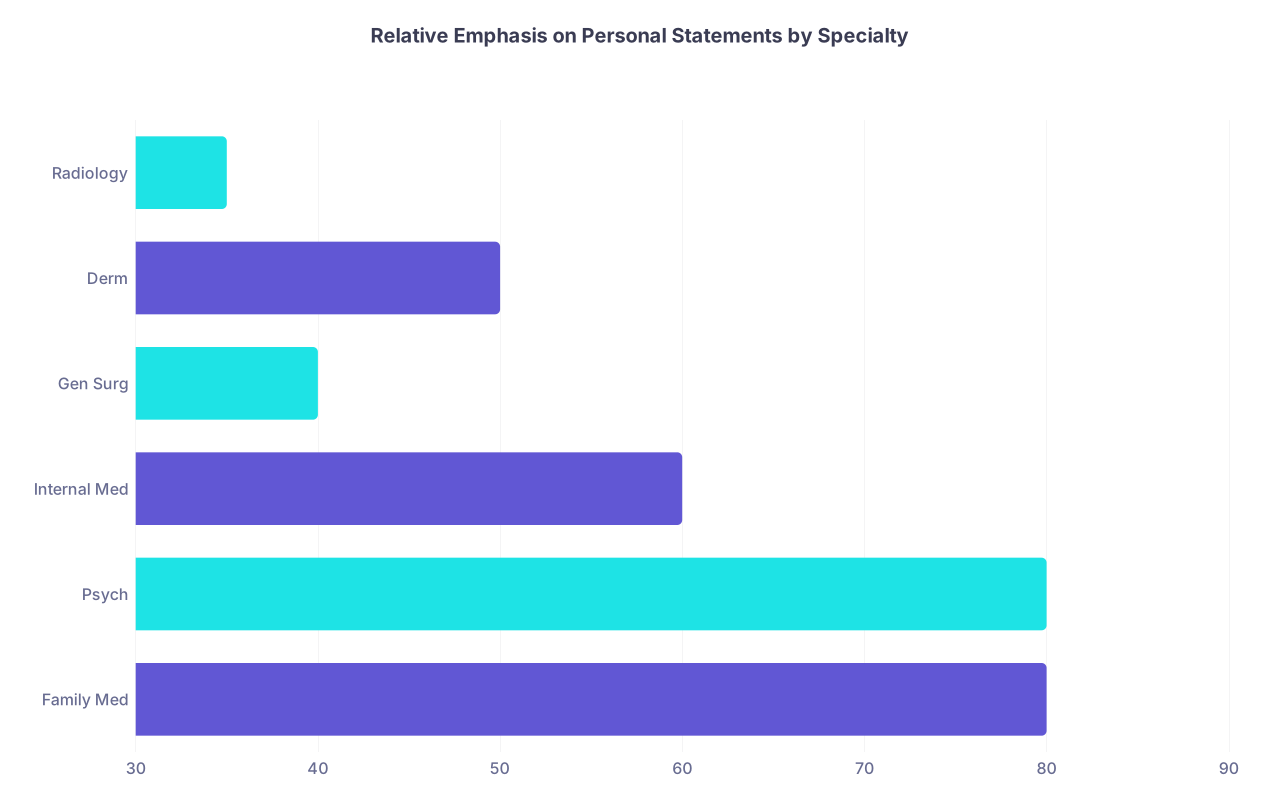
Not every specialty treats the personal statement the same way. Some care a lot more. Some barely care except as a red-flag screen.
| Category | Value |
|---|---|
| Family Med | 80 |
| Psych | 80 |
| Internal Med | 60 |
| Gen Surg | 40 |
| Derm | 50 |
| Radiology | 35 |
Here’s the translation behind those numbers:
- Family Med / Psych: They read these more closely. Fit and communication style are huge. The statement can rescue a so-so file or sink a strong one.
- Internal Med / Pediatrics: Moderate importance. With the flood of applicants, they often skim on first pass but will dig in for borderline cases and during ranking.
- Gen Surg / Ortho: Mixed. Some places barely read them unless there’s a concern. Others use them as a character check: “Are they humble enough? Do they understand the grind?”
- Derm / Rad / Anesthesia: The numbers and letters still dominate, but for highly competitive spots, a statement can separate “another strong applicant” from “someone we remember and want.”
At one derm program, a faculty member told me:
“If their statement is just ‘I like skin’ dressed up in SAT words, I assume they’re in this for lifestyle and prestige.”
And that assumption absolutely shifts where you land on the list.
What Makes a Statement Quietly Powerful (From the Committee’s Side)
Let me strip the romance out of this. A “great” personal statement in the committee room usually has three properties:
Memorable but not dramatic.
They remember one clear story or image tied to your name. Not fifteen stories. One.Grounded in reality.
You sound like you’ve actually done the work of this specialty. Seen the tradeoffs. And still want it.Shows growth.
Something changed in how you think, not just what you did.
A PD at a solid academic IM program once summarized the perfect statement like this:
“I want to finish it and think: I kind of know who this person will be as a resident at 2 a.m. That’s it. That’s the bar.”
Notice what’s missing:
- No desire for “hooks.”
- No need for trauma dumping.
- No expectation of literary genius.
They want a coherent, honest, mature voice.
The Quiet Ways You Lose Points Without Knowing
Most applicants don’t sabotage themselves with huge, obvious mistakes. They bleed points through small, avoidable missteps.
Here are the ones that come up again and again in committee comments:

1. The Template Statement
Faculty can smell a template from the first paragraph. They read hundreds. They know the common “beats” you pulled from Reddit or that one senior.
These are the statements where, if I swapped your name with 50 others, nothing would change.
Template = no positive comment. At best, “fine, nothing weird.” You never get the “this one stood out” bump.
2. The Hero Narrative
If every story ends with you saving the day, noticing what no one else did, advocating when everyone else failed—people roll their eyes.
It doesn’t matter if it’s technically true. It reads as insecure and self-aggrandizing.
Swap one of those for a moment when you almost got it wrong, or needed help. Then show what you learned. That’s the kind of humility attendings actually trust.
3. The Trauma Dump
You can absolutely write about adversity—poverty, illness, discrimination, family loss. Many of the best statements include it.
The line you cannot cross is this: The trauma becomes the main event, and your growth is an afterthought.
If the committee finishes reading and mainly feels pity, not respect, you’ve lost. They will say things like, “That’s a lot…” and quietly worry about your emotional reserves.
4. The Specialty Name Swap
We see this constantly: a generic “I love teamwork, continuity, and patient-centered care” statement with the specialty name swapped in the last paragraph.
It’s insulting, frankly. It tells the reader you don’t actually know what makes their work distinct.
Psych is not FM with a different population. EM is not IM with more adrenaline. Path is not IM but “behind the scenes.”
When a faculty member says, “I don’t believe they understand [specialty],” you’re done at that program.
5. The Unforced Red Flag
Things like:
- Taking shots at your med school or specific attendings
- Suggesting you were persecuted, with no evidence and no reflection
- Describing serious boundary issues with patients in a “funny” way
- Hinting at unresolved substance issues, but wrapping them in vague language
I have watched an applicant with excellent scores get cut from consideration solely because of how they framed a professionalism incident in their statement.
The event wasn’t the problem. The lack of ownership was.
What Actually Moves You Up in the Room
Let me flip this. When your statement is brought up in a rank meeting, these are the kinds of comments that move you up:
- “They had a really clear story of why they chose this field that felt real.”
- “You can tell they’ve seen the hard parts and still want to do it.”
- “Very grounded. No drama. I liked how they talked about that ICU rotation.”
- “They’ve thought about their own weaknesses in a mature way.”
Notice none of this has to do with fancy writing. It’s content. Perspective. Tone.
One of the highest-ranked applicants I saw in a recent cycle? Their statement was written in straightforward, almost plain language. But they described a near-miss, took responsibility, and unpacked how it changed how they practice. Everyone in the room understood exactly who they were.
That’s what you’re aiming for.
How to Think While You’re Writing (Instead of Chasing “Perfect”)
Here’s the mindset I’d want you to have while drafting:
Picture a tired attending reading this at 10 p.m. on their couch. What about this will make them think, “I could work with this person”?
Ask of every story:
“What does this reveal about how I think, handle mistakes, or care for people?”
If the answer is “not much,” cut it.Read your draft out loud. If you’d be embarrassed to say these sentences in a room of residents, it’s too fake.
Show it to someone who’s actually in the specialty. Ask one question: “Does this sound like someone who gets what you do?”
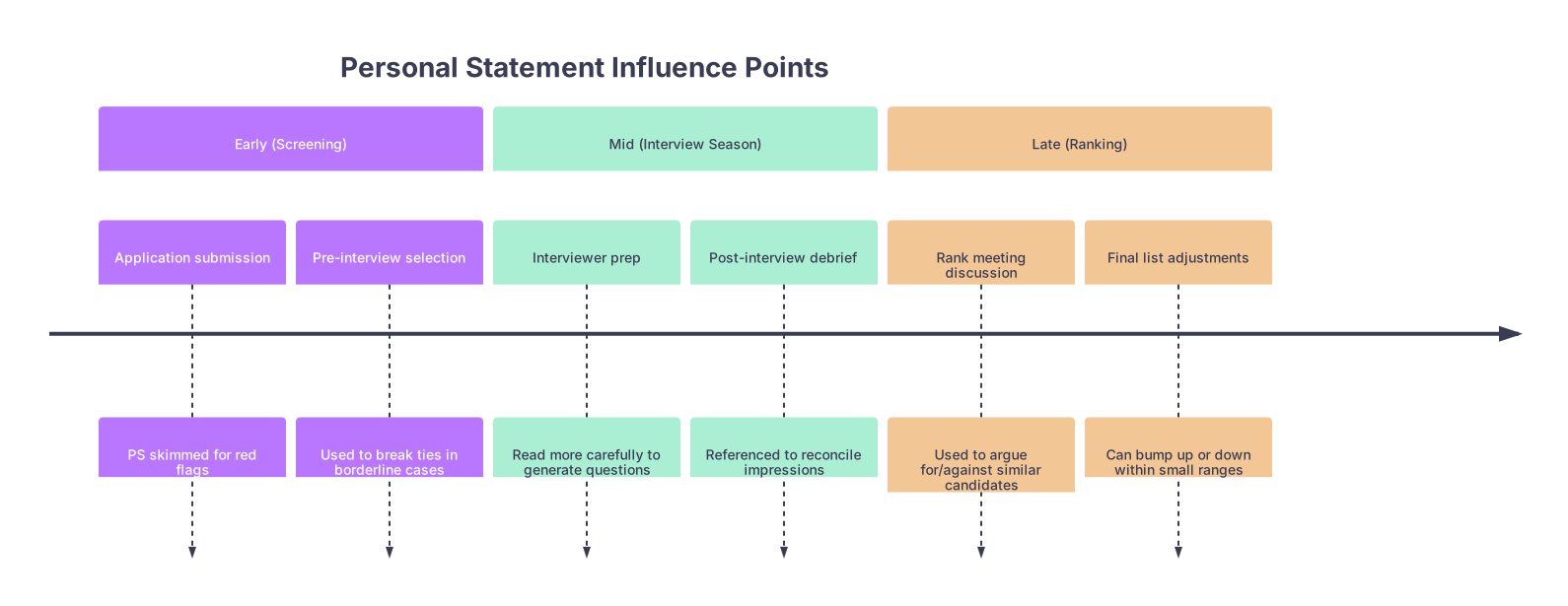
A Quick Reality Check Timeline: When Your Statement Matters Most
Just so you see where this fits in the wider process:
| Period | Event |
|---|---|
| Early (Screening) - Application submission | PS skimmed for red flags |
| Early (Screening) - Pre-interview selection | Used to break ties in borderline cases |
| Mid (Interview Season) - Interviewer prep | Read more carefully to generate questions |
| Mid (Interview Season) - Post-interview debrief | Referenced to reconcile impressions |
| Late (Ranking) - Rank meeting discussion | Used to argue for/against similar candidates |
| Late (Ranking) - Final list adjustments | Can bump up or down within small ranges |
It isn’t the lead actor. But it’s in every act.
FAQs
1. Do programs ever reject someone only because of a bad personal statement?
Yes. Not often, but it happens. Usually when the statement raises serious concerns: professionalism, poor judgment, aggressive tone, or an obvious mismatch with the specialty. I’ve watched strong applicants get cut from interview lists because a PD or APD said, “I have a bad feeling about them from this statement—I don’t want to deal with that for three years.”
2. Does anyone actually check for plagiarism or AI-generated content?
Some do. Quietly. There are plagiarism checks at a number of programs, especially after a few high-profile incidents. More important than tech, though, is inconsistency: if your statement sounds like a polished novelist and your emails, ERAS entries, and interview answers do not, people start asking questions. They may not “catch” you formally, but they will downgrade you for inauthenticity. Write like a sharper version of yourself, not a different person.
3. Should I tailor my personal statement to each program?
For residency, not usually. You do not have time to write 60 different versions. Write one strong, honest, specialty-specific statement. If you’re applying to very different types of programs (say, academic vs. strongly community-focused) and you have the bandwidth, you can have a slight variant, but the main work is the same. Where you tailor is in your interview answers and how you talk about your goals with each program, not in micro-editing your statement for individual hospitals.
You now know what really happens to your personal statement once you hit submit—the skim, the snap judgments, the shorthand labels in that closed-door room.
Your next move isn’t to chase perfection. It’s to write something a tired attending will recognize as coming from a real, thoughtful future colleague. Get that right, and when your file hits the maybe pile, you’ve given someone in that room a reason to say, “Let’s bring this one in.”
With that piece in place, the next battlefield is the interview itself—how you live up to the person you’ve painted on paper. But that’s a story for another day.