
Only 42% of residency applicants who write about a “powerful” single patient story actually do it without including at least one identifiable detail.
Let me be blunt: if program directors had time to run some of these essays past their institution’s privacy officer, a non-trivial number would get flagged. Not because the writer meant harm. Because no one ever taught them how to write about a clinical case correctly under HIPAA and basic privacy ethics.
You want to write about that one case that changed your trajectory. The code that shook you. The end-of-life conversation you can still hear in your sleep. Good. Those cases make for strong personal statements and meaningful ERAS essays.
But you are right to be nervous about HIPAA.
Let me break this down specifically: how to write about a single clinical case in a residency application without violating HIPAA, without sounding vague and generic, and without triggering alarm bells in the mind of a PD who has sat through too many institutional privacy trainings.
Step 1: Understand What “Identifiable” Really Means
Most students think: “I’ll just change the name and I’m fine.”
Wrong. HIPAA does not care about the name only. It cares about whether a “reasonable person” could identify the patient from the information in context.
HIPAA has 18 specific identifiers that must be removed under the “safe harbor” method. You do not need to memorize all 18, but you do need to internalize the categories.
Here is the stripped-down, residency-app-relevant version:
- Obvious: name, address, phone, email, MRN, photos of face.
- Time & place: specific dates (admission, discharge, procedure, birth, death), ages over 89, exact location details (“only neurosurgeon in this small town,” “rural hospital in X county during COVID surge”).
- Rare conditions / combinations: anything that, when combined with your location and training level, could point to a single person.
| Detail Type | Risk Level in Personal Statements | Example That Crosses the Line |
|---|---|---|
| Exact age | High for uncommon ages | "92-year-old marathon runner" |
| Specific date/event | High | "On Christmas Eve 2020 in our MICU" |
| Rare disease + city | High | "Only case of X in our region" |
| Unique social detail | High | "Well-known local pastor on TV" |
| First name + combo | Very high | "Maria, 37, from our only shelter" |
Changing the name and keeping everything else the same is like putting a hat on and insisting no one will recognize you.
You need to think in combinations:
- Your institution is on your CV.
- Your city is often obvious.
- Your rotation dates can be inferred from your MSPE.
If a colleague reading your essay could say, “Oh, that was the patient we had in June on the CT surgery service,” you are skating too close.
Step 2: Decide If You Actually Need a Single Case
This is where many applicants trip.
They feel they “must” have a single patient story because that is what everyone else does. So they over-share one detailed, vivid, borderline-identifiable case.
Sometimes the better move is to:
- Write about a pattern of cases (“I saw many patients with…”), or
- Use a composite patient (ethically constructed), or
- Focus on your behavior and growth rather than the patient’s granular biography.
So first question: is this case truly central to your story, or just the most dramatic?
Use it if:
- It directly illustrates a core motivation or turning point.
- You changed your behavior or trajectory because of it.
- You can tell it effectively even after stripping identifying details.
Skip it (or convert it to composite) if:
- The “hook” relies on ultra-specific features: “only surviving triplet,” “patient with condition that was front-page news.”
- Removing details makes the story dull or confusing.
- The emotional punch comes mainly from shock value or voyeurism.
I have read many essays where the best version would remove the patient entirely and just describe the applicant’s struggle with uncertainty, error, or growth. Do not cling to a case that does not survive de-identification.
Step 3: How to De-Identify Without Killing the Story
You can absolutely write a compelling case vignette that survives HIPAA scrutiny. You just need to be intentional.
Use this mental checklist: Change, Compress, Generalize, Omit.
1. Change
Alter non-essential details in a way that preserves the clinical and emotional truth.
Good changes:
- Age: “in her 30s” instead of “34”; “older adult” instead of “91”.
- Time: “early in my third year,” “during my sub-internship,” instead of “July 4th weekend.”
- Relationship roles: “relative” instead of “younger brother,” if not clinically important.
- Setting scale: “a community ED” instead of “the only ED in our small coastal town.”
Bad changes:
- Changing the diagnosis in a way that distorts what you learned.
- Changing outcome from death to survival just to make it uplifting.
- Creating drama (“cardiac arrest”) when it was not actually present.
You are not writing fiction. You are ethically anonymizing. Truth of experience matters more than truth of minutiae.
2. Compress
If you followed this patient across multiple admissions, clinics, and readmissions, do not spell out the entire timeline.
Combine encounters:
- “Over several weeks, I saw him multiple times…” instead of day-by-day detail.
- “During my rotation” instead of “on my second, fifth, and ninth night shifts.”
Compression reduces the number of identifiable anchor points while keeping the arc.
3. Generalize
Anything that makes the case highly searchable or obviously unique needs to be broadened.
Specific:
“An 11-year-old boy with Duchenne muscular dystrophy whose story was featured on our local news after receiving a specialized exoskeleton.”
Generalized:
“A school-age boy with a progressive neuromuscular disease whose family had been very public about his condition and hopes for new technology.”
You kept:
- Pediatric, progressive, neuromuscular, hope for technology.
You removed:
- Age, named disease, local media, unique device.
The ethical line: the point of the story stays intact (your reaction, growth, insight), but the breadcrumb trail to the exact patient disappears.
4. Omit
Some details are not needed at all. Cut them.
You do not need:
- Exact room numbers, clinic names, floor names.
- Specific ethnic background if not relevant to the insight.
- Job titles (“high school principal”) unless central to the narrative.
- Exact family composition unless clinically or emotionally essential.
If a detail does not change what you learned, it is a candidate for omission.
Step 4: Writing a HIPAA-Safe Single-Case Paragraph (Concrete Examples)
Let me show you what an unsafe vs safe transformation looks like.
Unsafe Version
“I met Ms. J, a 27-year-old single mother of two from the only homeless shelter in our small city, during my July 2023 OB rotation at County General. She was in her third trimester with twins and had been admitted on July 4th after collapsing at a public event. I recognized her from a local news story about the shelter’s struggle to keep families together.”
This is a privacy officer’s migraine. Why?
- Exact age.
- Family structure.
- Unique social setting (only shelter in a small city).
- Specific time (July 2023, July 4th).
- Twin pregnancy.
- Local news reference.
- Your institution is on your CV → easy triangulation.
Safer Version
“Early in my clinical years, I met a pregnant patient experiencing homelessness whose pregnancy was considered high risk. I first encountered her during a busy shift on my obstetrics rotation, then again later in the pregnancy and after delivery. Her struggle to balance her own health, her unborn children, and the unstable conditions around her forced me to confront how little control many patients have over the recommendations we make.”
What changed:
- Age removed.
- Exact dates and holiday removed.
- “Only shelter in our small city” → “experiencing homelessness.”
- Twins removed because not central to the insight.
- Local news reference removed.
- County General and city not mentioned.
The emotional and ethical truth is preserved: your encounter with a vulnerable, high-risk pregnant patient forced you to confront social determinants and your role. HIPAA risk is massively lower.
Step 5: Special Red Flags in Residency Personal Statements
Certain scenarios are high risk because they are inherently identifiable or regulated more tightly.
Watch yourself especially if you are writing about:
Psychiatric cases
Small community + psychiatric hospitalization + suicide attempt = highly identifiable.
Generalize setting (“inpatient unit” rather than “our 12-bed psychiatric unit”) and avoid detailed self-harm methods or contexts that made local waves.Obstetric and neonatal cases
Extreme prematurity, multiples, unusual complications, maternal death — those cases are often legendary within a hospital. Treat them carefully.
If you wrote a research abstract about that specific patient or it was part of a published case report, do not re-identify them in your statement.Rare diseases / rare procedures
If there were only one or two such patients in your hospital in the last several years, de-identify aggressively. Consider shifting from “a patient with condition X” to “a patient with a progressive neurologic disease” if the exact label is not crucial.Famous or public figures
Do not. Even if the case is de-identified on paper, the combination of details plus public knowledge makes it risky and, frankly, distasteful.Disability, HIV, substance use, immigration status, incarceration
These are sensitive, stigmatized domains. Ethically, you owe extra care.
The test: are you using the patient’s hardship as scenery, or are you genuinely reflecting on your role, your biases, and your responsibilities?
Step 6: Composites vs “Real” Cases – What Is Ethically Acceptable?
You are allowed to use composite patients in a personal statement, as long as you are not fabricating your actual growth.
Here is how to do this honestly and well.
Composite Patient Done Right
“I worked with many patients whose chronic conditions were tightly intertwined with unstable housing and limited access to primary care. One patient in particular — a middle-aged man with poorly controlled diabetes and frequent hospitalizations — represented this pattern. When I first met him…”
This could be:
- One real patient with details gently altered and compressed.
- A composite of several similar patients.
You are not lying about the system issue, your experience, or your reaction. You are simply consolidating similar interactions into one narrative anchor.
If you want maximum transparency, you can add a brief qualifier: “While this description reflects a composite of several patients, one particular encounter stands out…”
That level of specificity usually is not required, but it is ethically impeccable.
Composite Patient Done Wrong
Inventing an entire scenario that never happened just because it sounds dramatic:
- The code blue that you never attended.
- The deathbed conversation with the perfect quote that you only saw on TV.
- The miracle recovery that did not occur.
Program directors have finely tuned BS detectors. They have read thousands of these. They can tell when a story smells fictional. And if they suspect fabrication, you are done.
So: combine and anonymize, yes. Fabricate, no.
Step 7: How Much Clinical Detail Is “Enough” Without Being Too Much?
This is the tightrope: not so vague that it sounds generic, not so detailed that it risks identification.
Here is a simple rule: detail the clinical reasoning and your internal process more than the patient’s biography.
You want enough:
- Diagnosis category: “advanced heart failure” vs “shortness of breath.”
- Clinical context: “ICU,” “ED,” “continuity clinic.”
- Key turning point: “I realized I had not asked what mattered most to her,” “I recognized my own frustration.”
You do not need:
- All labs, imaging results, step-by-step differential diagnosis.
- Every component of the family structure.
- Every emotional detail of the patient’s life history.
Example of balanced detail:
“During my sub-internship in internal medicine, I helped care for a man with advanced liver disease who was not a transplant candidate. His hospitalization stretched over weeks, punctuated by episodes of confusion and brief improvements. I initially focused on adjusting diuretics and carefully tracking his labs. Only later, after a conversation with his sister at the bedside, did I grasp that the family’s real question was not about MELD scores, but about how to spend the remaining time in a way that felt meaningful to him.”
We know:
- General diagnosis (advanced liver disease).
- Setting (medicine sub-I).
- Clinical arc (prolonged, waxing/waning).
- Emotional and ethical insight.
We do not know:
- Age, dates, city, unique personal traits, rare features.
That is the balance you want.
Step 8: Quick Self-Audit Checklist Before You Hit Submit
Read your case vignette and interrogate it like a suspicious privacy officer:
Could someone at my institution reasonably identify this patient from the combo of:
- My school / hospital (which they know),
- My year and rotation, and
- The details I gave?
Did I remove or generalize:
- Specific dates, holidays, and easily searchable events?
- Exact ages and rare demographic combinations?
- Unusual social roles that would make this person “locally famous”?
Did I focus more on:
- My behavior, reflection, and growth
than on - The patient’s biography and tragedy?
- My behavior, reflection, and growth
Did I avoid:
- Graphic, sensational details that add drama but not insight?
- Any hint that I am gossiping about a vulnerable person?
If the patient or their family somehow read this, would I:
- Be able to look them in the eye and say, “I wrote this respectfully and protected your privacy”?
If you hesitate on that last question, revise.
Step 9: Legal HIPAA vs Professionalism vs Ethics
One more nuance. HIPAA is not the only bar you need to clear.
You can be technically HIPAA-compliant and still look untrustworthy.
Programs think in three layers when they see you write about patients:
- Legal – Would this potentially violate privacy law if someone pushed it?
- Institutional – Would our compliance officer be unhappy reading this?
- Professional – Does this applicant understand boundaries, respect, and the power imbalance between physician and patient?
Over-sharing intimate patient details for emotional effect, even when de-identified, makes you look immature. It suggests you might tell similarly detailed stories in less controlled settings.
On the other hand, a well-crafted, respectful case vignette that clearly prioritizes the patient’s dignity signals:
- You understand confidentiality.
- You can reflect without exploiting.
- You see patients as people, not props.
That matters more than whatever dramatic twist you are tempted to include.
Step 10: A Template You Can Adapt Safely
Here is a skeleton structure that keeps you inside the ethical guardrails.
Brief, generalized introduction to the patient “During my [rotation/role], I met a [age-band, if needed]-year-old [gender if relevant] with [broad diagnosis category] who had been [short context: recurrently hospitalized, newly diagnosed, nearing end of life].”
Your initial mindset or mistake “At first, I was primarily focused on [task/metric/protocol]. I prided myself on [X], but I overlooked [Y].”
The turning point “One interaction changed that. [Describe a conversational or observational moment, not a grisly detail.]”
Your internal reaction and growth “I realized that I had been [limitation/flaw]. This forced me to reconsider [assumption/practice].”
How it shaped your future behavior / specialty choice “Since then, I have [concrete change in how you approach similar situations]. It is one reason I am drawn to [specialty], where [connect to values or practices].”
You can drop your case into that scaffold and then refine. As you refine, constantly ask: am I adding detail for insight or for theater?
If it is theater, cut it.
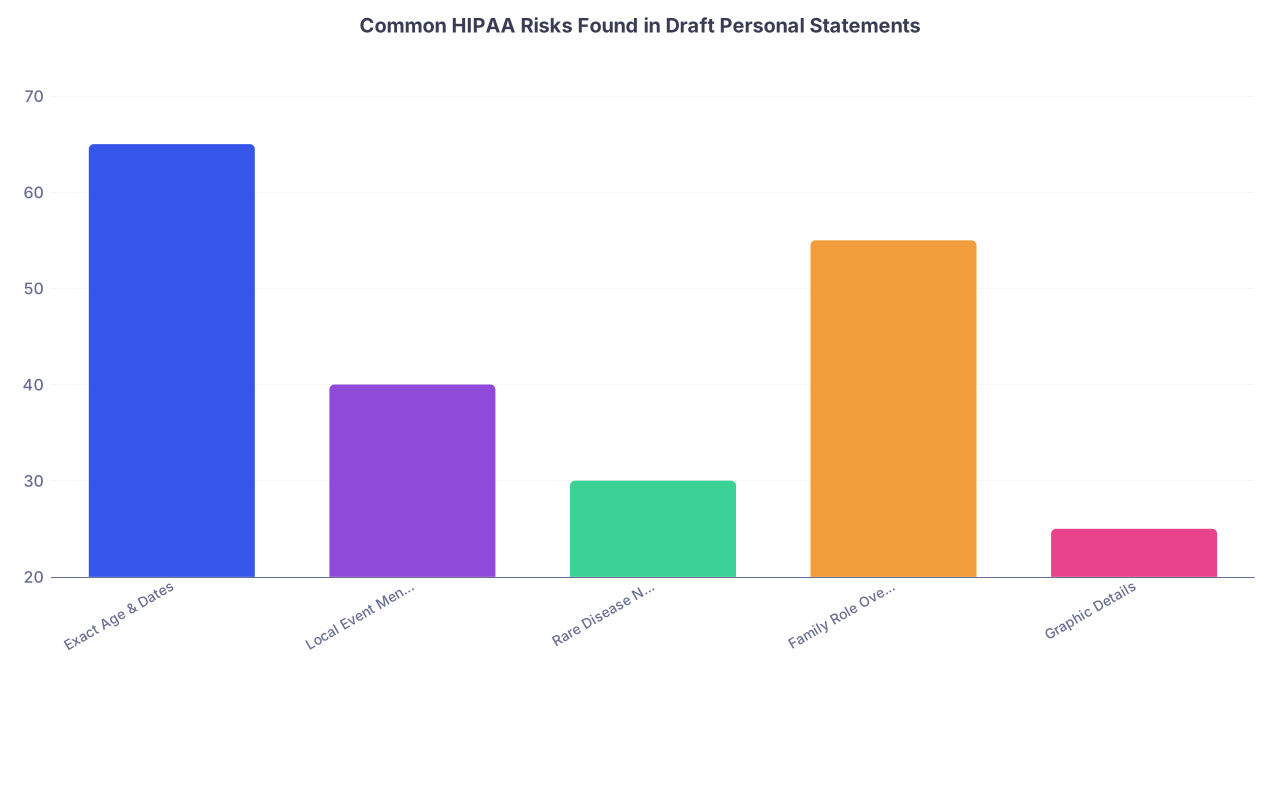
| Category | Value |
|---|---|
| Exact Age & Dates | 65 |
| Local Event Mentioned | 40 |
| Rare Disease Named | 30 |
| Family Role Over-Specified | 55 |
| Graphic Details | 25 |
Process Map: From Raw Case to HIPAA-Safe Story
Here is how I tell students to actually do this, step by step.

| Step | Description |
|---|---|
| Step 1 | Write Raw Case |
| Step 2 | Highlight Insight |
| Step 3 | List All Identifying Details |
| Step 4 | Delete |
| Step 5 | Generalize or Change |
| Step 6 | Check Combinations for Identifiability |
| Step 7 | Shift Focus to Your Reflection |
| Step 8 | Peer/Faculty Review |
| Step 9 | Final Privacy Check |
| Step 10 | Needed for Insight? |
Do not try to “HIPAA-proof” in your head while you are drafting. Write the raw version first (privately, never in a shared document with PHI), then strip it down and restructure.
FAQ (Exactly 4 Questions)
1. Is changing the patient’s name enough to avoid a HIPAA violation in my personal statement?
No. Changing only the name is absolutely not enough. HIPAA risk usually comes from combinations of details: age, dates, rare diagnoses, specific location, and social circumstances. Even with a fake name, if someone at your institution could reasonably identify the patient from your description, you have not de-identified them. You must alter or remove non-essential specifics while preserving the core clinical and emotional truth.
2. Can I say “this is a composite patient” in my essay, or will that look strange to programs?
You can, and it will not hurt you if done briefly and naturally. A line like “This description reflects a composite of several patients I met with similar challenges” signals maturity and respect for privacy. Many readers will actually see it as a positive — it shows that you understand confidentiality and are not trying to wring drama from a single vulnerable person’s life.
3. What if my most impactful case was published as a case report or in the news — can I still write about it?
You should be very cautious. If the case has already been publicized, repeating those details in a personal statement essentially re-identifies that patient, especially when linked to your name and institution. That may be technically allowed under certain circumstances, but it usually looks poor from a professionalism standpoint. In most cases, you are better off abstracting the themes: describe what you learned from “a rare, high-stakes case in our ICU” rather than recreating the published details.
4. Do programs actually care about HIPAA in personal statements, or is this just theoretical?
They care. Program directors live in a world of mandatory privacy training, incident reports, and institutional risk management. A statement that casually reveals too much about a patient does two things: it raises a real, if small, HIPAA concern, and it raises a much larger concern about your judgment. Even if no one calls legal, a PD who thinks “If they wrote this in an application, what will they say on social media?” is not going to rank you highly. Protecting patient privacy in your writing is not just about the law; it is an audition for your professionalism.
- Your goal is not to prove you remember every detail of a case; it is to show how the encounter changed you — that means focusing on your reflection, not the patient’s biography.
- De-identification is not just name removal; you must strip or generalize dates, locations, rare diagnoses, and unique social markers until a colleague could not reliably pinpoint the patient.
- Composite or generalized cases are entirely acceptable and often safer; honesty about your growth matters more than literal, traceable accuracy of every patient detail.