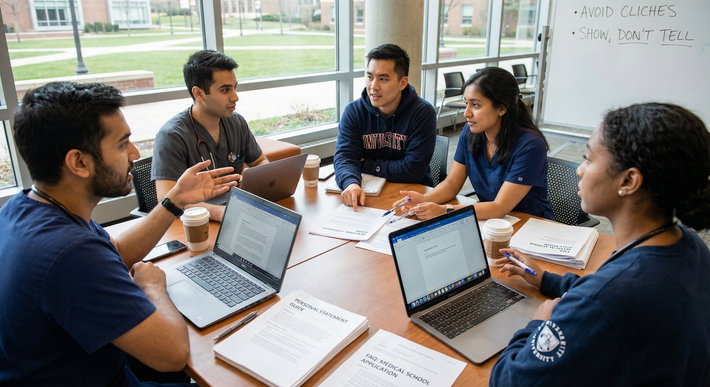
You are on your third cup of coffee, it is 11:47 p.m., and your personal statement is…almost there. The story works, the middle is solid. But the conclusion? It either sounds generic, abrupt, or like you ran out of steam. You keep typing some version of “In conclusion, I believe I will be an excellent resident…” and then deleting it in disgust.
Let me be blunt: most residency personal statement conclusions are forgettable. Or worse—actively hurt an otherwise decent essay. The bar is low. Which means if you get this part right, you stand out fast.
Let me break this down specifically.
What a Strong Personal Statement Conclusion Actually Has to Do
The best conclusions for residency personal statements do four jobs at once:
- They resolve the core story or theme you started with.
- They crystallize your professional identity and direction.
- They signal what kind of resident and colleague you will be.
- They leave a specific, memorable afterimage in the reader’s mind.
Notice what is not on that list:
- Repeating your CV.
- Listing your “passion for lifelong learning.”
- Having a paragraph that could be pasted into anyone’s statement in your specialty.
If your last paragraph could be dropped into 20 other applicants’ essays with no changes, you have a problem.
The conclusion is not a summary. It is a payoff. A reframing. The moment the reader goes, “Okay, I get this person.”
Advanced Structural Techniques For Strong Conclusions
Let’s talk structure. These are not fluffy “be authentic” platitudes. These are concrete, replicable patterns that work in residency essays.
1. The “Return and Reframe” Technique
You open with a specific scene. A code. A tough family meeting. Being a new intern on your sub-I who froze on rounds. Whatever it is.
In the conclusion, you return to that scene—but with a shift.
You do not repeat it. You reinterpret it now that you and the reader have been through the essay.
Example structure:
- Opening: You described a chaotic ED shift with a septic patient where you realized how much you did not know.
- Body: You walked through growth—learning to manage uncertainty, seeking feedback, specific rotations and mentors.
- Conclusion: You come back to that feeling of uncertainty but frame it as fuel, explain how that early moment now shapes how you want to show up as a resident.
This does two things: narrative closure and emotional coherence. Programs remember stories, not adjectives.
Bad version (generic):
“Experiences like these have made me a compassionate and dedicated future internist.”
Stronger version (return and reframe):
“On that first night in the ED, I stood outside the patient’s room, clutching a note card of sepsis criteria and hoping I would not be the weak link. Now, when I walk into a room like hers, I still feel the weight of responsibility—but it is no longer paralyzing. It is clarifying. It reminds me why I want a residency that will keep pushing me to that edge, where careful preparation and real human need meet.”
You close the loop and show growth without saying “I have grown.”
2. The “Zoom Out” Technique
Here you move from narrow to wide: patient → team → system → your role in that system.
You started with a close-up: one patient, one challenge. In the conclusion you zoom out to:
- Your future role in multidisciplinary care.
- The kind of environment where you thrive (not “supportive program,” but more precise: feedback-rich, busy safety-net hospital, strong critical care exposure, etc.).
- The contribution you want to make over 5–10 years, not just PGY1.
Example move:
“Caring for Mr. L on the wards taught me how fragile our discharges are when follow-up is uncertain.” →
“In residency, I want to train where those questions are not an afterthought, but core to the mission—where residents learn to navigate both the medicine and the systems that shape who gets better and who gets left behind.”
You are no longer just “interested in internal medicine.” You are someone who thinks about where medicine actually happens.
3. The “One-Line Thesis” Technique
Every strong conclusion has one sentence that basically is the applicant.
Not a slogan. Not “I am passionate about…” A concise, high-yield encapsulation of who you are professionally.
Patterns that work:
- “I am, at my core, a [role] who [does X] for [Y kind of patient / team / system].”
- “Where I add the most value is at the intersection of [A] and [B].”
- “I want to spend my career [doing X] with [Y population] in [Z type of setting].”
Example for psychiatry:
“At my core, I am a careful listener who is most at home in the gray zones—where a rushed diagnosis would be easy, but a better one is still possible.”
You can build the rest of the conclusion around that one line. If a PD remembers only that, you did your job.
4. The “Implicit Ask” Technique
You never say, “Therefore, I would be an excellent fit for your program.” That is clunky and needy.
Instead, you describe:
- The specific kind of training environment you are seeking.
- The specific kind of learner and colleague you are bringing.
A smart reader can fill in the rest: “This sounds like us, or this doesn’t.”
Example:
“I am looking for a residency that will not let me coast once I am ‘good enough’ with bread-and-butter medicine, but will keep pushing me toward the complex, messy problems that first drew me to internal medicine.”
You do not need “I hope to join your program.” The entire essay is that hope, expressed concretely.
What To Include (And What To Ruthlessly Cut)
Let us get precise about content. This is where most people sabotage themselves.
A. Specific, High-Yield Elements To Include
- A clear future direction
Not fake certainty. Direction.
- “I am especially drawn to critical care and palliative medicine, and expect to pursue fellowship training in one of these areas.”
- “I plan to work in a community-based outpatient setting with a large Spanish-speaking population.”
- “My long-term goal is to combine clinical work in epilepsy with medical education.”
It is fine if you change later. Programs do not hold you hostage. But being vague (“I am open to anything”) reads as underdeveloped professional identity.
- A concrete way you “show up” on a team
Not “hard-working” or “team player.” Those are table stakes. Instead:
- “I am the person who quietly keeps the sign-out updated and the to-do list realistic.”
- “I am the one who will ask the question everyone else is thinking but does not want to say on rounds.”
- “I am the resident who will pull up the actual trial instead of relying on folklore.”
Then embed that in one sentence in the conclusion.
- One small, vivid image
E.g., instead of “I want to work in underserved communities,” you write:
“I hope that ten years from now, my clinic day still includes a grandmother like Mrs. R, who brings tamales for the staff and apologizes for ‘bothering us again’ even as we adjust her insulin to keep her out of the hospital.”
One sentence. An image. That sticks.
B. Common Trash To Cut From Conclusions
If you recognize your draft in any of these, you need to revise.
“I am confident that my background has prepared me well for residency in [specialty].”
Empty. Everyone writes this. Offers no new information.“I am passionate about patient care, research, and education.”
So is everyone else applying. Needs specifics or it is noise.“Thank you for your time and consideration.”
This is a personal statement, not a cover letter to an HR portal. Drop it.“I will work hard and be a dedicated resident.”
Baseline expectation. The equivalent of promising not to steal hospital supplies.Apology or self-defense paragraphs
“I know my scores do not fully reflect my dedication…” If you must address red flags, do it briefly in the middle or in the additional comments section, not as your parting shot.
Advanced Rhetorical Techniques: Sound, Rhythm, and Subtext
Now the more subtle layer: how the conclusion sounds.
1. Sentence Rhythm
A wall of medium-length sentences reads flat. You want controlled variation: a long, reflective sentence followed by something short and decisive.
Example:
“Medicine has taught me to respect what I do not know, to listen longer than is comfortable, and to resist the urge to treat every discomfort as a pathology to be fixed. More than anything, it has taught me that showing up—consistently, attentively, honestly—is itself a form of treatment.”
See the rhythm. You can feel the stop.
Read your conclusion out loud. Anywhere you stumble, or where it sounds like chatGPT filler, cut or rework.
2. Avoiding the Cliché Trap
If a phrase has appeared in more than three PS drafts you have seen, do not use it.
Cliché magnets:
- “Ever since I was a child…”
- “Lifelong learner”
- “I am humbled and honored…”
- “The art and science of medicine”
- “Unique combination of compassion and dedication”
If you have a cliché idea you genuinely believe, translate it into concrete language.
Instead of “lifelong learner”:
“I am the person who bookmarks half of morning report and actually reads the papers that night.”
3. Subtext: Confidence Without Arrogance
You want something very specific: earned confidence. Not swagger, not self-deprecation.
Bad:
“I am certain I will excel as a resident in your program.”
(You are not. And they know you are not.)
Equally bad:
“I still have so much to learn and many weaknesses.”
(Everyone does. No need to flag this in your final line.)
Better:
“I am ready for the discomfort of being a new intern—of admitting what I do not know, asking for help early, and putting in the work between shifts so that my patients benefit from a slightly better version of me each day.”
That is confident about process, not outcome. Programs like that.
Specialty-Specific Nuances in Conclusions
Same general principles, but different emphases depending on the field.
| Specialty | Key Emphasis in Conclusion |
|---|---|
| Internal Med | Intellectual curiosity, systems |
| Surgery | Grit, coachability, technical focus |
| Pediatrics | Communication, family partnership |
| Psychiatry | Tolerance of ambiguity, insight |
| EM | Calm in chaos, decisive action |
| OB/GYN | Continuity + procedural balance |
Internal Medicine
IM conclusions should signal:
- Curiosity about complex, chronic disease and diagnostic puzzles.
- Respect for longitudinal relationships and systems of care.
Example concluding move:
“I am drawn to the patients whose problems do not fit cleanly into one admission or one organ system, and I am looking for a residency that will train me to be the person who does not give up when the chart gets long and the answer is unclear.”
General Surgery
You need to show:
- You understand the grind and still want in.
- You have coachability and team reliability, not just “love the OR.”
Weak:
“I look forward to a challenging surgical residency that will push me to my limits.”
Stronger:
“I am looking for a program where it is normal for an intern to stay late to see that last case, where direct feedback in the OR is expected, and where the standard is not perfection, but honest improvement over thousands of small repetitions.”
Psychiatry
You’re selling:
- Comfort sitting with uncertainty and complexity.
- Reflective capacity—how you think about patients and yourself.
“Over time, I have become less interested in arriving at the ‘right’ label for a patient and more interested in whether they feel seen, understood, and safe enough to try something different. I want to train in a place where those questions are not soft extras, but the center of the work.”
You get the idea. Align your conclusion with the personality of the field—but with your specific angle, not a stereotype.
Process: How To Actually Build Your Conclusion Step-by-Step
Here is a concrete workflow. Do not start with the conclusion. Start with the spine.
Step 1: Identify your essay’s real thesis (not the one you think)
Ask yourself: If a PD had to describe me in one sentence after reading this, what would I want that sentence to be?
Example answers:
- “She is thoughtful, calm under pressure, and unusually good at seeing the bigger picture of a patient’s life.”
- “He is relentless about closing his own knowledge gaps and quietly raises the standard of the team.”
That’s your north star. The conclusion has to lock that in.
Step 2: Extract your central image or story
Find the strongest scene in your statement—where something changed for you. The conclusion either:
- Returns to it (Return and Reframe), or
- Echoes its theme at a higher level (Zoom Out).
Do not introduce a totally new big story at the end. That’s whiplash.
Step 3: Draft a “too long” conclusion
Write it messy, 2–3 times longer than needed. Include:
- A future direction sentence.
- One line about how you show up on a team.
- One concrete future image (patient / clinic / OR).
- One “one-line thesis” sentence.
Do not edit yet. Just get the pieces out.
Step 4: Compress with a hard word limit
Give yourself 150 words. Then 120. Then 90.
Force yourself to cut fluff:
- Any sentence that restates things from earlier.
- Any generic adjective that could apply to anyone.
- Thank-yous and CV recaps.
The best conclusions are tight. 75–150 words is usually enough.
Step 5: Stand-alone test
Read only the conclusion, out of context. Ask:
- Do I still sound like a specific person, not a template?
- Could this exact paragraph belong to 50 other applicants?
- If a PD read only this, would they have a clear sense of my direction and how I think?
If the paragraph feels generic by itself, it is definitely generic in context.
Visual: How Your Conclusion Should Shift the Reader’s Impression
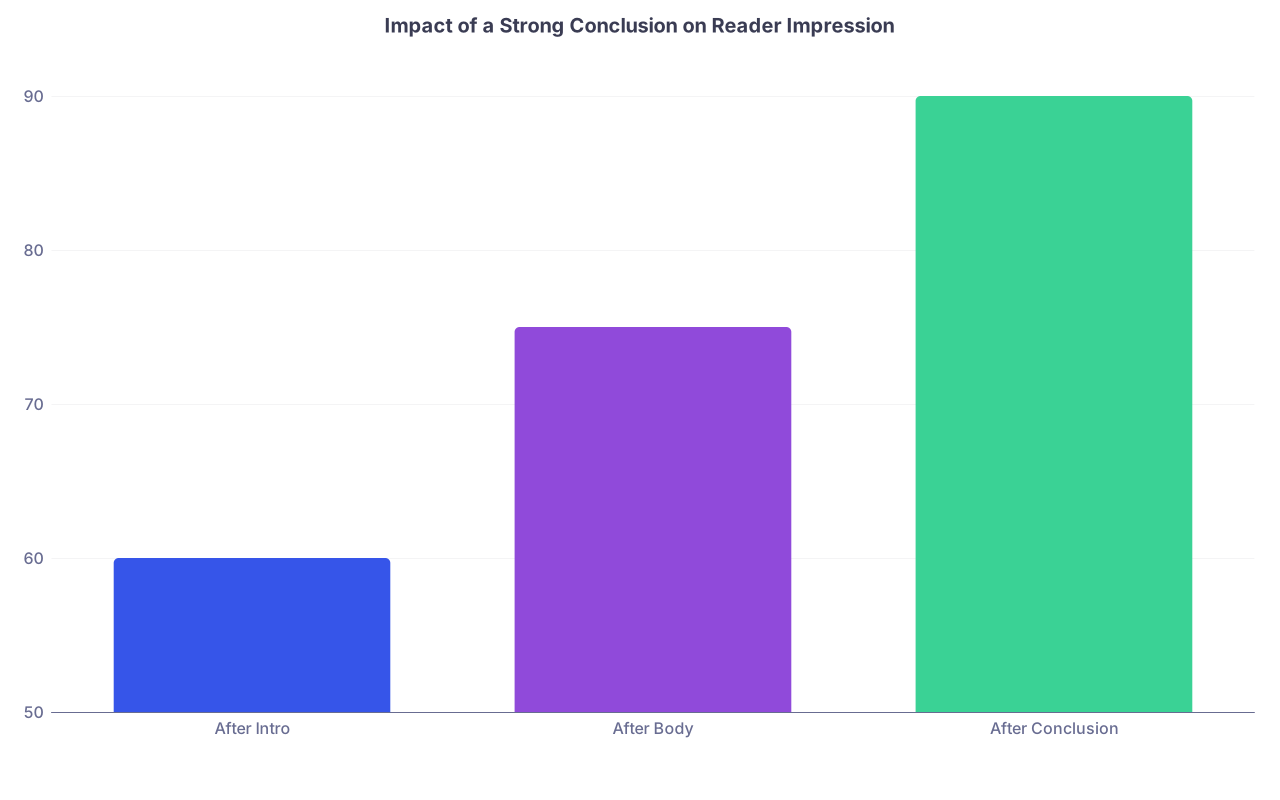
| Category | Value |
|---|---|
| After Intro | 60 |
| After Body | 75 |
| After Conclusion | 90 |
Think of it like this: your introduction and body move the reader from 0 to maybe 70–80 on the “I get this person” scale. A strong conclusion nudges that last 10–20 points into “memorable” territory.
A weak conclusion does the opposite. It drags a 75 down to a 60 with clichés and filler. Do not let your last 100 words undo your first 600.
Examples: Before-and-After Conclusion Rewrites
Let’s do a specific rewrite. Family medicine applicant.
Weak conclusion:
“Family medicine is the specialty that best fits my goals and personality. I am passionate about continuity of care and patient education. I have worked hard in medical school and on my rotations to prepare myself for residency, and I am confident that I will be a dedicated and hard-working resident. Thank you for your consideration.”
Problems:
- Could be anyone.
- Zero images.
- No sense of how this person operates.
- Wasted last sentence.
Stronger version:
“I plan to build a career in full-spectrum family medicine in a community much like the one where I grew up—where the same physician cares for a teenager with new-onset diabetes and her grandfather whose COPD has gradually taken his independence. On teams, I am the one who makes sure that when we debate lab choices and guideline nuances, someone also asks, ‘Can this patient actually get this medication and come back to see us?’ I am looking for a residency that will train me to keep both of those questions in view—the evidence and the reality—so that ten years from now, my clinic is a place where patients recognize me not just as their doctor, but as the person in their corner over time.”
Notice:
- Career direction is clear.
- Concrete image of patient/family.
- Specific team contribution.
- No begging. No “thank you for your consideration.”
Workflow Diagram: Draft to Final

| Step | Description |
|---|---|
| Step 1 | Draft Full PS Body |
| Step 2 | Identify Core Theme |
| Step 3 | Select Key Image or Story |
| Step 4 | Write Long, Messy Conclusion |
| Step 5 | Cut Generic Phrases |
| Step 6 | Compress to 90-150 Words |
| Step 7 | Read Aloud and Adjust Rhythm |
| Step 8 | Peer or Mentor Feedback |
| Step 9 | Final Polish and Integration |
You do not tack the conclusion on at the end as an afterthought. You engineer it backwards from your core theme.
Quick Checklist: Is Your Conclusion Doing Its Job?
Use this before you hit submit.

You should be able to answer “yes” to at least 5 of these 6:
- Does it contain one concrete, visual detail or image?
- Does it clearly state your likely career direction or interests?
- Does it describe, in specific terms, how you function on a team or as a learner?
- Could this paragraph not be copy-pasted into someone else’s essay without feeling wrong?
- Does it avoid “thank you,” “in conclusion,” and generic claims about hard work and passion?
- When read aloud, does it have a natural rhythm, with at least one sentence that “lands” strongly?
If you are at 3/6, you are not done.
FAQs

1. How long should a residency personal statement conclusion be?
Typically 75–150 words. If it is under 50, it usually feels abrupt or underdeveloped. Over 200 and it often drifts into summary or repetition. Focus on density, not length: every sentence should add new nuance, not rehash earlier content.
2. Is it acceptable to name specific programs or program features in the conclusion?
Do not name specific programs in the main ERAS personal statement. You are sending one statement to many places. However, you can reference the type of program you are seeking: “busy county hospital,” “strong global health track,” “robust critical care training.” If a program-specific letter is allowed (like some prelim/TY or supplemental essays), that is where you name them directly.
3. Can I introduce a completely new story or experience in the conclusion?
Generally, no. The conclusion is not the place to debut a major new story. You can briefly reference an additional patient or moment as an echo of themes you already developed, but if you find yourself needing three sentences of backstory to explain your final example, it belongs in the body or not at all.
4. How personal is too personal for the conclusion?
High-yield personal: how your experiences changed your thinking, your values, your professional identity. Too personal: unresolved trauma, graphic detail, unresolved anger toward supervisors or systems, or anything that shifts the focus from “here is how I function as a future resident” to “here is why you should feel bad for me.” Strong conclusions can be emotionally honest without becoming therapy sessions.
5. Should I restate my key strengths in the conclusion?
You should demonstrate them, not restate them. Instead of “These experiences have made me resilient and empathetic,” show one short line that reveals resilience (e.g., coming back after a failure) or empathy (e.g., a specific way you changed your behavior with patients). If a strength requires you to name it explicitly, it often was not shown convincingly in the body.
6. How many people should review my conclusion before I finalize it?
Two to three is ideal. One person who knows you very well (to check for authenticity), and one person with residency experience—resident, fellow, attending, or dean—who can tell you whether it sounds generic or sharp. More than three reviewers and you risk committee-written blandness. At the end, you make the final call; do not let well-meaning editors sand off every edge that makes you you.
Two things to carry with you as you finish this:
- Your conclusion is not a formality. It is the last frame of the film; it colors everything that came before. Treat it as such.
- Specific beats generic every single time. One sharp, honest, concrete sentence is more memorable than five smooth, polite ones.
If you feel a little uncomfortable—like you are saying something real instead of something safe—you are probably closer to where you need to be.