Busy Sub-Internship Month? A Compressed Personal Statement Schedule
It’s July 3rd. You’re four days into a brutal sub‑internship. You just finished admitting three patients, your intern is texting you to check vitals again, and somewhere in your email is a reminder: “ERAS personal statement draft due next week.”
Your brain’s fried. Your time is not your own. But the calendar doesn’t care. You still need a residency personal statement that doesn’t read like it was written post-call on hospital coffee.
So here’s the plan: a compressed, realistic, day‑by‑day schedule for getting a strong personal statement done during a busy sub‑I month. No fantasy “write 2 hours a night” advice. This is built for:
- 12–14 hour days
- Post‑call haze
- “I might get one day off this week” reality
You’ll get a 10–14 day timeline you can drop into your current month starting today, plus adjustment options if your sub‑I is lighter or heavier than average.
First, Know Your Window: Where You Are in the Match Timeline
Before you write a word, you need to pin down your deadline.
At this point you should:
Locate your true “drop-dead” date.
- When does your school want a draft?
- When do you plan to certify and submit ERAS?
- When are your letter writers expecting your materials?
Back‑plan at least 10 days.
You want 10–14 days for this compressed schedule. Less than that and quality drops fast. More than that and you probably procrastinate anyway.
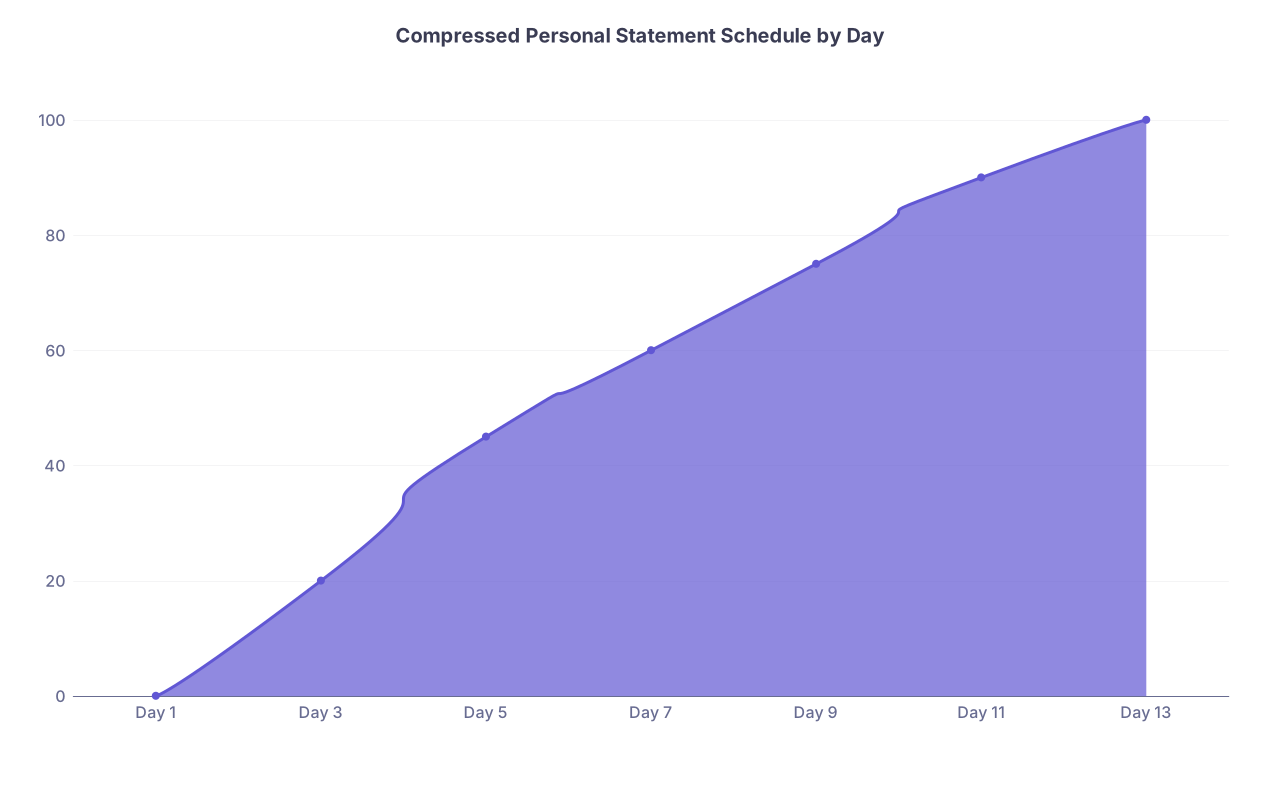
| Category | Value |
|---|---|
| Day 1 | 0 |
| Day 3 | 20 |
| Day 5 | 45 |
| Day 7 | 60 |
| Day 9 | 75 |
| Day 11 | 90 |
| Day 13 | 100 |
Use this rough completeness curve:
- Day 1–3: 0–20% done (idea extraction, no full draft yet)
- Day 4–7: 20–60% (ugly draft to structured draft)
- Day 8–11: 60–90% (refinement and feedback)
- Day 12–14: 90–100% (polish and lock)
Now let’s walk through a concrete 14‑day sub‑I‑compatible schedule. If your time window is shorter, I’ll show you how to compress later.
Days 1–3: Brain Dump and Story Mining (30–45 minutes per day)
Goal for this phase: Decide what you’re actually going to say before you’re too exhausted to think straight.
You are not “writing your personal statement” yet. You’re extracting content from your brain in small, low‑pressure chunks.
Day 1 – 30 Minutes: Quick Brain Dump (Evening, Not Post‑Call)
At this point you should:
- Block 30 minutes on your calendar. Literally. Set a reminder.
- Do this on a day you’re tired but not wrecked. Definitely not post‑call.
Three fast prompts. Set a 10‑minute timer for each. Write in bullet points, phrases, fragments. No sentences necessary.
Why this specialty?
- Specific clinical moments from sub‑I, rotations, earlier years
- Patient encounters where you thought: “This is the kind of work I want to do for decades”
- Things you like about the day-to-day, not just “I enjoy the pathophysiology”
Why you’re suited for it.
- Concrete behaviors: “I liked being the person everyone paged to figure out complex med recs”
- Skills that match the field: procedures, communication, longitudinal care, pattern recognition, etc.
What kind of resident you’ll be.
- Reliable? Good with chaos? Calm in codes? Nerd for guidelines?
- Times on rotation when someone commented on this: “You’re really good at …”
Keep it messy. But specific. “I love teamwork” is useless. “I was the one who rewrote our sign-out template so it actually made sense” is gold.
Day 2 – 30 Minutes: Pick Your Anchor Story
Your personal statement lives or dies on one or two anchor stories. Not five. Not you reciting your CV. One main narrative that shows:
- How you became interested in the specialty
- How you actually behave when you’re in that role
At this point you should:
- Re‑read your Day 1 notes for 5 minutes.
- Choose 1–2 stories that:
- Happened in real clinical settings
- Involve an actual patient or team scenario
- Changed something about how you see the specialty or yourself
Good anchor story examples:
- The first overnight call where you realized you like owning the pager
- A patient whose case sent you home reading, then you came back with ideas
- A bad outcome that made you rethink how you handle uncertainty
Weak anchor story examples:
- “I always loved science as a child”
- “In college I shadowed a physician and realized…” (fine as background, not your main punch)
- Jot a barebones outline for each chosen story:
- Setting (sub‑I, which service, what time of day)
- The problem (clinical or interpersonal)
- What you actually did
- What you learned that links to the specialty
This is the spine of your statement. Do not skip this.
Day 3 – 45 Minutes: Skeleton Outline
You’re still not allowed to write full paragraphs. You’re building a skeleton.
At this point you should create a 5‑part bullet outline:
Opening (Hook + Anchor Story Setup)
- 2–3 bullets: When/where, what was happening, why it mattered
Deepen the Story / Reflection
- 3–4 bullets: What you did, what you noticed, what it revealed about this specialty
Broader Evidence: Who You Are as a Future Resident
- 4–6 bullets:
- Sub‑I strengths
- Prior experiences (research, leadership, teaching) that match the specialty
- Skills: communication, procedures, follow-through, ownership
- 4–6 bullets:
Future Direction / Fit
- 3–4 bullets:
- What kind of training environment you’re seeking
- Long‑term interests (academics vs community, research vs QI, etc.)
- 3–4 bullets:
Closing (Tie Back to Opening)
- 2–3 bullets:
- Restate why this specialty
- What you’re bringing to a residency team
- 2–3 bullets:
You now have something you can write from on a call room computer at 11 p.m. if you have to.
Days 4–7: The Ugly Draft Phase (45–60 minutes per day, not every day)
Here you’re turning the skeleton into an actual, bad first draft. That’s the goal: bad but complete.
Day 4 – 45 Minutes: Write Only the Opening Story
At this point you should:
- Aim for 3 short paragraphs:
- Paragraph 1: Drop into the clinical moment
- Paragraph 2: What you did and what you were thinking
- Paragraph 3: What it revealed about your fit for the specialty
Tips:
- Start in the middle of the action, not with “I first became interested when…”
- Use concrete details: “It was 2 a.m. on the vascular surgery service” is better than “On one of my rotations…”
Do not worry about word count yet. Just get the story out. Stop at 45 minutes even if it’s not perfect.
Day 5 – 45 Minutes: Expand the Middle (Evidence Section)
This is your “Here’s how I consistently show up” section, not a CV reprint.
At this point you should:
- Turn your bullets from Part 3 of the outline into 2–3 paragraphs:
- How you worked on your sub‑I (ownership, reliability, communication)
- How earlier experiences support the same story (not random, but aligned)
- A line or two about feedback you’ve actually received (e.g., “attendings often commented on…”)
Avoid:
- Listing every award or project
- Long research paragraphs unless you’re applying to a research‑heavy field and you actually did substantial work
You want a clear through‑line: “The same person who stayed late to fix sign‑out is the same person who will be a reliable intern.”
Day 6 – 30–40 Minutes: Future Direction + Closing
You’re finishing the rough draft, not polishing.
At this point you should:
Write your future direction paragraph:
- What kind of resident you’ll be
- What kind of program environment you’ll thrive in (without naming specific programs)
- Any focused, credible interests (education, QI, underserved care, basic science)
Draft a short closing that:
- Ties back to the opening theme/story
- Emphasizes what you’ll contribute to a residency program
- Avoids cheesy “I will be honored to…” endings
Target: You now have a full, ugly draft. 600–900 words. Too long is fine. Too short usually means you’re under‑developed.
Day 7 – Off Day or Lighter Day: 30–45 Minute Read‑Through and First Cut
You need a day where you’re not a zombie. This is usually your golden off‑day or post‑call afternoon after you’ve slept.
At this point you should:
Read the entire draft out loud.
Yes, out loud. In your room. In your car. Wherever. Mark anything that:- Sounds like filler
- You would never actually say
- Is generic enough you could drop it into any other specialty
Do a first ruthless cut:
- Delete clichés (“I am passionate about…”, “ever since I was a child…”)
- Shorten long sentences that meander
- Make sure you are the subject of most sentences, not just “the patient” or “the team”
Get under 750–800 words if you’re way over.
Do not chase perfection. You just want it readable.
Days 8–11: Feedback + Focused Revisions (20–40 minutes per day)
Now you move from “bad but complete” to “tight and specific.” This is where most people get stuck. You will not, because you’re going to keep the work in small, focused chunks.
Day 8 – 20 Minutes: One Clean Pass + Send for Feedback
At this point you should:
Do a clean pass for clarity only:
- Are the paragraphs in a logical order?
- Does the opening connect clearly to why you chose the specialty?
- Is there any paragraph that feels like a detour? Cut or tighten it.
-
- 1 mentor or attending in your specialty
- 1 peer who writes clearly
Avoid mass‑emailing 6 people. You’ll get contradictory advice.
When you send it, be specific:
- “I’m on a brutal sub‑I and short on time. Can you focus on:
- Does this sound like me?
- Does it clearly communicate why I’m a good fit for [specialty]?
- Any spots that feel generic or confusing?”
Then stop touching it until you get feedback.
Day 9 – 20–30 Minutes: Quick Self‑Edit While You Wait
You might not have feedback yet. That’s fine.
At this point you should:
- Do a language and fluff pass:
- Replace vague words: “good”, “a lot”, “very” → more concrete descriptions
- Kill filler phrases: “I believe that”, “I think that”, “I feel that”
- Shorten any sentence that goes over two lines on your screen
Your goal: Make it tighter and more readable without major restructuring. Save your structural changes for after feedback.
Day 10 – 30–40 Minutes: Incorporate Feedback (Round 1)
Assuming you’ve gotten at least one set of comments.
At this point you should:
- Read feedback once without editing.
- Decide what you agree with. You don’t have to do everything they say.
- Make targeted changes:
- Clarify your main reason for choosing the specialty
- Sharpen weak sentences about your strengths
- Remove anything that sounded performative or inauthentic to your reader
Big rule: If two different people flagged the same sentence/section? It’s the problem, not them.
You should now be at Version 2: more focused, more you.
Day 11 – 20–30 Minutes: Final Content Pass
This is your last “substantial” revision.
At this point you should:
- Check for:
- Balance – not 80% story and 20% about you, or vice versa
- Specialty alignment – does this sound like an application to your field, or a generic “I like medicine”?
- Tone – confident but not arrogant, reflective but not melodramatic
Optional: If your mentor asked to see a revision, you can send this version back and say, “No pressure, but if you have time, this is my near‑final draft.”
Days 12–14: Polish, Proof, and Lock (10–20 minutes per day)
You’re almost done. Don’t sabotage yourself in the last 5%.
| Step | Time Needed |
|---|---|
| Big-picture read | 10–15 min |
| Line-by-line edit | 15–20 min |
| Proofreading | 10–15 min |
| ERAS formatting check | 10 min |
Day 12 – 15–20 Minutes: Big‑Picture Read with Fresh Eyes
Ideally do this after a half‑day or post‑call nap.
At this point you should:
- Read the statement top to bottom without editing first.
- Ask yourself:
- “If I were a PD reading 50 of these today, would I remember this one?”
- “Does this sound like how I talk on rounds, or like I swallowed a thesaurus?”
Then do one more content-level tweak pass:
- One sentence per paragraph that clearly states the main point
- One unnecessary sentence removed from each long paragraph
Stop yourself from rewriting entire sections. You don’t have time to burn it down and start over.
Day 13 – 15–20 Minutes: Line Edit + Proofread
At this point you should:
Do a line-by-line edit:
- Remove repetitive phrases (“I also…”, “Additionally…”)
- Vary sentence length: mix short punchy lines with longer ones
- Replace abstract claims with specifics (“hard‑working” → “I routinely stayed late to…”)
Then proofread like a stranger:
- Read it backwards, sentence by sentence
- Look for typos, extra spaces, missing words
- Double‑check patient details are anonymized and appropriate
If you have someone truly detail‑oriented in your life, this is the time to ask them for a final proof.
Day 14 – 10–15 Minutes: Final Format and Lock It
This is non‑negotiable. Formatting destroys more good statements than you’d think.
At this point you should:
- Paste your statement into a plain text editor first (to strip weird formatting), then into ERAS.
- Check:
- Paragraph breaks look normal
- No strange symbols or encoding issues
- Word count is within reasonable range (usually ~650–750)
Then you stop editing.
There is always one more sentence you could tweak. That’s fine. Save the energy for your next 28‑hour call.
If You Only Have 7 Days: Compressed Version
Some of you are reading this with a 7‑day window, not 14. You can still pull off something good. You just have to stack tasks more aggressively.
Here’s a brutal but workable 7‑day version:
- Day 1: Brain dump + pick anchor story + skeleton outline (60–75 minutes)
- Day 2: Write opening + middle (60 minutes)
- Day 3: Finish draft + first cut (60 minutes)
- Day 4: Clean pass + send for feedback (30–40 minutes)
- Day 5: Incorporate feedback (40 minutes)
- Day 6: Big‑picture + line edit (40 minutes)
- Day 7: Proof + ERAS formatting + lock (30 minutes)
You’ll be tired, but it’s still better than hammering out a single frantic draft at 1 a.m. the night before upload.
How This Fits Around a Sub‑I: Reality Check
Let me be blunt: you will not have big, luxurious blocks of time. Your writing slots are going to look like this:
- 30 minutes after dinner before you crash
- 20 minutes between cases when you’re waiting for an attending
- 45 minutes on your one day off
That’s why this schedule is built on short, precise tasks. At this point you should treat each block like a page in your sign‑out:
- Day 3: “Write skeleton outline – DONE”
- Day 5: “Draft middle paragraphs – DONE”
- Day 10: “Apply mentor feedback – DONE”
You don’t need inspiration. You need a checklist you can execute half‑tired.
Final 3 Things to Remember
A specific, honest statement beats a generic, over‑polished one every single time.
Programs want to see how you think and work, not your ability to write like a brochure.Short, focused work sessions stack up fast, even on a brutal sub‑I.
Ten days of 30–40 minutes beats one miserable 5‑hour writing marathon.Once it’s clear, specific, and clean, you’re done.
Another week of micro‑tweaks won’t move the needle—but it will steal time from sleep, studying, and being a solid sub‑intern.