
The biggest mistake applicants make is starting their ERAS personal statement 2 weeks before submission. That is not “last minute.” That is self-sabotage.
You need about 90 days. Not just to write, but to think, test, erase, and rebuild. At each point in this three‑month runway, there are specific actions that will either sharpen your story or lock you into a weak one.
Here is your week‑by‑week, then day‑by‑day guide. Follow it and you will not be the person panic‑emailing attendings for “quick feedback” on a bloated draft the night before ERAS opens.
Overview: Your 90‑Day PS Timeline at a Glance
At 90 days out, you should not be “writing” yet. You should be gathering raw material and deciding what version of yourself you are putting on paper.
At 60 days out, you should be drafting and testing multiple openings.
At 30 days out, you should be revising language, tightening structure, and getting targeted feedback.
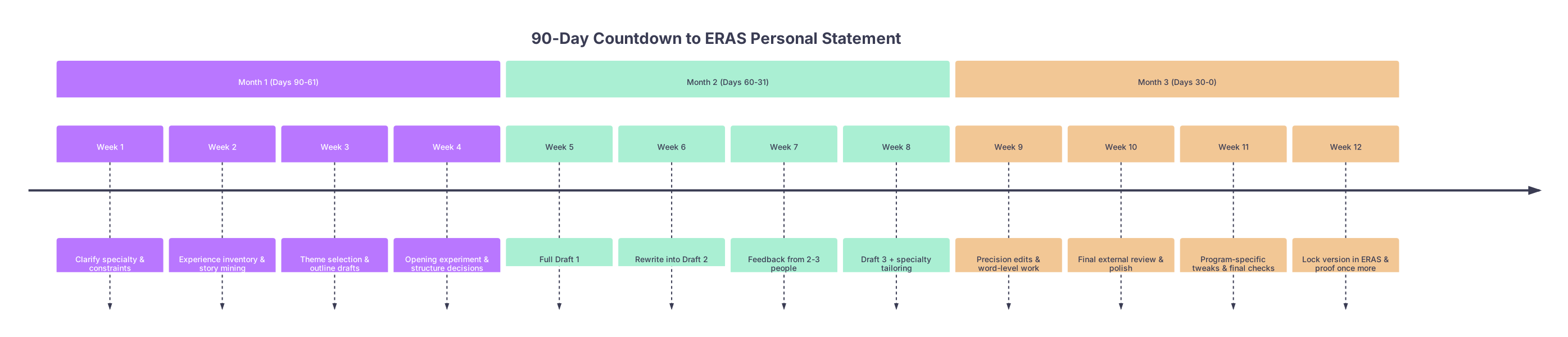
| Period | Event |
|---|---|
| Month 1 (Days 90-61) - Week 1 | Clarify specialty & constraints |
| Month 1 (Days 90-61) - Week 2 | Experience inventory & story mining |
| Month 1 (Days 90-61) - Week 3 | Theme selection & outline drafts |
| Month 1 (Days 90-61) - Week 4 | Opening experiment & structure decisions |
| Month 2 (Days 60-31) - Week 5 | Full Draft 1 |
| Month 2 (Days 60-31) - Week 6 | Rewrite into Draft 2 |
| Month 2 (Days 60-31) - Week 7 | Feedback from 2-3 people |
| Month 2 (Days 60-31) - Week 8 | Draft 3 + specialty tailoring |
| Month 3 (Days 30-0) - Week 9 | Precision edits & word-level work |
| Month 3 (Days 30-0) - Week 10 | Final external review & polish |
| Month 3 (Days 30-0) - Week 11 | Program-specific tweaks & final checks |
| Month 3 (Days 30-0) - Week 12 | Lock version in ERAS & proof once more |
Days 90–61 (Weeks 1–4): Foundation and Story Architecture
At this point you should not open a blank Word document. You are not ready. The first month is pre‑writing.
Week 1 (Days 90–84): Decide What You Are Actually Applying For
Goal: Clarity on specialty, red flags, and program filters so your statement is aligned with reality.
This week you should:
Lock your specialty (and backup options).
- If you are still torn between Internal Medicine and Anesthesia at Day 90, your statement will read confused.
- Decide:
- Primary specialty
- Whether you will create a second version (e.g., IM and Neurology)
- If you are dual‑applying, assume you need two distinct statements, not a watered‑down hybrid.
Audit your application profile.
- List:
- USMLE/COMLEX scores (including a fail if present)
- Gaps, LOA, career changes
- Research, leadership, and unique strengths
- Ask: What will PDs question when they see my ERAS? Your statement must pre‑empt those questions.
- List:
Define your “program fit” targets.
- Are you academic or community‑oriented?
- Geographic constraints?
- Interest in research, medical education, underserved care?
- You are not writing for “residency in general.” You are writing for a specific type of program culture.
End‑of‑week checklist:
- Primary specialty chosen
- Decision made about whether you need more than one PS version
- List of application strengths / concerns written out
- 3–5 sentences describing the kind of resident you want them to imagine
Week 2 (Days 83–77): Experience Inventory and “Story Mining”
At this point you should be collecting raw episodes, not polishing sentences.
This week you should:
Build a brutal, honest experience list.
- Open a document and brain‑dump:
- Rotations where you were “on fire” (good or bad)
- Patients that stuck with you (for real, not fake Hallmark stuff)
- Moments of failure or doubt
- Feedback you received: “You’re very calm in codes,” “You present in a very organized way”
- Aim for 20–30 bullets, not 5.
- Open a document and brain‑dump:
For each experience, answer 3 questions:
- What actually happened? (one sentence)
- What did I do or feel that reveals who I am?
- How did this change my behavior, priorities, or career goals?
Identify patterns.
- Highlight episodes that show:
- Clinical growth
- Resilience / response to difficulty
- Curiosity or ownership
- Teamwork and communication
- If you cannot find at least 3 patient‑care moments where you clearly did something that mattered, go back and mine again. They are there.
- Highlight episodes that show:

End‑of‑week checklist:
- 20–30 experiences listed
- At least 8–10 have brief reflections attached
- 3–4 recurring themes circled or highlighted (e.g., teaching, complex decision-making, underserved care)
Week 3 (Days 76–70): Choose Your Core Theme and Build Outlines
This is where people usually go wrong by trying to “tell their life story.” That is not your goal. You are telling a focused professional story.
This week you should:
Pick 1–2 primary themes.
- Good themes:
- “Ownership and follow‑through in complex patients”
- “Calm, structured thinking in high‑acuity settings”
- “Persistent curiosity and teaching others”
- Bad themes:
- “I have wanted to be a doctor since age 6”
- “I just really love helping people”
- Good themes:
Draft 2–3 different outlines.
- Each outline = different structure, not different content universe.
- Example Outline A (patient‑anchored):
- Hook: single memorable patient moment
- Reflection: what this revealed about how you approach medicine
- Body 1: example of ownership / team role
- Body 2: experience that defines your interest in the specialty
- Body 3: research / teaching / other dimension
- Future: what you are looking for in residency
- Outline B (chronologic growth):
- Hook: early uncertainty or pivot
- Early exposure that challenged your assumptions
- Clerkship example showing growth
- Sub‑I / AI example showing readiness
- Future direction and program fit
Do one “stress test” per outline.
- Ask: If I delete the first paragraph, is the rest still coherent?
- Ask: Can this same structure work if I swap in a different patient story? (If not, it is too dependent on one dramatic case.)
End‑of‑week checklist:
- 1–2 clear themes decided
- At least 2 distinct outlines created
- One outline chosen as primary, one as backup
Week 4 (Days 69–61): Experiment with Openings and Voice
At this point you should be playing with first paragraphs only, not entire drafts. The opening sets your voice.
This week you should:
Write 5 different opening paragraphs.
- Each 4–7 sentences, max 150 words.
- Variations:
- Patient story opening
- Rotations / team dynamic opening
- A tension or problem you faced (“I nearly chose another specialty…”)
- Statement of identity or values (“I work best where…”)
- Direct specialty statement with a brief anchoring moment
Test them with 2–3 honest people.
- Give them only the openings, numbered, no explanation.
- Ask:
- Which one makes you want to read more?
- What kind of resident do you picture from each?
Lock one opening, keep one as backup.
- Once you choose, stop tinkering. You will refine language later.
- Your goal now is to move forward into full‑length drafting.
End‑of‑month (Day 61) checkpoint:
- Specialty and theme locked
- Primary outline chosen
- Opening paragraph selected and saved
- Experience bank ready to plug into body paragraphs
If you are not here by Day 61, you are already behind. Catch up this weekend before moving on.
Days 60–31 (Weeks 5–8): Drafting, Rewriting, and First Feedback
This month is about building, then rebuilding. Not defending your first attempt.
Week 5 (Days 60–54): Draft 1 – Get the Whole Story Down
At this point you should draft fast and ugly.
This week you should:
Write a complete Draft 1 using your chosen outline.
- Aim for 750–850 words. You will cut later.
- Include:
- Your chosen opening (copy‑paste it in)
- 2–3 body sections grounded in specific episodes
- A clear “why this specialty” section that is not generic
- A “what I bring / what I seek” closing paragraph
Use concrete details, then stop.
- Not: “I am passionate about internal medicine.”
- Instead: “On my MICU rotation, I volunteered to call seven families in one afternoon to explain updates, because I had seen how much confusion built up when no one took ownership of communication.”
- If you catch yourself writing “passion,” “calling,” or “ever since I was a child,” highlight them. You will replace them later.
Leave it alone for 48–72 hours.
- Do not tweak.
- Print it and put it in a folder for next week.
End‑of‑week checklist:
- Full Draft 1 completed
- Word count recorded
- Draft printed or saved in a clearly labeled folder (not “Final_Final.docx”)
Week 6 (Days 53–47): Draft 2 – Restructure and Refocus
This is the painful week. You will cut a lot.
This week you should:
Read Draft 1 once, pen in hand, no editing.
- Margin notes:
- “This is generic”
- “More detail here”
- “This is the core of my story”
- Underline any sentence that only you could have written. These are keepers.
- Margin notes:
Rewrite as a new document, not incremental edits.
- Start a fresh file. Draft 2 should be a rewrite, not a patchwork.
- Keep:
- The best opening sentence or two (if they still work)
- 2–3 of your strongest examples
- Cut:
- Childhood origin stories
- Repetition of CV items word‑for‑word
- Overly dramatic language that sounds like a TV script
Tighten structure.
- Each paragraph should answer:
- What did you do?
- What does that show about how you think/work?
- How does that connect to the kind of resident you will be?
- Aim now for 650–750 words.
- Each paragraph should answer:
End‑of‑week checklist:
- Draft 2 completed as a new document
- At least 15–20% of Draft 1 content replaced or cut
- One paragraph clearly articulates “Why this specialty” with real content
Week 7 (Days 46–40): Targeted Feedback from the Right People
At this point you should not send your statement to 10 random people. That just dilutes the signal.
This week you should:
Choose 2–3 reviewers strategically:
- One attending or chief resident in your specialty
- One person who knows you well (advisor, mentor)
- Optionally: one non‑medical reader for clarity and flow
- Avoid:
- The attending who red‑pens everything into their own voice
- Family members who think everything you do is “perfect”
Give them clear instructions.
- Attach Draft 2 as a PDF.
- Ask them to answer, in 5 minutes:
- What 3 adjectives come to mind about me after reading this?
- At what point did your attention drift?
- Is there anything here that would worry a PD?
- Do not ask them to fix grammar. That is your job later.
Collect feedback, do not react yet.
- Save comments in one place.
- Look for patterns, especially if two people flag the same paragraph as confusing or flat.
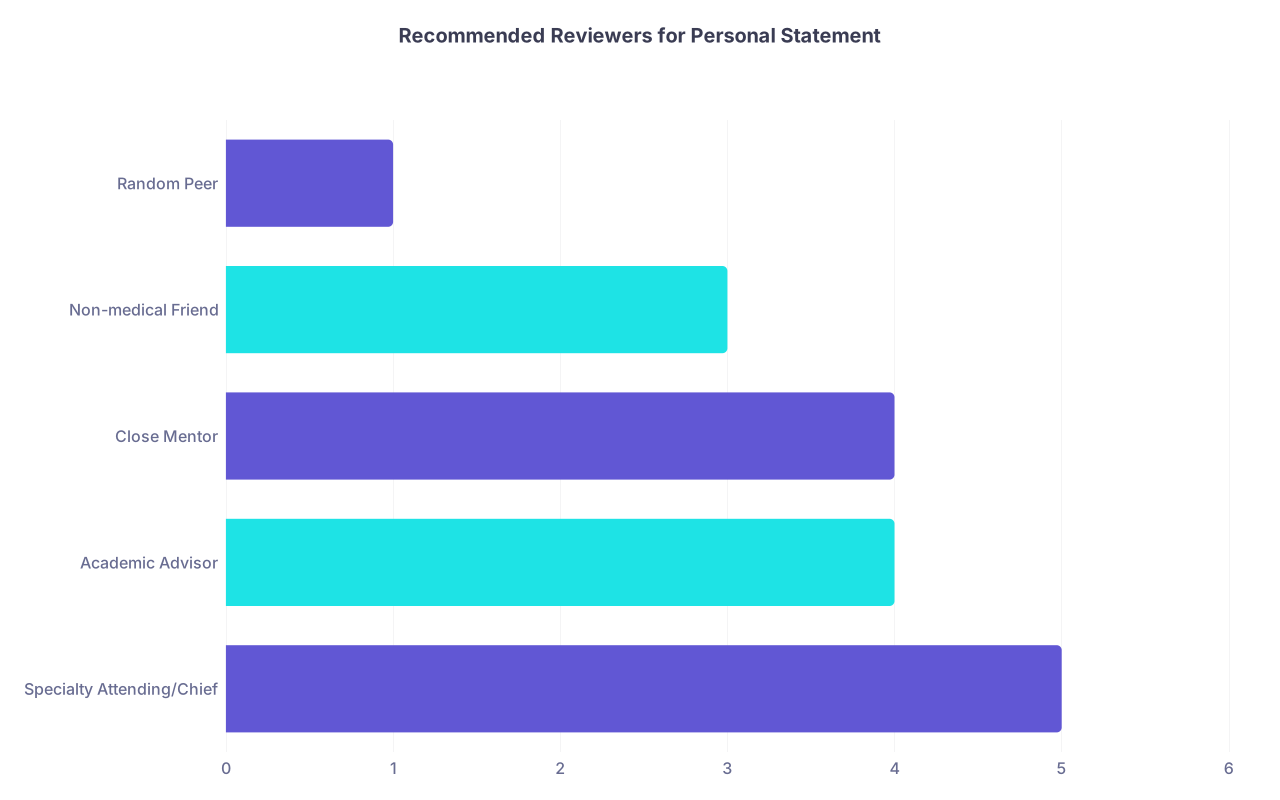
| Category | Value |
|---|---|
| Specialty Attending/Chief | 5 |
| Academic Advisor | 4 |
| Close Mentor | 4 |
| Non-medical Friend | 3 |
| Random Peer | 1 |
End‑of‑week checklist:
- Draft 2 sent to 2–3 reviewers
- All feedback returned or scheduled
- Common themes in feedback identified (even if you disagree with them)
Week 8 (Days 39–31): Draft 3 – Clarify, Cut, and Commit
Now you synthesize. This is where the statement starts to look like something you can submit.
This week you should:
Decide what feedback to ignore.
- If an attending wants you to add their favorite buzzwords but it makes you sound stiff, decline.
- If multiple people say your opening is confusing, fix it.
Revise into Draft 3.
- Focus on:
- Removing clichés and filler sentences
- Clarifying any confusing timeline (e.g., research years, career change)
- Strengthening transitions so each paragraph feels like part of a single argument: I will be a strong resident in X because…
- Get word count to 600–700 words. ERAS readers do not want a novel.
- Focus on:
Create alternate specialty versions (if needed).
- Copy Draft 3 into a new document and surgically swap specialty language and examples.
- Do not just change “Internal Medicine” to “Family Medicine.” That is lazy and obvious.
End‑of‑month (Day 31) checkpoint:
- Solid Draft 3 completed
- Word count in target range
- Specialty‑specific versions created if dual‑applying
If at Day 31 you are still on Draft 1, you are in trouble. Block off an entire weekend and compress Weeks 5–8.
Days 30–0 (Weeks 9–12): Precision Editing, Final Review, and ERAS Upload
This last month is not about big structural changes. If you are still rearranging whole paragraphs at Day 10, you misused the earlier weeks.
Week 9 (Days 30–24): Line‑Level Editing and Clarity
At this point you should be ruthless with language.
This week you should:
Do a sentence‑by‑sentence cut.
- Print Draft 3 and use a pen.
- For each sentence, ask:
- Does this add new information or insight?
- Is there a shorter, clearer way to say this?
- Cross out every “very,” “really,” and “extremely.” Replace with actual description.
Fix common residency PS problems:
- Remove:
- Quotes from patients or famous physicians (waste of space)
- Overly graphic clinical details
- Long lists of adjectives about yourself
- Ensure:
- You explicitly mention the specialty by name
- There is at least one sentence about what you are looking for in a program
- Remove:
Run a tech check (but do not obey blindly).
- Use a spellchecker and grammar tool.
- Fix genuine errors; ignore suggestions that flatten your voice.
End‑of‑week checklist:
- Marked‑up hard copy completed
- Clean Draft 4 created incorporating line edits
- No obvious clichés or redundant sentences remaining
Week 10 (Days 23–17): Final External Review
This is your last chance for real content changes.
This week you should:
Send Draft 4 to 1–2 high‑yield reviewers.
- Ideally:
- A program director or APD you know
- Or a trusted senior resident/fellow in your specialty
- Ask them specifically:
- Would you invite this person to interview based on this statement?
- Ideally:
Ask one person to read it out loud to you.
- Awkward, but effective.
- You will hear:
- Clunky phrases
- Overly long sentences
- Tone issues (too formal, too casual)
Incorporate only high‑impact changes.
- You are not rebuilding. You are refining.
- If someone suggests completely new stories at this stage, thank them and move on. Too late.
End‑of‑week checklist:
- Final content feedback received
- Necessary clarifications or small additions made
- Draft feels stable—no urge to rearrange whole sections
Week 11 (Days 16–8): Program Fit, Red Flag Coverage, and ERAS Formatting
At this point you should move from “good essay” to “smart application strategy.”
This week you should:
Ensure your statement addresses any red flags appropriately.
- One fail? Brief, factual, accountable explanation (1–2 sentences).
- Gap year? Connect to growth, skills, or clarity you gained.
- Career change? Show coherent reasoning, not impulsivity.
Align with the rest of your ERAS.
- Compare PS with:
- Experiences section
- Research descriptions
- MSPE draft (if available)
- Check that you are not contradicting yourself or over‑emphasizing something that appears weak on the CV.
- Compare PS with:
Prepare for ERAS constraints.
- Paste into a plain‑text editor to:
- Remove weird formatting
- Check paragraphs and spacing
- Verify:
- No bold/italics (ERAS strips formatting)
- Proper line breaks and spacing after paste
- Paste into a plain‑text editor to:
| Checkpoint | Target Status |
|---|---|
| Word Count | 600–700 words |
| Distinct Draft Versions | 1–2 (for each specialty) |
| Reviewers Consulted | 3–5 total |
| Red Flags Addressed | Brief, factual, present |
| ERAS Formatting Verified | Plain text, clean breaks |
End‑of‑week checklist:
- Red flags (if any) addressed succinctly
- Statement consistent with ERAS content
- Clean, plain‑text version ready for upload
Week 12 (Days 7–0): Lock, Upload, and One Last Proof
The final week is execution. No drama.
Day 7–5: ERAS Upload and Layout Check
At this point you should:
- Log into ERAS.
- Paste your final statement into the PS section.
- Save and preview:
- Check:
- Paragraph breaks look clean
- No strange characters or missing text
- Name and specialty are correct in the label
- Check:
Day 4–3: 48‑Hour Cooling Period
- Do not touch it.
- Focus on letters, program list, interviews prep.
- Let your brain reset so you can see errors.
Day 2: Final Read With Fresh Eyes
You should:
- Print the ERAS preview version (or PDF it).
- Read slowly, pen in hand.
- Fix:
- Typos
- Double spaces
- Any lingering awkward sentence that truly bothers you
If you spot more than 3–4 changes, you are probably over‑editing. Make the essential fixes only.
Day 1: Hard Lock
- Confirm:
- Correct PS assigned to correct specialty/programs
- No placeholder text or track changes junk
- Then stop. Close ERAS. You are done.
Day 0: Submission
- Submit your ERAS.
- Make a copy of your final PS for interview prep:
- You will be asked about every story in it.
- Re‑read before interviews so you are consistent and confident.
If You Are Starting Late
If today is Day 45 and you are just now reading this, you compress:
- Combine Weeks 1–3 into one intense 2–3 day block
- Write Draft 1 and Draft 2 within the same week
- Limit yourself to 2–3 reviewers total
Do not skip the experience inventory or the outline step. Those are non‑negotiable. Skipping them is how you end up with a generic, “I love helping people” statement that programs skim and forget 10 seconds later.
Open your calendar right now and label the next 12 weeks: “Week 1–12 Personal Statement Tasks,” then schedule this week’s actions—today—so you know exactly what you are doing by Friday.