
The worst personal statements are written by committee. The second worst are written in a vacuum. Your job is to land somewhere in between—on purpose.
You need the right people, at the right time, for the right kind of feedback. Not everyone who offers to “take a look” should actually see your statement. And if you bring people in too early or too late, they’ll either paralyze you or be forced into superficial edits.
Here’s how to time it properly during the residency application cycle.
Big Picture Timeline: Who Reads It When
Let’s anchor this to a typical ERAS cycle for a 4th-year med student in the U.S.
- Drafting usually starts: April–July (MS3 spring → MS4 summer)
- ERAS submission: September
- Final polishing: Late August–early September
At each phase, different readers make sense.
| Phase & Timeframe | Primary Readers |
|---|---|
| Brainstorm & Rough Draft (Apr–Jun) | Yourself, close friend/partner |
| Early Shaping (Jun–Jul) | Trusted peer, recent resident |
| Specialty Fit & Strategy (Jul–Aug) | Faculty mentor, program director |
| Polish & Proofread (Aug–Sep) | Writer/editor, detail‑oriented friend |
You do not need all of these readers. But you do need at least one from three categories:
- Someone who knows you
- Someone who knows residency
- Someone who knows writing
Let’s walk it chronologically, with hard boundaries on when to involve whom.
Phase 1: Before Anyone Reads It (Weeks 0–2)
Timeframe:
- MS3 late spring to early summer
- Roughly April–June (earlier is fine, later starts to hurt)
At this point you should keep your draft to yourself.
You’re doing:
- Brainstorming stories
- Free-writing terrible paragraphs
- Figuring out what you actually want in a career
You’re not ready for mentors or attendings yet. They’ll focus on polish, and you don’t even know the structure.
Week 0–1: Solo Brainstorm
Spend 3–5 hours across a week doing ugly work that nobody sees:
- List 10–15 specific moments that felt important on rotations
(e.g. “Night float cross-cover panic on 6/12”, “Family meeting with ESL family in MICU”) - Write 2–3 pages of free-writing per moment. No editing.
- Answer in bullet form:
- Why this specialty?
- What do I actually enjoy on a random Tuesday at 3 am?
- What do I not want to do?
Do not send this to anyone. It’s raw material, not a statement.
Week 2: First Coherent Draft (Still Private)
Your goal this week: a full, ugly, complete draft:
- 650–900 words
- Has:
- An opening scene or hook
- A clear “why this specialty”
- 2–3 concrete examples
- A conclusion that looks forward to residency
At this point you should still not involve faculty, PDs, or any “important” reader. They’ll get distracted by typos and phrasing. You need structural freedom first.
You’re ready to show it when:
- You can read it out loud without cringing at every sentence
- The general arc makes sense: who you are, why this field, what you bring
Only then do you bring in your first outside person.
Phase 2: First Outside Reader – Who Knows You (Weeks 3–4)
Timeframe:
- Usually June–early July
- After you have a full draft
At this point you should bring in one person who knows you well but doesn’t need to know medicine deeply.
Good options:
- Close non-med friend who’s thoughtful and honest
- Partner/spouse
- Sibling or parent who reads a lot and will tell you the truth
Bad options:
- The grammar-obsessed relative who rewrites everything in formal legalese
- The friend who thinks everything you write is “amazing!!!”
What you ask them (and what you don’t)
You want gut reactions, not line edits.
Tell them explicitly:
- “I don’t need grammar help yet.”
- “Tell me:
- Does this sound like me?
- What parts feel fake or forced?
- What part was most memorable?
- Where did you get bored or lost?”
If they say:
- “I don’t really see you in this.” → You rewrote yourself into a generic applicant.
- “This sounds like a brochure.” → You’re using too many clichés (“lifelong passion,” “privilege to care for patients” every paragraph).
Make 1–2 big changes based on this. Not 20 micro-changes. Then move on.
Phase 3: Peer & Near-Peer Review (Weeks 4–7)
Timeframe:
- Late June–July
At this point you should bring in people who know residency reality, but aren’t gatekeepers:
- Classmate applying to the same specialty who is serious about their apps
- Recent grad (PGY1–PGY2) in your target specialty
- Chief resident you’re comfortable with
You’re now asking:
- “Does this read like someone who understands this specialty?”
- “Am I accidentally sending red flags?”
What they’re uniquely good at catching
Near-peers catch things attendings miss:
Specialty clichés
- EM: “I love the fast-paced environment and variety” (so does everyone else)
- Ortho: “I love working with my hands and being part of a team”
- Peds: “Children are our future” (yes, and?)
Mismatched tone:
- Trying to sound like a trauma hero for psych
- Overly romanticizing death for pathology
Hidden red flags:
- “I prefer working alone” in a team-heavy field
- Overemphasizing how much you hate clinic in a specialty that is 60% clinic
Give them a specific, short task:
- “Tell me:
- Would this help or hurt me for [Internal Medicine]?
- What line or example would you cut?
- Is there one thing you’d want to know more about?”
Make another pass. Keep structural changes manageable. You should be on draft 2–3 now, not draft 9.
Phase 4: Faculty & Mentors – Who Know Residency Selection (Weeks 7–10)
Timeframe:
- Mid-July to early August
- Ideally after you’ve finalized your specialty choice and approximate program list
This is where people overexpose their statement. You do not want five attendings giving five conflicting rewrites.
At this point you should show your statement to:
- 1–2 max of the following:
- Specialty advisor
- Trusted faculty mentor who actually knows you
- Program director or associate PD who has offered to review
Do not mass-email your statement to everyone with “program director” in their title. That’s how you end up with a Frankenstein essay stitched from six different voices.
How to choose the right faculty readers
Pick:
- Someone who has written strong letters for you, or
- Someone who interviewed you for your home sub-I and said, “Send me your stuff when you’re ready,” and meant it
Avoid:
- The famous department chair who doesn’t know your name and will give 90 seconds of generic feedback
- The attending who rewrites your personal statement as if it’s their autobiography
What to ask faculty mentors
Before you send it, write this in the email or say it in person:
“I’m mostly looking for feedback on content, tone, and whether this would raise any concerns for PDs in [specialty]. I’m not wedded to every sentence, but I’d like to keep it in my own voice.”
Then specifically ask:
- “Does this make sense for someone applying to [academic vs community, competitive vs less competitive] programs?”
- “Is there anything you’d worry about if you read this as a PD?”
- “Is there a story/angle you think I should highlight more or less?”
They are good at:
- Calibrating how “personal” is too personal
- Spotting omissions (e.g., you never mention research when you actually have a lot)
- Making sure your explanation of a leave of absence or red flag is appropriate and brief
Do not let them:
- Turn it into a mini-CV paragraph listing every accomplishment
- Strip every bit of humanity out of it
You’re probably at draft 3–4 now. This is where the structure should solidify.
Phase 5: Professional Polish & Proofreading (Weeks 10–12)
Timeframe:
- Early to late August, before ERAS opens for submission in September
At this point you should lock the content and only tweak language.
This is where you bring in:
- A strong writer (friend who’s done a humanities degree, someone who’s edited personal statements before)
- Or a professional editor who understands medical applications (not mandatory, but helpful if you honestly struggle with writing)
Bad choice here:
- Someone who has never seen a residency personal statement and tries to turn it into a college admissions essay or a TED Talk.
What they should focus on
Be blunt with them:
- “I’m not changing the core stories unless you find something truly confusing or off-putting. Please focus on clarity, concision, and flow. Feel free to flag grammar.”
They should help you:
- Cut flabby phrases (“I have always had a strong desire to…” → “I want to…”)
- Vary sentence structure
- Fix obvious grammar/typos
- Tighten transitions so the reader doesn’t get lost
They should not:
- Say, “What if we open with a different story?” unless the current one is genuinely weak
- Double the length with philosophizing
You’re aiming for draft 4–5 as your final. If you’re on draft 10, you’ve probably listened to too many people.
Phase 6: Final Checks Right Before Submission (Last 7–10 Days Before You Certify ERAS)
Timeframe:
- Late August–early September
At this point you should stop asking for “feedback” and only ask for proofreading.
Bring in:
- One detail-obsessed friend or partner
- Or you, after a 48–72 hour break from looking at it
Tell them:
- “I’m not changing content. Please look for:
- Typos
- Weird punctuation
- Name/date errors
- Repetition that jumps out”
Good trick:
- Print it out and read it with a pen.
- Read it out loud slowly. Anything you stumble over, mark.
Stop involving new readers. No sending it to that attending you just met who says, “I’d love to take a look.” The cost of last-minute major edits is higher than the benefit.
Who Not to Involve (Or Involve Very Late, If At All)
Let me be direct: some people should either never see your statement, or see it only when it’s essentially done.
People who intimidate you into silence
- If you’re terrified of their judgment, your writing will freeze.
- Bring them in late or not at all.
People who always rewrite in their own voice
- You’ll end up sounding like a 55-year-old pulmonologist from Mississippi when you’re a 26-year-old FM applicant from Queens.
People who brag about how many personal statements they’ve “fixed”
- They often impose one template they think “works,” and you become Generic Applicant #37.
Too many co-applicants in your own class
- Group-edit sessions turn into comparison nightmares:
- “Should I also write about that code?”
- “Wait, you have five publications? Do I even deserve to apply?”
- Group-edit sessions turn into comparison nightmares:
Use them sparingly. One sharp peer > five anxious ones.
Visual: Timeline Overview
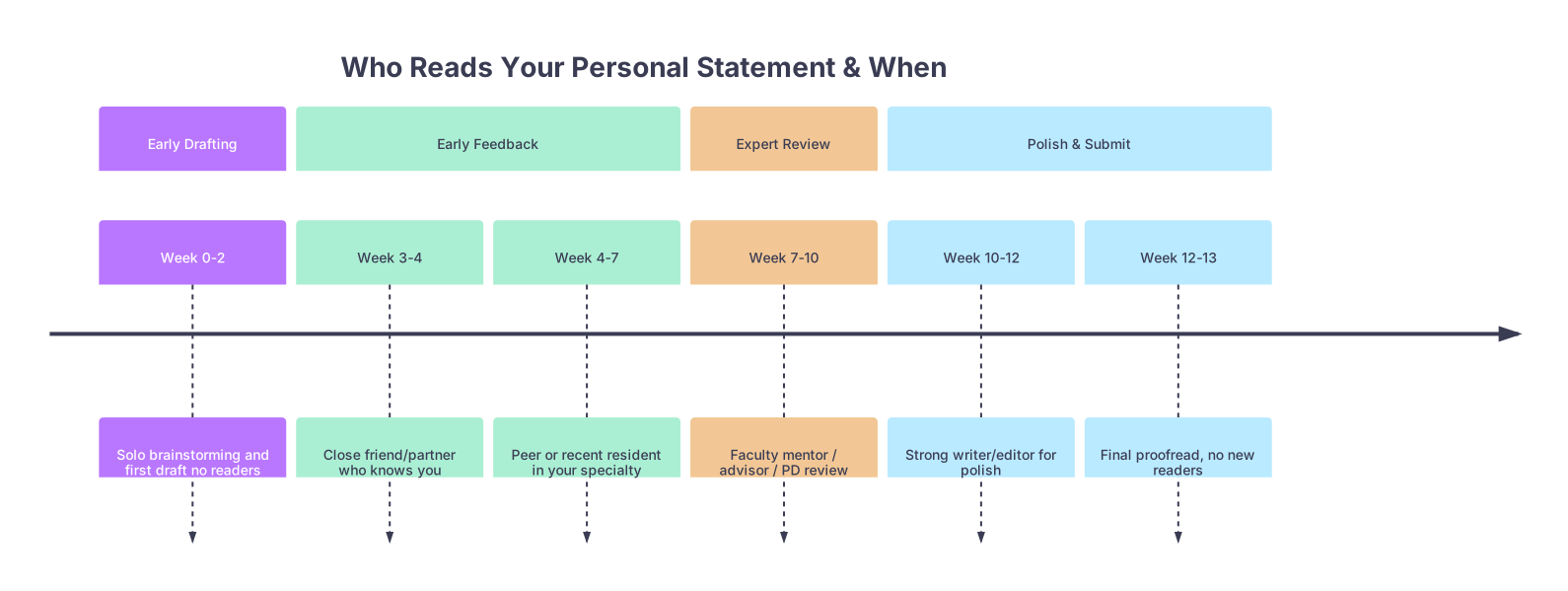
| Period | Event |
|---|---|
| Early Drafting - Week 0-2 | Solo brainstorming and first draft no readers |
| Early Feedback - Week 3-4 | Close friend/partner who knows you |
| Early Feedback - Week 4-7 | Peer or recent resident in your specialty |
| Expert Review - Week 7-10 | Faculty mentor / advisor / PD review |
| Polish & Submit - Week 10-12 | Strong writer/editor for polish |
| Polish & Submit - Week 12-13 | Final proofread, no new readers |
How Many Total Readers Is Enough?
If you need a number, here it is: 3–5 readers total. Across the whole process.
A solid mix might look like:
- One person who knows you deeply (friend/partner)
- One near-peer (PGY1 or strong MS4)
- One faculty mentor or PD-level person
- One writing-focused person/proofreader (this can overlap with #1–3 if they’re good)
That’s it.
If you’re beyond five distinct readers, you’re probably:
- Getting contradictory advice
- Rewriting endlessly
- Drifting away from your own voice
At that point you should stop chasing “perfect” and hit “good, coherent, and authentic.”
When To Say “No” To More Feedback
There’s a moment—usually about 1–2 weeks before ERAS submission—when additional feedback becomes toxic. You’ll recognize it when:
- Every new comment just undoes the last person’s suggestion
- You delete and re-add the same sentence three times
- You’re no longer improving ideas, only swapping synonyms
At this point you should:
- Make a final pass for clarity and typos
- Accept that no statement will please every possible reader
- Lock it in and move on to interview prep, program list, and rest
Key Takeaways
- The right order matters: start alone, then a close personal reader, then near-peers, then faculty, and end with a writer/proofreader.
- Limit total readers (3–5) and be specific about what you want from each—gut check, specialty fit, or polish—not all three from everyone.
- Stop adding new reviewers in the final two weeks before submission; at that point you refine, you don’t redesign.