
The blunt truth: Most applicants should not try to be funny in a residency personal statement. But that doesn’t mean humor is banned. It means the bar is high and the margin for error is tiny.
Let me walk you through when humor works, when it backfires, and how to tell which camp you’re in.
The Core Answer: Yes, But Rarely, and Never as the Main Feature
Here’s the answer you actually need:
- Yes, light humor can be appropriate.
- No, you shouldn’t write a “funny” personal statement.
- If your reader can’t tell you’re serious about medicine, you’ve failed.
Program directors are not reading your statement to be entertained. They’re reading it to decide:
- Will I trust this person with my patients at 3 a.m.?
- Will this person be easy or exhausting to supervise?
- Will they fit our culture?
If humor helps show you’re self-aware, grounded, and human, great. If it distracts from those three questions, it’s a problem.
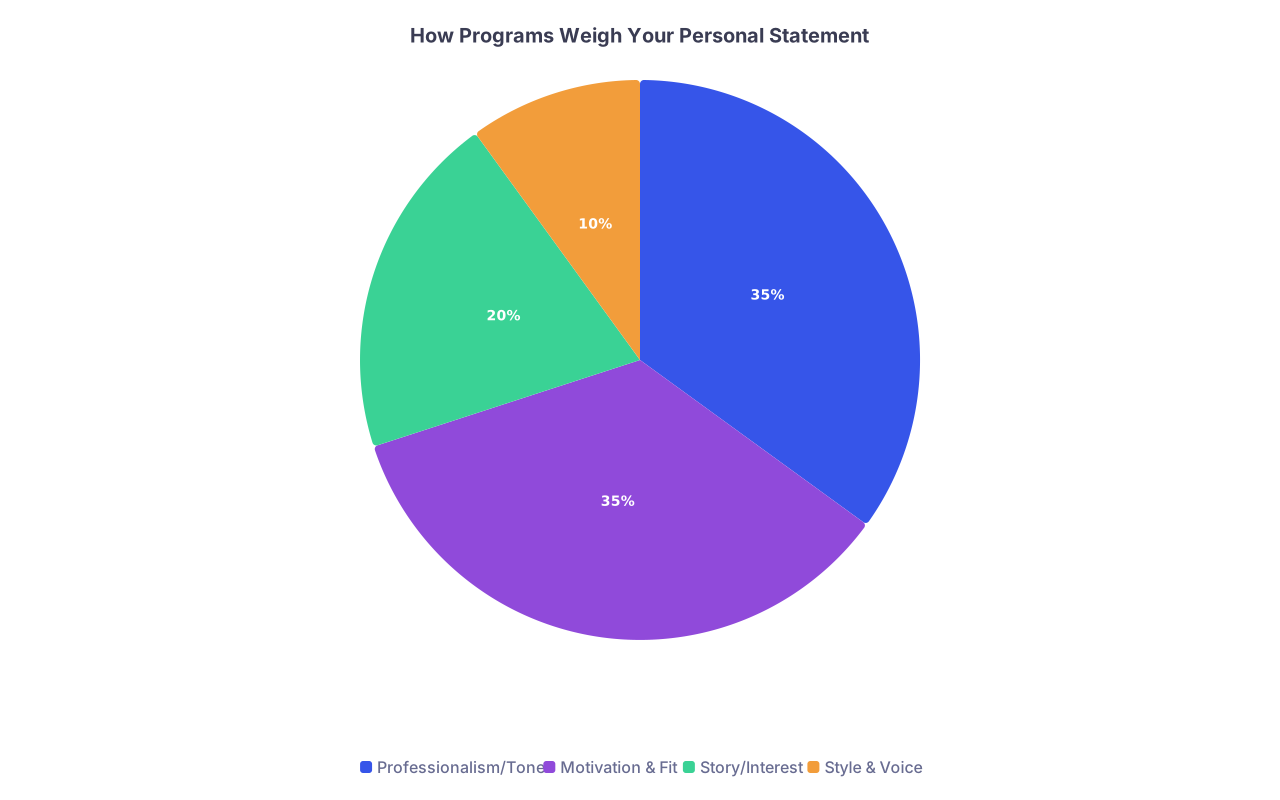
| Category | Value |
|---|---|
| Professionalism/Tone | 35 |
| Motivation & Fit | 35 |
| Story/Interest | 20 |
| Style & Voice | 10 |
Humor lives in “Style & Voice.” That’s the smallest slice of the pie. Don’t sacrifice the big stuff to chase a clever line.
When Humor Works (and When It Absolutely Doesn’t)
Let’s be concrete. I’ve read thousands of personal statements. Here’s where humor actually helps.
Appropriate Uses of Humor
Light self-deprecation that shows growth
Good:
“As a first-year medical student, my note-writing style could best be described as ‘creative fiction.’ Thankfully, a very patient senior resident dragged me into the world of concise, useful documentation.”Why it works: It’s mild, it admits a flaw, and it ends with growth and maturity.
A quick, subtle observational line
Good:
“On my first medicine call night, my survival strategy was simple: stay near the nurses and never pretend to know something I didn’t. It worked. They tolerated me, and the patients did well despite my newness.”This is wry, grounded, and still professional.
Showing personality in a single sentence, then moving on
Humor should read like a spice you added once. One line that makes the reader smirk, then you’re back to substance. If someone can remember lines but not your specialty choice, you overdid it.
Bad Uses of Humor (Don’t Do These)
Here’s where people get burned:
Jokes about patients
Even if you think you’re being kind. Any hint that you find patients ridiculous, annoying, or “content” for your story is a red flag.Dark humor or “ED humor”
The stuff you say to co-interns at 2 a.m. does not belong in your personal statement. That includes gallows humor, sarcasm about the system, or anything that could sound cynical.Stand-up routine intros
“I didn’t always want to be a doctor. Actually, I wanted to be a professional soccer player—until I realized my feet and gravity had other plans.”
One line like this might be fine. A whole paragraph? No.Mocking other specialties or colleagues
“I knew I wasn’t meant for surgery—I like my sleep and my relationships intact.”
That reads as immature and disrespectful, not clever.Forced “quirky” personality
Trying too hard to prove you’re fun or different. Residency programs are selecting colleagues, not characters.
If a joke makes you sound flippant, arrogant, bitter, or like you don’t take the work seriously, you’ve already lost.
The Big Filters: Should You Use Humor At All?
Here’s the framework I’d use with you if we were sitting down going line by line through your draft.
Ask yourself:
Are you actually good at written humor?
Spoken humor doesn’t always translate. Your friends laughing at your stories in person doesn’t mean strangers will “get” your tone on paper.Would someone reading this at 11 p.m. on a bad day still find it appropriate?
Because that’s how a lot of PDs and faculty read applications: tired, behind on work, with low patience.If the joke falls flat, is your statement still strong?
If the joke is carrying your introduction or your main theme, you’re in dangerous territory.
If you’re unsure on any of these, default to no humor. A straightforward, serious statement will never get you rejected for tone. A “creative” one can.
How to Use Humor Safely (If You’re Going to Use It)
If you insist on including a bit of humor, here’s how to keep yourself out of trouble.
1. Keep It Micro-Dose Only
Think one line. Maybe two. Total.
Examples of “micro-dose” humor:
- “I came into medical school convinced I’d be a cardiologist. Then I spent two weeks on inpatient psych and realized my favorite part of medicine didn’t involve stethoscopes.”
- “My first attempt at presenting on rounds included every lab value the patient had ever produced. The attending kindly suggested I ‘edit aggressively.’ I’ve been working on that ever since.”
Short. Warm. Clearly respectful.
2. Never Punch Down
No humor at the expense of:
- Patients
- Families
- Nurses
- Other specialties
- Your classmates
You can lightly tease yourself. That’s it.
3. Make Sure the Main Tone Is Still Serious and Reflective
If I skim your statement, I should come away with:
- Why this specialty
- What kind of resident you’ll be
- Evidence you’ve done the work and understand the reality
Humor should be decorative. Not structural.
If your intro is a whole anecdote built around a joke or punchline, rewrite it.
4. Test It With Opposite Personalities
You want feedback from:
- Someone who knows you very well (to see if it “sounds like you”), and
- Someone who doesn’t know you much at all (to see if it still feels professional)
Ask them two simple questions:
- “Does this make me sound less serious about residency?”
- “Could any part of this annoy or offend someone?”
If there’s even a little hesitation, cut the joke.
Specialty Culture: Does It Matter?
Yes. Some specialties tolerate a slightly lighter tone more than others. But don’t overthink this or stereotype too hard.
| Specialty | Humor Tolerance* |
|---|---|
| Emergency Med | Medium |
| Pediatrics | Medium-High |
| Psychiatry | Medium |
| Internal Medicine | Medium |
| General Surgery | Low |
| Neurosurgery | Very Low |
*This is culture, not a rule. You can absolutely be rejected from peds with a bad joke, and accepted to surgery with a very dry, serious statement.
The safer move: Assume low tolerance everywhere. Then, if your tiny bit of humor feels right and passes the tests above, keep it.
Concrete “Before and After” Examples
Let’s fix some typical missteps.
Example 1: Trying Too Hard
Bad intro:
“Some kids dream of being astronauts or rock stars. I was the weird one who loved watching my pediatrician irrigate earwax. My friends thought I was gross; I thought it was magic.”
Problems: Too cutesy, trying to be clever, opens on humor instead of seriousness.
Better:
“I’ve always been drawn to the quiet, practical moments where medicine changes a patient’s day rather than their entire life. As a child, that meant being fascinated by simple procedures; as a medical student, it meant realizing how much relief a straightforward intervention can bring to an anxious parent and their sick child.”
Still personal. Still interesting. No forced joke.
Example 2: Punching Sideways
Bad line:
“I briefly considered surgery, but I also enjoy sleeping and seeing my family.”
This is a cliché and it insults another specialty.
Better:
“I explored multiple specialties, including surgery, but I found I was most energized by longitudinal problem-solving and ongoing patient relationships rather than the procedural focus of the OR.”
No joke. More mature. And actually informative.
Where to Put Humor (If You Really Want It)
If you’re going to insert a light line, safest spots are:
Middle of the personal statement
After you’ve clearly stated your interest in the specialty and shown seriousness. A quick human moment in a clinical anecdote works well.End of a paragraph about growth
“My interns now come to me with the same nervous questions I once had, and I try to answer them with the same patience my senior showed me—minus my old 2-page progress notes.”
Where it’s riskier:
- First sentence: Too cold of a read, and it can land wrong.
- Final line: You don’t want the last thing they remember to be a joke.
Quick Checklist: Is This Line of Humor Safe?
Run your sentence through this:
Would I be comfortable reading this aloud to:
- A program director I admire?
- The most humorless attending I know?
- A patient’s family?
If someone doesn’t find it funny, does it still sound respectful and professional?
Could this be misread as:
- Mocking patients or colleagues?
- Dismissing the seriousness of medicine?
- Arrogant or self-congratulatory?
If the answer to any of those is “maybe,” cut it. There are a hundred safer ways to show personality: specific details, honest reflection, clear values, and stories that feel real.
Bottom Line: What Actually Gets You Interviews
Programs don’t rank you higher because you made them laugh. They rank you higher because:
- You sound like someone they’d trust with patients.
- You clearly understand their specialty and its realities.
- You’ve shown growth, resilience, and insight.
- You seem like you won’t be a drama magnet on the team.
Humor is optional. Professionalism is not.
If you’re unsure whether to include a joke, here’s the brutally honest rule: don’t. You will never be rejected for being “too professional” in your residency personal statement.
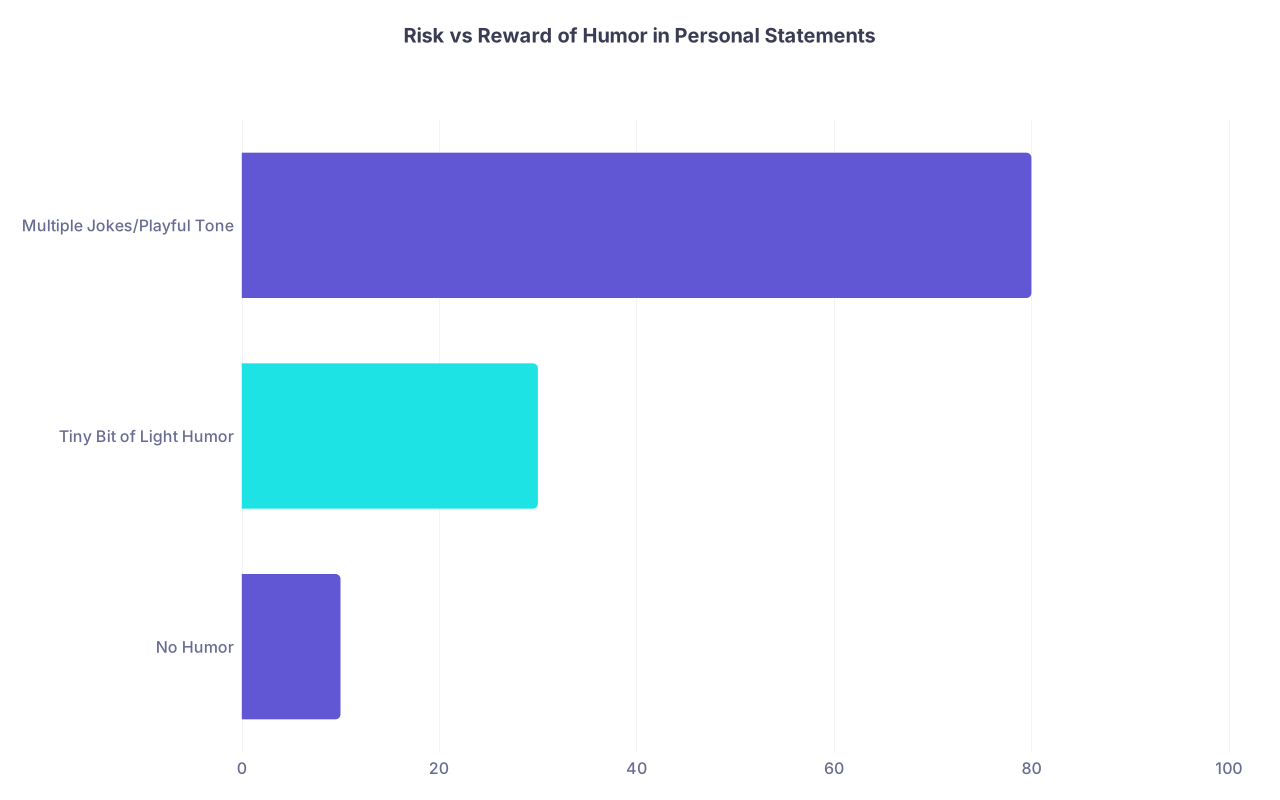
| Category | Value |
|---|---|
| No Humor | 10 |
| Tiny Bit of Light Humor | 30 |
| Multiple Jokes/Playful Tone | 80 |
That’s my estimate of “risk of misinterpretation,” not your chances of matching. The point stands: the more you lean on humor, the more you’re gambling.

FAQ: Humor in Residency Personal Statements
1. Can I start my personal statement with a funny story?
You shouldn’t. Openings set the tone. If your first impression is “this person is trying to be clever,” you’re already fighting uphill to prove you’re serious about residency. Start with clarity about your interest in the specialty; if you must include humor, sprinkle it later.
2. Is one light joke too much?
One short, gentle, clearly respectful line is usually fine, as long as the rest of your statement is serious and strong. If you’re worried enough to ask this question, you’re probably better off cutting it. No one misses jokes that aren’t there.
3. Do some specialties like funny personal statements?
Not really. Some cultures (peds, EM, psych) might be slightly more tolerant of a warm or lightly humorous tone, but no specialty is actively looking for a “funny” statement. Everyone is looking for maturity, insight, and professionalism first.
4. Can I use a humorous quote or pop culture reference?
You can, but it’s usually a bad idea. Quotes are overused and can feel like filler. Pop culture references age badly and may not land for an older reader or someone from a different background. If it doesn’t add direct, specific value to your story, skip it.
5. What’s a safer way to show personality without humor?
Use specific, concrete details. Describe one patient interaction that changed you. Show how you handled a tough moment on call. Explain what you love about your specialty in a way that only someone who’s actually done the work could write. That feels human, and it doesn’t depend on anyone “getting” your joke.
Key takeaways: Humor in a residency personal statement should be a rare, tiny accent, not the main ingredient. If there’s any doubt about how a line might land with a tired, literal, or conservative reader, cut it and lean on clarity, reflection, and specificity instead.