
The biggest risk in a residency personal statement is not being “too generic.” It is over-sharing. And programs will not tell you when you crossed the line. They will just quietly move on.
You are being judged on judgment. What you choose not to say matters as much as what you include. I have watched applicants with solid Step scores and glowing letters get dragged down because their personal statement read more like a therapy note than a professional document.
Let me be direct: you do not get extra points for maximum vulnerability. You get points for appropriate disclosure, clear insight, and good boundaries.
This is where people routinely get it wrong.
The Core Truth: Your Personal Statement Is Not a Confessional
If you remember nothing else, remember this: a residency personal statement is a professional argument for why you are a safe, reliable, teachable physician in their hospital, not an unfiltered life story.
Programs are asking:
- Can you handle stress without imploding?
- Will you show up for patients at 3 a.m.?
- Will you be drama or stability on the team?
Over-sharing makes them doubt the answer to those questions. Not because your struggles are shameful, but because poor judgment on the page hints at poor judgment on the wards.
Here is the line in one sentence:
You can reference struggles and vulnerability.
You should not require your reader to emotionally rescue you.
If the reader finishes your personal statement feeling worried for you instead of confident about working with you, you crossed the line.
The Most Common Over‑Sharing Landmines
There are predictable traps that destroy otherwise decent applications. I see the same handful repeatedly.

1. Turned Your Trauma into the Main Plot
This is the single most common and most damaging mistake.
Example I have actually seen versions of:
“I was sexually assaulted in college, which led me into a deep depression with self-harm and suicidal thoughts. My grades crashed, I withdrew socially, and I still struggle with trust. This experience, however, taught me empathy and is why I want to do psychiatry.”
What program directors think reading this:
- “Is this person currently stable?”
- “How will they handle night float with acutely suicidal patients?”
- “Is this an ongoing liability for our program?”
Is that fair? Not always. Is it reality? Yes.
The problem is not that you sought help. The problem is detail and emphasis. You are asking them to see you as a physician but forcing them to see you as a patient first.
Where the line should be:
- You can briefly reference that you went through a significant personal hardship.
- You do not detail graphic trauma, self-harm, suicidal behavior, or ongoing severe symptoms.
- If you must explain an academic dip due to mental health, you keep it brief, stabilized, and resolved.
Better, tighter version:
“During my second year of college, I experienced a significant personal trauma that led to a period of depression and academic difficulty. With professional help and support, I recovered, returned to my prior level of performance, and learned how to recognize and respond to psychological distress in others. This experience ultimately deepened my interest in psychiatry and my commitment to early intervention.”
Notice the difference. Same core truth. Different level of exposure. One reads as processed and stable. The other reads as actively fragile.
2. Graphic Mental Health Disclosures Without Clear Stability
Another classic misstep: listing your diagnoses and symptoms like a psychiatry intake.
“I have struggled with severe anxiety and panic attacks for years. During Step 1 prep I was on two medications, in weekly therapy, and could barely sleep.”
You think you are showing grit. They see risk.
The line:
- You can mention mental health history if it is essential to your story or to explain a real discrepancy.
- You must clearly frame it as:
- Past or well‑managed
- Under ongoing appropriate care if relevant
- Not currently impairing your performance
Too many applicants do step 1 (disclose) and skip step 2 (reassure).
If you describe uncontrolled symptoms, emergency hospitalizations, or repeated leaves of absence without a rock‑solid, current stability narrative, you are asking a risk‑averse committee to take a gamble. They usually will not.
Sensitive Content: What Is Usually Safe vs Usually Dangerous
Use this like a firewall. If your topic sits in the “Usually Dangerous” column, you had better know exactly what you are doing, and most of you do not.
| Topic Area | Usually Safe Version | Usually Dangerous Version |
|---|---|---|
| Mental health | Brief, resolved, insight-focused | Graphic, ongoing, crisis-focused |
| Substance use | None / very minimal mention | DUIs, rehab, relapse details |
| Family dysfunction | Brief context | Detailed abuse, graphic descriptions |
| Romantic relationships | Omit | Breakups, infidelity, divorce venting |
| Political / ideological views | Not included | Rants, controversial positions |
| Religion / spirituality | Subtle, values-focused | Preaching, conversion narratives |
You are not lying by omitting detail. You are exercising judgment. That is exactly what you are being evaluated on.
Over-Sharing vs Being Genuine: The Real Distinction
You are told “Be authentic.” Then you get punished for being too authentic. No wonder people are confused.
The truth: “Authentic” for residency means emotionally honest but professionally filtered.
Think of your personal statement like talking to a respected attending you know well enough to be real with, but not well enough to share your entire therapy history.
Where you cross the line:
- When the emotional tone shifts from reflective to raw.
- When the reader is forced into the role of therapist, rescuer, or moral judge.
- When your vulnerability is not balanced with evidence of competence and stability.
Quick test: Read your essay imagining a grumpy, overworked program director with 80 applications in their queue. If you picture them pausing and thinking, “Yikes,” at any paragraph, you probably overshared.
The Big Three Red Flag Categories
Let us go deeper on the categories that most often sink personal statements.
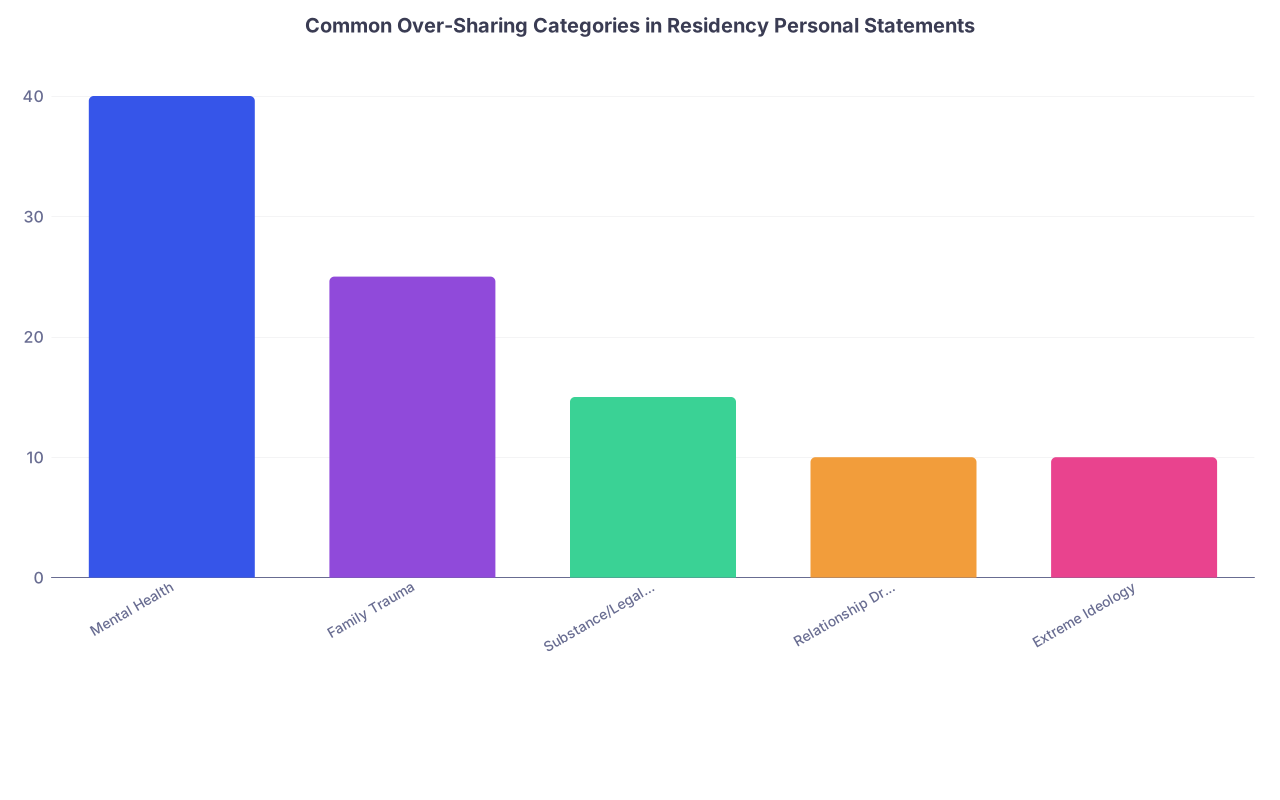
| Category | Value |
|---|---|
| Mental Health | 40 |
| Family Trauma | 25 |
| Substance/Legal Issues | 15 |
| Relationship Drama | 10 |
| Extreme Ideology | 10 |
Numbers are approximate, but the proportions feel about right from stacks of applications I have seen.
1. Mental Health and Burnout
This is delicate. Many of you have struggled. Many of you want to go into psychiatry, EM, anesthesia, surgery precisely because you have seen the dark side of stress.
Major mistakes:
- Describing untreated or unstable illness without clear resolution.
- Romanticizing suffering as the source of your empathy.
- Using clinical labels casually without evidence they were professionally diagnosed.
Example to avoid:
“I have always had obsessive-compulsive tendencies, checking doors 10–15 times, but that same drive is what makes me compulsively thorough with patients.”
You just handed programs a liability issue. That line stays in their head, not the part about your thoroughness.
Safer structure:
- One sentence naming the challenge in broad terms.
- One or two sentences about action taken (treatment, support, change).
- One or two sentences about current function and insight.
- Swift pivot back to your development as a physician.
If you cannot honestly say you are currently functioning well and safely, you should not be applying. The personal statement is not the place to process this.
2. Substance Use and Legal Trouble
I have read personal statements that include:
- Drunk driving.
- Academic probation for plagiarism.
- Underage drinking arrests.
All described in vivid detail. Then followed by “This made me who I am.”
I understand the impulse to be transparent. The problem is programs are constrained by hospital policy, malpractice concerns, and institutional risk. Alcohol and legal issues sit in a special category of “No thank you.”
General rule:
- If it is on your record and absolutely must be addressed (e.g., formal disciplinary action), use the designated application section, not the personal statement, unless there is no other place.
- If you have the option to leave it out of the personal statement, leave it out.
- If you must mention it:
- Be brief.
- State the fact.
- State the consequence.
- State what changed and how your record has been spotless since.
This is not the centerpiece of your narrative. It is a controlled acknowledgment.
3. Family and Relationship Chaos
Another landmine: turning your personal statement into a family drama script.
Common over-shares:
- Graphic descriptions of parental addiction or abuse.
- Long stories about partner cheating, divorce, or custody battles.
- Venting about unsupportive or toxic family members.
Programs can respect that you came from difficulty without needing front‑row seats to your trauma. You are not on trial; you are applying for a job.
You can say:
“I grew up in a household marked by instability and financial stress, which forced me to work and advocate for myself early. That experience shaped my empathy for patients facing structural barriers.”
You do not need to list exactly what your father said when he was drunk or how many times the police came to your home. That is for your therapist or your memoir, not your ERAS file.
How to Talk About Hard Things Without Over‑Sharing
You do not need to write a sterile, emotionless essay to stay “safe.” You just need structure and boundaries.
Here is a practical framework that works.

| Step | Description |
|---|---|
| Step 1 | Consider including sensitive topic |
| Step 2 | Leave it out |
| Step 3 | Do NOT include yet |
| Step 4 | Frame as past, managed, and growth-focused |
| Step 5 | Limit to 2-4 sentences |
| Step 6 | Pivot back to training, skills, and future goals |
| Step 7 | Does it directly explain your path or performance? |
| Step 8 | Can you describe it briefly and professionally? |
Key tactics:
Summarize instead of detailing.
“Significant personal loss” is enough. You do not need the entire story of your sibling’s final days.Past tense, stable present.
Your verbs should signal that the crisis is over, not ongoing.Growth, not gore.
Focus on what you learned and how you changed professionally, not on the shocking elements of the event itself.Balance with competence.
For every sentence of struggle, you need at least one of resilience, action, or achievement.
If your essay is 60% hardship and 40% medicine, you have the ratio backwards.
Red Flags That You Have Already Crossed the Line
If any of these are true of your current draft, do not send it.
- You feel physically exposed or anxious imagining a stranger reading it.
- You would not be comfortable if your co‑residents repeated a line from it on rounds.
- Your most memorable sentence is about your suffering, not your work.
- A non‑medical friend read it and said, “Wow, that is intense.”
- You are hoping your vulnerability will “make up for” a mediocre application.
Your personal statement cannot fix a weak application. It can, however, hurt a strong one.
The “Two People” Test
Before you finalize anything with sensitive content, have two specific readers:
- A brutally honest non‑medical friend who will interrupt you with “Why are you telling them THAT?”
- Someone senior in medicine (resident, fellow, attending) who has seen real applications.
Ask them two pointed questions:
- “Does anything in here make me seem unstable, risky, or unprofessional?”
- “If you were on a selection committee, would any sentence here make you hesitate to rank me?”
If either of them says yes and can point to a line, you revise. Or delete that section entirely.
Do not crowdsource this to a Reddit thread. You will get people who enjoy drama and tell you your rawest, riskiest draft is “so powerful.” They do not have to live with the consequences. You do.
Concrete Rewrites: From Over‑Share to Appropriate
Let us make this painfully clear.
Example 1 – Mental health
Over‑shared:
“After my fiancé left me, I spiraled into a deep depression. I stopped going to class, stayed in bed for days, and at my worst I thought about crashing my car to end it all. I am still learning how to cope, but this showed me how fragile mental health can be.”
Safer rewrite:
“During my second year of medical school, a major relationship ended abruptly, and I struggled emotionally, leading to a temporary decline in my academic performance. With support and treatment, I returned to my previous level of functioning and passed all subsequent courses and exams. That experience increased my empathy for patients facing life‑altering stress and reinforced my commitment to addressing mental health proactively.”
Example 2 – Family trauma
Over‑shared:
“Growing up with a father who screamed, drank until he passed out, and sometimes hit us taught me how cruel people can be. I still flinch when people raise their voices, but I try to channel that pain into compassion for my patients.”
Safer rewrite:
“I grew up in a household marked by instability and emotional volatility. As a child, I often served as the mediator and caretaker, which pushed me to mature quickly and shaped my instinct to protect more vulnerable people. That background now fuels my commitment to creating a calm, safe environment for my patients during vulnerable moments.”
The second versions are not dishonest. They are edited. Professional. That is the point.
A Quick Content Filter You Should Use Before Submitting
Right before you upload your statement, do this fast mental triage:
Highlight in one color every sentence that involves:
- Your own mental or physical health
- Trauma, death, or serious loss
- Legal, academic, or disciplinary trouble
- Family dysfunction
- Romantic relationships
Now ask:
- Is this section truly necessary to:
- Explain a major red flag (LOA, failed Step)?
- Explain a major motivation that cannot be explained any other way?
If not, cut it or condense it.
Whatever remains must:
- Be concise.
- Be framed as past + managed.
- Be outweighed by content about your training, skills, and future as a resident.
If those sentences are still the emotional center of gravity of your essay, you are still over-sharing.
Final Reality Check: Programs Are Not Your Therapist
Residency programs can be kind. Individual attendings can be deeply compassionate. But an application file is not where compassion is primarily operating. Risk management is.
So protect yourself.
You do not need to hide who you are. But you do need to show that you understand professional boundaries and that you will not bring uncontrolled personal chaos into their already over‑stressed system.

The Line, In Plain Terms
Here is where the line actually is:
- You can mention hardship. You cannot center your entire essay on graphic, unresolved trauma or crisis.
- You can reference mental health struggles. You cannot describe ongoing instability, suicidal behavior, or uncontrolled symptoms without making yourself a clear risk in their eyes.
- You can show vulnerability. You cannot demand emotional caretaking from the reader.
If you use your personal statement to prove you are human, fine. Just do not use it to prove you are still bleeding.
Keep your boundaries. Protect your future self.