
Most residency interview disasters don’t come from bad answers. They come from bad personal statements that trapped the applicant weeks earlier.
You think you’re “polishing the story.” The interviewer reads it as: “This person bends the truth.” And once that seed is planted, your odds nosedive.
Let me be blunt: the fastest way to get quietly red‑flagged is to exaggerate in your personal statement and then stumble when a program director asks a basic follow‑up. They’ve seen this pattern for years. You are not the first, and you won’t be the last. But you do not have to be the next.
This is your warning label.
The Core Problem: Your Personal Statement Becomes Cross‑Examination Material
Programs don’t read your personal statement like a creative writing piece. They read it like something they’ll interrogate you on later.
Interviewers do three things with your statement:
- Skim for big claims and bold language
- Circle anything unusual or dramatic
- Ask you about it when you’re tired, stressed, and sitting across the table
That’s where the honesty traps spring. You wrote it at midnight, fueled by Reddit, caffeine, and vibes. They’re reading it with a red pen and decades of applicant patterns in their head.
The traps usually fall into predictable categories. Let’s walk through them before they walk you out of contention.
Trap #1: Inflated Impact – When Your “Small Role” Becomes Heroic
This is the most common and the most deadly: taking routine participation and dressing it up as leadership, innovation, or “transformational change.”
You know this language:
- “I led a quality improvement initiative that reduced readmissions by 30%.”
- “I was instrumental in developing a new curriculum for medical students.”
- “I spearheaded a research project that changed how our department manages sepsis.”
On paper? Impressive. In the interview? Dangerous.
Here’s what happens. A faculty member who has actually run real QI projects or curriculum committees reads that sentence. Their brain goes straight to:
- What was the baseline data?
- What intervention did you design?
- How did you measure the 30% reduction?
- Over what time frame?
- Who else was on the team?
If you can’t answer those quickly and concretely, you look like someone who borrowed someone else’s work and upgraded your role. I’ve watched this exact thing happen in real interviews:
Applicant: “We reduced readmissions by 30%.”
Faculty: “That’s impressive. How did you calculate that?”
Applicant: “Uh… I’m not sure, my attending handled the numbers.”
Faculty: silence that says everything
Do not confuse “was present when good things happened” with “caused good things to happen.”
How to avoid this trap
- Accurately name your role: “I contributed to…”, “I assisted with…”, “I collected data for…”, “I participated in…”
- If you mention an outcome, be ready with:
- Time frame
- Your specific responsibilities
- Who led the project
- One concrete detail about the process (the form you redesigned, the specific checklist, the patient population)
If you can’t explain it in simple, specific language on the spot, don’t claim it as your win in the personal statement.
Trap #2: The Overstated “Passion” – You Can’t Back Up What You Claim to Love
Programs are tired of reading that every single applicant is “deeply passionate” about:
- Medical education
- Health policy
- Global health
- Underserved care
- Research
Here’s the problem: if you say you’re “deeply passionate,” they expect your track record to show at least some consistent engagement.
I see this constantly:
“I am deeply passionate about medical education and have always enjoyed teaching.”
CV: one afternoon of tutoring MS1s before an exam.
Or:
“Global health has always been a driving force in my career.”
Reality: a 1‑week trip in MS1 and nothing since.
Interviewers are not stupid. They cross‑reference your personal statement with your ERAS experiences. If the passion doesn’t match the evidence, it’s a credibility hit.
How this blows up on interview day
Attending: “You mentioned being passionate about medical education. Tell me about the most meaningful teaching experience you’ve had recently.”
If your brain scrambles to drag up something from two years ago… they know. “Passion” is not a word you can throw around carelessly. It’s a high‑volume word that demands high‑volume proof.
Better alternatives
- Scale your language to your evidence:
- “I’ve really enjoyed the teaching I’ve been able to do so far, especially…”
- “I’m exploring medical education and want to grow this interest in residency.”
- Be specific:
- “Working with first‑year students in the anatomy lab made me realize how much I enjoy teaching clinical reasoning step by step.”
- Anchor in recent examples:
- If you can’t recall something from the last 12–18 months, don’t call it a central passion.
Passion you can’t substantiate turns into skepticism. Every time.
Trap #3: Emotional Overreach – Trauma and “Life‑Changing” Stories You Can’t Carry
Another very common honesty trap: pushing emotional intensity way beyond what you can comfortably discuss in an interview.
You write about:
- The “single patient who changed your life”
- “The moment in the ICU when everything clicked and I knew this was my calling”
- A personal tragedy that “reshaped my entire worldview”
On paper, that kind of drama can look moving. But there are three major problems:
- Interviewers will ask you to talk about it. Out loud. To their face.
- Many applicants freeze, tear up, or give shallow answers because they wrote it for effect, not from processed reality.
- If it seems emotionally raw or inconsistent, it reads as either performative or unstable.
I’ve seen people write incredibly intense stories about a patient death, then on interview day:
Interviewer: “You wrote about this patient who died and said it changed you as a future physician. Can you share more about that?”
Applicant: “Um… yeah, I mean, it was just really hard… I don’t remember all the details…”
Then they visibly shrink. Voice cracks. Story falls apart.
That’s not vulnerability. That’s you being ambushed by your own writing.
Rules to protect yourself
- Don’t put any story in your personal statement that you would not comfortably discuss in a room with 2–3 strangers.
- Don’t describe something as “life‑changing” if you can’t articulate what actually changed:
- Your behavior?
- Your future plans?
- Your priorities?
- If the main reason you included the story is “it sounds powerful,” cut it.
Strong emotion is not the problem. Inauthentic, over‑amped emotion that you can’t carry consistently under stress is.
Trap #4: Research Inflation – Turning “I Helped” Into “My Project”
This one burns people in academic and competitive programs all the time.
You were a sub‑I or a med student on a project. The attending or fellow designed it. You:
- Collected data
- Entered charts
- Helped with literature review
- Maybe drafted part of a manuscript
Then the personal statement magically promotes your role:
- “My research on sepsis outcomes demonstrated…”
- “I designed a study to evaluate…”
- “I published a paper showing…”
Program directors, especially in academic centers, live in the world of authorship order, IRBs, and grants. They know exactly how often a medical student is the one actually “designing” anything. They also know how multi‑author projects work.
You’re not fooling them.
How they catch you
They ask simple, direct questions:
- “Walk me through the design of that study.”
- “What was the primary endpoint?”
- “How did you handle confounders?”
- “What were your major limitations?”
If your answers sound like: “Uh… my mentor decided that” or “I’m not sure, I mainly did data collection,” they realize your personal statement implied ownership you didn’t have.
It’s not just about research. It signals character. If you exaggerate here, what will you exaggerate about in residency?
How to fix your research language
Replace ownership words with accurate role words.
| Risky Phrase | Safer, Honest Alternative |
|---|---|
| I designed a study | I contributed to a study designed by Dr. X |
| My research proved | I worked on a project that suggested / found |
| I led a project | I assisted with / helped coordinate a project |
| I published a paper | I am a co-author on a paper about |
You’re not smaller for being honest. You’re more trustworthy. Programs prefer that over fake “PI at 24” energy.
Trap #5: Manufactured Fit – Claiming You’re “Dedicated” to Something You Barely Touched
The application cycle tempts people to tailor their personal statement to what they think a specialty or specific program wants to hear.
So they oversell:
- Interest in underserved care when their entire clinical time has been at private hospitals
- Commitment to research in a community-based program with no significant research on the CV
- Love of “high acuity” in EM or ICU with zero evidence beyond buzzwords
Here’s a simple truth: if a theme is central to your personal statement, it must also echo in your CV and letters. Programs compare.
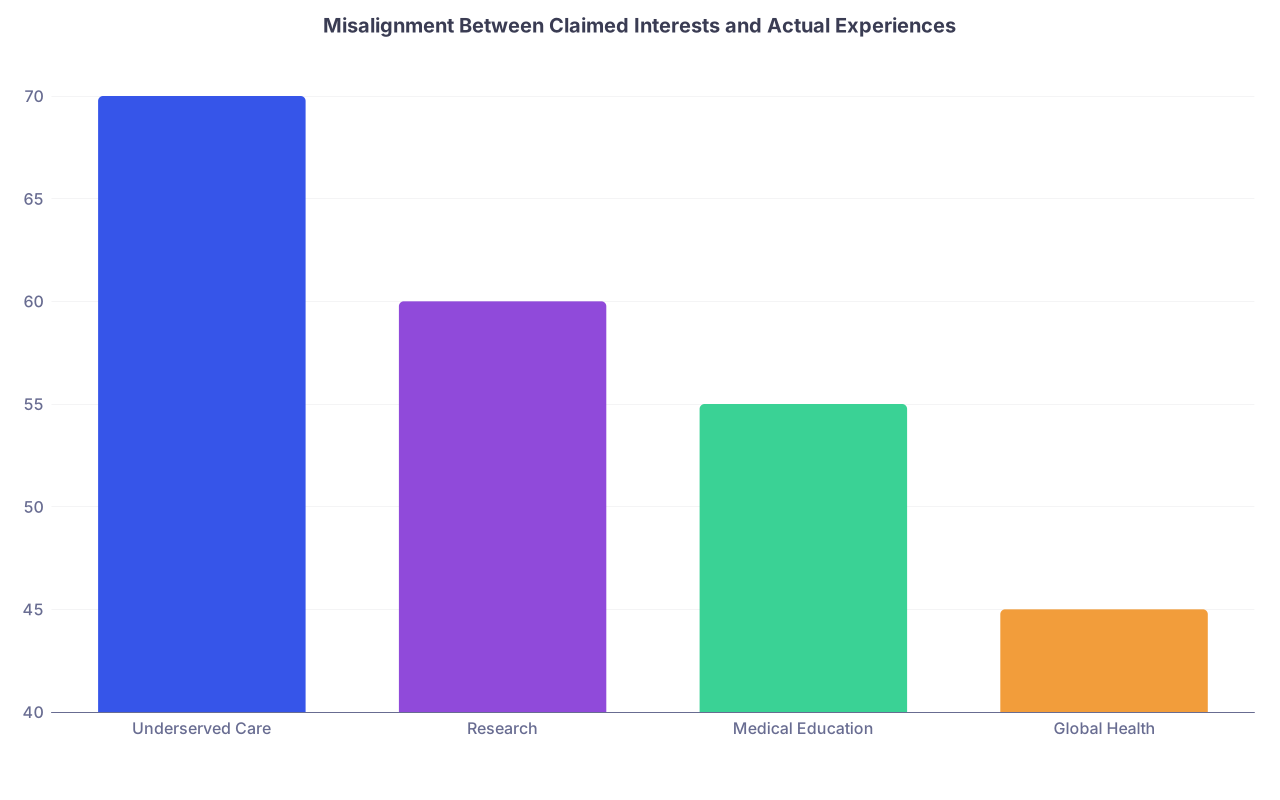
| Category | Value |
|---|---|
| Underserved Care | 70 |
| Research | 60 |
| Medical Education | 55 |
| Global Health | 45 |
(Imagine: percent of applicants claiming strong interest vs actual track record. The gap is large. Faculty notice.)
How this backfires in interviews
You write: “Working with underserved communities has always been at the heart of my motivation for medicine.”
Interviewer at a safety-net hospital reads that. They live this mission. So they ask:
- “What long-term commitments have you had with underserved populations?”
- “Tell me about a continuity relationship you’ve had with an underserved patient.”
If your only experience is one optional 2‑week rotation in MS3, the mismatch is obvious.
Or you declare: “I’m extremely interested in research and hope to have a substantial research career.”
But:
- Zero ongoing projects
- No clear idea of your area of interest
- Weak or no publications, no posters recently
They’ll ask: “What projects are you working on now?” If the answer is “None at the moment,” your written “interest” collapses.
Principle to remember
Do not anchor your personal statement to something your CV cannot support. You can mention a budding interest. Just don’t declare it your life’s work if it barely exists.
Trap #6: The “Perfect Persona” – Polished to the Point of Being Unbelievable
Another red flag: writing yourself into a flawless, saintly caricature.
You know these statements:
- “Every patient I encounter teaches me something profound.”
- “I wake up every day excited to learn something new.”
- “I always put my patients first, no matter what.”
It sounds harmless, even noble. But experienced interviewers read this kind of language and think: unrealistic, naive, or trying too hard.
Worse, when they meet you and you’re clearly a normal, tired human with normal irritations and limits, they sense a gap between your written persona and the real you.
Programs don’t want martyrs or robots. They want reliable, grounded colleagues who know their limits.
The subtler version
Overly polished reflections that sound like they were lifted from a Step 1 motivational poster:
- “This experience taught me the importance of empathy, communication, and patient-centered care.”
- “I realized that being a doctor is about more than medicine; it’s about being there for people.”
Of course those things are true. But when everyone says them the same way, it starts to look like borrowed wisdom instead of lived experience.
Interviewers then probe: “Tell me about a time when you struggled with empathy or communication.” If everything in your narrative is unrealistically shiny, you may fumble a real, grounded answer.
How to sound human and still strong
- Admit small limits or tensions:
- “I was initially frustrated by…”
- “I struggled with…”
- “I realized I’d jumped to conclusions when…”
- Show growth that actually cost you something
- Not just “I learned communication is important,” but “I had to change how I explained things because my usual approach failed with this patient.”
Honesty doesn’t mean confessing your deepest flaws, but it does mean avoiding the airbrushed superhero version of yourself.
Trap #7: Timeline and Skill Inflation – Claiming Competence You Don’t Really Have
One more subtle but lethal trap: exaggerating how experienced or competent you are.
You’re a graduating med student or transitional year resident. You write like you’re already a mini‑attending.
Watch for:
- “I have extensive experience managing complex ICU patients.”
- “I’m highly skilled at procedures such as central lines and intubations.”
- “I’m comfortable independently managing…”
Programs know exactly how many months you’ve actually spent in ICU, ED, or specialty rotations from your CV. They also know what typical med students or prelims actually do and do not do at most institutions.
If your language implies you’re functioning at a higher level than is plausible, they assume you’re either insecure and overcompensating or you lack insight.
How they test this in interviews
They might ask:
- “Walk me through how you’d manage a crashing septic patient overnight.”
- “On your ICU rotation, what aspects of care were you independently responsible for?”
- “How many central lines have you personally done? Under what supervision?”
If your numbers are vague, or your description reveals that you were mostly observing or “helping,” your earlier claims look inflated.
Safer framing that still shows growth
- “During my ICU rotation, I gained exposure to managing complex patients and began to learn how to prioritize interventions under supervision.”
- “I’ve assisted with X procedures and am eager to gain more hands-on experience in residency.”
- “Under close supervision, I’ve participated in the care of…”
No one expects you to be fully formed. But they do expect your self-assessment to be honest and proportional to your stage.
Trap #8: Borrowed Language – When Your Voice Doesn’t Match Who Walks In
One last honesty trap that people underestimate: sounding like an entirely different person on paper than in person.
This often happens when:
- You heavily “borrow” phrasing from examples or online templates
- You let a mentor or editing service rewrite your statement into something that no longer sounds like you
- English isn’t your first language and the edited version reads like a native literary essay, but your spoken interview English is very different
Interviewers pick up on this quickly. They read:
“That night on call, as the city lights flickered against the rain-soaked window, I found myself contemplating the profound privilege of bearing witness to human vulnerability.”
Then you show up and you’re a normal, straightforward person who would never say “bear witness to human vulnerability” out loud. The mismatch is jarring.
They may not consciously think “this person lied.” But they will think:
- Who actually wrote this?
- How much editing did this go through?
- Does this person have insight into themselves?
Guardrails to keep your voice real
- Read your statement out loud. If you’d never say it that way to a colleague, fix it.
- Watch for phrases that sound like someone else’s essay: “ever since I was a child,” “in that moment, I knew,” “it was then that I realized.”
- If you’re an IMG or ESL, it’s fine (and smart) to get help with grammar—but don’t let anyone reconstruct it into prose you cannot replicate verbally.
You want the interviewer to feel: “Yes, the person I’m meeting is clearly the person who wrote this.”
A Simple Stress Test: Will This Survive a Tired, Direct Attending?
Before you finalize your personal statement, imagine this scenario:
You’re on your fourth interview of the week. You’re tired. You’re in a small conference room with a program director who looks like they’ve been on service for 10 days straight. They have your personal statement in front of them with 3 lines highlighted.
Now ask yourself, for each bold claim, emotional high point, or “passion” statement you made:
- Could I comfortably, calmly talk about this for 3–5 minutes?
- Could I give specific, concrete details—not vague generalities?
- Does my CV and letters actually support what I’m saying here?
- Would my mentor or attending agree with the way I’ve described my role?
If the answer to any of those is “no,” you’re looking at an honesty trap.
Visualizing What Interviewers Actually Probe
To really drive this home, here’s what interviewers typically drill into from personal statements.

| Step | Description |
|---|---|
| Step 1 | Bold Claim in Personal Statement |
| Step 2 | Impact/Outcome |
| Step 3 | Passion/Interest |
| Step 4 | Emotional Story |
| Step 5 | Research/Leadership |
| Step 6 | Ask for specifics and numbers |
| Step 7 | Ask for recent concrete examples |
| Step 8 | Ask for details and reflection |
| Step 9 | Ask about role and design |
| Step 10 | Type of Claim |
If your answers at C1, D1, E1, or F1 are weak, vague, or contradictory, the impression is not “nervous.” It’s “not entirely honest.”
How to Write Strongly Without Lying to Yourself
You don’t need exaggeration to stand out. You need clarity, specificity, and believable growth.
Three practical habits:
Replace superlatives with specifics
Don’t say: “I am extremely passionate about X.”
Say: “Over the past two years, I’ve sought out X by doing A, B, and C.”Shrink your role, not your impact
It’s better to say, “I helped with data collection on a project that ultimately changed our discharge process,” and then describe your learning, than to pretend you led it.Anchor reflections in concrete facts
Instead of “This experience taught me empathy,” say, “After that encounter, I started sitting down during difficult conversations and asking at least one question about what worried patients most.”
Those are details you can carry into an interview without sweating.
Quick Reality Check Before You Submit
Use this as a final filter:
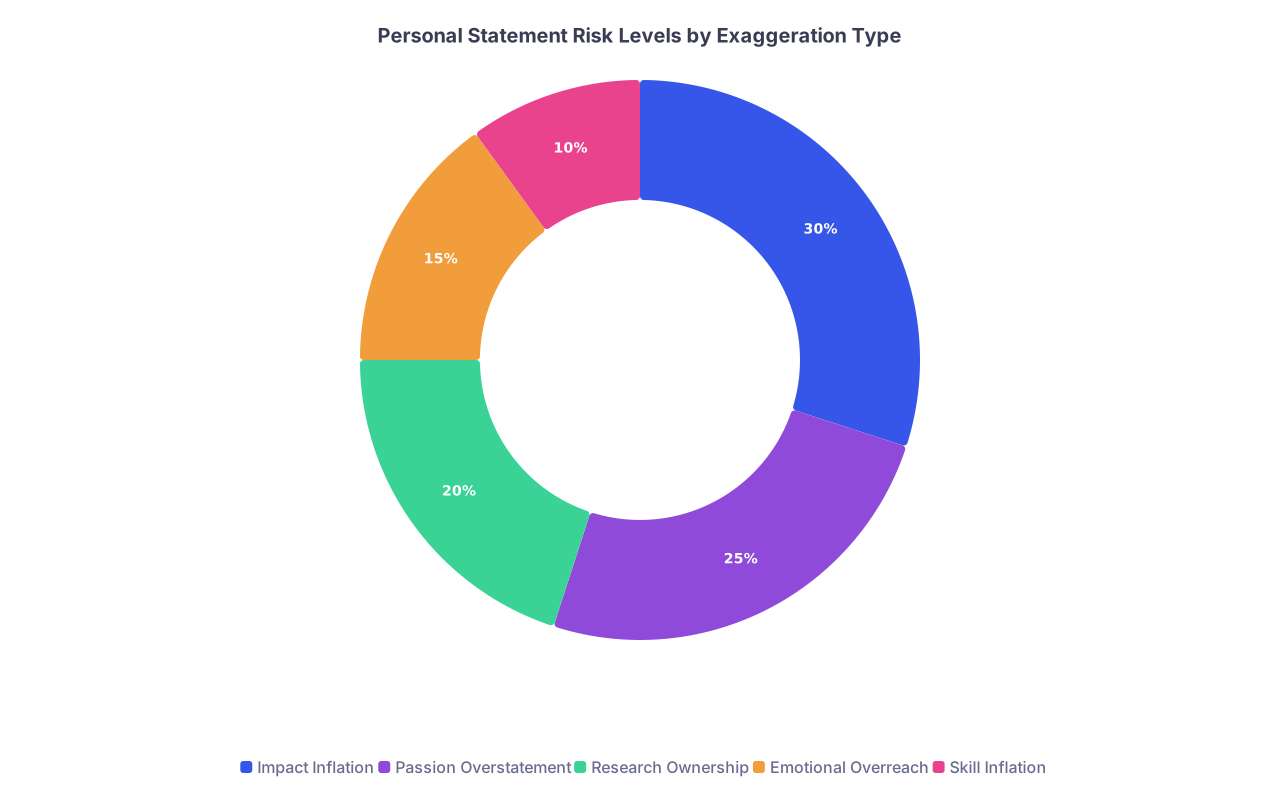
| Category | Value |
|---|---|
| Impact Inflation | 30 |
| Passion Overstatement | 25 |
| Research Ownership | 20 |
| Emotional Overreach | 15 |
| Skill Inflation | 10 |
The highest-risk zones: impact inflation and passion overstatement. Start there.
Then ask yourself, brutally:
- Is there anything here that would make me nervous if an attending grilled me on it?
- Did I write any sentence mainly because it “sounds impressive”?
- Does any part of this feel just a little fake when I read it out loud?
If yes, fix it now. Before it follows you into the interview room.
The Bottom Line
Three takeaways so you don’t sabotage yourself:
- Any claim in your personal statement is fair game for detailed questioning. If you can’t defend it calmly and specifically, rewrite it.
- Don’t inflate roles, passions, or skills. Match your language to your actual experience and let your growth—not your hype—speak for you.
- Your written voice and your in-person self must match. If the essay sounds like someone else’s script, it will crack under pressure.