
Most applicants are hurting their residency chances by “being vulnerable” in exactly the wrong way.
Let me be blunt: the current obsession with radical vulnerability in personal statements is wrecking otherwise strong applications. I have watched excellent candidates get quietly down-ranked because of one thing—how they chose to talk about “failure.”
Not that they mentioned failure.
How they did it.
You are being told everywhere: “Be authentic.” “Show vulnerability.” “Talk about a time you failed.” The advice is not completely wrong. But taken literally, and without understanding how program directors actually read, it becomes dangerous.
What follows is a guide to when talking about failure helps you and when it quietly kills your file.
If you are writing a residency personal statement, you cannot afford to get this wrong.
The Core Misunderstanding: You Think It Is Therapy. They Think It Is Risk Assessment.
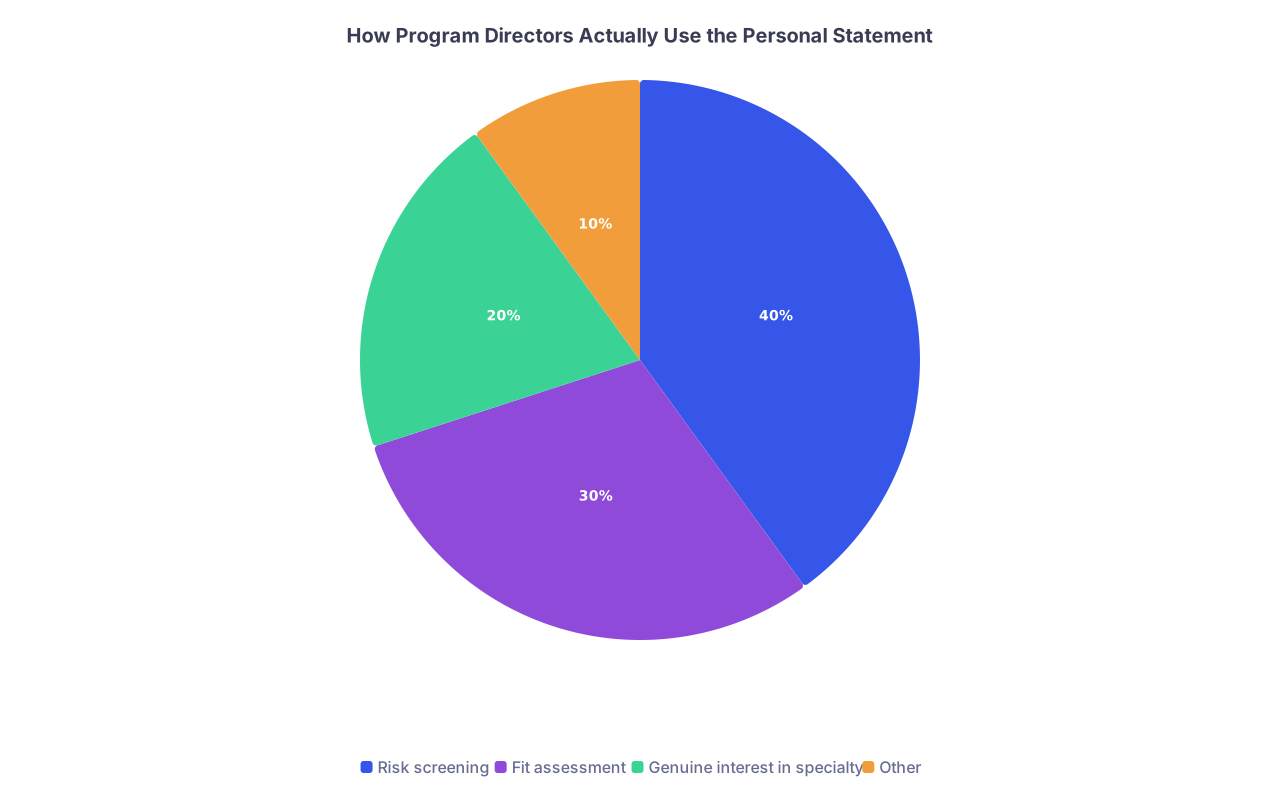
| Category | Value |
|---|---|
| Risk screening | 40 |
| Fit assessment | 30 |
| Genuine interest in specialty | 20 |
| Other | 10 |
You think you are writing your story.
Program directors are reading for three things:
- Risk – Will you fail their in‑training exams, implode under stress, or cause drama?
- Reliability – Will you show up, do the work, and not need constant rescuing?
- Fit – Will you function on their specific service, with their workload, and their personalities?
So when you launch into a detailed narrative about failure, what you think is “vulnerability” can easily read as:
- Instability
- Poor judgment
- Lack of insight
- Potential for professionalism problems
The biggest mistake: you center the failure instead of centering your response and growth.
If the reader finishes your essay remembering the bad thing more than your transformation, you just branded yourself as high‑risk.
The Most Common Failure‑Story Disasters

Here are the patterns I keep seeing that get applicants silently filtered out.
1. Confessing the Wrong Kind of Failure
There are failures that show resilience and growth.
And there are failures that scream, “This person might be a problem on the wards.”
Dangerous topics you should almost never center your statement around:
- Academic probation for professionalism or conduct
- Major lapses in integrity – cheating, plagiarism, lying, altering notes
- Repeated exam failures without a clear upward trend and strong context
- Boundary violations with patients, classmates, or staff
- Serious legal trouble (DUI, assault, fraud) as the core of your narrative
Do these mean you must never mention them? Not necessarily. But if the failure is:
- Recent
- Repeated
- Directly tied to judgment or professionalism
…then making it the emotional heart of your personal statement is asking them to see you as a liability.
Typical mistake paragraph (paraphrased from real essays):
“In my third year, I failed my internal medicine shelf exam twice. I struggled with anxiety and found it hard to focus, which led to me remediating the rotation. This was a very difficult time in my life and I learned to push through adversity.”
A program director reading this does not think, “So inspiring.”
They think:
- Why twice?
- Why was this addressed so late?
- What happens when this person faces boards?
- Are they going to be safe to put on nights?
If you must address a significant failure, keep it succinct, factual, and paired with concrete evidence of sustained improvement, not just emotional language about “perseverance.”
2. Telling a Raw, Unprocessed Story
Another big landmine: trauma dumping in a high‑stakes professional document.
I have seen essays that read like this:
- Detailed description of a personal mental health crisis
- Graphic family trauma with little transition to professional growth
- Long narrative of burnout, hopelessness, or near-dropout
- Emotional language that still feels acute, not reflective
If your reader finishes your essay thinking, “This person is still in the middle of this,” you are not going to the top of their rank list.
You want to project:
- Stability
- Insight
- Emotional maturity
Not “I am still actively working through all of this and might unravel under pressure.”
3. Making the Failure Bigger Than the Recovery
This is the most common structural mistake.
You spend 70–80% of the paragraph on the failure:
- How bad it was
- How ashamed you felt
- How everyone doubted you
Then one or two sentences at the end:
“In the end, I came to see this experience as a growth opportunity and I emerged more resilient and committed to medicine.”
That is not enough. That is a Hallmark card, not evidence.
If you insist on using a failure story, the ratio must be flipped:
- ≤ 25% on the failure itself – what happened, briefly
- ≥ 75% on:
- What you concretely changed in your behavior
- Objective improvements (scores, feedback, responsibilities)
- How that change will show up as a resident
If you are not willing to do that work on the page, skip the failure story.
When “Vulnerability” Becomes Self‑Sabotage

| Step | Description |
|---|---|
| Step 1 | Choose failure story |
| Step 2 | High concern |
| Step 3 | Possible asset |
| Step 4 | Do NOT put in PS |
| Step 5 | Address briefly, not centerpiece |
| Step 6 | Reframe or drop |
| Step 7 | Careful, limited vulnerability |
| Step 8 | Type of failure |
| Step 9 | Strong, objective recovery? |
| Step 10 | Story structured around growth? |
Let us go through the main ways “vulnerability” hurts you rather than helps.
1. You Over‑Identify With Your Failure
You shape your entire narrative around being:
- The student who failed Step 1
- The person who burned out
- The child of chaos who “made it anyway”
You think this makes you unique. It actually makes you risky.
Residency programs are not hiring a redemption arc. They are hiring someone to cover the ICU at 3 a.m.
Your identity in the statement should be built around:
- Competence
- Curiosity
- Commitment to a specialty
- Ability to work on a team
If your defining story is, “I used to be a mess, but now I am better,” you push all their attention toward, “How much of that mess is left?”
2. You Use Emotional Language Instead of Evidence
Words that mean almost nothing to a PD unless you back them with proof:
- Resilient
- Dedicated
- Passionate
- Hard‑working
- Grateful
I see essays that pour on tearful language about how meaningful the failure was, but show zero hard data that anything actually changed.
Example of weak “growth”:
“I began to prioritize my mental health and learned to ask for help. I found balance and renewed my commitment to patient care.”
Compare that to something that actually reassures a PD:
“After failing Step 1, I joined a structured study group, met weekly with our learning specialist, and switched to question‑based learning. Over the next 9 months, my NBME practice scores rose from the 15th to 55th percentile. I passed Step 1 comfortably and later scored 243 on Step 2, using the same system and schedule I had built.”
See the difference? One is vibes. The other is evidence.
Vulnerability without evidence reads as risk.
3. You Confuse Honesty With Full Disclosure
You are not under oath in your personal statement.
You do not need to:
- Catalog every mistake you have ever made
- Turn your worst life moment into a poetic centerpiece
- “Be so real” that you frighten the people who must trust you with their patients
You need to be honest, selective, and strategic.
If something is already in your application:
- LOA
- Failed exam
- Gap year under odd circumstances
Then you may need to briefly explain it somewhere (often better in the “adversity” or “anything else” section, not center stage in your main PS).
But “briefly explain” is not the same as “emotionally excavate.”
Safer Alternatives: How To Show Growth Without Tanking Your File
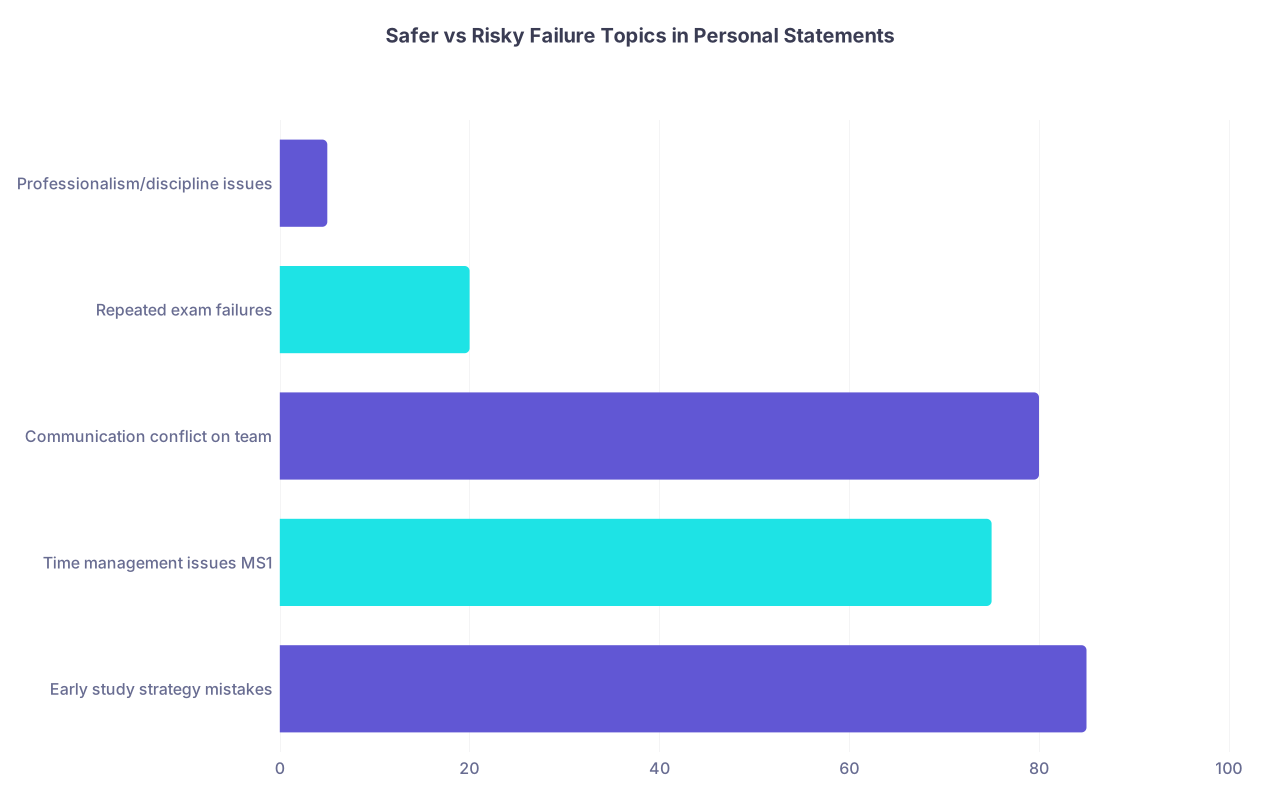
| Category | Value |
|---|---|
| Early study strategy mistakes | 85 |
| Time management issues MS1 | 75 |
| Communication conflict on team | 80 |
| Repeated exam failures | 20 |
| Professionalism/discipline issues | 5 |
You want to show maturity, self‑reflection, and growth. Good. You just do not need to light yourself on fire to do it.
Here are safer, still‑honest angles that demonstrate growth:
1. Skill‑Based Struggles, Not Character‑Defining Failures
Examples that can work:
- Early difficulty transitioning from pre‑clinical memorization to clinical reasoning
- Struggling with time management during your first clerkship but improving with a specific system
- Initial trouble giving or receiving feedback, then learning to do it well
- Being overly anxious about procedures, then deliberately building confidence through repetition and coaching
These show:
- Normal human imperfection
- Growth under pressure
- Operational changes that a PD can trust will carry into residency
They do not scream “liability.”
2. Conflicts That End in Professional Resolution
You can talk about:
- A miscommunication with a nurse that you resolved constructively
- A disagreement on a team about a plan of care where you learned to speak up respectfully
- Being called out for a minor professionalism slip (late note, incomplete prep) and how you systematized better habits
Where people go wrong: writing the conflict like a grievance letter, or making themselves the misunderstood hero.
If you describe conflict, the resolution must make you look:
- Calm
- Accountable
- Coachable
3. Using Minor “Failures” as Micro‑Lessons
You do not have to describe a disaster. You can show insight from smaller moments:
- A time you realized you were too focused on labs and missed a family’s emotional needs
- A moment when you froze during a code, then later practiced algorithms until you could run them in your sleep
- Realizing you were hovering in the background on rounds and then intentionally stepping up for tasks
These are failures in the lowercase sense, but they read as secure, reflective, grounded.
How To Handle Necessary Red Flags Without Over‑Sharing

Sometimes you do not have a choice. The red flag is big, visible, and there is no hiding it. Leaves of absence. Multiple failures. Legal trouble. A major professionalism incident.
Here is how to avoid making an already hard situation worse.
1. Put the Explanation in the Right Place
Often, the main personal statement is the worst place to address the biggest red flag, because:
- You only have ~1 page to sell yourself
- You cannot afford to spend half of it on damage control
Better options:
- The “adversity” or “additional information” section
- A brief comment in the ERAS experiences if it is tied to a specific period
- Rarely, a short paragraph in the PS if it directly relates to your specialty interest and you have a strong recovery arc
2. Use Clinical, Not Confessional, Language
Wrong style:
“I spiraled into a deep depression, felt like an utter failure, and could not get out of bed. It was terrifying and I am still working through a lot of this.”
Better style:
“During my second year, I developed a depressive episode that impaired my academic performance. In consultation with my physician and dean, I took a medical leave, engaged in treatment, and returned with a structured support plan. Since then, I have successfully completed all rotations on time, passed Step 2 on the first attempt, and maintained strong clinical evaluations.”
Notice:
- No graphic emotional detail
- Clear actions taken
- Concrete stability since then
You are not hiding the truth. You are presenting it in the way a colleague would document in a chart: factual, organized, purposeful.
3. End on Demonstrated Stability, Not Ongoing Struggle
If your story is essentially:
“This has been really hard and I am still kind of in it.”
Do not make that your personal statement.
The narrative needs to land on:
- A sustained period of success after the failure
- Structures you built that will carry into residency
- Evidence that the underlying issue has been treated, resolved, or heavily mitigated
If you cannot honestly say that yet, you probably should not put that story front and center.
Concrete Structural Rules To Keep You Out of Trouble
| Aspect | Safer Choice | Risky Choice |
|---|---|---|
| Length of failure part | ≤ 25% of paragraph | 50–80% of paragraph |
| Focus | Response and growth | Emotions and pain |
| Type of failure | Skill/process, early misstep | Integrity, professionalism, repeated failure |
| Tone | Reflective, factual | Raw, confessional, graphic |
| Evidence of change | Specific, measurable improvements | Vague claims (“more resilient”) |
Here are working rules you can apply directly while drafting:
- One failure story maximum. Most of you do not need any.
- If you include one, test the ratio:
- How many words describe the failure vs the response?
- Ask yourself:
- Have someone with no emotional attachment to your story read it and answer:
- “Does this make you more or less comfortable having me cover nights in July?”
If the answer is “less comfortable,” cut or reframe.
Quick Before‑You‑Submit Checklist

Run your personal statement through this filter, line by line.
About your failure content:
Did you describe more than one major failure?
Did you focus on:
- Professionalism issues
- Integrity breaches
- Repeated academic failures
If yes, are you absolutely sure this helps you?
Is the emotional intensity of the writing higher than the evidence of your recovery?
Could any sentence be misread as:
- “I am still overwhelmed by this.”
- “I am still pretty fragile.”
About reader perception:
- Would a PD reasonably worry about your:
- Reliability?
- Judgment?
- Emotional stability?
- Could your “vulnerability” story be paraphrased as:
- “This applicant has a pattern of not coping well with stress.”
If you cannot answer those questions safely, you are not “being authentic.” You are volunteering to be a risk outlier.
Final Word: Vulnerable Is Not The Goal. Trustworthy Is.

You are not applying to a writing workshop. You are applying to be a physician that people will trust at 3 a.m. with a crashing patient and no backup in the room.
Program directors are not impressed by how raw you can be on the page. They are scanning for:
- Stability under pressure
- Honest but contained self‑awareness
- Evidence that you learn from setbacks and do not repeat them
You can absolutely talk about growth. You can acknowledge imperfection. You just need to stop centering the story on the explosion and start centering it on who walked out of the smoke and what they can do now.
Two things to remember:
- Do not romanticize your worst moments. You are not the narrator; you are the candidate.
- If your vulnerability does not clearly increase a program’s trust in you, it is not helping. It is hurting.
FAQ (Exactly 5 Questions)
1. Should I ever talk about failing Step 1 or Step 2 in my personal statement?
Only if three conditions are met:
- The failure is already obvious in your application.
- You have a clear, objective recovery (e.g., strong Step 2 after Step 1 failure).
- You can explain it concisely, focusing on what you changed and how that will make you a stronger resident.
If you do not have substantial improvement to point to, do not build your statement around that failure. At most, give it a brief, factual mention in an “additional information” section.
2. Can I write about mental health struggles as a growth experience?
You can, but this is one of the easiest ways to accidentally label yourself as unstable. If you choose to do it, the emphasis must be on:
- Treatment and concrete steps taken
- Sustained stability and functioning since then
- Structures you have in place going forward
Avoid graphic descriptions, ongoing turmoil, or framing that suggests you are still on shaky ground. If you cannot confidently show stability, leave this out of the main PS.
3. What if my biggest failure is actually what led me to my specialty?
Then you still need to ask: does describing this failure increase or decrease a PD’s trust in me? If the failure is a normal‑human level misstep that pushed you toward your specialty and you can show growth and insight, it may help. If it was a major professionalism, legal, or safety issue, you are usually better off emphasizing other experiences that led you to the specialty and addressing the failure briefly elsewhere, if at all.
4. Is it dishonest to avoid talking about a major failure that shaped me?
No. A personal statement is not your full autobiography. It is a professional document with a goal: show you are ready and safe for residency in that specialty. You are allowed to choose which parts of your life serve that purpose. Omitting a story that would only make you look risky is not lying; it is basic judgment.
5. How can I tell if my “failure” story is helping or hurting?
Give the relevant paragraph to someone who knows nothing about your backstory—ideally a resident or attending, not a friend who loves drama. Ask them two questions:
- “After reading just this paragraph, are you more or less confident I would be a solid intern?”
- “What single word would you use to describe me based on this?”
If the answers are anything like “less confident,” “unstable,” “emotional,” or even “risky,” the story is hurting you. Reframe it around growth with concrete evidence, or cut it entirely.