
The lines that actually impress program directors are not the ones you think.
The soaring “I realized my calling in medicine” paragraphs? We skim them. The dramatic code-blue stories? We’ve read a hundred versions this season alone. What quietly grabs a program director’s attention are specific, almost throwaway lines that signal: this applicant will make my life easier, my service safer, and my residents less miserable.
Let me walk you through what really lands with people behind that committee table, and why.
What PDs Actually Look For Between the Lines
You’ve been fed the wrong priority list.
You were told the personal statement is about passion, origin stories, and “why this specialty.” Program directors read it for three things:
- Are you normal and safe?
- Will you function on day one?
- Do you understand how residency actually works?
They are not consciously looking for “magic lines,” but there are patterns. Certain phrases make people’s ears perk up in the selection meeting. Because those phrases hint at traits we know correlate with low drama and high reliability.
Here’s the reality: by the time we’re reading your statement, we already know your scores, your grades, and your letters. Your statement is being used to answer one brutal question:
“Would I be okay having this person on my team at 3 a.m. when everything is falling apart?”
The lines that secretly impress us are the ones that answer “yes” without you ever saying those words.
The Line That Signals You Actually Understand Residency
The biggest tell that someone “gets it” is tiny: they write about unglamorous work without complaint and without self-pity.
Lines like:
“On our busy medicine service, I became the unofficial ‘discharge person,’ and I learned to enjoy the puzzle of coordinating meds, follow-up, and making sure the patient actually understood the plan.”
That does more for you than three paragraphs about how fascinated you are by pathophysiology.
Why? Because discharge summaries, med recs, follow-up logistics—this is a lot of your life as an intern. A student who has actually paid attention to that, and can describe it with some ownership, sounds like someone who won’t crumble when the real work starts.
Compare:
“I love the diagnostic challenge of internal medicine and the complexity of managing multiple comorbidities.”
We’ve all seen this sentence. It could be copied from a template. It tells me nothing about you.
But when I read:
“I found I liked being the person who stayed late to finish the sign-out because I hated not knowing what was going on with every patient on our list.”
I know two things:
- You’ve actually been at sign-out.
- You care about continuity and responsibility, not just “interesting cases.”
That’s the sort of line that quietly gets you tagged as “solid” in someone’s notes.
The Line That Makes Faculty Say: “This One Will Show Up”
Attendance and reliability are taboo topics in official documents, but they dominate back-room conversations.
You want to impress a program director? Drop one honest, specific line that demonstrates you show up, even when it’s inconvenient, with no dramatic heroics.
Something like:
“During my sub-internship, I realized that being the first one to pre-round was less about impressing anyone and more about not wasting my team’s time later when decisions needed to be made quickly.”
That’s a subtle flex. It tells us:
- You were actually there early.
- You connected your behavior to team efficiency, not pure virtue-signaling.
- You’re not sugar-coating; you’re describing a specific behavioral shift.
Another line that hits well:
“After I missed a key lab result early in my third year, I started building a system for myself—every patient, every day, I run through vitals, labs, imaging, and check one more time before sign-out.”
We like that because it says: I made a mistake, I adapted, and I built a system to prevent recurrence. That’s a resident mindset.
No drama. No martyrdom. Just concrete proof that you’re reliable.
The Line That Shows You Learn Like a Resident, Not a Student
Program directors do not care if you were “always curious” as a child. They care how you respond when an attending dismantles your plan on rounds.
Lines that demonstrate how you take feedback, and how quickly you convert it into action, are gold.
This is the kind of thing that gets highlighted during committee:
“Halfway through my ICU rotation, my fellow told me my notes were ‘thorough but unusable.’ That night, I pulled three examples from senior residents, rewrote my templates, and by the end of the week I was anticipating questions instead of scrambling to find answers.”
Behind the scenes, a PD reading that is thinking:
- This person survives feedback without melting.
- They know how to copy success (looking at resident notes).
- They iterate quickly instead of just nodding and staying the same.
Another version that works:
“When my attending pointed out that my presentations were ‘a list of facts without a story,’ I spent the rest of the rotation forcing myself to start every presentation with a one-line problem representation. It felt awkward at first, but by the end I could feel my own thinking getting sharper.”
You’re signaling that you were teachable and self-aware on rotation. That’s exactly the kind of line that makes a borderline Step 2 score suddenly less concerning.
The Line That Quietly Proves Professionalism
No one is impressed by the sentence “I am professional and compassionate.” That’s like saying “I’m honest” on a first date. If you say it, we’re already suspicious.
What does impress people is a tiny, almost offhand moment that only someone who has actually behaved professionally would include. For example:
“On a busy ED shift, I realized the patient’s mother had not eaten all day. I offered to sit with her while she ate the sandwich I grabbed from the break room, and we went through the plan together in calmer detail.”
No big speech. No “this showed me the importance of empathy.” You let the scene prove your point.
Or this:
“When a patient became verbally aggressive with the team, my resident later explained that he had been in the ED for 18 hours before admission. Since then, I’ve tried to pause before reacting and ask what the patient’s day has actually looked like.”
Again, understated. It’s the pattern that matters: you notice context, you adjust your reaction, you don’t make it about how good you are. That kind of line earns quiet respect.
The Line That Shows You Know the Difference Between Interest and Commitment
Every applicant is “passionate” about their chosen specialty. It’s meaningless to say it.
What impresses PDs is seeing that you’ve done something boring but sustained that’s aligned with the specialty. That screams commitment.
For example, in an internal medicine statement:
“Over 18 months, I kept a simple spreadsheet of every heart failure patient I followed, noting their ejection fraction, discharge meds, and whether they were readmitted. It started as a way to understand why some patients bounced back, but it turned into the basis of my quality improvement project.”
This is the kind of line that makes me say in a meeting, “This one is actually into the work.”
Or for EM:
“I volunteered to attend monthly morbidity and mortality conferences in the ED even when I wasn’t on that rotation because I wanted to see how the department handled near-misses and errors.”
That’s not glamorous. It’s not “saving lives.” But it shows that you are interested in the systems and not just the adrenaline. Program directors notice that.
The Line That Signals You Actually Read the Room
One of the most quietly impressive traits is situational awareness. Residents who understand team dynamics are dramatically easier to work with.
A line that lands:
“On my surgery rotation, I learned that the most valuable thing I could do in the OR as a student was anticipate when my resident needed the next instrument, or quietly adjust retraction without being asked, rather than trying to prove I knew every step of the procedure.”
You’re telling us:
- You’ve been in an OR enough to know what actually matters at your level.
- You do not need constant spotlight.
- You understand that value at the bottom of the hierarchy is mostly in making your seniors’ lives easier.
Faculty who interview you will remember that. And when the PD asks post-interview, “Would you want this person on your team?” those details matter.
Same kind of impact in IM:
“I learned that sometimes the most helpful thing I could do for my team was not answer one more question, but step out and make sure the CT was actually done and uploaded so we weren’t waiting an extra hour for results.”
That sentence says: I understand that patient flow and logistics are as important as pure medical knowledge. That’s a resident brain developing.
The Line That Shows You Can Handle the Emotional Reality Without Making It Your Whole Personality
Program directors are wary of personal statements that are pure trauma dumps. They are also unmoved by totally sterile, robotic essays.
The lines that hit the sweet spot acknowledge emotional reality without turning you into a martyr or a savior.
For example:
“After a patient I had followed for weeks in the ICU died, I was surprised by how strongly I felt it on my post-call day. I went for a walk with one of the residents, and she told me, ‘If you stop feeling anything, that’s when you should worry.’ I have tried to let myself feel these moments without letting them paralyze me.”
Notice:
- There’s emotion.
- There’s a coping mechanism.
- There’s a boundary—“without letting them paralyze me.”
That sounds like someone who is unlikely to decompensate with the first bad outcome.
Another version:
“I still think about a patient I misjudged as ‘non-compliant’ until I actually saw her medication list and realized the cost and transport barriers she faced. That experience has stayed with me, not as guilt, but as a reminder to ask one more question before I label someone.”
You’re not dramatizing. You’re not turning it into your “tragic turning point.” You’re showing that you can integrate emotional experiences into your practice in a stable way. That impresses people more than you might realize.
The Line That Makes You Sound Like a Future Colleague, Not a Student
This is one of the biggest secrets: program directors are hunting for glimpses of you as a peer, not a learner.
When a line makes them think, “That sounds like something one of my residents would say,” you’ve won.
For instance:
“The best days on my sub-internship were the ones when my intern trusted me to follow two or three patients closely and I could update them before they had to ask.”
That is resident-speak. Division of labor. Initiative. Trust.
Or:
“I’ve realized that what I enjoy most is owning the details for a smaller number of patients rather than quickly seeing large volumes with limited follow-up.”
That’s a line that tells me you understand how different specialties feel to practice, not just what they treat. You’re talking like someone choosing a job, not just a prestigious field.
The Line That Makes You Easier to Defend in the Room
Here’s what happens in selection meetings: someone will go to bat for you. Or they won’t.
Nobody says, “They wrote beautifully about their passion.” They say things like:
- “This applicant built a system after they missed a lab.”
- “This one voluntarily attended M&M for a year.”
- “This one actually likes doing discharges.”
So you want one or two lines in your statement that are easy to quote.
Things like:
“I started a habit of writing a one-sentence ‘if-then’ summary in my sign-out for each patient, forcing myself to anticipate what might happen overnight.”
That’s the kind of thing a faculty member will literally repeat out loud in a meeting. Because it is concise, concrete, and directly relevant to residency function.
Or:
“If there is a job on the team that no one wants, I tend to notice it and take it. I have found that doing those jobs builds trust faster than trying to impress people with what I know.”
In the room, someone will say, “I liked that they explicitly talked about taking on the unsexy work.” You’ve just made yourself defensible.
A Quick Look at What PDs Quietly Value
Let me put this in stark contrast. This is roughly how the same content lands when written like a brochure vs. like a resident.
| Theme | Cliché Line | Impressive Line |
|---|---|---|
| Teamwork | "I work well on a team." | "I started staying five extra minutes at the end of my shift to ask my resident, 'What could I have done today that would have made your life easier?'" |
| Responsibility | "I take ownership of my patients." | "I kept a running list of 'my' patients and made sure every one of them had a clear follow-up plan in the chart before I left." |
| Learning from errors | "I learn from my mistakes." | "After I missed a critical potassium result, I built a checklist and haven’t missed one since." |
| Interest in specialty | "I am passionate about internal medicine." | "I started tracking my heart failure patients over 18 months just to understand who bounced back and why." |
| Professionalism | "I treat every patient with compassion." | "I noticed the patient’s daughter hadn’t eaten, so I sat with her while she had a quick snack and walked through the plan again." |
How to Actually Build These Lines (Without Sounding Fake)
Here’s the part nobody tells you: you cannot manufacture these lines from thin air. Program directors can smell when you’re writing a fantasy version of yourself.
You need to mine your actual experiences for very small, very real moments.
A simple process to get there:
- Take each core trait programs care about: reliability, teachability, teamwork, ownership, emotional stability.
- For each trait, write down a specific moment when you showed that trait on a real rotation. No embellishment.
- Pull out one or two sentences that capture what you did and what changed afterward.
You don’t need 20 of these. Four or five scattered through the statement is enough.
Then—this part is crucial—strip out the commentary. Trust the scene to speak. For example, don’t follow that ED mother-without-food moment with a paragraph on “the importance of empathy.” You’re over-explaining to people who’ve lived this for twenty years.
Let the attending or PD reading it connect the dots. They will. Faster than you think.
To help conceptualize how these moments accumulate through training:

A Quick Note on What Secretly Annoys Program Directors
Since I’m being blunt, let me also tell you what lines quietly irritate PDs, even if they won’t say it publicly.
Overblown hero stories. Over and over:
- “In that moment, I knew I was meant to be a surgeon.”
- “This was the day I truly became a doctor.”
- “I realized then that nothing would stop me from pursuing this path.”
We roll our eyes because we know you wrote those under fluorescent library lights six months later. The drama reads as immaturity.
What we want instead is the less glamorous, more grounded version:
“That day didn’t make me a surgeon, but it did make me realize I’m comfortable making decisions when the stakes are high and time is short.”
That’s how actual residents talk.
Also on the “please don’t” list:
- Lines that insult other specialties (“I realized I needed more continuity than EM could offer” is fine; “I didn’t want to just stabilize and turf” is not).
- Grandiose mission statements with zero evidence (“I will revolutionize primary care for underserved populations” when you’ve never set foot in a free clinic).
- Vague “teamwork” claims with no specific behavior.
You don’t get extra points for poetry. You get points for sounding like someone people want around at 3 a.m.
How These Lines Play Out on Interview Day
One last behind-the-scenes truth: those secretly impressive lines are often what your interviewers bring up to start the conversation.
If you wrote:
“I started attending our ED M&M voluntarily, even when I wasn’t on service.”
Your interviewer in EM will ask, “Tell me more about what you got from those conferences.” You’re now talking about systems, errors, and safety culture—not reciting why you love acute care.
If you wrote:
“I began each day on my sub-I by rewriting my patient list from scratch so I understood every active problem before rounds.”
An IM or peds attending will say, “Walk me through your system on busy days—how do you keep track?” That’s exactly the kind of conversation where you can sound like a future resident instead of a well-rehearsed student.
Those lines are not just brownie points on paper. They shape the entire perception of you in the process.
To visualize the hidden weight of different parts of your application:
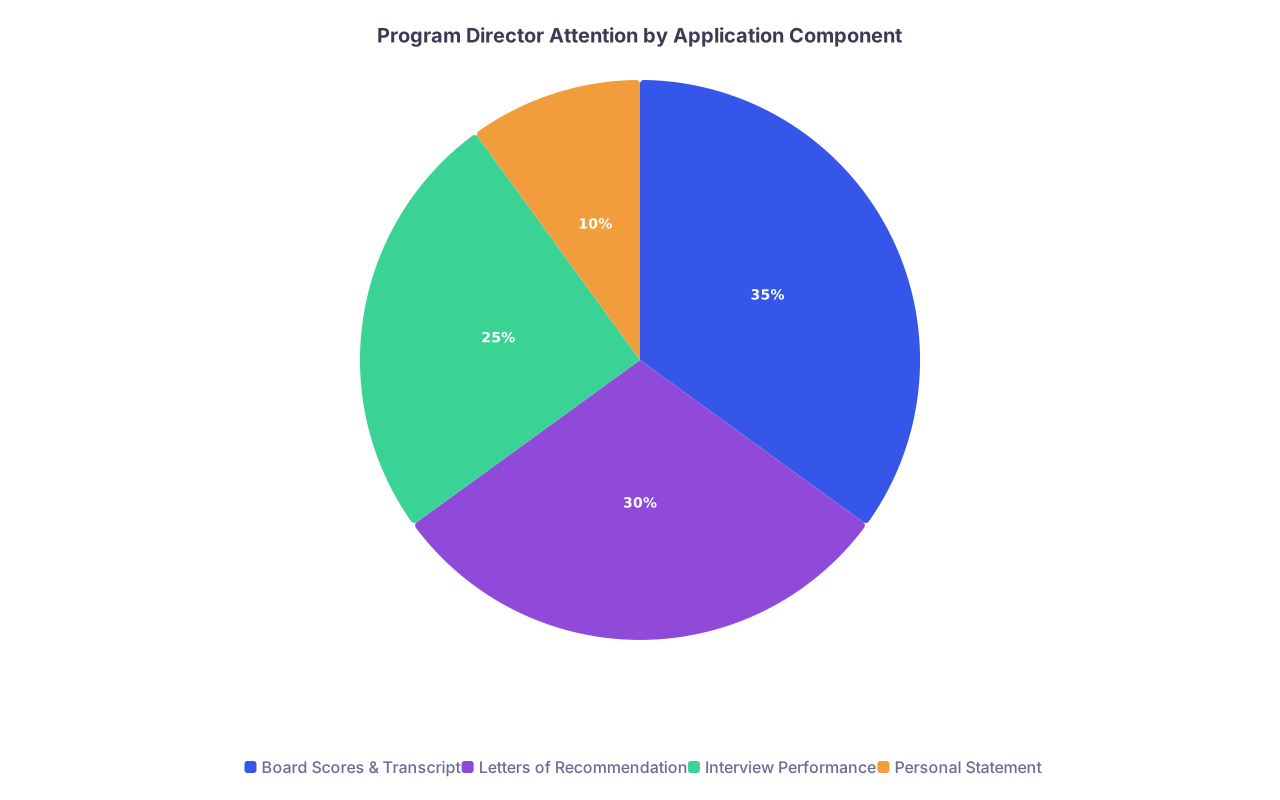
| Category | Value |
|---|---|
| Board Scores & Transcript | 35 |
| Letters of Recommendation | 30 |
| Interview Performance | 25 |
| Personal Statement | 10 |
The personal statement is a smaller slice, yes—but that 10% is often the tiebreaker when everything else is similar. And those few sharp, concrete lines are doing the heavy lifting inside that slice.
The Bottom Line
You do not impress program directors by sounding profound.
You impress them by sounding like someone they can trust with real patients, real work, and real pressure.
If you remember nothing else, keep these three points:
- Trade drama for detail. The lines that land are small, specific behaviors that quietly scream reliability, teachability, and ownership.
- Write like a future resident, not a premed. Describe systems you built, feedback you integrated, and unsexy work you chose to own.
- Give them one or two quotable lines. Make it easy for a faculty member in a selection meeting to say, “Take this one—I liked how they ___.”
Do that, and your personal statement will do what it’s actually supposed to do: not convince us you love the field, but convince us we’ll be glad you matched here.