
You are here
It is 11:47 p.m. You have your ERAS portal open in one tab and a half‑finished personal statement in the other. You keep staring at one story.
That code where the patient died, and you “found your calling.”
That time your attending yelled at a nurse and you “advocated for the patient.”
That wild psych admission that would make any dinner table lean in.
You can feel it: this story is powerful. Emotional. Dramatic. It “shows growth.” It “stands out.” Maybe it even made your mentor cry when you told them.
Let me be blunt: this is exactly how people write themselves into the “No” pile.
Program directors are not hunting for maximum drama. They are screening for judgment, professionalism, and whether you understand where the line is with patient stories. Many strong applicants get quietly filtered out because their personal statement contains the wrong kind of honesty.
You are not just choosing what to share. You are telling them what kind of colleague you will be at 3 a.m. in their ICU.
Below are the patient encounter stories that scream red flag—plus how they usually show up in statements, why they are a problem, and how to avoid setting yourself on fire.
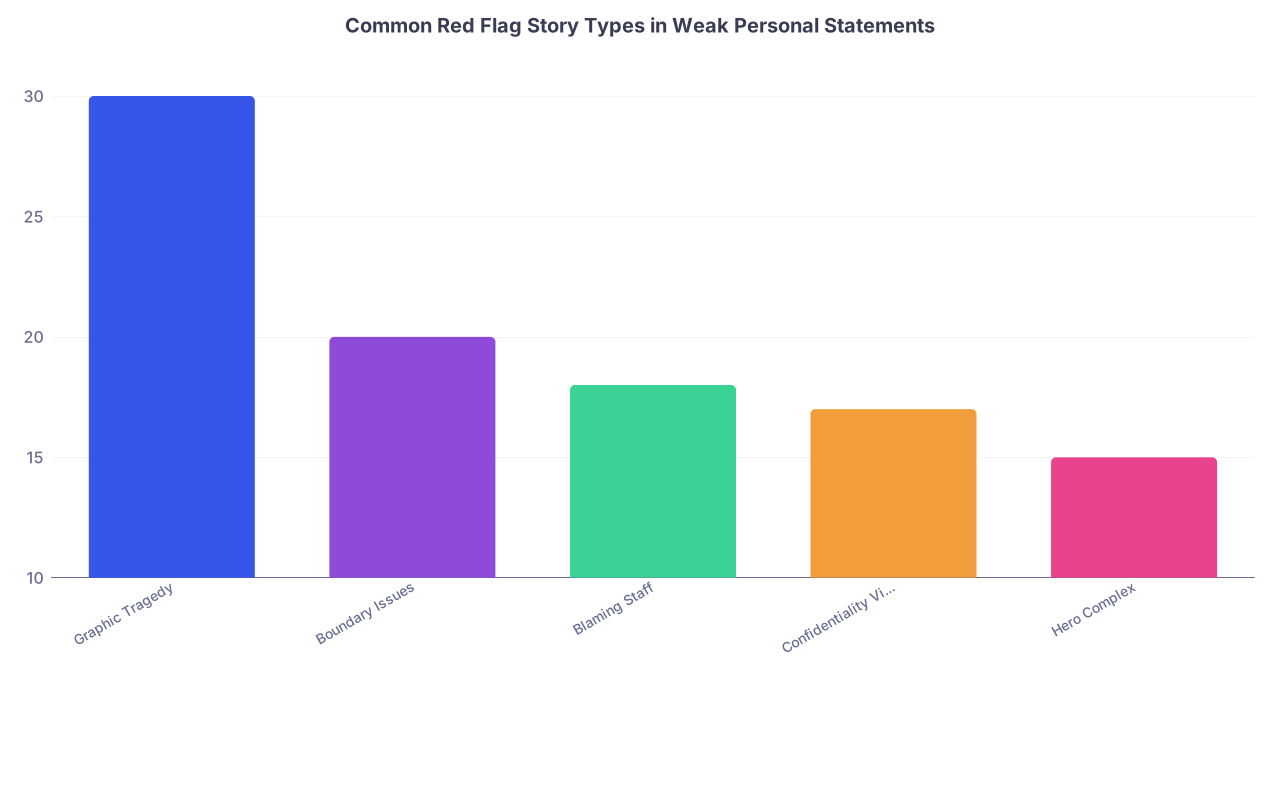
| Category | Value |
|---|---|
| Graphic Tragedy | 30 |
| Boundary Issues | 20 |
| Blaming Staff | 18 |
| Confidentiality Violations | 17 |
| Hero Complex | 15 |
1. The “Trauma Porn” Case: Graphic, Sensational, or Voyeuristic Stories
You know exactly the kind I mean.
- The disemboweled trauma in the ED where “blood pooled around his body.”
- The pediatric code where you describe the parents’ screams and “blue lips” in clinical detail.
- The psych patient’s violent outburst written like a crime novel.
How it usually appears
“I will never forget the day a young mother came in after a high-speed collision. Her skull was partially exposed, blood covered the floor, and her children watched as we…”
You think: This shows I have seen real medicine. I can handle intensity.
They think: Why is this person writing like this about a real human being? What are they like with patients?
Why this is a red flag
It reads as exploitative.
You are using someone’s worst day as a narrative device. Program readers are very attuned to that. They see dozens of these a year and they all blur into the same uncomfortable category.It suggests poor professional boundaries.
If you are willing to describe graphic details to strangers in an application, what do you share with your friends? On social media? In a bar?It centers you in someone else’s suffering.
“Her husband wept uncontrollably as I realized I wanted to be a surgeon.”
This is not reflective. It is self‑absorbed.It is often unnecessary.
You can talk about emotional impact and responsibility without turning the story into a Netflix script.
How to avoid this mistake
- Do not use graphic sensory detail (blood, body parts, specific injuries) to “hook” the reader.
- If the “power” of your story depends on how horrific the case was, drop the story.
- If a non-medical family member would read it and say, “That is disturbing,” it does not belong in your statement.
A hard rule: if you feel tempted to prove your toughness by describing how bad the scene looked or how traumatized the family was, you are stepping into red‑flag territory.
2. “I Saved Them”: Hero Complex and Overclaiming Your Role
This one kills otherwise strong applications.
You had a meaningful role in a case. Good. But your statement reads like you were the attending, the social worker, and the ethics committee rolled into one.
How it usually appears
- “I realized I was the only one truly listening to her.”
- “The team did not know what to do, but I stepped in and…”
- “Without my insistence, the mistake would have gone unnoticed.”
Sometimes it’s more subtle:
- Writing as if you made the diagnosis when you were a third‑year silently Googling in the corner.
- Describing “our management” as if you were directing it, when in reality you were observing.
Why this is a red flag
It screams lack of insight into your training level.
Program directors know exactly what a med student can and cannot do. If your version is inflated, they peg you as unreliable.It hints at poor team dynamics.
“No one else noticed.” “I was the only one who…”
Translation in their heads: This person will be the intern who thinks they are smarter than everyone and throws people under the bus.It creates liability concerns.
If what you describe sounds like you practiced beyond your scope (“I performed the lumbar puncture alone after everyone left”), some readers will literally stop there and flag it.
How to avoid this mistake
Ask yourself:
- Can the role I am describing realistically be done by a student? If not, scale it back or cut the story.
- Are there strong verbs that overstate my involvement? (“Decided,” “determined,” “managed,” “treated”) Change to “observed,” “participated in,” “contributed to.”
Better language:
- “I observed how the attending navigated…”
- “I was asked to collect the initial history, which allowed me to recognize…”
- “As the student on the team, I…”
You show maturity by being appropriately small in the story, not by pretending you were the hero.
3. The “Calling from a Tragedy” Death Scene
You are allowed to talk about patient death. But there is a very specific trap: using a death, especially a traumatic one, as the emotional climax where you “discover your purpose.”
How it usually appears
“The patient died despite our efforts. As I watched the mother collapse on the floor, I knew at that moment I was meant to be an emergency physician.”
I have seen dozens of variants of this exact line. Every year.
Why this is a red flag
It commodifies grief.
Their death becomes your character development. That feels wrong to many readers, even if you mean well.It can feel emotionally immature.
You are allowed to be impacted. But turning an immediate raw grief scene into “my calling” can read as shallow or melodramatic.It is overused.
You are not the first person to “realize your calling” during a code blue. These all blend together.
Safer ways to handle patient death
Focus on what you learned about the process, not your destiny:
- Communication with families
- The importance of preparation and systems
- The limits of medicine and how teams respond afterward
Shift the “moment of calling” away from the exact second of death:
- “Over the following weeks, I found myself returning to that patient’s chart…”
- “Reflecting later, I recognized that what drew me in was…”
Or better yet: pick a different story. If your most powerful moment involves a fresh death and a crying family, there is a very high risk you will cross the line into red flag.

4. Stories That Violate (or Almost Violate) Confidentiality
This one is non‑negotiable. Many applicants underestimate how specific a story can be while still being “de-identified.”
How it usually appears
- Rare condition + specific age + specific hospital + timeframe = identifiable.
- “A 37-year-old woman, an oncology nurse at our hospital, was diagnosed with…”
- “Last October in the ICU at [Specific City] when I was the only student on nights, I cared for a famous local musician who…”
You may think you de‑identified because you did not use the patient’s name. You did not.
Why this is a red flag
It questions your HIPAA judgment.
If they can imagine the patient recognizing themselves, or colleagues immediately knowing who it is, they see risk.It suggests you share too freely.
If you put this in an application to a national database, what do you put on Instagram?
How to avoid this mistake
Remove or blur:
- Exact ages (“in her 30s” instead of “37”)
- Specific dates (“during my third-year medicine rotation” instead of “October 17, 2023”)
- Rare or unique combinations of details
- Distinctive occupations or descriptors
Do not use:
- “Celebrity patient” stories
- Any case where your classmates or nurses would instantly know which patient you are describing
A simple test: If someone at that hospital could confidently guess the patient from your description, you have not de‑identified enough. Change it or drop it.
5. Blaming, Shaming, or Exposing Your Team
This is a major one. Some of you are about to make the mistake of “showing integrity” by calling out how bad the system/attending/resident was.
How it usually appears
- “My attending dismissed the patient’s concerns and laughed about them later.”
- “The resident was rude and uninterested; I was disgusted by their unprofessionalism.”
- “The nurses on that service often ignored orders and delayed care.”
You frame it as: I saw injustice and felt called to be different.
They read it as: This applicant is comfortable trashing colleagues in writing.
Why this is a red flag
No program wants to hire their future critic.
They are not interested in bringing in someone who will later write scathing essays about them.They know you have limited insight into the full picture.
You saw one corner of the case as a student. You did not see the prior notes, the politics, the whispers outside the room. But you are making moral judgments anyway.It signals poor professionalism and discretion.
Residency is full of flawed situations. They need to trust you to handle them without turning every frustration into a public case study.
How to handle system issues without red flags
You can write about system problems, but be surgical about it:
Critique the process, not the person.
- “Communication between shifts broke down…” not “The night resident was lazy.”
- “The structure of the clinic visits left little time for…” not “The attending did not care.”
Turn the focus back to your growth.
- What did you learn about doing better?
- What kind of environment are you hoping to help build?
If your draft contains a clear villain (the bad attending, the cruel nurse, the lazy resident), that is almost always a problem.
6. Boundary‑Crossing “Special Relationship” Stories
You want to show compassion and connection. You end up describing a relationship that makes program directors lean back in their chair and raise an eyebrow.
How it usually appears
- “I stayed long after my shift to visit her every night.”
- “We began texting so I could check on his progress.”
- “I attended his child’s birthday party after discharge.”
- “She told me things she never told anyone else, not even her doctors.”
You think this proves dedication. They think: Do you understand professional boundaries at all?
Why this is a red flag
It suggests you blur personal and professional lines.
Residencies do not want the intern who gets too involved, cannot step back, or creates dual relationships.It hints you may not respect institutional policies.
Texting patients. Meeting outside clinical contexts. Staying in rooms long after hours. This all raises risk flags.It questions your resilience.
If your involvement is so intense that you cannot let go, they worry about burnout, countertransference, and boundary issues.
How to avoid this mistake
- Avoid stories where:
- You have ongoing contact with a patient outside the formal care setting.
- You are clearly their favorite and emphasize that (“She only trusted me.”).
- You cross into inappropriate self-disclosure or emotional dependency.
You can show empathy and longitudinal care through standard, appropriate behavior: following up during rotations, advocating within the team, providing clear explanations during rounds.
If it sounds like something your professionalism coach would question, do not put it in your personal statement.
| Aspect | Safer Choice | Red Flag Choice |
|---|---|---|
| Detail Level | General, non-graphic | Graphic injuries, vivid gore |
| Your Role | Clearly student-level | Heroic, decision-maker language |
| Other Staff Portrayal | Neutral or appreciative | Critical, blaming, mocking |
| Patient Identity | De-identified, generic | Specific, rare, easily recognizable |
| Boundaries | Professional involvement | Texting, social events, personal favors |
7. Using Mental Illness or Substance Use as Shock Value
Psych, addiction, self-harm—these are part of medicine. You will see them. You can write about them. But many applicants write about them badly.
How it usually appears
- “He was a schizophrenic who talked to the walls…”
- “She was a heroin addict who kept lying…”
- “The bipolar patient was wild and unpredictable…”
Or the worst: using a psychotic break, suicide attempt, or overdose as your dramatic opener.
Why this is a red flag
Language reveals your attitude.
If you describe people by their diagnosis (“a schizophrenic,” “a drunk”), you sound dehumanizing and dated.It can feel voyeuristic or mocking.
Overemphasis on bizarre behavior, shocking quotes, or chaos reads like you are telling a story about that “crazy patient,” not reflecting on their care.It exposes stigma.
Program directors in every specialty are unhappy reading stigmatizing descriptions of mental health or addiction.
How to avoid this mistake
- Person-first language: “a patient with schizophrenia,” “a patient with severe alcohol use disorder.”
- Focus on:
- Communication challenges
- Safety, trust, adherence
- Systems issues (access to care, social determinants)
If the most memorable part of your story is how abnormal or “wild” the patient seemed, do not use it. You will not sound like the thoughtful physician you are trying to become.
8. Over-Sharing Your Own Trauma Through a Patient Story
One more minefield: intertwining your personal trauma with a patient’s case in a way that feels unstable rather than insightful.
You can mention hardship—illness, family death, mental health struggles. The problem is how you pair it with a patient encounter.
How it usually appears
- “As I watched his father die, I was transported back to my own father’s death, and I began to cry uncontrollably at the bedside.”
- “Her miscarriage triggered my own unresolved grief, and I could barely function in the rest of the shift.”
You think this shows vulnerability. They think: How will this person cope on call? On OB nights? On the cancer service?
Why this is a red flag
They worry about your ability to function clinically.
If your narration shows you losing control in ways that interfere with care, they cannot ignore that.It suggests unresolved issues.
Everyone has pain. Residency programs need to know you have enough distance and support to manage it.
Safer approach
- If you connect a personal hardship to a patient story:
- Keep the focus on long-term growth, not acute breakdown.
- Show evidence of coping, mentorship, and professional behavior.
If your honest draft reads like raw journal writing from the week something happened, it is probably not ready for your residency statement.
How to Stress-Test Any Patient Story Before You Use It
Here is the quick filter I use with applicants when we go through their drafts.
Ask yourself, honestly:
Would I be comfortable reading this aloud to:
- The patient or their family?
- The attending or resident involved?
- A risk management lawyer?
If a screenshot of this paragraph showed up on Twitter with my name attached, would it look:
- Compassionate and professional?
- Or sensational, arrogant, or indiscreet?
Does the story require:
- Graphic detail
- Someone else being obviously “the villain”
- Me being more important than a med student usually is
in order to feel powerful?
If yes to any of those, you probably need a different story.
When in doubt, show it to someone who has read applications. Not your classmate who loves creative writing. A clerkship director, faculty advisor, or recent chief resident. Watch their face when they hit that paragraph. That reaction is reliable.
2–3 Things You Should Remember
- Any patient story that relies on shock, tragedy, or someone else’s failure to make you look good will read as a red flag, not a strength.
- You are judged less by what happened and more by what your telling of it reveals about your judgment, humility, boundaries, and respect for patients and teams.
- If you are hesitating, or you feel you need to “tone down” a story multiple times, pick a different one. Safe, thoughtful, and maybe a little boring will beat dramatic and risky every single time.