
You are sitting in front of ERAS, cursor blinking in the “Personal Statement” box.
You already changed paths once — maybe twice. You are not the straight-through M1-to-MD, med-student-since-age-5 stereotype. And now you are stuck on one thought:
“How do I make this career transition sound deliberate instead of flaky or confused?”
Let me break this down specifically. The problem is not your transition. The problem is how you structure it on the page.
This is not “how to write a personal statement” in general. This is “how to handle career transitions inside the personal statement structure” so that a PD reads your story and thinks:
- “Clear reasoning.”
- “Increasing commitment.”
- “Trajectory that makes sense for my program.”
Not: “What is this person doing?”
We are going to build that.
Step 1: Understand the Risk Profile of Your Transition
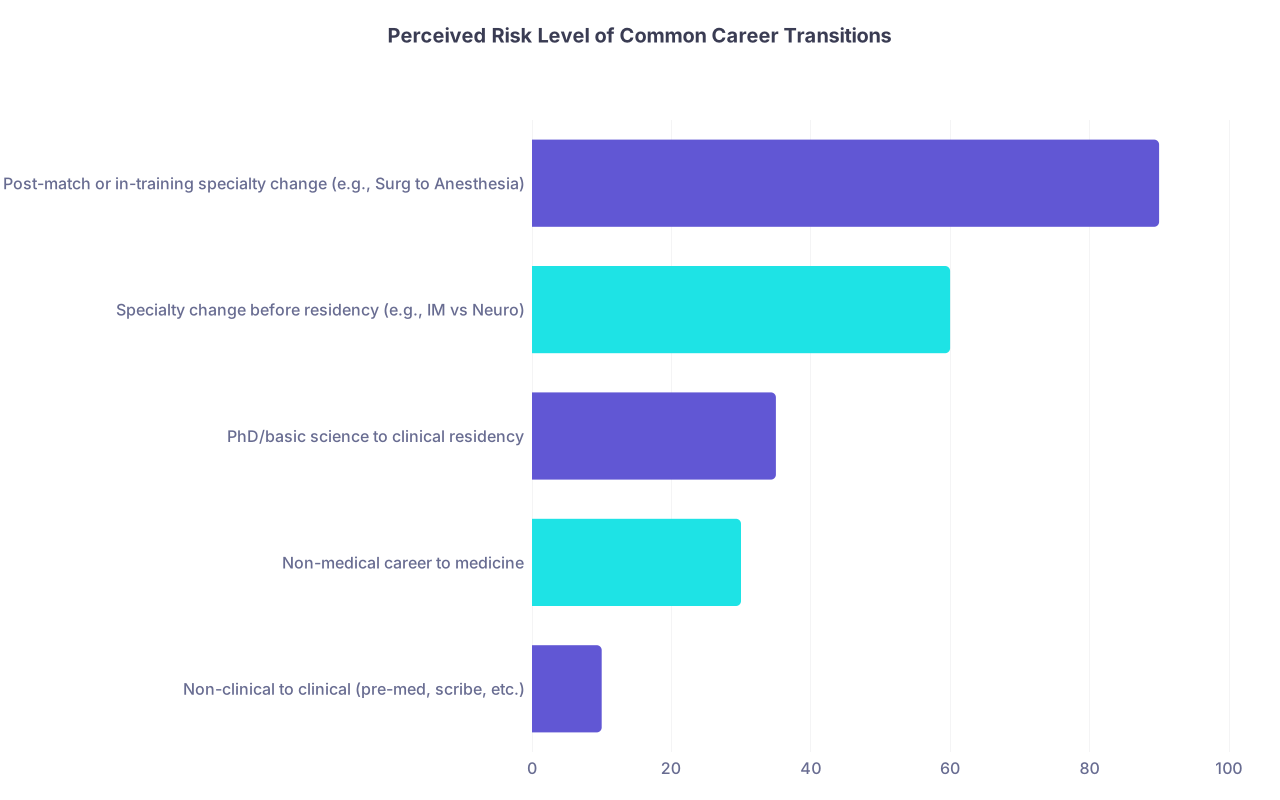
Before you write a single line, you need to be brutally honest about what kind of transition you are explaining. Different moves raise different red flags.
| Category | Value |
|---|---|
| Non-clinical to clinical (pre-med, scribe, etc.) | 10 |
| Non-medical career to medicine | 30 |
| PhD/basic science to clinical residency | 35 |
| Specialty change before residency (e.g., IM vs Neuro) | 60 |
| Post-match or in-training specialty change (e.g., Surg to Anesthesia) | 90 |
Here is how programs usually (quietly) categorize you:
Low-risk transitions
- Undergraduate major → medicine (engineering, humanities, business)
- Non-clinical early jobs → medicine (EMS, teaching, research assistant, scribe)
These do not bother anyone. You barely need to defend them. Just show why you landed where you did.
Moderate-risk transitions
- PhD or long research career → clinical residency
- Non-medical prior career (e.g., finance, tech, military) → medicine
- MD with gap years → now applying
Here the main question is: “Are they really committed, or are they experimenting?”
High-risk transitions
- Specialty switch after already starting another residency
- Match failure + reapplication in a new specialty
- Prior attempt in a completely different field (e.g., neurosurgery → family medicine)
The silent question: “Is this person going to leave again? Is there drama?”
If you do not write toward the risk profile, you will write a generic statement that ignores the one thing PDs will absolutely discuss at the rank meeting: your transition.
So you do not have the luxury of being vague. You must control the narrative.
Step 2: The Core Personal Statement Structure (That You Then Bend Around a Transition)
First, the basic structure I want you to start from. Then we will layer the transition into it.
Think of the residency personal statement as four moves:
- Hook and present identity (1–2 paragraphs)
- Turning points and evidence of fit for the specialty (2–3 paragraphs)
- Address transition / non-linear path with clarity and brevity (1–2 paragraphs)
- Current self + future direction, tied to what you want from training (1–2 paragraphs)
You will notice: the transition is not the whole essay. It is a defined segment. The mistake most applicants make is either:
- Ignoring the transition completely, hoping no one notices (they notice), or
- Making the entire PS a confessional about regret and uncertainty.
Your job is to integrate the transition as one chapter of a longer, coherent story — not the entire book.
Step 3: Choosing the Right Narrative Frame for Your Transition
There are only a few narrative frames that work well for transitions. Everything else tends to sound like excuse, chaos, or “I woke up one day and realized.”
The frames that work:
Gradual re-alignment of interests
Example: “I entered neurology for the diagnostic complexity, but over time I found myself consistently drawn to longitudinal relationships and outpatient continuity, which led me toward internal medicine and primary care.”
Key: Show a pattern over time, not a sudden swerve.Increasing proximity to the core thing you value
Example: Engineer → clinical medicine: “I moved from working on devices to realizing I wanted to be directly responsible for outcomes, not just for tools.”
Key: You are moving closer to the “center” of what matters to you, not away from it.Clarification through exposure
Example: You thought you wanted surgical intensity; clinical exposure revealed you cared more about complex medical decision-making and patient counseling.
Key: Direct clinical experiences modified an earlier hypothesis.Structural or life constraint that has now changed
This one is dangerous and must be used carefully. Think: visa issues, family responsibilities, military commitments.
Key: Must show that the constraint is now resolved and not likely to recur.
You are not allowed to use:
- “I just did not feel passionate enough.” Sounds immature.
- “Work-life balance.” You can hint at it through examples, but if you say it bluntly as the main point, programs get nervous about your resilience.
- “I did not like the people in that specialty.” Horrible look. Reflects poorly on judgment.
If you cannot fit your story into one of the valid frames above, re-examine your explanation. PDs will do it for you anyway.
Step 4: Where to Put the Transition in the Statement
Placement matters.
General rule: Do not lead with the transition unless your entire professional identity is built around it (e.g., 10-year military career then med school). For most residency transitions, you want:
- Open by anchoring who you are now, in the specialty you are applying to
- Then backfill how you got there, including the transition, once the reader already has a stable picture of your current direction
Think in terms of reader psychology. They want to know, within the first few paragraphs:
- What specialty are you applying to?
- Do you understand what this specialty actually involves?
- Are you excited about the right things?
Once that is clear, you can safely say:
“Getting to this point was not a straight line.”
And then you explain.
A common high-yield layout:
Paragraph 1–2: Present tense. A vivid clinical moment in your chosen specialty. Then a sentence or two of reflection: what parts of that work hook you.
Paragraph 3–4: Past tense. The path that led you there, including the transition. One or two key moments. You explicitly name the prior path and the pivot.
Paragraph 5–6: Present and future. Who you are now (skills, values, strengths) and what you are looking for in residency, tied to your program type.
You see the pattern: Present → Past (with transition) → Future. Clean arc.
Step 5: How to Explain the Transition Without Sounding Defensive
This is where most people stumble. They either confess too much or too little.
Here is a simple 4-sentence template for the transition paragraph itself. You will adapt the content, but keep the structure:
- One sentence naming the prior path neutrally.
- One to two sentences describing what you genuinely valued in that path.
- One to two sentences describing the specific mismatch that emerged, grounded in clinical or day-to-day reality.
- One to two sentences describing how that mismatch consistently pointed you toward the new specialty, with concrete examples.
Let me give you specific examples.
Example A: Surgical PGY-1 → Anesthesiology Applicant
Weak version (what I see too often):
“I realized surgery was not the right fit for me. I wanted more lifestyle balance and more time for my family, so I decided to pursue anesthesiology.”
That screams: I may leave again.
Structured version:
“I entered general surgery attracted to the acuity, the team-based environment in the OR, and the opportunity to make immediate, tangible impact. During my intern year, I found myself consistently most engaged in the pre-operative optimization and intra-operative management of our sickest patients, often staying late to follow them through the ICU. I enjoyed the procedures, but I was less fulfilled by the long hours outside the OR and the limited time to understand the physiology driving each decompensation. Through repeated collaboration with our anesthesiology colleagues, I realized that the aspects of perioperative care that energized me most — real-time hemodynamic management, airway decision-making, and critical care — were central to anesthesiology rather than peripheral. That recognition, reinforced over months of cases and consults, led me to pursue formal training in anesthesiology.”
Notice:
- There is respect for surgery.
- No melodramatic regret.
- The mismatch is specific and clinically grounded.
- The transition points toward anesthesiology’s core identity.
Example B: Prior PhD Scientist → Internal Medicine Applicant
Bad:
“I enjoyed research but missed patient interaction, so I decided to go to medical school.”
Better structured:
“Before medical school, I completed a PhD in immunology and spent four years studying host–pathogen interactions. I valued the intellectual rigor of hypothesis-driven research and the satisfaction of seeing a project move from idea to publication. Over time, however, I became increasingly aware that the questions that kept me up at night were not about pathways in isolation, but about how those mechanisms translated into real decisions for individual patients: whether to start a biologic, how to interpret an unusual set of labs, how to counsel a patient about risk. Shadowing in clinic highlighted how much I wanted to be the person at the bedside making those choices, rather than the one several steps upstream. That realization led me to pursue medicine, and through my clinical years I found that internal medicine, with its emphasis on complex diagnostic reasoning and longitudinal care, best aligned with how I think and what I want my daily work to be.”
You are not “fleeing” research. You are sharpening your focus.
Step 6: Length: How Much Space Should the Transition Take?
Here is the blunt truth: the higher the perceived risk, the more directly you must address it, but the tighter the writing must be.
Rough guideline:
| Transition Type | Recommended Length in PS |
|---|---|
| Low-risk (major → medicine) | 1–2 sentences |
| Moderate-risk (prior career, PhD) | 1 short paragraph |
| High-risk (residency switch, reapplicant) | 1–2 focused paragraphs |
If half your personal statement is about what you used to be doing, that is a problem. The dominant impression must still be: this is an applicant deeply aligned with [specialty X], right now.
A common mistake: applicants who switched residencies write three paragraphs defending the old choice, apologizing for it, or re-litigating their prior program. Completely wasted space and actively harmful.
Step 7: Things You Must Avoid Saying (No Matter How Tempting)
I am going to be very specific here. There are phrases and moves that almost always hurt you in a transition PS.
Avoid:
Blaming individuals or institutions
- “My PD did not support me.”
- “The culture in that specialty was toxic.”
This may be 100% true. On the page, it brands you as a potential problem.
Over-sharing personal crisis details
- “My divorce…”
- “My mental health breakdown…”
These can belong in a separate, tightly controlled explanation letter if relevant, not front-and-center in a PS. If you must mention them, do it with extreme brevity and focus on stability and treatment, not drama.
Language of regret and failure as the main theme
- “I felt like a failure.”
- “I was lost and confused.”
One sentence acknowledging difficulty is enough. Do not center your identity on it.
Over-emphasis on lifestyle as the primary driver
Programs know lifestyle matters. But if the central move is, “I wanted better hours,” they will assume you will walk when the hours inevitably get bad in their field too.Vague “passion” language
- “I realized my true passion was…”
Fine once. But if you cannot describe concrete aspects of the work that you want, it sounds shallow.
- “I realized my true passion was…”
Instead, anchor everything in:
- Specific tasks you want to do
- Specific patient populations or clinical situations that energize you
- Specific skills you have developed that match the specialty
Step 8: Integrating Strengths from Your Prior Path
Your transition is not just a liability. If you ignore its strengths, you are wasting an advantage.
Ask two questions:
- What did my prior path train me to do exceptionally well?
- How does that directly make me a better [future specialty] resident?
Then you explicitly connect the dots in 1–2 sentences.
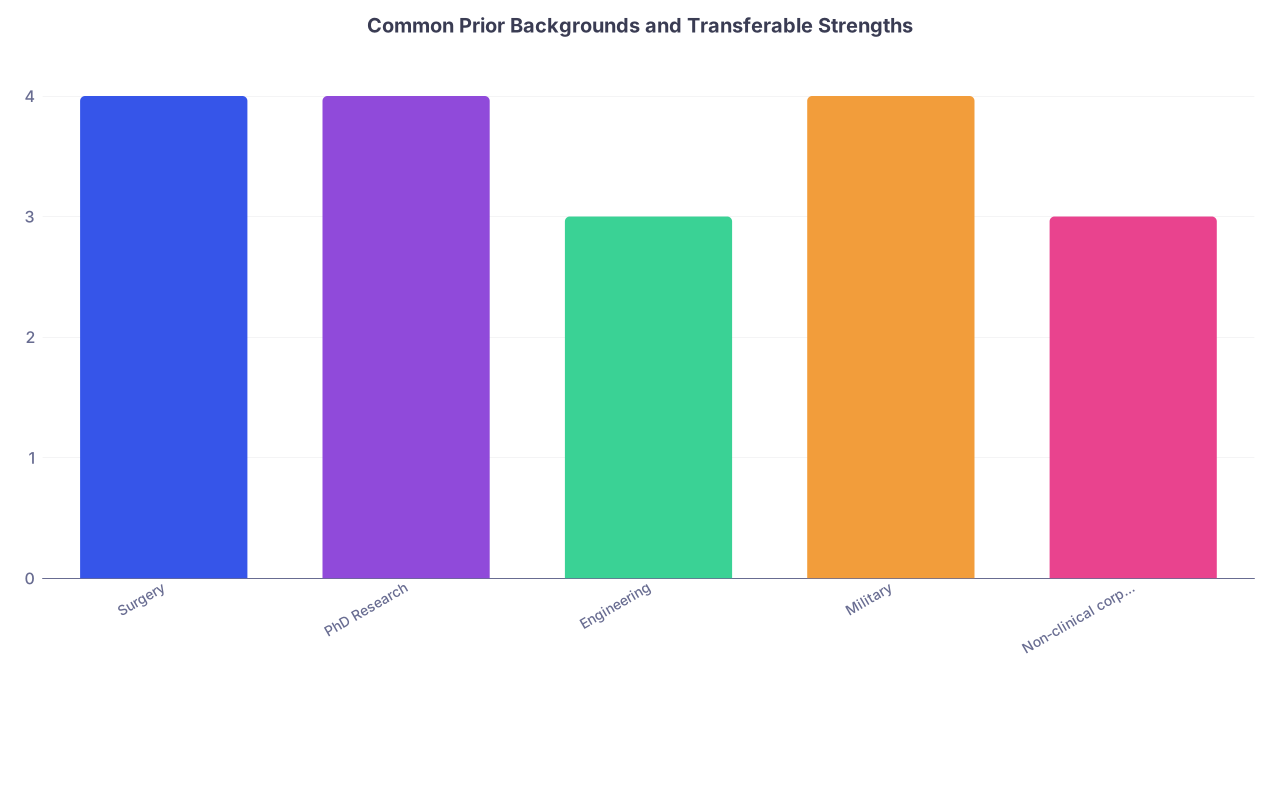
Examples:
- Surgery → Anesthesia: comfort with the OR environment, procedural skills, communication with surgeons, acute care mindset.
- PhD → IM: ability to appraise literature, comfort with ambiguity, long-horizon perseverance on complex problems, teaching.
- Engineering → Radiology: systems thinking, spatial reasoning, familiarity with imaging physics, comfort with technology.
- Military → EM: operating under pressure, clear chain-of-command communication, crisis leadership.
You do not write an ode to your old life. You say:
“From [prior field], I bring [X, Y, Z concrete skills or habits], which I now apply to [specific scenarios] in [new specialty].”
| Category | Value |
|---|---|
| Surgery | 4 |
| PhD Research | 4 |
| Engineering | 3 |
| Military | 4 |
| Non-clinical corporate | 3 |
(Where higher values reflect higher density of clearly transferable skills if articulated well.)
Step 9: Handling the “Why Not Just Stay?” Question
One of the unspoken questions in every transition case is:
“If they were good enough to do X, why did they not just stick with X?”
Your PS must implicitly answer that.
You do it by:
- Showing that you fully engaged with the prior path (not a premature jump at the first sign of difficulty)
- Demonstrating that the choice to change was made after enough exposure and reflection
- Making the new specialty feel like the logical endpoint of that process, not a random alternative
For a completed residency → fellowship change, this is easy; the path is standard.
For a mid-residency switch, your wording matters a lot. You want lines like:
“Over the course of my intern year…”
“Across multiple ICU and consult rotations…”
“Repeatedly, during X scenarios…”
This shows accumulated pattern recognition, not whim.
You do not want:
“After a difficult call, I realized…”
That sounds reactive and impulsive.
Step 10: A Few Concrete, Specialty-Specific Mini-Blueprints
Let me give you quick structural sketches. These are not templates to copy, but patterns to steal.
A. Internal Medicine after an unsuccessful first match (SOAP or reapplicant)
Structure:
- Open: A present-tense moment on IM wards during a sub-I or prelim year—something that shows you functioning well on a team.
- Next: One paragraph acknowledging the prior application cycle very briefly. One line: “My initial application was to [specialty], driven by [X]. During [prelim year / additional rotations], I recognized that my strengths and interests aligned more closely with internal medicine because [Y, Z examples].”
- Then: Emphasize what your current clinical evaluations highlight: reliability, patient ownership, teaching, cognitive work.
- Close: Concrete future goals in IM: fellowship desire is fine, but keep it balanced with generalist training.
Key: Minimal commentary on the “failure” itself; maximum focus on current competence and clear alignment.
B. Anesthesia after partial general surgery residency
Structure:
- Open: Present-tense anesthesiology moment (airway management, unstable patient in OR, ICU transfer).
- Next: One paragraph naming prior surgical training, with respect and neutrality.
- Then: One paragraph explaining the specific aspects of perioperative care that drew you toward anesthesia, tied to repeated experiences.
- Then: One paragraph on what your surgical time gives you: OR flow familiarity, procedural discipline, communication with surgeons, understanding of operative risk.
- Close: What you want from an anesthesia residency and how you see your role in the OR and ICU.
Key: You are not “escaping surgery”; you are honing in on your niche within perioperative care.
C. EM physician assistant → EM resident (career change to MD/DO)
Structure:
- Open: Present-tense EM encounter as a medical student (or sub-I), clearly in the physician role but informed by prior PA experience.
- Next: One paragraph describing your years as a PA succinctly, what you learned, and what stayed unsatisfied.
- Then: Directly state that you pursued medical school to expand responsibility, decision-making authority, and longitudinal ownership.
- Then: Emphasize that prior PA experience gives you pragmatic emergency department skills: flow, procedures, interdisciplinary communication, real sense of what the work is.
- Close: Align your goals with EM training: breadth, resuscitation, community or academic orientation.
Key: You respect your prior role but show convincingly why stepping into the physician role was a logical progression, not a repudiation.
Step 11: Editing Pass: The “Red Flag” Sweep
Once you have a draft, you need to run a specific, not generic, editing pass for transitions.
Ask yourself:
- Have I named the transition clearly, or am I dancing around it?
- Is there any hint of bitterness or blame toward individuals or institutions?
- Can a reader easily answer: Why did this person move? Why are they not likely to move again?
- Does the statement spend more time in the old world than the new? (If yes, cut and rebalance.)
- Have I explicitly stated at least one concrete way my prior path strengthens me in this specialty?
Then — and this is important — have one person who knows your situation well (mentor, PD, advisor), and one who does not know your backstory read it cold. Ask the second person:
“Based only on this statement, what do you think happened, and why did I change?”
If their answer does not match your intended narrative, you are not there yet.

| Step | Description |
|---|---|
| Step 1 | Draft PS Focusing on Current Specialty |
| Step 2 | Add Clear Transition Paragraph |
| Step 3 | Integrate Prior Strengths |
| Step 4 | Red Flag Language Check |
| Step 5 | Mentor Review |
| Step 6 | Non-involved Reader Review |
| Step 7 | Revise for Clarity and Balance |
Step 12: Where to Put the “Hard Stuff” if Your Transition Involves Problems
Sometimes the transition is tied to very real issues:
- Leave of absence
- Failing a board exam
- Disciplinary action
- Significant personal illness
The personal statement is rarely the best place to litigate all of that. You have:
- ERAS “Additional Information” section
- A separate explanation letter (sometimes requested by programs)
- Dean’s letter/MSPE or PD letter context
Use the PS to:
- Acknowledge briefly if context is necessary to make your story coherent
- Emphasize stability, insight, and better functioning now
- Re-center on who you are as a clinician and teammate
One sentence can be enough:
“During my second year, a family health crisis required a brief leave from training; with that resolved and with institutional support, I returned and have since completed my clinical work with strong evaluations and renewed focus on [specialty].”
If you feel tempted to write three paragraphs on the crisis itself, stop. That content belongs elsewhere, where it can be framed administratively, not narratively.
Step 13: Final Litmus Test: If I Removed the Transition, Would This Still Be a Strong PS?
This sounds paradoxical, but it is the end-game.
A strong transition personal statement is one where, if I blacked out the 1–2 paragraphs about your path change, I would still see:
- A clear understanding of the specialty
- Concrete, believable experiences in it
- A coherent present and future identity as that kind of physician
If the transition paragraphs feel like the only “interesting” part — and the rest is vague boilerplate — your proportions are off.
Programs do not rank transitions. They rank future colleagues. Your structure needs to reflect that.
FAQs
1. Should I explicitly state that I “regret” my earlier specialty choice or career path?
No. Regret is implied by the fact that you changed directions. Stating it outright rarely helps and often makes you sound either unstable or overly emotional. Focus on what you learned, how your thinking evolved, and why your current direction is a better fit rather than on emotional self-flagellation.
2. Where should I address a failed prior match or SOAP outcome — in the personal statement or elsewhere?
Mention it very briefly in the personal statement only if it is essential for your narrative coherence (e.g., you applied to a different specialty last year). The detailed context — scores, timing, logistics — belongs in the ERAS “Additional Information” field or in a separate explanation letter if recommended by your advisor. In the PS, you stay focused on alignment with your current specialty and evidence that you are now a strong, ready applicant.
3. How honest should I be about lifestyle or burnout contributing to my transition?
You can allude to wanting sustainable practice or valuing longitudinal relationships over procedural volume, but do not frame “better lifestyle” as the central driver. Programs worry about resilience and commitment. Instead, lean into the clinical and professional aspects that align better with your strengths, and let the lifestyle advantages remain implicit or secondary.
4. If I am switching residencies, do I need to mention my prior program by name?
Generally, no. You can describe your training level and type (“During my PGY-1 year in general surgery…”) without naming the institution. The critical piece is articulating what you gained from that year and how it led you toward the new specialty. If there were formal issues (non-renewal, remediation), coordinate with your prior PD and your current mentors about where and how that should be disclosed.
5. Can I reuse parts of my old personal statement for the new specialty?
You can reuse selective components that genuinely apply — a formative early experience, a brief background paragraph — but do not simply “find and replace” specialty names. Programs can smell that laziness. Your new statement must show clear, believable understanding of the new specialty’s day-to-day reality and how your transition led you there. If your old PS reads like it could apply equally well to three different fields, throw most of it out and start fresh.