
Your personal statement rarely gets you ranked #1. But it absolutely can knock you 30 spots down—or off the list entirely.
Let me pull back the curtain on how this really works inside program rank meetings, because what students think happens and what actually happens are wildly different.
You’ve been told: “The personal statement is your chance to stand out” and “Sell your narrative.” That’s the brochure version. Inside the committee room, the statement plays a much more brutal—and much more specific—role.
What Your Personal Statement Really Is To Us
Inside most programs, your personal statement is not a creative writing contest. It’s a screening tool. A risk detector. A tiebreaker. And occasionally, a rescue line.
Most PDs and faculty use it in three main ways:
- To confirm our existing opinion of you (based on letters, scores, school, interview).
- To look for red flags that would make you dangerous, exhausting, or impossible to train.
- To differentiate between similar applicants when we’re building the final rank order list.
If you imagine your application like a legal case, your personal statement is not the main evidence. It’s closing argument. It can’t create facts that don’t exist, but it can absolutely change how we feel about the facts in front of us.
Here’s the uncomfortable truth: the statement rarely rockets a mediocre file into the “must-rank-high” category. But it very often takes a solid file and quietly pushes it down or out.
When We Actually Read Your Statement (And When We Don’t)
Most applicants don’t understand when their statement gets read. That timing is everything for how it affects your rank.

| Step | Description |
|---|---|
| Step 1 | ERAS Application Downloaded |
| Step 2 | Auto-screened Out |
| Step 3 | Holistic Review |
| Step 4 | Skim or Skip Statement |
| Step 5 | Read Statement Fully |
| Step 6 | Interview Invite Decision |
| Step 7 | Interview Day |
| Step 8 | Statement Revisited |
| Step 9 | Statement Ignored |
| Step 10 | Rank Up or Down |
| Step 11 | Step 1 Filter? |
| Step 12 | Pre-interview Review |
| Step 13 | Rank Meeting |
Here’s the pattern I’ve watched for years across internal medicine, surgery, EM, peds, and psych:
1. Pre-interview review
If you’re on the border of getting an interview, your personal statement may be read closely. A thoughtful, grounded, specialty-specific statement can push you onto the invite list. A vague or bizarre one can get you cut.
If you’re clearly strong on paper, we might skim a few lines or not read it at all before offering an interview. We assume it’s at least “fine” until proven otherwise.
2. Just before (or during) the interview
A lot of interviewers open your file the night before or 5 minutes before you walk in. They scan the personal statement just to find something to talk about:
- “So you mentioned working in a free clinic…”
- “Tell me more about that ICU experience with your grandfather…”
Here, your statement is feeding the conversation. It’s seeding the impression they’ll later report in the rank meeting.
3. During rank list meetings
This is the part no one tells you.
By the time we’re building the rank list:
- We remember a few applicants vividly.
- We vaguely remember a lot of others.
- We’ve completely forgotten more than you’d like to know.
So what happens? Someone says: “Who’s Applicant #1243 from UMass?” We all stare at the screen. No one remembers you. Then somebody scrolls to your personal statement and reads the first paragraph or two out loud.
Your first few lines become your identity in that room.
If that opening is specific, mature, and aligned with the specialty, you often drift upward a bit. If it’s generic, cringey, or raises questions, you slide downward.
That’s how the statement actually hits the rank list.
The Hidden Scoring System No One Admits To
Most programs will deny having a “score” for personal statements. That’s technically true. But in practice, we mentally put you into categories.
| Category | Effect on Rank List Position |
|---|---|
| 1. Clear Red Flag | Can drop you off the list entirely |
| 2. Concerning/Weird | Drops you significantly within a tier |
| 3. Generic/Adequate | No major movement; other factors dominate |
| 4. Strong/Aligned | Small boost, especially as a tiebreaker |
| 5. Exceptional/Compelling | Noticeable boost within your competitiveness |
Let me walk you through each, because this is where careers rise or fall.
1. Clear Red Flag (Worst Case)
These are the statements that get mentioned by name in the hallway afterwards. “Did you read the one where…?”
Things that land you here:
Uncontrolled oversharing
Writing extensively about your own untreated mental illness, substance use, or catastrophic boundary issues without any sense of current stability or insight. Programs do not want to train a crisis. They just don’t.Blaming and bitterness
Ranting about unfair rotations, “toxic attendings,” or how you were misunderstood. That tone sets off every alarm for “difficult resident who’ll be constantly in conflict.”Inappropriate content
Graphic patient details, romanticized death, or hero fantasies. The kind of language where people around the table literally shift in their seats.
These statements absolutely affect rank list position. I’ve seen applicants with solid scores and decent interviews get quietly moved to the bottom or deleted from the list over a single bizarre or hostile statement.
2. Concerning/Weird (Significant Drop)
This bucket hurts you more than you realize because it’s subtle. Nobody says, “We’re eliminating them.” They just keep slotting you a little lower than your stats and interview would predict.
Common themes:
Obsessively prestige-focused
If your whole tone screams, “I’m using this place as a stepping stone to the finest fellowships at MGH/Stanford/Brigham,” community and mid-tier academic programs will roll their eyes and push you down. They don’t want a flight risk who thinks they’re above the program.Incoherent specialty reasoning
“I love procedures and want quick results” in a psych application. “I prefer long-term relationships with patients” in EM. Committees notice the mismatch and question your judgment and self-awareness.Trying too hard to be “unique”
Extended metaphors about surgery and jazz music, the “medicine is my calling because of a single magical moment” sort of thing—when it’s overdone, it reads like you’re performing, not reflecting. Faculty are harsher on this than you’d think.
You won’t be banned. But if you would’ve been around #20 on the list, you might end up #45. Same application, different statement, different rank.
3. Generic/Adequate (Most People)
This is where the majority land. Your statement:
- Explains why you like the specialty in a generic way.
- Mentions some rotation experiences.
- Says you value teamwork, teaching, and patient care.
Fine. Safe. Forgettable.
If you’re already a top-tier applicant with great letters and a strong interview, this doesn’t hurt you. You’ll still be high on the list.
If you’re mid-pack or from a less well-known school, a generic statement means you miss a chance to nudge yourself up relative to peers. You become the kind of applicant that makes a PD say, “Yeah, solid, I guess. Who else do we have around that range?”
4. Strong/Aligned (Quiet Advantage)
This is where the smart applicants aim.
A “strong” statement in our eyes is not dramatic. It’s clear, anchored, and obviously written by someone who actually understands the specialty they’re choosing.
Patterns I see in strong statements:
A concrete, believable path into the specialty
Not “I knew it was destiny,” but: “Third-year medicine, I kept gravitating to patients with X, and my attendings kept pulling me into Y, and I noticed I was staying late for Z.”Specific details that only make sense for that field
EM: chaos, undifferentiated complaints, resus bay. IM: diagnostic puzzles, longitudinal care. Surgery: OR culture, technical progression. Psych: complex narratives, alliance, patience.A grounded voice
Not flowery. Not breathless. More: “Here is the kind of resident I am becoming and the kind of team I want to be part of.”
This kind of statement earns comments like, “They really get it,” or, “Good fit for our program style.” That’s how you rise within whatever band your objective metrics put you in.
5. Exceptional/Compelling (Rare but Real)
These are maybe 5–10% of statements at most. The committee actually remembers them.
They usually combine:
- An authentic, non-dramatic story that shows growth.
- A clear understanding of the field’s realities (including the ugly parts).
- A voice that sounds like the person we met at interview—consistent, mature, self-aware.
When we’re at the painful part of the meeting—arguing who lands at 8 vs 14 vs 22—these are the people someone fights for. “Remember, this was the one who wrote about X. I really liked them.”
That’s how you climb not two spots, but ten.
How Much Movement Can Your Statement Actually Cause?
Let’s quantify this a bit, because “it matters” is too vague.
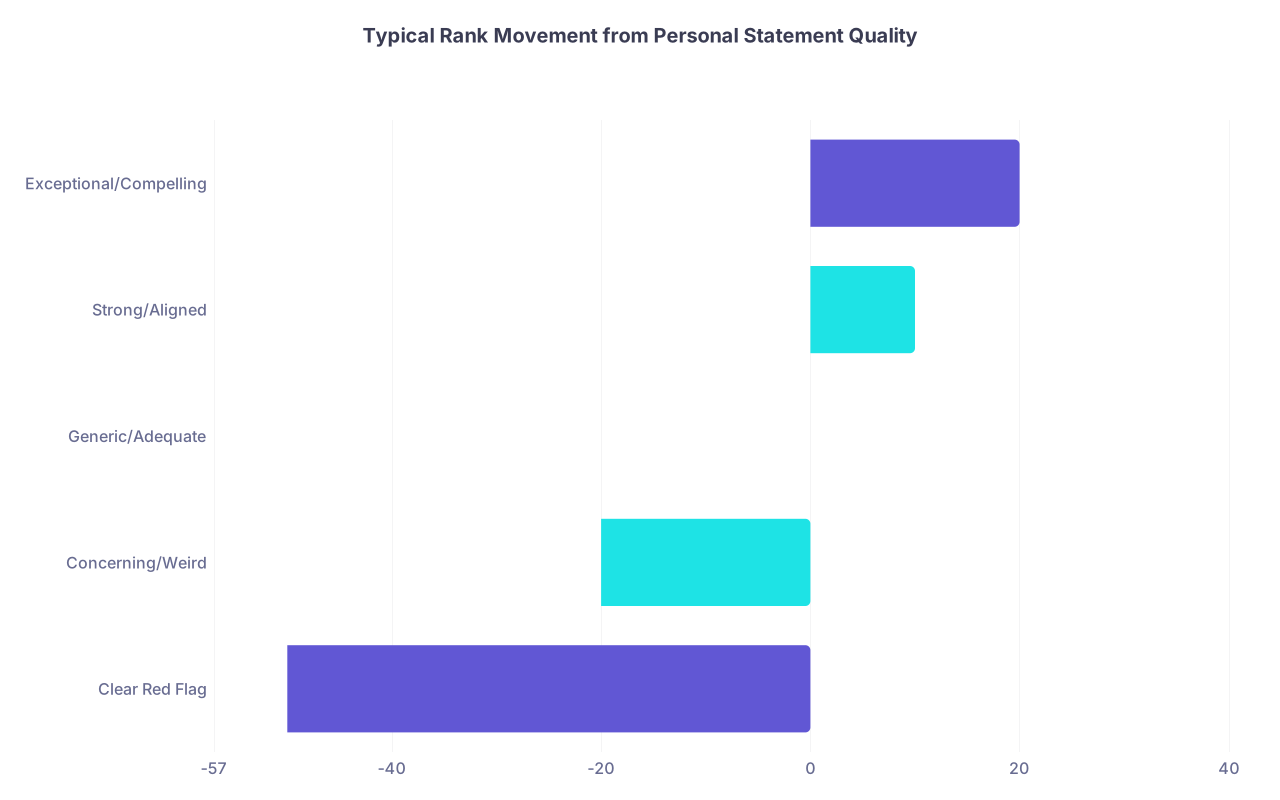
| Category | Value |
|---|---|
| Clear Red Flag | -50 |
| Concerning/Weird | -20 |
| Generic/Adequate | 0 |
| Strong/Aligned | 10 |
| Exceptional/Compelling | 20 |
Here’s the translation in real committee language:
- Clear red flag: “Take them off the list.” That’s not dramatic. That’s exactly how it sounds.
- Concerning/weird: “Let’s move them down; I’m a little nervous about X.”
- Generic/adequate: No one talks about your statement at all.
- Strong/aligned: “Yeah, they seem like a really good fit; let’s keep them a bit higher.”
- Exceptional/compelling: “I’d be happy if they matched here. Can we move them up in this cluster?”
Notice what’s missing: nobody is saying, “The personal statement is so great we can ignore poor clinical performance or an unhinged letter.” It doesn’t override core data. It shades the interpretation.
The Fit Question: Where Your Statement Really Bites
Program directors are obsessed with one word they pretend is objective but is totally subjective: fit.
Your personal statement is one of the main places they decide if you “fit” their culture.
Some insider examples:
County EM program
They want resilient, gritty residents. If your statement emphasizes perfectionism, control, and discomfort with unpredictability, they’ll worry you’ll break there.Research-heavy academic IM program
If your statement is 100% about community clinic work and never mentions curiosity, scholarship, or systems-level thinking, you’ll drift down compared to the person with similar stats who clearly likes research.Surgical program with intense autonomy culture
They want people who want responsibility. A statement full of “I’m terrified I’ll make mistakes” language can kill you there.
The same exact essay can help you at one program and hurt you at another, purely based on culture.
That’s why copying a “model” statement from someone matching at MGH or UCSF is dangerous. Their tone, their emphasis, and their goals may be the wrong vibe for the majority of places on your list.
How We React To Certain Common Mistakes
Let me walk through a few patterns I watch committees react to over and over.
The “Trauma Dump”
You tell a long, raw story about your own illness, a family member’s death, or some major trauma. You think it shows vulnerability. What we hear is: “Is this person stable enough to take call? Are they going to relive this every time they see a patient like that?”
Here’s the insider rule:
If your story doesn’t end with clear, sustained stability and insight—and if it’s not obviously connected to how you’ll function as a resident—don’t center it.
The “I Love All the Specialties” Essay
You talk about how you adore peds, IM, surgery, EM, psych, and heme/onc equally, then pivot at the end to “which is why I chose anesthesia.” That reads as indecisive and immature.
Programs want people who’ve actually committed. Not people sampling a tasting menu.
The “Hero Narrative”
You describe impossible saves. You vaguely take credit for outcomes that were clearly the attending’s work. You use words like “fight,” “battle,” “warrior” in ways that give off savior complex energy.
Every senior person around that table has a hair-trigger for this kind of thing. They’ve trained the resident who thought they were the protagonist of every story. It was miserable.
The “Artificial Humility” Statement
You spend 90% of the essay talking about how “honored” you are, how “humbled” you feel, how “in awe” you are of everyone else. But we barely learn anything concrete about you.
We don’t ding you for this. But we don’t remember you either.
What A Rank Meeting Actually Sounds Like About Your Statement
Let me simulate an internal medicine rank meeting I sat in. This will be more helpful than any generic advice.
We’re in hour three. Coffee is cold. Half the room wants to go home.
- “Next cluster: Applicants 18 through 26. Any thoughts?”
- “#19—great letters, strong Step 2, interview was fine. Anyone have concerns?”
- “Their statement was… nothing special. But fine.”
(We leave them where they are.)
Next:
- “#21 from a Caribbean school. Very strong interview, PD letter was solid.”
- “Read the first paragraph of their statement again?”
Someone does. It’s short, clear, and shows a realistic understanding of IM in an underserved setting. - “I really liked this one; they know exactly what they’re getting into.”
(We bump them up two spots.)
Next:
- “#23—US MD, scores fine.”
- “This is the one with the three-paragraph story about being wronged by their surgery clerkship, right?”
Heads nod. - “I’m a bit uneasy; I don’t want that energy in our program.”
- “Drop them into the next tier.”
(They fall 10–15 spots, maybe more.)
Your file in that room is a handful of remembered phrases, scores on a spreadsheet, a gut sense from the interview, and occasionally one vivid detail from your statement.
Your job is to control that detail.
So What Should You Actually Do When Writing?
I’m not going to give you cutesy template lines. You’re smarter than that. But if you want your statement to help your rank instead of quietly hurting it, aim for this:
- One or two specific clinical moments—not trauma porn, not heroics—that show how you think and what you noticed.
- A clear, realistic articulation of what attracts you to this specialty’s day-to-day reality, not just its highlights.
- A concise picture of the resident and colleague you’re becoming.
- Language that any attending in that specialty would recognize as grounded and sane.
And then ruthlessly cut:
- The drama.
- The vague clichés.
- The defensiveness.
- The temptation to impress with vocabulary instead of clarity.
You’re not applying to be a novelist. You’re applying to be trainable, reliable, and someone we won’t regret handing a pager to at 2 a.m.
That’s what your personal statement is really auditioning for.