
Last cycle, I read a personal statement from a strong applicant: solid scores, good letters, impressive leadership. Halfway down the page, three sentences about a leave of absence exploded into a full-blown autobiography of family drama, financial chaos, and medical details nobody on an admissions committee wanted. It tanked what should have been an easy interview invite.
If you’re reading this, you probably have a leave of absence (LOA) on your record and you’re stuck on one question: “How do I explain this without sounding unstable, unreliable, or oversharing my life story?” Let’s walk through exactly how to handle it, line by line, scenario by scenario.
First Reality Check: What Programs Actually Care About
Program directors don’t sit around judging you for being human. They do, however, care deeply about risk. Your LOA triggers a set of questions in their head:
- Is this problem likely to happen again during residency?
- Did this person handle it responsibly?
- Can they function under the nonstop pressure of residency?
- Are they hiding something?
Notice what’s not on that list: “Do I feel emotionally moved by their backstory?”
Your job isn’t to win a trauma Olympics. It’s to reassure a risk-averse committee that:
- There was a real reason.
- You handled it as an adult.
- The issue is either resolved or well-managed.
- You still grew into someone they’d trust at 3 a.m. with a sick patient.
That’s it. Anything beyond that is optional, and usually dangerous in a personal statement.
Decide: Personal Statement, ERAS Comments, or Both?
Before writing a single sentence, you have to decide where to address the LOA. You have three main options:
| Location | Best For |
|---|---|
| ERAS 'Education' Comment Box | Brief, factual explanation only |
| Personal Statement | When LOA meaningfully shaped your path |
| Both | Short in ERAS, 1–3 sentences max in PS if relevant |
Here’s how I’d break it down:
Use ERAS comment box only if:
- The LOA was short (e.g., one semester)
- It didn’t dramatically shape your specialty choice or career goals
- The reason is straightforward (family illness, surgery, financial, research year)
Use both ERAS and personal statement if:
- The LOA genuinely changed your path, perspective, or specialty
- Ignoring it would leave a big unexplained gap in your story
- You can connect it to clear growth without wallowing in details
Use personal statement only rarely:
- Usually a mistake. If there’s an official LOA listed, programs prefer a factual note in ERAS. Hiding it from ERAS and “explaining” in your statement feels evasive.
Default rule:
Put the facts in ERAS. Put interpretation and growth (briefly) in the personal statement only if it supports your overall arc.
The Golden Rules: How To Talk About an LOA Without Oversharing
Let me be blunt. The biggest mistakes I see:
- Naming exact diagnoses when you don’t need to
- Describing graphic or highly personal medical details
- Venting about your school, family, or “unsupportive” dean
- Turning the LOA into the emotional centerpiece of your personal statement
You’re not writing a memoir. You’re building trust.
Here are the rules that keep you safe.
Rule 1: Be Specific Enough, But Not Graphic
Bad:
“I took time off due to my struggle with major depressive disorder, recurrent suicidal ideation, and panic attacks that required multiple medication changes and hospitalizations.”
Better:
“I took a medical leave during my second year to address a mental health condition that required focused treatment and recovery.”
You give them a category (medical/mental health/family/financial/etc.) and a timeframe. You don’t need your psychiatric chart in the document.
Rule 2: One Sentence for Cause, One for Action, One for Outcome
If you’re putting this in your personal statement, aim for 2–4 sentences. That’s it. You are not the LOA. You are not the problem you had. You are an applicant with a brief detour.
The structure:
- Cause: broad reason
- Action: what you did to handle it
- Outcome: what changed / what you learned
- Reassurance: why this won’t derail residency
Example:
“During my second year of medical school, I took a one-semester leave of absence to address a health issue that required consistent outpatient treatment. During this time, I worked closely with my physicians, focused on recovery, and built habits that allowed me to return to full-time coursework. Since resuming school, I have completed all clinical rotations on schedule and have maintained strong performance while continuing to manage my health responsibly.”
Professional. Clear. No drama.
Rule 3: Avoid Blame and Bitterness
Program directors hate drama. If you frame your LOA as a fight with the administration, a toxic environment, or endless injustice, they’ll assume you’ll bring that energy to their program.
Do not write:
- “I was forced to take a leave…”
- “The administration did not support me…”
- “Due to unfair circumstances…”
Even if all of that is true. Save it for your friends, not ERAS.
Instead, stick with:
- “I took a leave of absence…”
- “I stepped away temporarily…”
- “I elected to take time to…”
You frame yourself as someone who takes ownership, not someone who blames.
Rule 4: Keep the Emotional Tone Steady
You’re not applying to be a protagonist in a novel. You’re applying to be calm under pressure. Don’t swing between extremes like:
“I was absolutely shattered…”
“My world fell apart…”
“I was devastated beyond words…”
You can acknowledge difficulty without melodrama.
Better:
“This was a challenging period, but it ultimately strengthened my resilience and clarified my priorities as a future physician.”
Concrete Scripts for Common LOA Reasons
Let’s stop being abstract. You probably fall into one of a few buckets. I’ll give you templates you can adapt.
1. Medical or Mental Health Leave
You do not need to name the condition unless your advisor explicitly tells you to, and it clearly reassures more than it harms. Often it does not.
ERAS comments (short version):
“I took a one-semester medical leave during my second year to address a health condition that required treatment and recovery. I returned the following semester and have since completed all coursework and clinical rotations without interruption.”
Personal statement (if relevant):
“Halfway through my pre-clinical years, I took a medical leave of absence to address a health condition that required focused treatment. During that time, I learned how to prioritize my own well-being, communicate openly with my care team, and build sustainable habits. Returning to school, I carried those lessons into clinical rotations, where I’ve been able to empathize more deeply with patients managing chronic illness while maintaining consistent performance and reliability.”
Notice: no diagnosis. No medication list. No gory detail.
2. Family Crisis or Caregiving
Think: parent with cancer, sibling with serious illness, major caregiving responsibilities.
ERAS comments:
“I took a leave of absence during my third year to return home and serve as the primary caregiver for an ill family member. I resumed my clinical training after this period and completed my remaining rotations on schedule.”
Personal statement (if it truly shaped your path or specialty):
“During my third year, I took a leave of absence to return home and care for a close family member with advanced illness. Navigating their appointments, advocating during hospitalizations, and coordinating home care changed how I viewed the role of a physician. That experience directly influenced my decision to pursue [specialty], where longitudinal relationships and patient advocacy are central.”
You don’t have to describe the person’s entire course, diagnosis, or death. Committees don’t need those details to understand.
3. Financial or Logistics Leave
You had to work. Visa issues. Housing disaster. Whatever it is, again: simple.
ERAS comments:
“I briefly stepped away from medical school for one semester for financial reasons and to address housing and work obligations. After resolving these issues, I returned to school and completed the curriculum without further interruption.”
Personal statement (if you really need it):
“As a first-generation college and medical student, I took a semester away from school to address financial and housing instability. Working during that period sharpened my appreciation for the barriers many patients face in accessing care. When I returned to school, I sought opportunities in community health clinics where those realities are part of daily practice.”
Again, clean. Adult. No oversharing.
4. Academic Difficulty Leading to LOA
This one’s tricky because programs will care about academic risk. You can’t wave it away with vague language.
ERAS comments (do not lie here; they already have your transcript):
“I took an academic leave of absence after struggling with the pre-clinical curriculum. During this time, I worked with academic support services, adjusted my study strategies, and addressed underlying learning challenges. On returning, I successfully passed all subsequent coursework and clinical rotations, showing significant improvement in my performance.”
Personal statement (short and focused on change):
“Early in medical school, I struggled with the volume and pace of the pre-clinical curriculum and ultimately took an academic leave. During that period, I worked closely with learning specialists, revamped my study strategies, and identified how I learn most effectively. Since returning, I’ve passed all subsequent coursework and excelled in clinical rotations, where I’ve consistently received strong evaluations for preparation and reliability.”
Do not write a long apology essay. Show the inflection point, then move on.
Where in the Personal Statement Do You Put This?
You have three realistic placements:
- Middle paragraph where you’re describing your medical school journey
- Brief aside when moving from pre-clinical to clinical experiences
- Very short mention near the end when talking about preparation for residency
I’d avoid starting or ending your statement with it. You don’t want the LOA as your opening impression or your final taste.
Example of weaving it in the middle:
“During my second year, I briefly stepped away from school for a medical leave of absence to address a health condition. Working with my physicians and mentors during that time reinforced for me the value of clear communication and continuity of care. Returning to the wards, I found myself especially attuned to patients facing similar uncertainty, and I sought out rotations in [X] and [Y] where long-term relationships were central to care.”
Notice how it becomes one short beat in a larger narrative, not the centerpiece.
How Much Detail Is Too Much? A Quick Test
When I review drafts, I use a brutal filter for LOA paragraphs. You can use it on yourself.
Ask:
- Does this explanation raise additional questions I don’t want to answer in an interview?
- Would I be comfortable if this paragraph were read out loud in a room of 20 strangers?
- Am I writing this to process my feelings or to inform a PD?
- If I cut this by half, would anything truly important be lost?
If your LOA section is more than 4–5 sentences, you’re probably drifting into self-therapy. Cut it.
Coordinate With Your Dean’s Letter and Letters of Recommendation
You’re not writing this in a vacuum. The MSPE (Dean’s Letter) and possibly a letter from a mentor will also touch on your LOA.
What you want:
- Your ERAS comment
- Your personal statement (if used)
- Your MSPE
- Any mentor’s letter
…all roughly matching. Not word-for-word, but same reason, same timeline, same tone.
If your MSPE already has a clean, neutral explanation that sounds something like:
“Student X took an approved leave of absence from [date] to [date] for personal/medical/family reasons and returned to complete the curriculum successfully.”
Then your personal statement does not need a whole paragraph. One or two sentences at most, or nothing if it truly didn’t shape your story.
If your MSPE wording worries you (too vague, or sounds negative), you may need to be a bit clearer in your own statement to balance it. But don’t contradict it.
A Few Real-World Examples (Good vs. Bad)
Oversharing Version
“During my second year, I experienced severe depression with suicidal thoughts. I was hospitalized twice and tried multiple medications, some of which caused debilitating side effects. At my lowest point, I was unable to get out of bed or attend class…”
This triggers concern, not confidence.
Professional Version
“During my second year, I took a medical leave of absence to address a mental health condition that required focused treatment. With the support of my care team and school administration, I returned the following semester and have since completed all clinical training without interruption, while continuing to manage my health responsibly.”
That’s how you sound like someone ready for residency.
Practical Edit Pass: What To Do With Your Draft
If you already wrote a long, emotional LOA section, don’t panic. Here’s how to fix it:
- Highlight the entire LOA chunk.
- Force yourself to reduce it to 3–4 sentences max.
- Make sure each of these is present and labeled in your head:
- Reason category (1 sentence)
- What you did/changed (1–2 sentences)
- Current stability/reassurance (1 sentence)
- Delete any:
- Exact diagnoses (unless advised otherwise)
- Graphic details
- Blame of others
- Long descriptions of feelings
Then read the statement without that extra detail. If your core story still stands, you’ve probably cut the right amount.
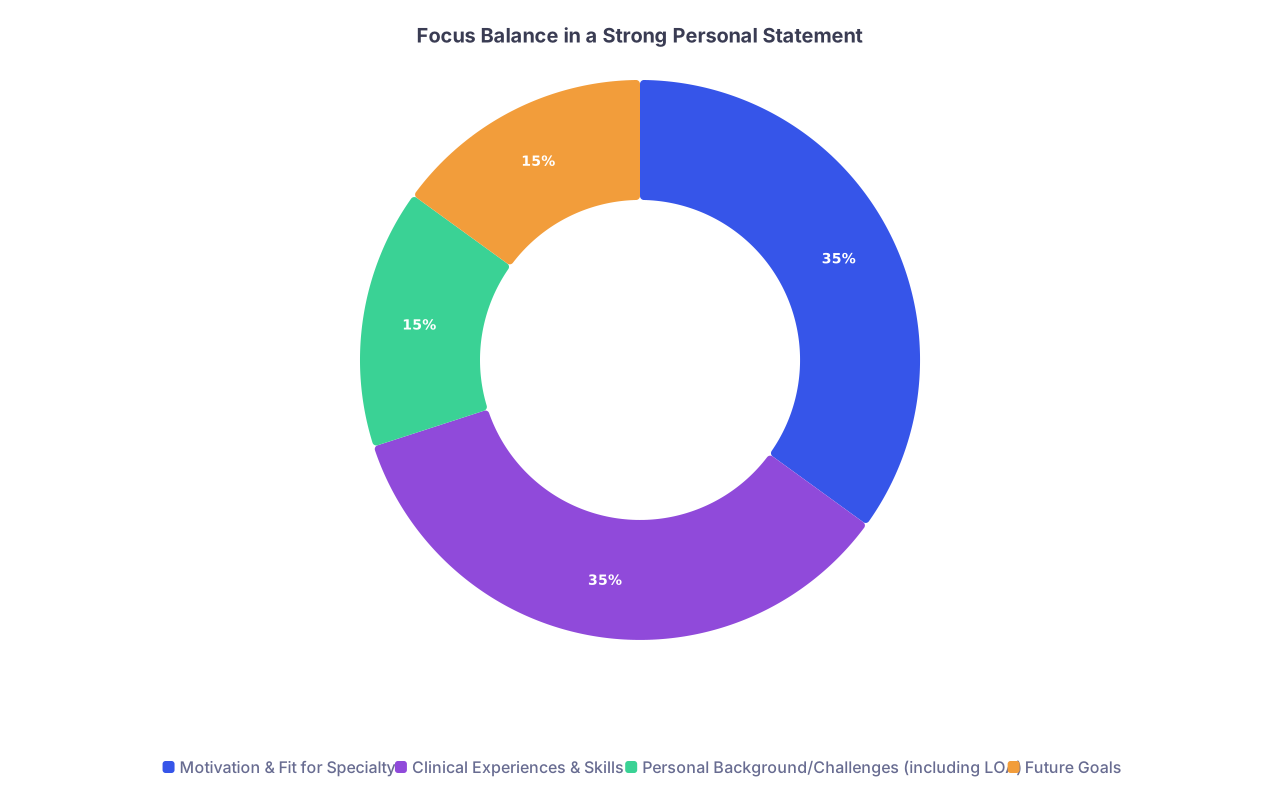
| Category | Value |
|---|---|
| Motivation & Fit for Specialty | 35 |
| Clinical Experiences & Skills | 35 |
| Personal Background/Challenges (including LOA) | 15 |
| Future Goals | 15 |
When You Shouldn’t Put It in the Personal Statement
Let me be very clear: having an LOA does not automatically mean it belongs in your personal statement.
Skip it in the PS if:
- It was administrative/technical (curriculum change, school policy) and already explained in MSPE/ERAS
- It genuinely did not influence your path, growth, or specialty choice
- The explanation would pull focus away from stronger, more relevant parts of your story
- You feel tempted to write more than 4–5 sentences about it
In those cases, keep it in ERAS comments and MSPE. Use your personal statement for what actually sells you: your fit for the specialty, your values, and how you work with patients and teams.

| Step | Description |
|---|---|
| Step 1 | LOA on Transcript |
| Step 2 | Explain briefly in ERAS comments only |
| Step 3 | Too emotional/detailed → Edit down first |
| Step 4 | Use ERAS for facts, PS for brief growth note |
| Step 5 | Significant impact on path or specialty? |
| Step 6 | Can you explain in 2-4 sentences? |
Final Takeaways
Your leave of absence is a data point, not your identity. Programs mainly want to know that you’re stable, self-aware, and not a hidden risk.
Keep it short, factual, and grown-up: one sentence for cause, one for actions, one for outcome, and one for reassurance if needed. Then move on to what really matters—showing who you are as a future resident, not replaying the hardest chapter of your life on the page.