
It’s August. ERAS opens in a few weeks. You’re staring at your academic record, and there it is in black and white: Academic Probation.
You’re working on your personal statement or experiences section, and the dread hits:
“Do I bring this up? How much do I say? Will this sink my entire application?”
You’ve probably heard the bad advice already:
- “Just don’t mention it. Maybe they won’t notice.”
- “Blame the school; they’re super strict.”
- “Make it sound vague—‘personal challenges’ and move on.”
Ignore all of that.
Here’s the reality: if you were on academic probation, programs will see it. What matters now is whether you look like:
- A risk they don’t want to touch, or
- Someone who hit a bump, took it seriously, fixed it, and is now stronger.
You control that narrative—especially in your personal statement and supplemental responses.
Let’s walk through exactly how to handle this like a professional adult and not a panicked student trying to dodge responsibility.
1. First: Figure Out If And Where You Need To Address It
Before writing a single line, you need clarity on three things:
What exactly is in your record?
Go pull the documents, not your memory. That means:- Official transcript
- MSPE/Dean’s Letter
- Any professionalism/committee letters if your school issues them
How is it labeled and described?
Was it:- “Academic probation”
- “Warning”
- “Remediation required”
- “Professionalism concern”
Programs care less about the label than the pattern. One clear, contained episode with a clear resolution is very different from repeated remediation.
Where in ERAS will it show up or be asked about?
You may see:- A checkbox about academic difficulty or disciplinary action
- School-specific or program-specific supplemental questions
- It may be explicitly mentioned in the MSPE
If you’re not sure how your school describes it, email or meet with your student affairs dean and ask exactly what’s in your MSPE. Don’t guess. I’ve seen people write long explanations for something that ended up being a single bland line in their letter.
When do you address it in a personal statement?
You should address probation clearly (and briefly) in your statement or a supplemental essay if:
- It is explicitly labeled “Academic Probation” or “Remediation” in your transcript or MSPE
- The episode affected your timeline (leave of absence, course repetition, delayed Step, etc.)
- There’s a visible GPA/grade/Step jump that begs for context
- You’re asked directly by a program or in a secondary
You can skip it in the main statement (and save it for secondaries/interviews) if:
- It’s a very low-level “warning” with no transcript/MSPE label
- Your dean confirms it’s not being reported in the MSPE or official documents
- There’s no timeline disruption and no visible pattern
If you’re borderline, lean toward owning it once, clearly, in a controlled way instead of dancing around it.
2. The Mindset Shift: You’re Not Begging For Mercy
Programs aren’t looking for perfection. They’re looking for:
- Reliability
- Honesty
- Insight
- Capacity to improve
The probation itself isn’t the death blow. The red flag is:
- Excuses
- Defensiveness
- Vague “I had some personal challenges” fluff
- Or pretending it didn’t happen
Think about how an attending thinks:
“If this resident is on my team and something goes wrong, will they tell me early, own their role, and fix it? Or will they hide and blame?”
Your probation explanation is basically your first test of that.
Your writing needs to communicate three things clearly:
- What happened in plain language
- What you changed in response
- What your performance looks like now
That’s it. Anything beyond that tends to hurt more than help.
3. Structure: A Clean 4–Part Template That Works
Use this when you address probation in a personal statement, secondary, or interview. Keep it tight.
Part 1: Brief, direct context (2–3 sentences)
You’re not writing a confession letter. You’re giving context.
Bad:
“Medical school was extremely challenging and I struggled with multiple aspects of the transition, which unfortunately led to me being placed on academic probation, which was very difficult emotionally.”
Better:
“During my second year of medical school, I was placed on academic probation after failing the renal and pulmonary blocks. My study habits from college were not effective with the volume and pace of the pre-clinical curriculum.”
Notice: direct, concrete, no drama.
Part 2: Own your role without beating yourself up (2–4 sentences)
Bad:
“I was overwhelmed, and the curriculum wasn’t well designed, and the grading system was harsh.”
Also bad:
“I was irresponsible and lazy and completely failed.”
What you want instead: clear responsibility + specific insight.
Example:
“I underestimated how much daily active review I needed and relied too heavily on last-minute cramming and passive reading. I also tried to manage everything alone instead of asking for help when I started falling behind.”
This tells them you:
- Understand the cause
- Aren’t blaming the world
- Can self-assess
Part 3: Concrete changes you made (3–5 sentences, with specifics)
Here’s where most people stay way too vague: “I worked harder. I improved my time management.” That tells them nothing.
You need observable behavior changes. Think:
- Tutoring
- Mandatory remediation processes
- Board prep structure
- Time blocking
- Wellness/mental health treatment if relevant
Example:
“I met weekly with our learning specialist to redesign my study schedule, shifting to daily spaced repetition and board-style questions instead of re-reading notes. I also joined a small study group, committed to pre-reading before each lecture, and met with course directors early whenever I struggled. I began seeing a therapist to address the anxiety and insomnia that were worsening my performance.”
Now they can picture what you actually did.
Part 4: Evidence of sustained improvement (2–4 sentences)
You cannot just say “Since then, I have done better.” You need proof.
This is where you pull in:
- Later course grades
- Clerkship evaluations
- Shelf scores
- Step 1/2 scores
- Honors or distinctions
- Comments like “outstanding preparation” or “one of our top students”
Example:
“Since completing probation, I have passed all subsequent courses and clerkships on the first attempt, with honors in Internal Medicine, Pediatrics, and Surgery. My Step 2 CK score of 247 reflects the consistent approach I use now. Faculty comments during my sub-internship emphasized my reliability, preparation, and steady performance on call.”
Programs like trajectories. They want to see “low point → intervention → upward slope.”
4. Where To Put This In The Personal Statement
You have two good options. Do not open with probation, and do not end with it.
Option A: Short middle paragraph
You tell your story, motivations, and interest in the specialty first. Then, somewhere in the middle, you drop a short, controlled paragraph:
Example structure:
Paragraph 1: Why this specialty / core story
Paragraph 2: A clinical moment or defining experience
Paragraph 3: Academic probation explanation (brief and clean)
Paragraph 4+: Who you are now / what you bring / future goals
You want it to feel like part of the overall story of growth, not the headline.
Option B: Address it in a separate essay / addendum if available
If there’s a designated secondary question like “Describe any academic difficulty,” use that first. Then you can either:
- Skip it in the main statement, or
- Give it a one-sentence reference that points to the supplemental response
Example one-liner in PS:
“I’ve described an episode of academic probation during my second year in my supplemental responses; that experience led directly to the more structured and disciplined approach I use in my clinical work now.”
That’s it. No need to repeat the whole saga.
5. Common Situations And How To Frame Them
Let’s go through a few scenarios I’ve seen repeatedly.
Scenario 1: Early academic probation, then strong clinical performance
You failed a block or two in M1/M2, got probation, then crushed rotations and Step 2.
Frame it as:
- Misjudged transition to medical school
- Identified specific problems in study process
- Built a new system
- Clinical years + Step 2 as evidence you’re not the same student
This is one of the easier ones to recover from if you’re honest and specific.
Scenario 2: Probation tied to personal or health issues
You had depression, a major family event, illness, etc. That context matters—but you’re still responsible for how you handled it.
Bad version: “My family situation was very difficult, so my school placed me on probation.”
Better version:
“During my second year, my mother was hospitalized for several months with complications from surgery. I tried to manage frequent travel home, missed coursework, and worsening depression on my own and fell significantly behind, leading to academic probation. I later arranged formal accommodations, started weekly therapy, and coordinated with the school to complete remediation in a structured way.”
You’re not oversharing, but you’re also not pretending mental health or family crises don’t exist. The key is showing that:
- The situation has stabilized or is being actively managed
- You’ve put structures in place so this doesn’t unravel during residency
Scenario 3: Professionalism-related probation
This is harder, and programs take it more seriously. You can’t spin this. You also can’t be vague.
Example issue: missed mandatory sessions, poor communication, unprofessional email, conflict with staff.
You must:
- Name the behavior category clearly (without graphic detail)
- Show direct insight into how it was unprofessional
- Describe specific behavioral changes
- Show clean professionalism record since
Example:
“In my third year, I was placed on professionalism probation after recurrent tardiness to a required didactic series and a defensive response to feedback from a faculty member. At the time, I misunderstood these sessions as lower priority than clinical duties and did not communicate effectively about my schedule conflicts. Through the remediation process, I met regularly with our professionalism committee chair, created a detailed schedule with built-in buffers, and practiced more direct communication with residents and attendings. I have since completed all rotations and my sub-internship without further incidents, consistently arriving early and proactively clarifying expectations with my teams.”
Programs know 90% of professionalism problems are about reliability, communication, and attitude. You’ve got to show you fixed those.
6. Things That Quietly Kill Your Credibility
If you want to torpedo your chances, these are reliable ways to do it:
Blaming the school, curriculum, or “harsh grading”
I have literally heard PDs read lines like “Our school has a strict curve” and say, “Pass.”Vague euphemisms that dodge the word “probation”
If your record says “probation” and you write “I faced some academic challenges,” they see that as evasive.Over-explaining or going page-long on the story
Four to eight solid sentences usually do more than a full page of apology.Making it your whole identity
If half your statement is about probation, you look defined by it. You’re not. Show other strengths.Inconsistency between your statement and your MSPE
If the MSPE says, “Failed two courses and repeated M2,” and you say, “I struggled in one block,” that mismatch destroys trust.
7. Example Paragraphs You Can Adapt
Do not copy these word for word, but you can model the structure.
Example 1: Early academic probation, fixed
“During my first year of medical school, I was placed on academic probation after failing the cardiovascular block. I relied heavily on passive review and last-minute cramming, habits that had worked previously but were not effective for the volume and complexity of the curriculum. Through our school’s remediation process, I worked closely with a learning specialist to adopt daily spaced repetition, increase question-based learning, and create a fixed weekly schedule that protected study time. Since then, I have passed all subsequent courses on the first attempt and earned honors in my Internal Medicine and Pediatrics clerkships. This experience forced me to build a sustainable, disciplined approach that I now apply consistently in clinical settings.”
Example 2: Personal crisis + improvement
“In my second year, I was placed on academic probation after failing the neurology and psychiatry blocks while trying to manage my father’s sudden cancer diagnosis and frequent travel home. I attempted to continue coursework without adjustments, and I did not inform the school early about the impact on my focus and attendance. Once on probation, I met with student affairs, arranged a reduced course load, and began counseling to address the anxiety and sleep issues that were compounding the problem. With these supports, I successfully remediated the blocks and completed the remainder of the pre-clinical curriculum on schedule. My later clerkship performance and Step 2 CK score of 245 reflect the stable, structured approach I now bring to my work.”
Example 3: Professionalism probation
“In my third year, I was placed on professionalism probation after repeated tardiness to morning sign-out and inadequate communication about my absences. At the time, I underestimated the impact of my behavior on the team and became defensive when confronted. Through the remediation process, I met biweekly with a faculty mentor to review expectations, solicited 360-degree feedback from residents and nurses, and implemented concrete changes such as arriving 15–20 minutes early and confirming schedule changes in writing. Since then, my evaluations consistently highlight my reliability and teamwork, and I have not had any further professionalism concerns documented.”
8. How To Talk About Probation In Interviews
If you handle this well in writing, you’ll still get asked about it in interviews. Expect it. Prepare for it.
Keep your verbal answer:
- Calm
- Short
- Matter-of-fact
- Aligned with what you wrote
Use this simple spoken structure:
- One sentence: what happened
- Two–three sentences: what you learned and changed
- One–two sentences: evidence you’re stable now
Example:
“During my second year, I was placed on academic probation after failing two organ system blocks. I realized I’d been relying on ineffective study strategies and trying to manage a significant family stressor without asking for help. I worked with our learning specialist, started therapy, and redesigned my schedule completely. Since then, I’ve passed all courses and clerkships on the first attempt, honored Internal Medicine and Surgery, and felt much more consistent in my day-to-day performance.”
Then stop. Don’t keep talking out of anxiety.
9. Quick Comparison: Weak vs Strong Handling
| Aspect | Weak Handling | Strong Handling |
|---|---|---|
| Tone | Defensive or vague | Direct, calm, accountable |
| Detail level | “Challenges” and “stress” only | Specific blocks, behaviors, and changes |
| Responsibility | Blames school/situation | Owns decisions and missed opportunities |
| Changes described | “Worked harder” | Concrete strategies and supports |
| Evidence of improvement | “I did better after” | Specific grades, clerkships, Step scores |
10. If You’re Still Unsure How Much To Disclose
If you’re at the edge case and second-guessing everything, do this:
Talk to:
- Your student affairs dean
- A trusted faculty mentor
- Someone who has sat on a residency selection committee
Ask them to:
- Read your MSPE language
- Read your draft probation paragraph
- Tell you if it feels proportionate
Default to:
- Clear, concise acknowledgment
- No extra drama
- Proof of change
You’re not trying to engineer the “perfect” story. You’re trying to look like someone a PD can trust at 3 a.m. when the ICU is on fire.

| Step | Description |
|---|---|
| Step 1 | Review Record |
| Step 2 | Consider not addressing in PS |
| Step 3 | Plan brief explanation |
| Step 4 | Use 4-part structure |
| Step 5 | Get dean/mentor feedback |
| Step 6 | Align PS, supplements, interviews |
| Step 7 | Is probation visible in MSPE/transcript? |
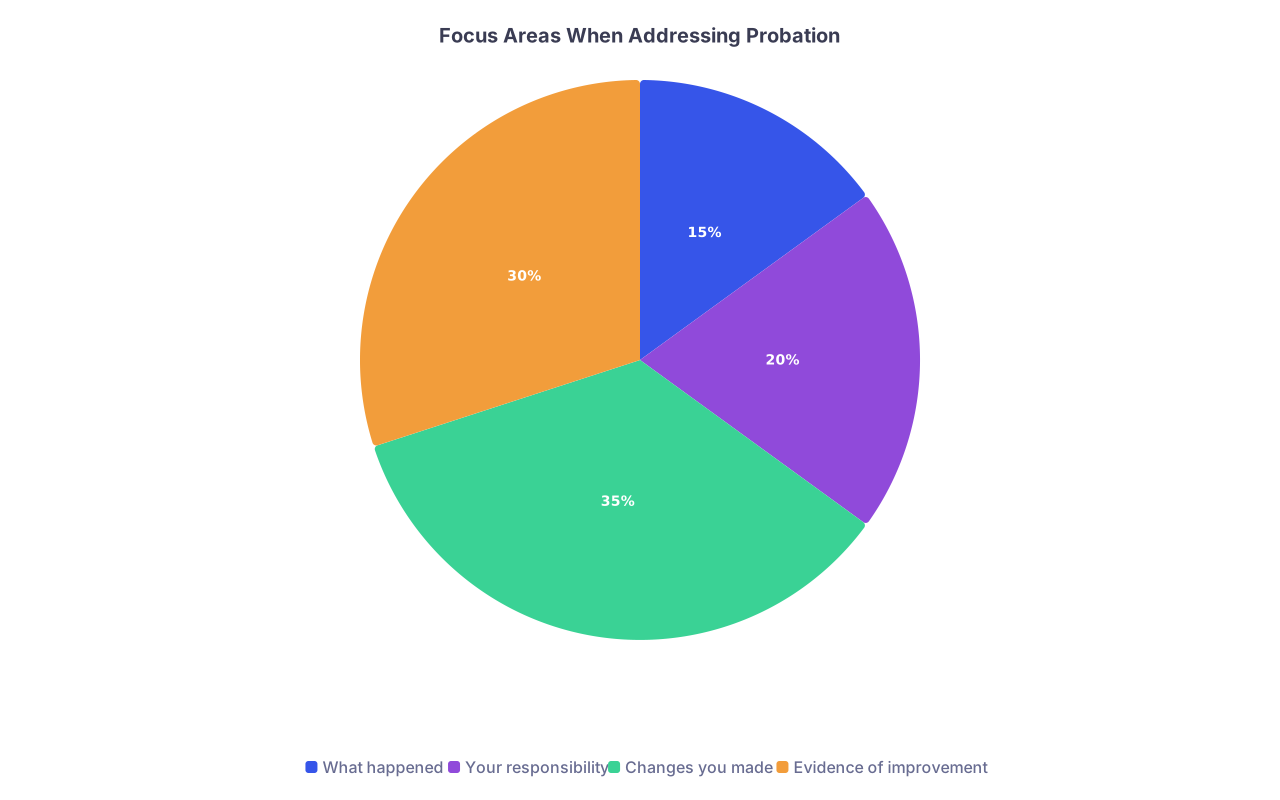
| Category | Value |
|---|---|
| What happened | 15 |
| Your responsibility | 20 |
| Changes you made | 35 |
| Evidence of improvement | 30 |



FAQ (Exactly 5 Questions)
1. Do I absolutely have to mention academic probation in my personal statement?
Not always. You must address it somewhere if it appears in your MSPE or transcript. If there’s a dedicated question in a supplemental application, that’s the best place. In the personal statement, keep it brief and in the middle, not as the opener or closer. If your dean confirms it’s not being reported and it didn’t affect your timeline, you may not need to mention it at all.
2. How long should my probation explanation be in the personal statement?
Aim for 4–8 sentences. That’s typically one short paragraph. Long enough to give clear context, ownership, changes, and evidence of improvement—but short enough that it doesn’t dominate your story. If you need more space, put the detail in a supplemental essay and keep the PS reference tighter.
3. Will academic probation automatically prevent me from matching?
No. I’ve seen applicants with probation match into solid programs—sometimes even competitive ones—when the rest of the application was strong and the trajectory after the incident was clearly upward. What kills chances is a pattern of issues, poor Step 2, weak clinical performance, or evasive explanations. A single, well-addressed probation with strong later performance is survivable.
4. Should I mention mental health or family issues as part of the explanation?
Yes, if they were a real factor and you can describe them briefly and professionally. You don’t need graphic detail or a full personal history. The key is to show that you recognized the problem, got appropriate help, and now have stable supports and functioning. Programs don’t expect you to be superhuman; they expect you to manage your life and health responsibly.
5. How do I know if my explanation sounds too defensive or too apologetic?
Read it out loud to yourself first. If it sounds like a legal defense or a tearful confession, it’s off. Then have a faculty mentor or dean read it and ask them directly: “Do I sound defensive or like I’m begging for forgiveness?” You want the tone to be: calm, factual, accountable, forward-looking. One clear paragraph that makes them think, “They get it. They fixed it. Moving on.”
Key takeaways:
- Don’t hide probation, don’t dramatize it—acknowledge it clearly, own your role, and move on.
- Show concrete changes and sustained improvement; programs care more about your trajectory than your low point.
- Align your story across PS, supplements, and interviews so you come across as exactly what you want to be seen as: a thoughtful, reliable adult who’s already learned from the hardest lesson.