It’s late November. You’re between interview days, you finally have a second to breathe, and you pull up your ERAS application “just to look it over.”
You read your personal statement. Then you scroll through your CV. And your stomach drops.
You realize that the “longstanding passion for underserved primary care” you wrote about… conflicts with two summers of boutique derm research, a plastics sub-I, and a case report in rhinoplasty. Or you told a dramatic story about an ICU rotation that “changed your career path” that doesn’t even appear in your experience list. Or the volunteer narrative you leaned on heavily? The actual hours and dates on your CV do not back it up. At all.
You’re thinking: “Did anyone notice? Do programs actually cross-check this stuff? Will this tank my application?”
Let me tell you what really happens behind those doors.
How PDs Actually Read Your Application
Here’s the part applicants rarely understand: most program directors and faculty are not reading your documents like a college English professor grading an essay. They’re doing pattern recognition at high speed. They’re hunting for coherence.
They’re subconsciously asking three questions:
- Does this story match the data in front of me?
- Does this person seem honest and self-aware?
- Do I believe they actually want this specialty and this kind of program?
They’ve been doing this for years. Some for decades. The good ones can smell inconsistency by the second paragraph.
The workflow is usually something like this:
- First pass: scores, school, red flags, obvious standouts.
- Then: quick scan of CV and experiences.
- Then: personal statement, often right before deciding on interview or when prepping for your interview.
- During interview prep: they pull your PS and CV side by side and mark anything “weird.”
And yes, they absolutely compare what you say in the personal statement with what your CV actually shows.
I’ve watched PDs circle sentences on a printed PS and then literally write in the margin: “Not supported on CV.” That’s the kiss of death for trust. They may still rank you. But you’ve already dropped a few spots.
The Main Ways Your PS and CV Clash (That PDs Notice Immediately)
Let’s walk through the main conflict types, because I’ve seen the same mistakes over and over.
1. The “Passion” That Your CV Doesn’t Support
Classic move: “I’ve always known I wanted to work with underserved communities.”
Then the CV shows:
- No FQHC rotations
- No free clinic volunteering
- No global health work
- Research in private hospital settings only
- Leadership in Dermatology Interest Group and Plastics Club
You might get away with this in undergrad. Residency PDs are not that naive.
They won’t always say it out loud, but the thought is: “If this was your passion, why doesn’t it show up anywhere in 4 years?” They don’t need your entire CV to be perfectly aligned. But they expect some evidence.
The more competitive the specialty, the harsher this judgment is. In dermatology, ortho, plastics — the bar for coherence is higher. In family or psych, they may be more forgiving, but not blind.
2. The Dramatic Story That Never Happened (On Paper)
You open with an emotional, vivid clinical story on your ICU month. It’s the pivot moment of your statement. Beautifully written.
Then someone flips through your CV and… there is no ICU rotation listed. Or the ICU month happened as a fourth-year elective in September, but you’re claiming it was the moment that “solidified your decision” way back in second year. The dates don’t fit.
Faculty catch that stuff. They’re used to residents fudging timelines about QI projects and research. They’re sensitive to it.
Are programs assuming you’re lying? Not immediately. But they start a mental file: “exaggerates,” “fluffy,” “narrative > reality.” That file absolutely affects rank decisions when they’re splitting hairs between you and the next candidate.
3. The Sudden Specialty Pivot With No Bridge
You wrote a personal statement that screams “I am born to be an internist.” Longitudinal primary care clinic, chronic disease management stories, role models in IM.
Your CV?
- Two ortho sub-Is
- Spine research for 2 years
- A first-authored paper in JBJS
- Presentations at AAOS
The PD sees it and thinks: “This person wanted ortho. Something went wrong.” That doesn’t automatically disqualify you, but it forces a question: Was this a considered decision or a desperation pivot?
Here’s the inside piece: many PDs will actually respect a pivot — if you explain it honestly and your CV shows a believable transition. They do not respect pretending you’ve always wanted what you obviously didn’t.
4. Timing and Hours That Don’t Match the Narrative
Another classic: “For the last four years, I’ve devoted my weekends to hospice volunteering.”
Then your CV lists the role as:
“Hospice Volunteer, 06/2023–08/2023, 3 hrs/week.”
That’s not four years. That’s one summer.
You’d be stunned how many applications have this exact kind of inflation. Most of it isn’t malicious. It’s sloppy storytelling. But PDs don’t have the time or generosity to distinguish. They just see “embellishes.”
Once that word is in their head, it’s nearly impossible to erase.
5. The Personality Mismatch
This one is subtle but lethal.
Your personal statement paints you as humble, reflective, collaborative, “I love feedback.” The PS is all about growth and vulnerability.
Your CV, on the other hand, is loaded with:
- “Founder and President” of multiple groups that last one year
- “Spearheaded,” “single-handedly,” “personally led” everything
- A dozen leadership titles, very little continuity
- Zero activities where you were clearly a small part of a bigger team
Then you show up to the interview sounding… overly polished, slightly rehearsed, and deflective about weaknesses.
Faculty pick up on that mismatch between “how you describe yourself” and “what your track record actually looks like.” They may not articulate it, but the gut sense is: something doesn’t fully line up.
What Happens in the Room When They Spot a Conflict
Let me walk you into the conference room where rank lists are made. You need to understand the psychology.
Programs often have something like this: a stack (or folder) of applicants. Each faculty member has scribbles on your PS, your LORs, maybe your CV.
When a conflict is obvious, someone will say it.
I’ve literally heard:
- “Her statement says she loves inpatient, but look at her schedule — all outpatient, all lifestyle-heavy electives.”
- “He claims this global health work changed his life, but it’s a one-week trip. Come on.”
- “This reads like a neurosurgery statement that got hastily edited to say ‘neurology’ instead.”
- “Beautiful essay. But I don’t see any of this reflected in what he actually did.”
Sometimes they shrug and still rank you high if the rest of the file is strong. But if they have any reservations about fit, professionalism, or honesty, those conflicts become ammunition to push you down the list.
The phrase you never want associated with you is: “I don’t fully trust this application.”
Not “I don’t think they’re smart enough.” That you can occasionally overcome. But a whiff of dishonesty? Hard to recover.
The Quiet Ways This Hurts You on Interview Day
Even if your conflicts don’t kill your interview chances, they bleed into how your interview day goes.
Here’s how:
Targeted Probing
Faculty are not stupid. If something feels off, they probe it.
You’ll get:
- “Tell me more about your interest in underserved care. What have you actually done in that area?”
- “You mentioned ICU being central for you — when did that rotation happen?”
- “You talk about mentorship a lot. Who have you mentored, exactly?”
- “I see a lot of ortho work here. Help me understand your journey to internal medicine.”
They’re not just making conversation. They’re stress-testing whether your PS is authentic or decorative.
You can feel that shift when it happens. The interview stops being a friendly chat and becomes more like a gentle cross-exam.
Cognitive Dissonance
When your PS says one thing and your body language or stories say another, faculty leave the room with an odd, slightly uneasy feeling.
The internal monologue sounds like: “I wanted to like them, but something didn’t quite match. I can’t put my finger on it.”
That “can’t put my finger on it” is almost always some kind of narrative/CV mismatch they haven’t consciously named.
People don’t fight for those applicants on rank day.
What You Should Do If You Already Have Conflicts
Now to the part you actually need: what to do when you realize this late in the game.
Step 1: Identify the Category of Conflict
Be blunt with yourself. Which bucket are you in?
| Conflict Type | Core Problem |
|---|---|
| Unsupported Passion | Claims not reflected in activities |
| Timeline Mismatch | Dates/hours contradict narrative |
| Specialty Pivot | Past focus different from current PS |
| Exaggerated Impact | Role overstated vs. actual position |
| Personality Inconsistency | Self-description vs. track record |
Knowing which type you’ve got tells you how to fix, frame, or at least contain the damage.
Step 2: Decide: Fix Quietly vs. Address Directly
There are basically three paths.
Quiet correction moving forward
You adjust how you talk about it in interviews. You stop parroting the problematic phrasing. You refine the story verbally to align with the actual CV.Direct explanation when asked
When someone probes — and they will — you give a clean, honest, concise explanation that bridges the conflict rather than dodging it.Rare case: official correction
For serious factual errors (wrong dates, missing experiences, or truly misleading statements), some applicants email programs or update ERAS addenda. That’s not common and should be done carefully; amateur apology tours look worse than the original problem.
Step 3: Rewrite the Story in Your Own Head
The gap between PS and CV often exists because you wrote the PS to impress, not to reflect reality. So now you need a new internal narrative that’s actually true.
Example:
- Old version: “I’ve always been passionate about primary care for underserved populations.”
- Reality: You figured this out late, after trying for derm.
- New honest version:
“I took a longer route here than some of my peers. I initially thought I wanted a more procedural, outpatient specialty. Over time, I realized what actually energized me were longitudinal relationships and complex medical decision-making. My experiences in X and Y helped me shift toward primary care with my eyes open, not by default.”
That’s believable. Faculty can work with that. It respects their intelligence.
Step 4: Build Verbal Consistency
From here on out, everything that comes out of your mouth in interviews should match:
- Your ERAS dates and hours
- The actual scale/impact of your projects
- The genuine timeline of your specialty decision
You don’t need to call attention to the old PS phrasing. Most interviewers will not have your PS memorized. They just remember the flavor. As long as your live story feels coherent, a lot of minor written conflicts fade.
How to Avoid Conflicts in the First Place (What Insiders Wish You Knew Earlier)
If you’re pre-writing for next year or still drafting, pay attention here. This is what we wish applicants understood before they ever hit “submit.”
Rule 1: Do Not Write Aspirational Fiction
Do not write the version of yourself you wish you were. Write the best, honest version of who you actually are on paper.
Your “passion” should be something your CV can defend in court. That does not mean every line of your CV must line up. But when you say:
- “I care deeply about X,”
you should be able to point to at least one sustained, concrete activity that supports it.
Rule 2: Timeline Test
For every major claim in your statement, ask:
“Can someone verify the timing of this from my ERAS?”
If you write “early in medical school,” it better not be an M4 rotation. If you say “during my pre-clinical years,” don’t base it on a sub-I. It sounds pedantic, but faculty do notice.
Rule 3: Magnitude Test
Any time you’re tempted to use big words — “devoted,” “immersed,” “transformed my trajectory” — check the magnitude on your CV.
A 10-hour shadowing experience shouldn’t be portrayed like a six-month commitment. A single poster should not become “a series of national presentations.”
Here’s what faculty think when they catch these mismatches: “If they exaggerate in small things, will they overcall consults? Will they misrepresent to patients? To me?”
Rule 4: Specialty Fit Across Documents
Your PS, experiences, and letters should all be singing roughly the same song about who you are and what you want.
Not identical lyrics. Same album.
If your CV is full of surgery, but you’re applying to IM, then you build a bridge in the PS and in interviews:
“I loved the technical side of surgery, but what pulled me more was the cognitive, diagnostic work, and the chance to follow patients over time.”
That’s how adults explain change. PDs respond well to that.
A Quick Reality Check: What Actually Gets You Tossed vs. Just Questioned
Let me be blunt.
You will not get automatically rejected because your PS says you love underserved care and your CV is light on it. Plenty of applicants get away with softer conflicts.
The things that really hurt you are:
- Factual contradictions about dates, hours, or roles
- Emotionally manipulative narratives that don’t match the scope of the experience
- Specialty commitment claims that completely ignore an obvious prior trajectory
- Statements that feel dishonest when compared to your letters (this one stings — faculty know when another attending is sugar-coating)
On the other hand, you can survive:
- Slight over-enthusiasm (“that rotation was especially meaningful”)
- Evolving interests as long as you tell the truth about the evolution
- A non-linear path if you own it and connect the dots
What PDs are really screening for is integrity and self-awareness. You can absolutely show both even with a messy story.
Visual: How Often Conflicts Actually Matter
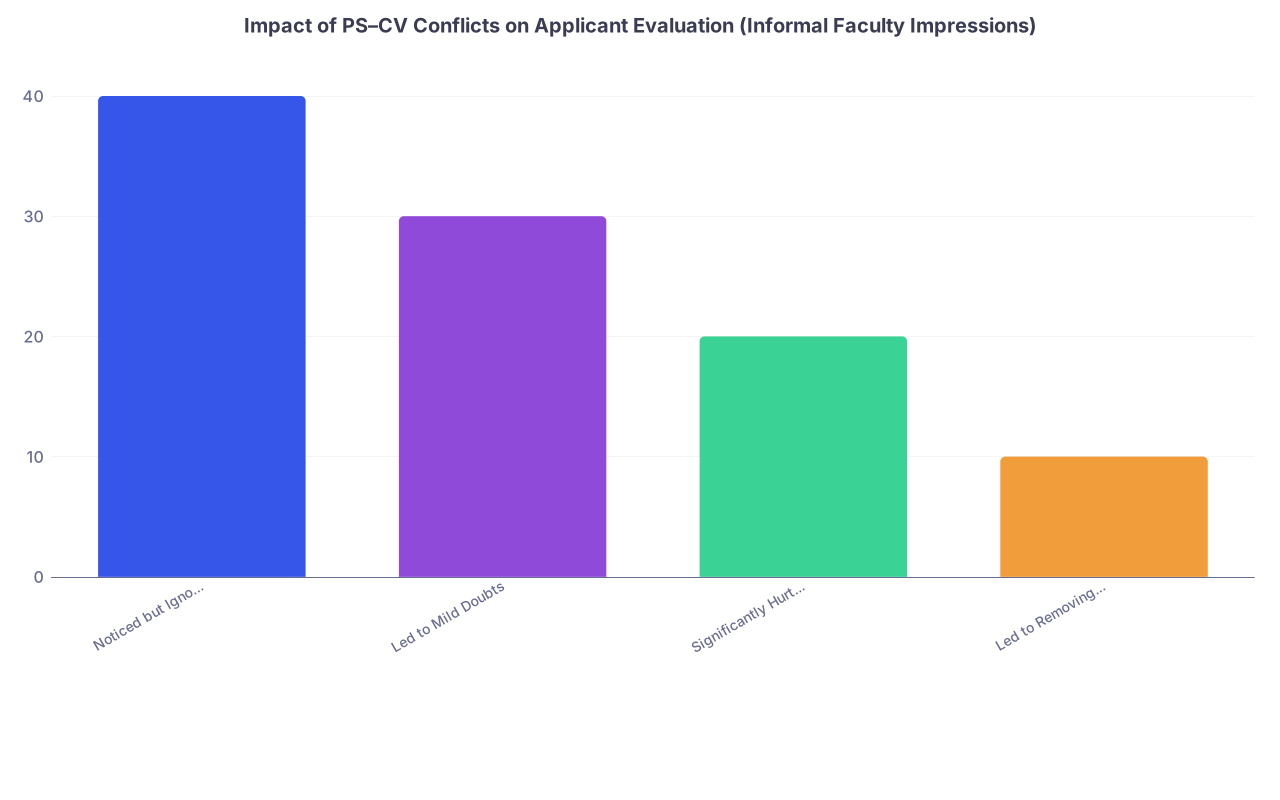
| Category | Value |
|---|---|
| Noticed but Ignored | 40 |
| Led to Mild Doubts | 30 |
| Significantly Hurt Ranking | 20 |
| Led to Removing from Rank List | 10 |
These are not hard data; they’re roughly what you’d get if you asked a room of faculty how often conflicts change their decision. Most of the time, it’s a small nudge, not a guillotine. But that 20–30% where it actually shifts your position? That’s the difference between matching at your #3 vs #9. Or not at all in a tight year.
How to Answer When They Confront the Mismatch Directly
You’re in the interview. The question comes:
“I noticed your CV has a lot of [X], but your personal statement emphasizes [Y]. Can you talk about that?”
Here’s the structure that works. I’ve seen it de-escalate suspicion in real time.
Acknowledge, do not dodge.
“You’re right, that’s a fair observation.”Give the real timeline in one or two clean sentences.
“I started out very focused on [X] because of [brief reason]. Over time, through [specific experiences], I realized I was more drawn to [Y].”Connect your past to your present choice.
“The work I did in [X] actually helps me now, because it gave me [skills/perspective]. But I see my long-term home in [Y] for [concrete reason].”End with a grounded, specific future orientation.
Not “I just love helping people.” Something like:
“In the next few years, I’d like to develop as a clinician-educator in [Y] and stay involved in [related activity] to keep that original interest alive in a way that fits this specialty.”
What you do not do: pretend the conflict doesn’t exist, blame others, or get defensive. PDs are allergic to that.
FAQ (Exactly 3 Questions)
1. Should I email programs if I realize there’s a factual inconsistency between my PS and CV after submission?
Only if it’s a serious, objective error that could be seen as dishonesty — wrong role, wrong dates by years, claiming you did something you truly did not. For smaller narrative exaggerations or tone issues, do not spam programs with corrections; you’ll draw more attention to the problem than they would have given it. Instead, tighten your verbal story for interviews so it’s accurate, grounded, and consistent with the CV they see.
2. Can I reuse a specialty-specific personal statement if I pivoted late but didn’t fully change my activities?
You can, but only if you revise the statement to explicitly acknowledge the pivot and connect your previous focus to your current choice. If you simply find-and-replace “surgery” with “internal medicine,” faculty will notice. Your CV is the paper trail of your true priorities over time. The PS should explain, not erase, that history.
3. What if my strongest story doesn’t appear clearly as an item on my CV?
You can still use it, but you need to anchor it to something verifiable: a specific rotation, clinic, elective, or role that is listed. Do not build your entire statement around a vague, undocumented “experience” that has no footprint. Mention the rotation or setting clearly enough that faculty can tie it to your ERAS, even if the exact patient or scenario isn’t documented. That way, it feels like a deep dive into a real part of your record, not a freestanding piece of fiction.
Bottom line:
- Program directors are not just reading your personal statement; they’re cross-checking it against your CV for coherence and honesty.
- Conflicts don’t always kill your application, but they absolutely erode trust and can drag you down the rank list when it matters.
- The fix is not better “spin.” It’s aligning your story with your actual record and being bluntly honest about how you got from there to here.