Most program directors don’t read your personal statement. They interrogate it.
They’re not sitting there admiring your prose. They’re scanning for subtext: red flags, ego problems, lack of self-awareness, evidence of maturity, and whether you’re going to be a pain at 2 a.m. on call. Let me walk you through what they’re actually seeing while you’re busy obsessing over your “I knew I wanted to be a doctor when…” opening line.
I’ve sat in rooms where a PD read a single sentence out loud, smirked, and said, “This guy is going to be exhausting,” and that applicant was effectively done. Not because of a typo. Because of what that sentence revealed about who they’d be in a residency.
You think you’re telling a story. They’re reading a psych profile.
How PDs Actually Read Personal Statements
Here’s the first truth: most PDs and faculty don’t read your statement linearly from top to bottom. They skim in layers.
They’re asking, in order:
- Does this feel like a normal, stable human being?
- Do I see any red flags or weirdness?
- Is there any positive signal above the noise—maturity, insight, resilience, good team dynamics?
- Does this fit my program’s culture and needs this year?
They’re not giving you style points for your metaphor about “stitching lives back together like the lacerations I repaired.” They’re asking: is this person grounded or self-dramatizing?
And yes, they are judging you based on things you didn’t realize you were revealing.
What Your Tone Secretly Tells Them
PDs read hundreds of these things. They get very good at hearing tone through the page. Let’s break down what’s going through their head.
1. The “Hero Complex” Tone
You write:
“I knew in that moment that I had found my calling: to save lives and advocate for those who could not advocate for themselves.”
What they hear:
- Main character energy.
- Possibly self-centered.
- May struggle with team-based care and hierarchy.
- May overestimate their own impact.
If your statement is full of “I saved,” “I fixed,” “my patient,” “I realized I was meant to,” without any real acknowledgment of the team, supervision, or limitations of your role, PDs quietly slide you into the “ego risk” bucket.
Programs have been burned before. They’ve taken on the “hero” who argues with nurses, ignores instructions, and melts down when they’re no longer the star student but the least experienced resident on the team. They learn to sniff this out early.
Stronger subtext:
- “Under the guidance of my senior and attending…”
- “I watched my team navigate…”
- “I learned how my small actions—calling the family, following up labs, reassessing one more time—fit into something bigger.”
Humility with competence. That’s the balance they’re looking for.
2. The “Trauma Dump Without Insight” Tone
You write about a personal loss, illness, or major adversity. Very common. But you focus 90% on the event and 10% on what you actually learned or how it changed your behavior.
What they hear:
- Is this person still processing this?
- Will they decompensate when exposed to similar situations?
- Are they going to need more emotional support than our program realistically provides?
The problem isn’t adversity. PDs respect hardship. The problem is unprocessed adversity. If the statement reads like a therapy session, you’ll make people nervous.
They read between the lines for:
- Time distance: Has this been processed over years or is it clearly raw from last year?
- Narration vs re-living: Are you describing and analyzing, or reliving in dramatic, emotional detail?
- Agency: Are you stuck in what happened to you, or what you did with it?
If you’re going to include something heavy, you must show: emotional stability, growth, and how it concretely shapes how you show up as a team member or physician.
Otherwise, it looks like unresolved baggage, not resilience.
3. The “Polished but Empty” Tone
You write flawless, generic, beautifully structured prose that could belong to 10,000 other applicants.
What they hear:
- Probably used a template.
- Competent but unmemorable.
- Does not help me rank them up or down.
- I still know nothing about who this person will be on rounds.
This is death by neutrality. No obvious negatives. But no compelling reason to advocate for you either.
And here’s the harsh part: in borderline rank discussions, it’s the applicants that made some real impression—good or occasionally even slightly controversial—who get talked about. The “well-written but generic” statements are forgotten. Fast.
The fix isn’t to be dramatic. It’s to be specific. Generic = safe but invisible. Specific = human, and therefore memorable.
The Signals They Scan for in Your Stories
PDs don’t just read what happened. They read what you chose to notice, and what you took away from it. That’s where your real evaluation happens.
Let me show you the subtext they’re tracking.
| Surface Feature | What Weak Applicants Signal | What Strong Applicants Signal |
|---|---|---|
| Patient story | Self-dramatizing, vague role | Clear role, appropriate boundaries |
| Discussing team | “I outshone others” vibe | Respect for nurses, residents, attendings |
| Failure / mistake | Defensiveness, blame | Ownership, learning, system awareness |
| Personal adversity | Trauma dump, no resolution | Processed, integrated, mature perspective |
| Career goals | Unrealistic, buzzword-heavy | Grounded, tied to actual experiences |
The Patient Story Trap
The most overused structure:
“Patient X came in with [insert condition]. I was struck by [suffering]. I [insert action]. I realized [insert generic epiphany about medicine].”
On the surface, it’s fine. Underneath, faculty are asking:
- Did you clearly state your actual role, or are you inflating what you did?
- Are you revealing boundaries? Did you understand what was appropriate for your level of training?
- Did you learn something beyond “I like helping people and medicine is powerful”?
Red flag example:
“I knew I had to advocate for my patient, so I demanded the team reconsider the plan.”
That single sentence got an applicant shredded in a committee room I sat in. The attending said, “So as a student, they ‘demanded’ that I reconsider the plan? Hard pass.”
What they wanted to see instead was something like:
“I was uneasy about the plan. I discussed my concerns with the resident, trying to understand the reasoning. As we talked it through, I began to see…”
Same concern. Different tone. Shows respect for hierarchy, curiosity, humility.
What Your Structure Reveals About How You Think
PDs love pattern recognition. They spot cognition in your writing structure.
The Wandering, Unfocused Narrative
If your statement:
- Starts with childhood, jumps to undergrad research, jumps again to your mom’s cancer, then ends with “I like variety,”
- Uses transitions like “Another important experience was…” repeatedly,
- Spends equal time on irrelevant ancient history and current motivations,
Then you’re signaling disorganized thinking. And that matters. Because scattered narrative often mirrors how you’ll present on rounds.
I’ve heard an APD mutter: “If this is how they organize one page about themselves, I don’t want to hear their 10-minute presentation on new onset heart failure.”
Your statement doesn’t need to be perfect, but it should show:
- You know what’s central to your story and what’s background
- You can sustain a thread instead of lurching across topics
- You understand relevance: you pick details that connect to your specialty and training
The Over-Engineered “Theme”
Some advisors push you to pick a “theme” and hammer it to death. “Thread your love of running through your entire personal statement!” they say.
Done well, it can work. Done badly, it looks contrived and immature.
If you stretch some hobby metaphor through every paragraph, PDs can feel the effort. It reads like you prioritized cleverness over substance. I’ve watched people read these and roll their eyes: “We get it. You like rock climbing. Tell me something about residency.”
They’re reading for whether you can communicate like a resident: clear, direct, purposeful. Not like a college admissions essay.
The Red Flags Hidden in “Harmless” Lines
Let me be blunt. These are the kinds of things that quietly kill you and you never hear about it.
1. The Martyr Line
“I always put my patients ahead of my own needs.”
They hear:
This person has terrible boundaries, is at risk for burnout, and will probably neglect their own rest and safety. Bad fit for a high-intensity program.
Stronger alternative:
“I’ve learned to care deeply for patients while also respecting my own limits and the importance of rest and teamwork.”
2. The Subtle Complainer
“I often found myself frustrated that others did not care as much as I did.”
Or: “I sometimes struggled with team members who did not share my work ethic.”
PDs have zero appetite for this. It reads as judgmental and oblivious to the complexity of team dynamics.
They assume you’re going to complain about nurses, night float, consults, everyone. Residents who create drama are poison. They’d rather take someone a bit green but collaborative than a genius with resentment issues.
3. The “I, I, I” Page
Count your sentences. If nearly every one of them starts with “I,” you’ve got a problem.
It reads as self-focused and tone-deaf. PDs want people who see systems, teams, and context.
You don’t fix this with pronoun gymnastics. You fix it by actually writing about:
- What others taught you
- How your actions fit into a broader team effort
- What you noticed about systems and patients beyond yourself
4. The Overcompensation for a Weakness
Students with lower scores or leaves of absence sometimes write statements that scream, “Please forgive this.” Every paragraph circles back to how hard they work now, how dedicated they are, how much they’ve overcome.
PDs notice the repetition. It makes them think there’s more under the surface, or that you’re excessively defined by that weakness.
Address issues cleanly in one focused section, own them, show concrete change, and move on. Lingering is what raises eyebrows.
Specialty-Specific Subtext: How Fit Gets Read
No, they don’t just read for “good/bad.” They read for fit—especially in competitive specialties.
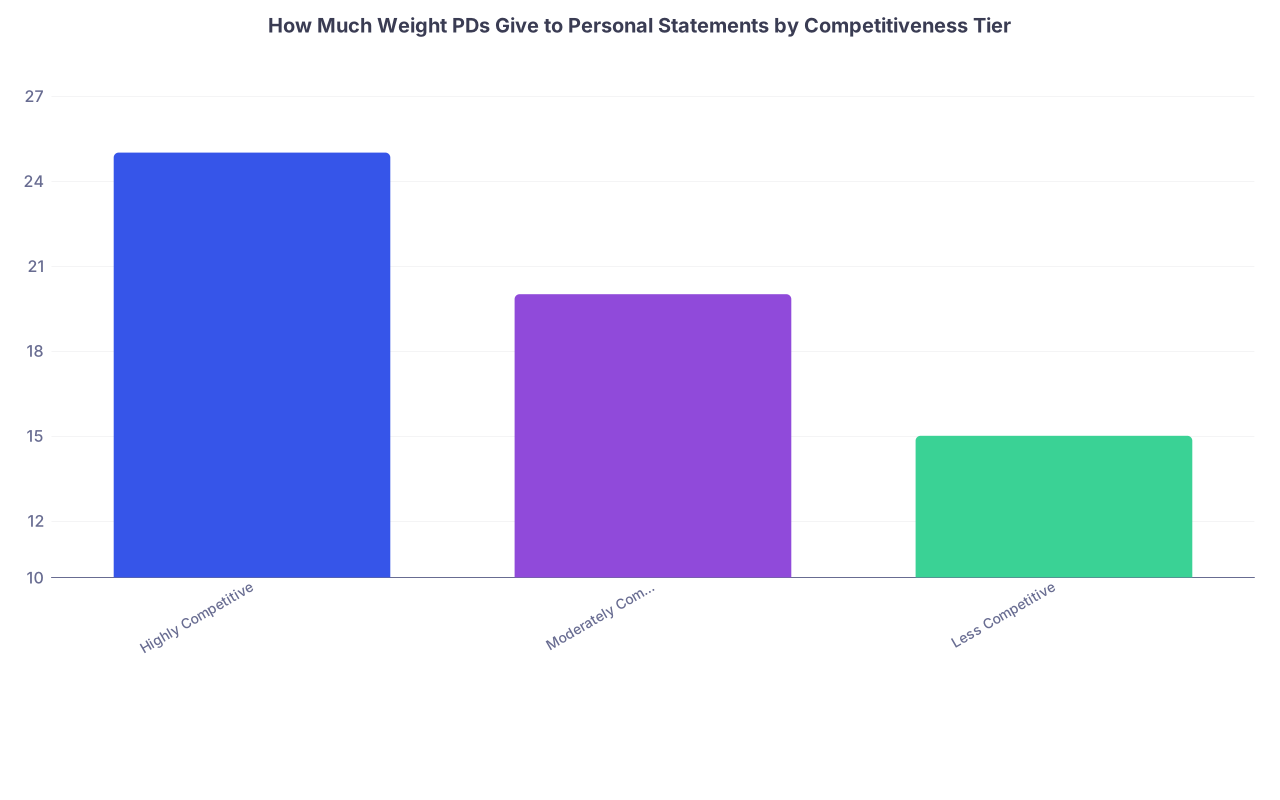
| Category | Value |
|---|---|
| Highly Competitive | 25 |
| Moderately Competitive | 20 |
| Less Competitive | 15 |
Yes, numbers are approximations. But the hierarchy is real: in more competitive fields, the statement doesn’t save a terrible app, but it sure can sink a borderline one—or give a small boost to someone on the bubble.
Surgery
They’re reading for:
- Grit without masochism
- Coachability
- Team orientation (yes, even in surgery)
- Respect for hierarchy without being a doormat
If you emphasize “independence” too much, that’s a red flag. Surgery wants people who will follow protocols and channel their drive inside a strict system.
Psychiatry
They’re reading your emotional insight like a diagnostic interview.
Red flags:
- Overly dramatic psych stories
- Boundary violations (e.g., extensive self-disclosure to patients)
- Poor reflection on your own inner world
- Glamourizing mental illness or over-identifying with patients
They want to see that you understand transference, boundaries, complexity. Not that you think psychiatry is “interesting” because “the mind is a mystery.”
Pediatrics
They’re reading for warmth plus backbone. If your entire statement is saccharine and child-focused with no evidence you can handle difficult parents, late nights, or serious illness, you look naïve.
They want people who can say: “This broke my heart” and “Here’s how I kept functioning and supporting the team anyway.”
Internal Medicine / Family Medicine
They’re scanning for:
- Longitudinal thinking
- Comfort with complexity and uncertainty
- Ability to work with a wide range of patients and disciplines
If you sound impatient with complex social factors or frustrated with “noncompliant” patients, they will absolutely notice. And they will not reward it.
Hidden Green Flags PDs Quietly Love
You want to know what actually makes faculty eyes light up?
Not poetry. Not your “unique” origin story. Things like:
- A concrete example of a time you received tough feedback and changed your behavior
- Honest acknowledgement: “I was initially overwhelmed by…” followed by how you adapted
- Clear understanding of what residency actually is (work, not vibes)
- Respectful shoutouts to mentors, nurses, residents—without name-dropping prestige
- Realistic, grounded future goals tied to work you’ve already started
One APD I know regularly boosts applicants who show one specific trait: accountability. A line like:
“I missed an early sign of deterioration in a patient. Though my attending ultimately made the decisions, I carried that with me. I sought out additional teaching, started a habit of structured re-assessment, and I’ve become quicker to ask for another set of eyes when unsure.”
That’s catnip. Because everyone screws up. The ones who can own it and systematically improve are gold.
How to Rewrite Your Statement with PD Eyes
If you want a practical exercise, do this:
- Print your statement.
- Take a pen and, in the margins, write what a cynical PD might think about each paragraph. Not what you meant. What it could imply.
- Look for spots where it could read: arrogant, vague, unprocessed, overdramatic, generic, self-pitying, or oblivious to team dynamics.
- Rewrite those lines so the subtext says: self-aware, grounded, team-oriented, resilient, coachable.
It’s not about being paranoid. It’s about recognizing that in a pile of 800 statements, they’re not grading your English. They’re hunting for signals.
You control more of those signals than you think.
FAQs
1. Do PDs actually care about the personal statement, or is it just a formality?
They care selectively. Many will skim past most average statements. But they absolutely care when something stands out—positively or negatively. The statement rarely gets you an interview by itself, but it does get used as a tie-breaker, a personality check, and a red-flag detector. And it matters more in borderline and holistic review cases.
2. Is it safe to talk about mental health struggles in my personal statement?
It can be, but only if it’s clearly processed and stable. You need time distance, evidence of functioning, and a calm, non-dramatic tone. If it reads like you’re still in crisis, or if your entire identity is wrapped around the struggle, PDs will worry about your ability to handle residency stress. Often it’s better in an addendum or discussed briefly with strong emphasis on treatment, support, and sustained recovery.
3. How many patient stories is too many?
Usually more than one is too many. One well-chosen, well-analyzed patient story beats three shallow ones. If every paragraph is a different patient, it feels like a highlight reel instead of a coherent narrative. PDs want to see how you think about experiences, not how many you’ve collected.
4. Should I tailor my personal statement to specific programs?
You won’t realistically customize for 60 programs, but you should tailor it to the specialty and avoid generic “any field” language. For a small number of top-choice programs, a short, specific line about why their philosophy or structure fits you can help—if it’s clearly genuine and based on real knowledge, not flattery. Don’t force it if you’re just guessing.
5. Can a great personal statement overcome a low Step score or weak grades?
No. It can’t erase hard filters. But it can absolutely move you from “maybe” to “yes” in holistic programs, or convince a PD to take a chance on you if there’s a plausible narrative of growth and accountability. Think of it this way: it won’t rescue a fatally weak application, but it can rescue a risky but interesting one—and that’s often enough.
Remember:
- PDs read your personal statement for subtext, not style.
- Your tone, structure, and choice of stories silently advertise your maturity—or your lack of it.
- If you write with their real concerns in mind—ego, resilience, team fit—you stop sounding like everyone else and start sounding like someone they can actually trust on their service at 3 a.m.