
The belief that your residency personal statement must either be “vulnerable” or “safe” is wrong.
You do not need a tear-jerker. You need controlled honesty with professional judgment.
Let me be direct:
The problem isn’t vulnerability. The problem is unedited vulnerability, dumped on the page without thinking like a physician applying for a job.
You’re not writing in your journal. You’re writing for attendings, program directors, and faculty who are asking one core question:
“If I put this person in my program, will they be stable, teachable, and safe with patients at 3 a.m.?”
Everything about vulnerability vs. safety has to serve that question.
The Real Question: Does Vulnerability Help or Hurt Your Application?
Vulnerability helps if it does three things:
- Shows growth and insight.
- Demonstrates resilience and professionalism.
- Connects to why and how you’ll be a better resident or physician.
Vulnerability hurts when it:
- Centers trauma without clear resolution.
- Raises red flags about reliability, stability, or judgment.
- Feels like a therapy session instead of a professional narrative.
Programs are not afraid of applicants who have struggled.
They are afraid of applicants who are currently unstable or unaware of their own limits.
So the question is not “vulnerable or safe?”
The question is: “Does this detail make a reasonable reader more confident in me—or less?”
A Simple Framework: Green, Yellow, and Red Topics
Here’s the decision framework I use with residents and applicants who ask me exactly this question.
| Level | Topic Type |
|---|---|
| Green | Safely professional |
| Yellow | Use with careful framing |
| Red | Usually avoid |
Green-Light Vulnerability (Usually Safe, Often Powerful)
These topics, when handled well, almost always help you:
- Struggling with impostor syndrome early in training, and how you developed confidence.
- A difficult rotation or failure (e.g., needing to remediate a clerkship or exam) that led to concrete change.
- Burnout risk signs you noticed in yourself and addressed with boundaries and support.
- Caring for a challenging patient or family that forced you to confront your biases, assumptions, or limitations.
- Being a first-gen student, working through financial strain, language barriers, or systemic obstacles—with a clear arc of adaptation and success.
Key:
You describe a real challenge, show what you actually did about it, and make it obvious you’re functioning at a high level now.
Yellow-Light Vulnerability (Handle With Surgical Precision)
These can help, but only if they’re presented with a lot of maturity and distance:
- Death of a close family member or loved one.
- Your own mental health diagnosis (anxiety, depression, ADHD, etc.).
- A serious personal illness or chronic condition.
- Family dysfunction, instability, or difficult upbringing.
- Prior academic/professional setbacks beyond the usual.
Faculty do not automatically reject you for these. I’ve seen applicants match well with all of them on the page.
But they will ask themselves:
- Are you stable now?
- Do you have insight and treatment/support?
- Are you likely to decompensate under residency stress?
- Is this going to be a recurring crisis or a managed part of your life?
If you can’t clearly answer those questions on the page—without overexplaining—you should not center these topics.
Red-Light Vulnerability (Usually Not Worth It)
These are topics that almost always create doubts, not confidence:
- Detailed discussion of ongoing, severe mental health crises.
- Active substance use disorder without clear recovery and a long track record of stability.
- Legal issues, arrests, or professional misconduct that are not already forced into the open by your application.
- Graphic descriptions of trauma, abuse, or violence.
- Romantic relationship drama, breakups, infidelity.
- Blaming narratives: long rants about “toxic attendings,” “unfair systems,” or “terrible administrators.”
Can you ever mention some of these? Maybe. But if you’re at the point of asking whether to build your statement around them, the answer is almost always no.
How to Decide: A 5-Question Stress Test for Any Vulnerable Topic
Take the topic you’re considering and run it through this filter:
Time and distance
Has enough time passed that you can write about it calmly, without sounding raw or bitter?
If it still makes you want to write a rant, it does not belong in your statement.Stability now
Could you look a program director in the eye and say, “I’m stable, high-functioning, and these are the concrete steps I take to stay that way”—and mean it?
If yes, you might be able to include it. If no, do not.Relevance to being a resident
Does this experience change how you care for patients, work on teams, handle stress, or commit to your specialty in a meaningful way?
If not, it’s probably just personal content, not useful narrative.Growth and action
Can you clearly describe what you learned and what you do differently now?
“I became stronger” means nothing. “I learned to ask for early feedback and now schedule monthly check-ins with my seniors” means something.Program director test
If a risk-averse PD read this, would they feel more confident you’ll show up, do the work, and not implode?
If there is any real doubt, you cut or soften it.
If a vulnerable topic fails even one of these, do not build the statement around it. At most, mention it briefly, if required to explain a gap or red flag in your application.
What “Safe” Topics Get Wrong
On the flip side, applicants swing to the other extreme and choose “safe” topics that say nothing:
- “I have always loved science and helping people.”
- “During my internal medicine rotation, I realized the importance of holistic care.”
- Long, generic patient vignettes with no actual insight from you.
This is not safe. It’s bland. And bland hurts you because:
- You become indistinguishable from hundreds of other applicants.
- You waste your only real narrative space.
- You subtly signal that you either lack reflection or are hiding behind clichés.
The sweet spot is selective vulnerability:
- You share real moments of doubt, struggle, or imperfection.
- You anchor them in specific examples.
- You show reflection and concrete change.
- You connect them directly to who you are as a future resident.
That’s not “safe” in the boring sense. But it’s safe in the PD won’t panic sense.
Strong Examples vs. Bad Ones
Let me contrast this, because it’s easier when you see it.
Example of Effective, Controlled Vulnerability
You don’t write:
“I developed crippling imposter syndrome and thought I’d never be a good doctor.”
You write something like:
“On my first surgery rotation, I left the OR feeling like the slowest student in the room. For a week, I stayed quiet, took notes, and hoped no one would notice. My turning point came when my senior resident asked, ‘Why aren’t you speaking up? You’re not here to be invisible.’ I realized my fear of being wrong was getting in the way of learning. I started preparing two questions before each case and committed to answering at least one intraoperative question out loud, even if I was unsure. By the end of the month, I was still not the fastest, but I was engaged, and my feedback reflected that change.”
That’s vulnerability. But it shows:
- Self-awareness.
- Action.
- Improvement.
- A resident mindset.
Example of Vulnerability That Hurts
You write:
“I have always struggled with depression, which worsened in medical school. There were days I could not get out of bed, and I thought seriously about quitting. I am still working through these challenges and have good days and bad days, but I hope residency will give me the sense of purpose I need.”
A PD reads that and thinks:
- Is this person going to call out frequently?
- Are they depending on residency to “fix” them?
- Will they fall apart under call pressure?
Even if every word is true and human and fair—that version does not belong in your statement. That belongs with your therapist, your support system, your doctor.
How Deep Should You Go? Depth vs. Detail
Here’s the line:
You want emotional depth, not emotional detail.
Depth =
“I questioned whether I could handle caring for patients who reminded me of my own family, but supervision, reflection, and time taught me how to show up fully while having boundaries.”
Detail =
“For months after my father’s death, I had nightmares about the ICU, and every time I stepped into the hospital I felt nauseous and shaky.”
Depth shows insight. Detail can feel like oversharing.
If you feel yourself writing about bodily sensations, graphic moments, or specific traumatic scenes, you’re probably going too far for a professional statement.
What Programs Actually Need to Know (And What They Don’t)
- You can reflect on your experiences with some maturity.
- You’ve dealt with real challenges without losing professionalism.
- You understand your limits and use support systems.
- You’ll show up for patients and colleagues consistently.
Programs do not need:
- Every painful thing that’s ever happened to you.
- Your full mental health or family history.
- Detailed trauma narratives.
- Attempts to shock them into caring.
If you’re including a vulnerable topic primarily because you think it will make your essay “stand out” emotionally, don’t. That’s manipulation, not professionalism, and good readers can smell it.
When You Should Address Difficult Topics
Sometimes you don’t get to choose. A failed Step, a leave of absence, a gap, a major transcript issue—something is sitting in your application screaming for context.
In those cases:
- Address it briefly, factually, and maturely.
- Acknowledge your role without self-flagellation.
- Describe what you changed and how your performance improved afterward.
- Move on. Do not let it dominate the statement.
You’re not confessing. You’re explaining.
Practical Rules to Apply Today
Use these as hard filters when revising your draft:
- If a detail makes you think “This might freak someone out,” assume it will and cut or soften it.
- If you would feel uncomfortable answering a follow-up question about it in an interview, do not include it.
- If the only reason it’s in there is “this is the most painful thing I’ve ever experienced,” it’s probably not right for this essay.
- If you can’t clearly tie the experience to how you’ll function as an intern or resident, it’s filler.
And one more:
Ask one person inside medicine (resident, attending, advisor) and one outside medicine (smart non-medical friend) to read it and tell you:
“Does this make you feel more or less confident in me as a future doctor?”
If either hesitates, that’s your signal.
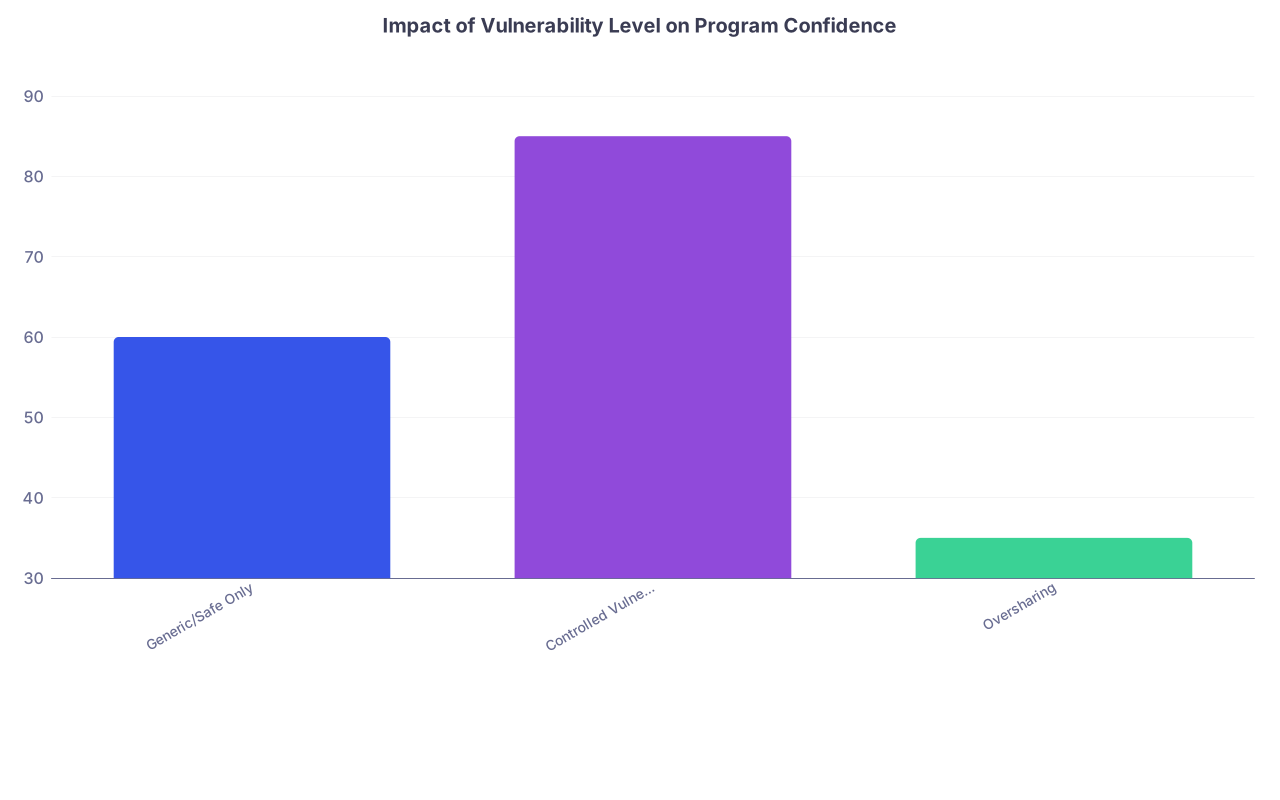
| Category | Value |
|---|---|
| Generic/Safe Only | 60 |
| Controlled Vulnerability | 85 |
| Oversharing | 35 |

| Step | Description |
|---|---|
| Step 1 | Consider vulnerable topic |
| Step 2 | Leave it out |
| Step 3 | Trim or reframe |
| Step 4 | Include briefly & professionally |
| Step 5 | Is it relevant to residency performance? |
| Step 6 | Are you stable & functioning now? |
| Step 7 | Can you show growth & actions? |
| Step 8 | Would a PD feel more confident reading this? |

FAQs: Vulnerability vs. Safe Topics in Residency Statements
Should I disclose my mental health diagnosis in my personal statement?
Usually no, not as a central theme. If it’s well managed, directly relevant (e.g., led you to psychiatry), and you can demonstrate stable functioning with concrete support systems, you might mention it briefly and in general terms. But understand that some readers are risk-averse. If in doubt, focus on how you cope with stress and maintain wellness without attaching labels.Can I talk about a family member’s illness or death?
Yes, if you: keep details non-graphic, show how it shaped your values or specialty interest, and make it clear you’re not still in acute crisis. The focus should not be on reliving grief; it should be on how the experience changed your approach to patients, communication, or resilience.Is it okay to talk about failing a course, exam, or needing remediation?
Yes—and sometimes it’s strategically smart, especially if the failure is already visible. Own it directly, avoid blaming others, and emphasize what changed afterward (study strategies, seeking feedback, time management, using mentors). Then point to improved performance as evidence. That’s controlled vulnerability that many PDs actually respect.Will my application be boring if I avoid deeply personal trauma?
No. Boring essays are vague, cliché, and impersonal. You can be engaging by using specific cases, real moments of uncertainty, and concrete reflections about your specialty—without disclosing your most painful life events. You don’t need shock value; you need clarity and authenticity.How do I know if I’m oversharing?
Signs: you’re describing graphic scenes, bodily sensations, or intimate relationship details; you feel emotionally raw writing it; you worry “this might be too much, but it’s my truth.” Remember: your personal statement is not obligated to hold your entire truth. It’s a curated, professional slice of it.Can I write about burnout or struggling during COVID?
Yes, but almost everyone can. So you need specificity and maturity. Don’t just say, “COVID was hard.” Say what you noticed in yourself, what boundaries or coping strategies you built, how you protected patient care, and what habits you’re carrying forward into residency. Avoid framing yourself as a passive victim of circumstances.What if the most important thing that shaped me is also the riskiest to share?
Then separate “most important” from “most strategic for this context.” Your life story is bigger than one 1-page document. You can honor that experience in other spaces—therapy, conversations, essays not tied to licensure and employment. For this statement, choose experiences that move a reasonable program director toward one conclusion: “I can trust this person on my team.”
Open your current personal statement draft and do one ruthless pass:
Highlight every vulnerable detail in yellow. For each, write in the margin: “Does this make a PD more confident in me?” If you cannot answer “yes” in one clear sentence, cut it or rewrite it until you can.