
If your residency personal statement feels like a montage of every “unforgettable patient,” you’ve already gone too far.
You are not writing a patient-of-the-week episode. You’re writing about you—and using a patient story sparingly as a tool. Most applicants get this backwards.
Let me answer the core question first, then walk you through how to actually use patient stories well.
The Short Answer: How Many Patient Stories Is Too Many?
One. Maybe two. That’s the real answer.
More precisely:
- Ideal: 1 primary patient story, woven through as a narrative anchor
- Acceptable: 2 very short, clearly distinct anecdotes if both directly serve a point
- Too many: 3 or more patient stories in a 650–850 word residency personal statement
Once you have 3+ patients, your essay almost always turns into:
- A list of cases
- Emotional whiplash from story to story
- Shallow reflection (“I learned empathy”) repeated 4 times
- No coherent sense of who you are as a future resident
A good PD (program director) or faculty reader won’t be impressed. They’ll just stop reading and move on.
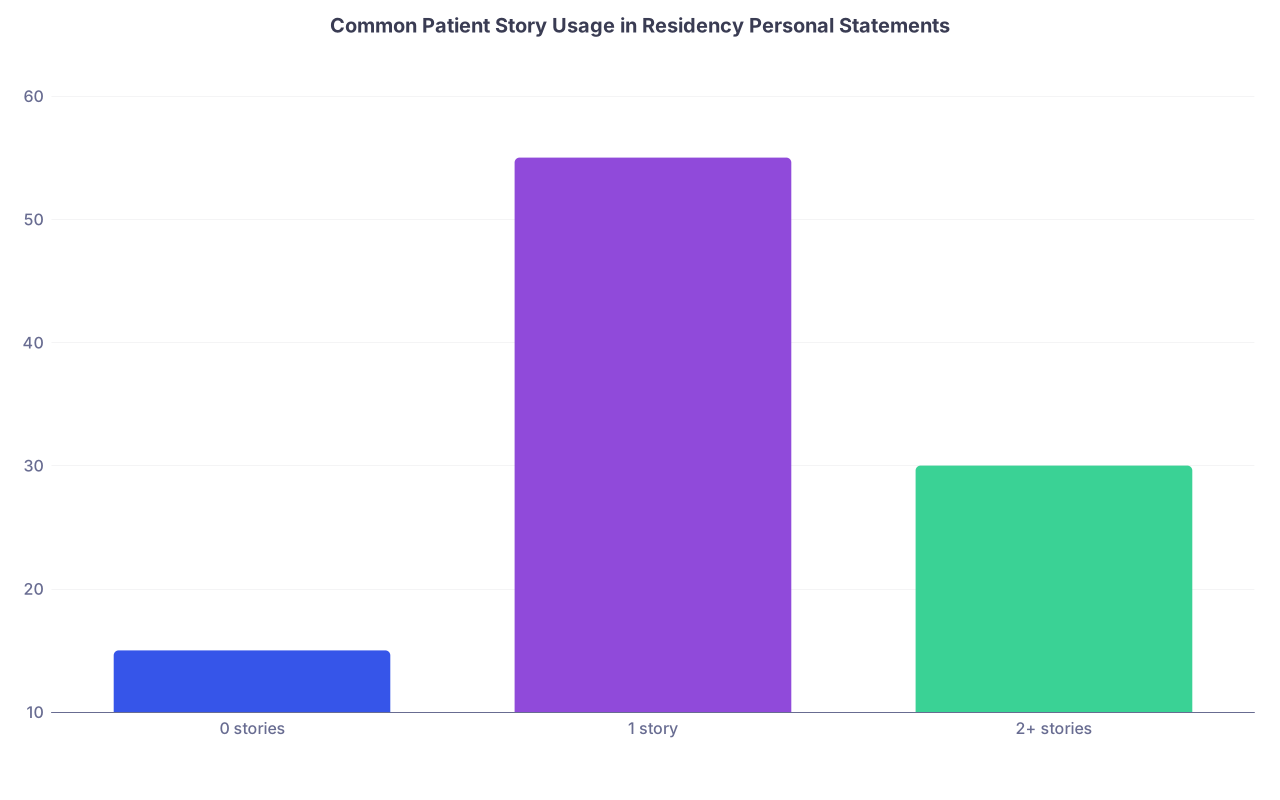
| Category | Value |
|---|---|
| 0 stories | 15 |
| 1 story | 55 |
| 2+ stories | 30 |
Here’s the rule I give applicants:
Use one well-developed patient story as a vehicle to show your growth, values, and fit for the specialty. Anything beyond that needs to justify its existence ruthlessly.
If that’s all you take away, you’re already ahead of half the pool.
What Program Directors Actually Want From Your Statement
They’re not looking for a Hallmark card. They’re scanning for specific things:
- Why this specialty?
- What kind of resident will you be?
- Can you reflect like an adult, not like a premed?
- Do you understand the day-to-day reality of the field?
- Do you sound like someone I’d trust at 2 a.m. on call?
Patient stories are allowed but optional. They’re not required.
What they do not want:
- Four vague cases that all blur together: “I met Mr. A in the ICU… I met Ms. B in clinic…”
- Trauma tourism: detailed suffering only used as emotional shock value
- Hero narrative: “I realized I was meant to save lives”
- Generic reflections: “This taught me the importance of compassion and teamwork”
A single, concrete story that shows you grappling with uncertainty, communication, limitations, or responsibility is infinitely more powerful than five saccharine mini-vignettes.
How to Use One Patient Story Well
If you’re going to use a patient, do it with intention. Here’s the structure that works repeatedly.
1. Start in the middle of the moment
Skip the “As a third-year medical student on my internal medicine rotation…” throat-clearing. Drop us into the scene.
Bad opening:
During my third-year internal medicine rotation, I encountered many patients who taught me about compassion and resilience.
Better:
The first time I held Mr. L’s hand, he was trying not to cry in front of his teenage son.
Immediately, we’re there. Now keep it short.
2. Keep the clinical details minimal
You are not writing a case report. The reader does not need lab values, exact chemo regimens, or the full differential.
You need just enough to understand:
- Who this patient roughly was
- What the central issue or conflict was (diagnostic, emotional, ethical, communication)
- What you were doing there (your role, not your attending’s)
If you’re spending more than 3–4 sentences on medical details, you’re wasting space.
3. Shift quickly to your internal experience
The point of the story is what it reveals about you.
Good questions to answer (implicitly):
- What did you notice that others might have missed?
- What did you get wrong at first?
- How did this challenge your assumptions about your specialty or yourself?
- What did this push you to do differently next time?
For example:
I found myself focused on adjusting his oxygen and reviewing his labs, while his wife kept asking the same question in different ways: “Is he getting better?” I realized I was answering as if I was presenting to my attending, not speaking to a terrified spouse.
That line tells the reader more about your self-awareness than five stories of “I was so moved.”
4. Tie directly to specialty-specific themes
The story should clearly support why this specialty fits you. Otherwise it’s just a nice emotional moment.
A few examples of what your reflection might highlight:
- Internal medicine: longitudinal thinking, complexity, diagnostic curiosity
- Emergency medicine: comfort with uncertainty, team coordination, rapid decisions
- Pediatrics: communication at different developmental levels, family-centered care
- Psychiatry: listening, non-judgment, comfort with ambiguity and slow progress
- Surgery: ownership, technical focus paired with big-picture responsibility
The story is a vehicle for those themes, not the destination itself.
When (and How) Two Stories Are Okay
Sometimes one story truly cannot carry the whole essay. Two short, sharply different anecdotes can work if:
- Each story is short (3–5 sentences of setup, then reflection)
- They highlight different aspects of you
- They’re clearly tied to the same core message
Example that works:
- Story 1: ICU patient showing you the emotional weight and team-based nature of critical care
- Story 2: Outpatient follow-up that showed you the importance of continuity and communication
Both funnel into: “This is why I want pulmonary/critical care–style medicine: complex decisions + longitudinal relationships.”
Where people screw this up:
- They stack trauma cases: the dying child, the failed code, the tragic cancer diagnosis
- They repeat the same lesson: “I learned empathy… and then I also learned empathy again”
- They use one story per paragraph with no connecting thread
If you’re not sure whether you need two, you probably don’t. One strong anchor + one or two brief, one-line references to other experiences can do the same work without clutter.
When Patient Stories Actually Hurt Your Application
Here’s where readers really start to roll their eyes.
1. The “patient dumping” essay
This is where you name-drop five or more patients to prove you’ve “seen a lot.”
You get something like:
From the elderly gentleman I comforted in the ICU, to the young mother I counseled in clinic, to the teenager I reassured in the ED…
Translation in a PD’s head: “I don’t know how to choose what matters, so I’m listing everything.”
2. Emotional exploitation
If your story reads like it’s using a patient’s suffering mainly to make you look deep, that’s a problem.
Red flags:
- Graphic details that don’t serve any reflection
- Telling the most tragic story just because it’s tragic
- Turning someone else’s worst day into your inspirational moment without nuance
You can write about death, codes, trauma. But you’d better show seriousness, humility, and some understanding of boundaries.
3. Zero boundaries / HIPAA issues
No names. No ultra-specific combinations of demographics + diagnosis that make someone identifiable. No “Mrs. Gonzalez from 12B with metastatic breast cancer and three kids under 5 in X small town.”
You can absolutely preserve the essence while blurring the identifiers. If you can’t do that, don’t use the story.
A Practical Framework: Building Your Statement Around One Story
Here’s a simple structure that works for most applicants.
Rough outline (for a ~750-word statement)
Hook (3–5 sentences):
- Start in the middle of your main patient encounter or key moment.
- Keep details tight; hint at the emotional/ethical/clinical tension.
Reflection + specialty tie-in (2–3 short paragraphs):
- What did you realize about yourself and this specialty from that moment?
- How did it shift how you approach patients, teams, or decisions?
Broader experiences (1–2 paragraphs):
- Briefly reference 1–2 additional experiences (research, leadership, other rotations, another quick patient line) that reinforce the same core themes.
- Do not fully narrate another case; just allude to them.
Looking forward (final paragraph):
- Who are you becoming as a resident?
- What type of program environment helps you thrive?
- What will you bring to their team?
Notice: only one story gets full narrative treatment. Others are quick references, like:
I saw the same need for honest, careful communication during my sub-internship, whether calling families overnight about new lab results or updating patients about unexpected surgical delays.
That’s enough. No new full scene needed.

| Step | Description |
|---|---|
| Step 1 | Patient Hook |
| Step 2 | Reflection on Self |
| Step 3 | Connect to Specialty |
| Step 4 | Broader Experiences |
| Step 5 | Future Resident & Program Fit |
How to Audit Your Draft for “Too Many Patients”
Pull up your current draft. Do this quickly:
- Highlight every place you introduce a patient or case.
- Count them.
Then ask:
- Are more than 2 of them described in more than 3–4 sentences each?
- Does each one show something different about you?
- If I deleted one entire story, would my core message still stand?
If the answer to that last one is “yes” for any story, cut it or compress it to 1 line.

Here’s a quick rule of thumb table to sanity check yourself:
| Patient Stories Used | Typical Outcome | Recommendation |
|---|---|---|
| 0 | Fine if reflection is strong | OK, but be sure it’s not generic |
| 1 | Best balance | Strongly preferred |
| 2 | Risk of crowding | Only if both are tight & distinct |
| 3 | Feels fragmented | Usually too many |
| 4+ | Reads like a case list | Cut aggressively |
Quick Fixes If You Already Have Too Many Stories
If your draft is overloaded with cases, you don’t have to start from scratch. Try this:
Pick your strongest story:
- Clear details
- Real emotional or intellectual tension
- Direct tie to specialty → keep this as your anchor.
Convert others into one-liners, for example:
- “I saw the same challenge repeated during my sub-internship…”
- “This pattern came up again with a patient in clinic…”
Replace some stories with non-patient experiences:
- A moment of feedback from a resident or attending
- A mistake you made on call (and learned from)
- A leadership or QI project that reveals how you think
You’ll end up with a cleaner, more adult-feeling essay.
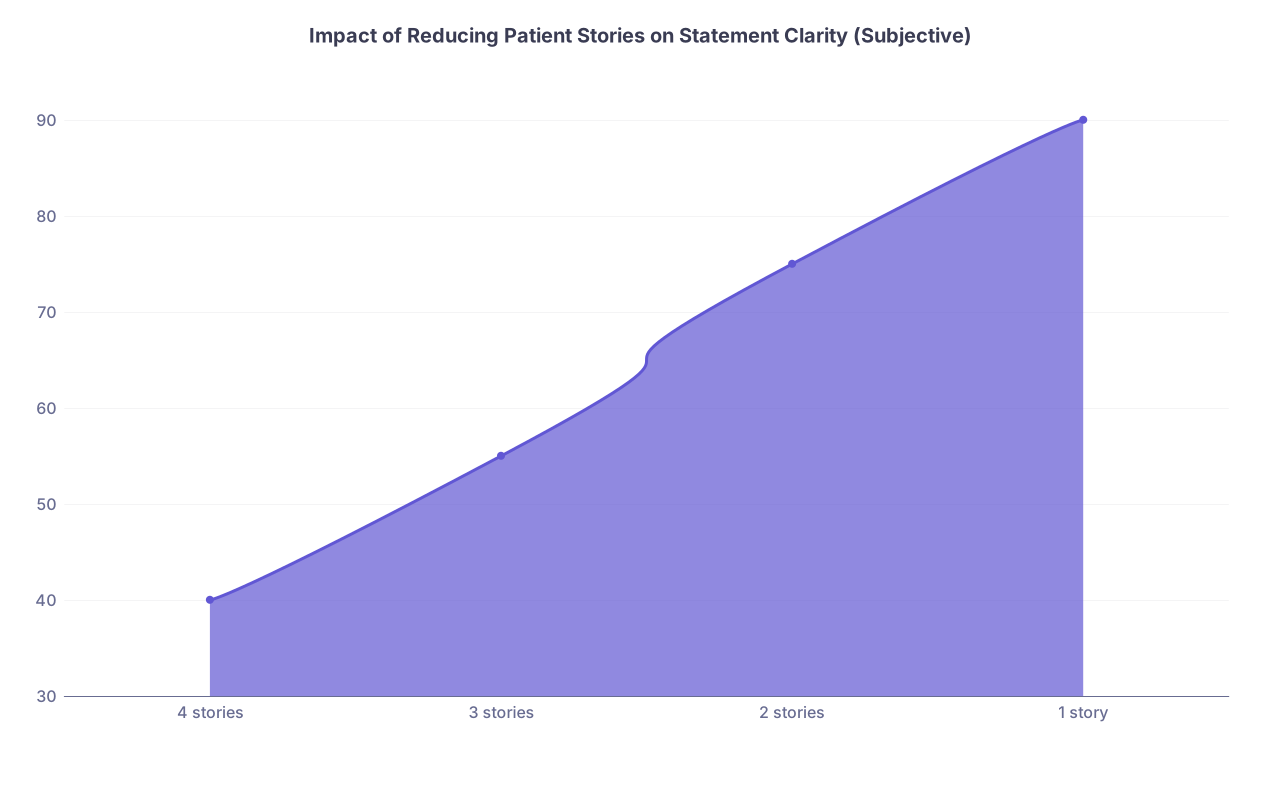
| Category | Value |
|---|---|
| 4 stories | 40 |
| 3 stories | 55 |
| 2 stories | 75 |
| 1 story | 90 |
FAQs: Patient Stories in Residency Personal Statements
1. Do I need a patient story at all?
No. You don’t. A lot of strong statements are built around a turning point (feedback, a mistake, a project, a rotation) that isn’t a single dramatic patient case. If you can vividly describe a moment of growth or realization without leaning on a patient story, that’s perfectly acceptable.
2. Can I reuse a patient story from my MSPE or evals?
You can reuse the experience but not copy the language. Also be careful: if your dean’s letter already leans heavily on one famous story (“the night of the code”), repeating it in your statement may feel redundant. If you reuse it, bring new insight—show what that event means to you, not just what happened.
3. How detailed can I be without violating confidentiality?
Keep demographics broad (no names, no hyper-specific ages + towns + conditions). Focus on emotions, conflict, and your role. If a patient or family member could recognize themselves instantly from your description, you probably need to blur details. You’re writing about your development, not documenting their life.
4. Is it OK if my patient story is about a mistake I made?
Yes—and often it’s more compelling. As long as: the mistake is appropriate for a student level, no catastrophic harm, and you clearly show insight, accountability, and change. “I missed that the patient was asking for comfort, not lab explanations,” is solid. “I ignored chest pain and they coded” is not.
5. Can my main patient story be from preclinical volunteering or before med school?
For residency, it’s weak if your primary patient story is preclinical or pre-med. You’re being hired as a physician-in-training today, not for your college hospice volunteering. You can briefly nod to earlier experiences, but your main narrative anchor should be from clinical years or sub-I time.
6. How emotional is too emotional?
If you are the emotional center, you’re drifting. If the story reads like you’re auditioning for a tearjerker, pull back. Show that you can feel strongly and still think clearly and act professionally. One or two concrete, specific emotional observations beat five sentences of “I was deeply moved and profoundly humbled.”
Key takeaways:
Use one well-chosen patient story as an anchor, not five as decoration. Keep details lean and reflection deep. And always remember: the personal statement is about who you are as a future resident—not a highlight reel of every “unforgettable” patient you have ever met.