
What Program Directors Really Look For in Your Personal Statement
Most program directors barely read your personal statement. The best ones read every line. And both groups are looking for the same few things—just at different speeds.
Let me tell you what actually happens on the other side of ERAS, behind the “holistic review” language and the smiling program website.
The reality: how your personal statement is really used
On paper, the personal statement is “an opportunity to share your unique story.” In practice, in most programs, it’s used in three very specific ways:
- To screen out red flags quickly.
- To explain discrepancies or weirdness in your application.
- To give interviewers something to talk about and a sense of what you’d be like at 2 a.m. on call.
That’s it. Not to be inspired. Not to assess your love for the specialty (everyone “has always loved it,” remember?). Not to find the next Atul Gawande.
I’ve sat in rooms where a PD scrolls through applications at terrifying speed. CV, Step scores, MSPE, letters, then a two‑second scan of the personal statement just to make sure it’s not obviously bad or bizarre.
You’re not trying to write the best personal statement ever written. You’re trying to write one that:
- Makes them relaxed, not suspicious.
- Confirms what the rest of your app says.
- Gives them 1–2 memorable, concrete hooks.
If you understand that, your approach changes completely.
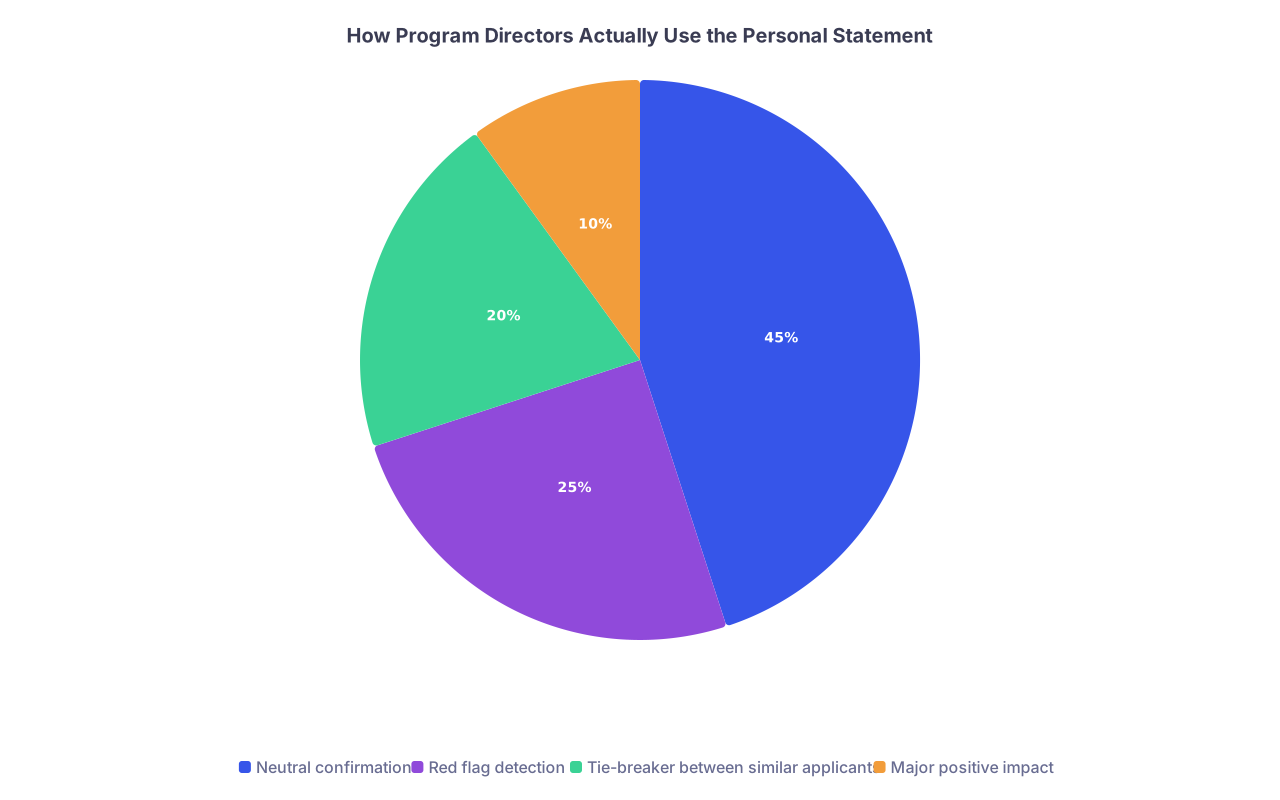
| Category | Value |
|---|---|
| Neutral confirmation | 45 |
| Red flag detection | 25 |
| Tie-breaker between similar applicants | 20 |
| Major positive impact | 10 |
What gets your statement tossed immediately
The dirty secret: most personal statements are not read deeply because they do not deserve to be. They’re generic, vague, or clearly written in a rush.
The first pass on your statement is usually a speed read. Here’s what triggers a mental “Nope” or at least a downgrade.
1. Generic, template language
If your first paragraph could be swapped with 200 other applicants in the same specialty, you’ve already lost ground.
Program directors are sick of:
- “I have always been passionate about helping others.”
- “It was then that I knew I wanted to be a [specialty].”
- “Medicine combines my love of science and working with people.”
You think this sounds “professional.” To them, it sounds lazy and interchangeable.
Behind closed doors, they say things like:
“This could be anyone.”
“I have no idea who this person is.”
“Next.”
What they’re really checking in those first 5–7 seconds is: Is this a real human with a story, or just a copy‑pasted med student template?
2. Drama or trauma with no insight
There’s a quiet rule many PDs follow: “Tragic story, zero reflection = pass.”
The problem isn’t that you talk about family illness, loss, or hardship. Many residents have powerful stories. The problem is when the entire statement is:
- Grandparent died → “I knew I wanted to save lives.”
- Childhood in poverty → “I want to give back.”
- Personal illness → “I want to be there for my patients.”
All feeling. No thinking.
What PDs and selection committee members look for is processing. They ask themselves: Did this person actually learn anything specific, or are they just weaponizing sadness?
If the story explains how you function—your patterns, your choices, your maturity—it helps. If it’s there just to impress or gain sympathy, it backfires.
3. “Savior complex” language
This is a bigger red flag than you think, especially in fields like family medicine, pediatrics, EM, psychiatry, and any safety‑net heavy program.
Phrases that quietly worry them:
- “I want to give a voice to the voiceless.”
- “I want to fix the broken healthcare system.”
- “My goal is to always be there and never let my patients down.”
You think you sound idealistic. They hear someone with no boundaries who’ll burn out, clash with team‑based care, and struggle when reality hits.
A PD once said, scrolling through apps: “Anyone trying to ‘never let a patient die alone’ in a busy county ICU is going to fall apart by October.”
4. Sloppy writing and basic errors
This is simple. Typos. Random tense changes. Wrong program name from copy‑pasting.
People get rejected over this when they’re on the bubble.
No one expects literary genius. But they absolutely expect:
- No obvious grammar disasters.
- Clean structure.
- Correct specialty and no mis-addressed sentences.
I’ve seen a surgery statement that mentioned “my love for psychiatry” and a psych statement addressed to “Dear Residency Selection Committee at the Department of Anesthesiology.” The comments in the room are not kind.

What program directors are quietly hoping to see
Now the more useful side of this. When PDs, APDs, and core faculty read a personal statement carefully—usually for applicants already flagged as interesting—what are they actually looking for?
I’ll break it down by what matters most across most specialties.
1. A coherent story that matches the rest of your file
The personal statement is a consistency check.
If your CV screams research beast—10+ pubs, PhD, multiple posters—and your statement is entirely about bedside humanism with zero mention of your academic life, that disconnect makes them pause. Not in a good way.
Same with:
- “I’ve always loved teaching” with no teaching activities listed.
- “Global health is my passion” with no global health work whatsoever.
- “I’m committed to underserved populations” but your entire application is affluent private hospitals and no continuity clinics, no community service.
Does that mean you cannot aspire to something? Of course not. But when you claim a core identity, they look for receipts somewhere else in your application.
The best statements read like a narrative version of your CV: same themes, same values, same through‑line, just with more color.
2. Evidence you understand the actual job of that specialty
This one separates serious applicants from “I decided in February” applicants very quickly.
Faculty roll their eyes at cartoon versions of their field:
- For surgery: only talking about “using my hands” and “immediate results” with zero mention of long cases, complications, or longitudinal follow‑up.
- For EM: only trauma, sirens, and “organized chaos” with no nod to bread‑and‑butter cases or system navigation.
- For IM: “complex diagnostic puzzles” but nothing about chronic disease management or team‑based inpatient care.
- For psych: “mind‑body connection” buzzwords and inspirational quotes but no mention of risk assessment, longitudinal work, or interprofessional teams.
What really reassures them is a sentence or two that show you’ve actually seen the non‑Instagram parts of their work and still want in.
Something like:
- “On my night float week in the ICU, what stayed with me wasn’t the codes, but meeting the same families again and again and realizing how much of critical care is interpretation, communication, and knowing when not to do more.”
That shows you get it.
3. Emotional regulation and perspective
This is the part no one tells you. PDs read your statement and ask: What’s this person going to be like at 3 a.m. when things go wrong?
They’re looking for clues:
- Do you catastrophize everything?
- Are you the hero in every story?
- Is everyone else either an obstacle or an ungrateful patient?
- Do you take any responsibility when things go sideways?
If every story is framed like, “I stepped in and fixed what everyone else missed,” that’s a problem.
If you talk about a hard moment and your takeaway is balanced, humble, focused on growth—huge plus.
I’ve seen statements that made PDs say, “This person is grounded. I want them in my call room.”
4. Professional maturity without stiffness
There’s a narrow sweet spot:
Too formal, and you sound like ChatGPT with a stethoscope.
Too casual, and you sound like you don’t understand this is a job.
The best statements sound like a thoughtful junior colleague explaining why they chose their field. Clear, direct, not melodramatic. With just enough personality that you feel like you’re meeting them.
PDs are listening for voice. Not poetry. Voice.
| Situation | Typical Impact of Personal Statement |
|---|---|
| Strong scores + strong letters | Confirm fit, provide talking points |
| Borderline application | Can push into interview pile or out |
| Red flags (leave, failures, gap) | Critical for context; can salvage or sink |
| Highly competitive programs/specialties | Tie-breaker between near-identical applicants |
| Post-interview ranking | Used to recall who you are, confirm impressions |
The specific elements that make a statement work
Let’s get concrete. When PDs and faculty talk about a “good” personal statement in committee, it usually has these components.
Not all, but most.
A clean, simple structure
Nobody is grading your narrative arc. But a clear structure makes it easier to read fast:
- A focused opening that orients the reader—who you are and why this field.
- 1–2 specific experiences that illustrate how you think, what you value, how you function on a team.
- A brief connection between your traits/experiences and what residency in this field actually demands.
- A forward-looking close: the kind of resident and future physician you want to be.
Notice what’s missing: multiple childhood stories, long literary descriptions, grand visions of changing healthcare.
Faculty are reading between consults. Between OR cases. In 10-minute bursts. Do not make them work for it.
Concrete details instead of adjectives
PDs are numb to adjectives: “hardworking,” “empathetic,” “resilient.” Every applicant is all three, apparently.
What wakes them up is specificity.
Instead of:
“I am a team player and a dedicated learner.”
Show:
“On my sub‑I, I started arriving 30 minutes early to pre‑round on the two complex liver patients so that our team rounds could focus on plan discussion instead of data gathering. By the second week, the senior was handing me those pages first.”
They picture you on their team. That’s the goal.
One or two memorable hooks
When rank meetings happen, nobody is re-reading full statements. They’re going off impressions, notes, and 1–2 things that stuck.
You want to give them obvious, easy hooks:
- “The former paramedic who went into EM.”
- “The IM applicant who did community organizing around insulin access.”
- “The psych applicant who grew up bilingual and talks about language in mental health.”
You can build that with a paragraph or two that’s specific enough that they can remember you later.
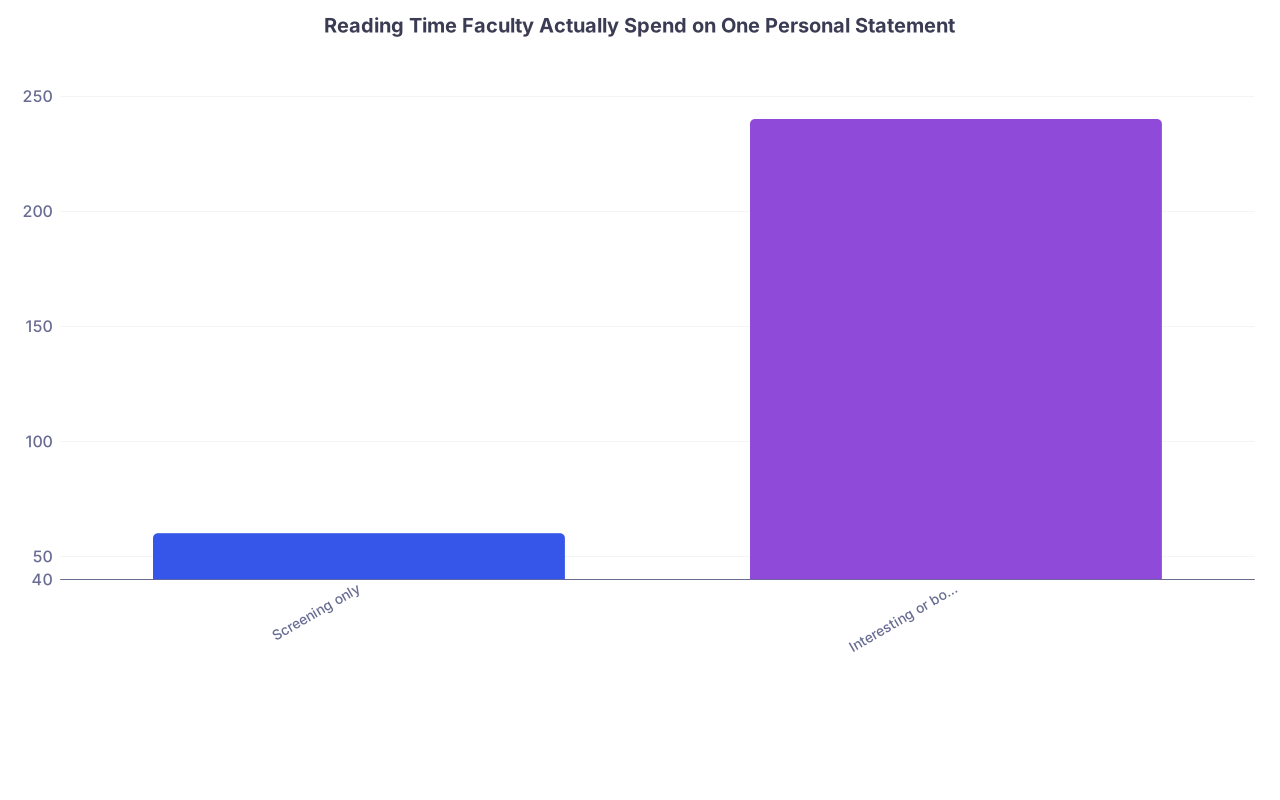
| Category | Value |
|---|---|
| Screening only | 60 |
| Interesting or borderline applicant | 240 |
(Values in seconds: ~1 minute vs ~4 minutes for deeper reads.)
The “red flag management” function of your statement
Let me be blunt: if you have a gap, leave of absence, Step failure, or major career pivot, some people will soft-pass your file without reading your explanation. Others will hunt for it.
For the second group, your personal statement is the only place they’ll hear the story from you instead of the MSPE.
Here’s how this plays out in real selection meetings:
- “Why did they take a year off?”
- “What happened with that failed Step?”
- “Why the switch from gen surg to anesthesia?”
If the MSPE has a vague line and your personal statement ignores it, they assume the worst or at least think you lack insight.
Handled right, though, I’ve seen applicants with serious hits still get interviews—and match well.
The pattern that works:
- Briefly state what happened. No drama. No defensive tone.
- Take clear ownership, even if there were external factors.
- Show what changed in concrete, behavioral terms.
- Point to subsequent performance that backs up your growth.
PDs are not naïve. They’ve all had their own rough stretches. What they care about: Are you reliable now? Have you learned anything they're going to benefit from?
If your statement dodges the issue, they decide you’re not ready to own it.

| Step | Description |
|---|---|
| Step 1 | Open Application |
| Step 2 | Check Scores/CV |
| Step 3 | Review MSPE & Letters |
| Step 4 | Read PS for explanation |
| Step 5 | Quick PS scan for red flags |
| Step 6 | Read PS for fit & story |
| Step 7 | Decide: Interview or Reject |
| Step 8 | Any concerns or gaps? |
| Step 9 | Competitive/Interesting? |
What different specialties quietly care about
Program directors will never put this on their website, but different fields absolutely read your statement with different priorities.
Here’s the quick and honest version.
Internal Medicine
They want: evidence you can handle complexity, ambiguity, and day‑to‑day grind without theatrics.
They look for:
- Comfort with longitudinal care, not just “mystery case” hunting.
- Ability to collaborate with consultants and primary teams without ego.
- Any interest in future fellowship is fine—but if your whole statement is “I want GI or I’m nothing,” community IM programs tune out.
General Surgery
They want: resilience, realism, and a non‑romanticized view of the OR.
What reassures them:
- You understand the physical and emotional demands.
- You’ve seen complications and it didn’t scare you off.
- You talk about team—nurses, techs, anesthesia—not just, “I can’t wait to lead the room.”
They’re wary of: grandiosity, entitlement, or statements that read like “Grey’s Anatomy fan fiction.”
Emergency Medicine
They want: adaptability, team orientation, and non‑chaos seeking personalities. The days of loving “adrenaline” as a selling point are fading.
Green flags:
- Stories showing you can switch tasks quickly without losing composure.
- Respect for consultants and hospital systems.
- Awareness that EM is 80% bread‑and‑butter, disposition, and documentation.
Red flags: “I hate rounding,” “I want shift work so I can surf,” or “I love the chaos.”
Psychiatry
They want: reflection, boundaries, and an understanding that psychiatry is medicine, not just talking.
They look for:
- Evidence you actually like working with complex, sometimes frustrating patients.
- Curiosity about people’s stories that doesn’t veer into voyeurism.
- Some sign you can tolerate uncertainty and chronicity.
Overly confessional statements worry them—when your own unresolved issues dominate the narrative, they wonder how that’s going to play out in training.
Pediatrics, Family Medicine, OB/Gyn, etc.
These fields watch your language very carefully for respect, humility, and non‑judgmental attitudes. They’re also disproportionately sensitive to savior narratives and missionary vibes.
They want to see you:
- Value team and continuity.
- Respect patient autonomy, even when choices differ from yours.
- Understand that real care is often unglamorous and slow.

How to actually write this without sounding fake
You’re probably thinking: “Great, so I can’t be generic, dramatic, savior‑y, or stiff. What’s left?”
Here’s the insider approach most successful applicants don’t realize they’re using.
Step 1: Decide on 2–3 real themes
Not values you think they want to hear. Things that actually show up over and over in your real life.
Examples:
- You keep taking on systems/organization roles in teams.
- You’re drawn to situations where patients are scared and need translation of complex info.
- You naturally become the “calmer” in chaotic or emotional situations.
Then look at your experiences and find the ones that demonstrate those themes. Not the most prestigious things. The clearest ones.
Step 2: Write the “ugly draft” honestly
No one sees this but you. Drop the professional voice and write:
- Why this specialty, without buzzwords.
- 2–3 moments that made you think “Yes, this feels like my people/my work.”
- What your honest worries are about residency.
- How you’ve already handled things even slightly similar to those worries.
Hidden benefit: this draft surfaces what’s actually real and unique about you. Then you can clean it up, tighten it, and professionalize it.
Step 3: Edit for clarity, not for drama
When PDs say they like “authentic” statements, they do not mean emotionally raw diary entries. They mean: clear, unforced, not trying too hard.
Ask with every sentence:
- Does this sound like something I’d actually say out loud?
- Could literally anyone else in my class say the same thing?
- Is there a concrete example backing this up somewhere in my app?
If the answer to #2 is yes, you either cut it or get more specific.
FAQ: What Program Directors Really Look For in Your Personal Statement
1. Can a personal statement actually get me an interview I otherwise wouldn’t have?
Yes—but mostly in borderline cases or when you have something unusual to explain. If your scores and letters are clearly above a program’s usual range, they’ll interview you regardless of a merely “fine” statement. Where it moves the needle is when your numbers are average for that program, but your story, clarity, and maturity make people in the room say, “I want to meet this person.” I’ve seen applicants with a failed Step and mid‑range scores get pulled into the interview pile because multiple faculty liked how they owned their story and matched the program’s mission.
2. How many “stories” should I include?
One or two. That’s it. Three is pushing it unless they’re very tightly connected. The worst statements read like a highlight reel of your entire CV—global health trip, research project, volunteer clinic, patient encounter—none of them in enough depth to show how you think. Pick one anchor story that shows you doing the work of your chosen specialty, then maybe one secondary example that reinforces a key trait (teaching, QI, leadership). Depth beats breadth every time.
3. Is it a mistake to say I’m interested in a specific fellowship?
It depends how you say it and where you’re applying. Academic programs usually like to see some direction, as long as you’re not inflexible or dismissive of general training. “I’m currently most interested in cardiology, though I’m open to how residency shapes that” is fine. “My only goal is to match GI at a top‑tier fellowship and everything else is secondary” makes community programs and even some academics tune out. Your statement should signal openness to being a good resident for their patients and their service first.
4. Who should actually read my personal statement before I submit?
Ideally three types of people: one person in your chosen specialty (for realism and content), one strong writer/editor (for clarity and flow), and one person who barely knows you (to tell you what they remember 10 minutes later). What you do not want is 8 different attendings all line‑editing it into a lifeless committee product. Too many cooks and you end up with something technically correct, utterly forgettable. Two or three targeted readers who understand the goal is better than a crowd.
Bottom line:
Your personal statement is not your masterpiece. It’s a tool. Use it to (1) confirm the story the rest of your application already tells, (2) show you actually understand the reality of the field you’re choosing, and (3) give overworked faculty 1–2 concrete reasons to remember you—and trust you—when it’s time to pick who gets in.